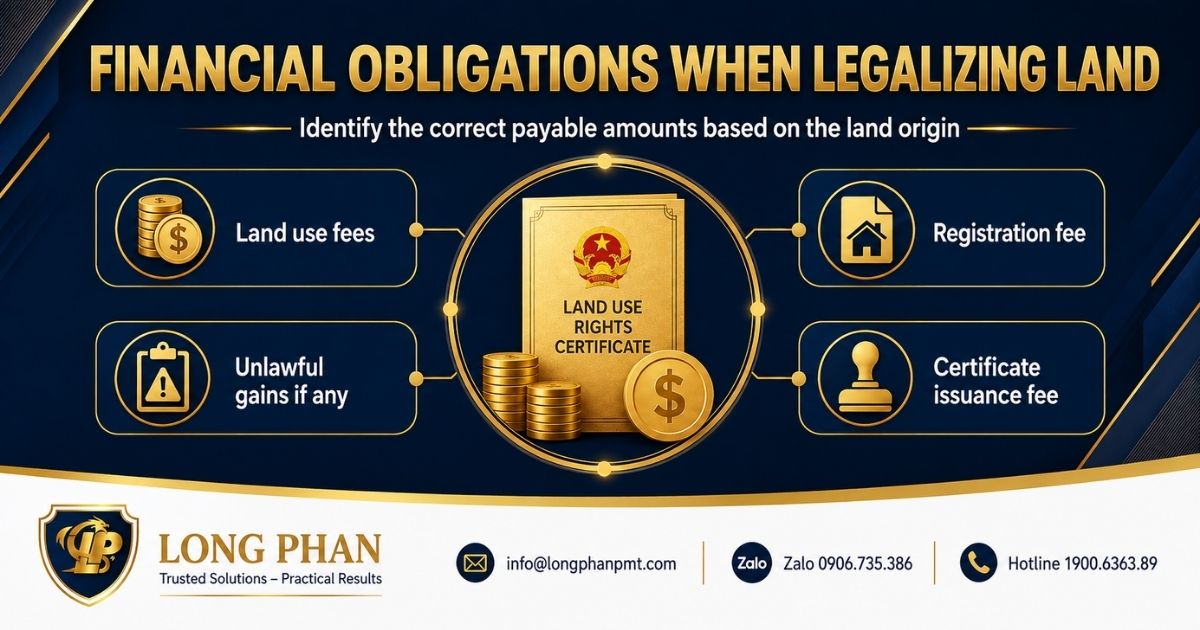
Long Phan Consulting frequently receives inquiries about additional financial obligations for legalizing land violations. Many inquiries come from households whose land was encroached, occupied, or allocated without proper authority and who now wish to apply the Law On Land to obtain a Land Use Rights Certificate. The amount payable falls into three groups: land use fees, the amount to be returned for illegal gains (if any), and related fees and charges. The specific amount depends on the type of violation, the time the land was used, and the recognized area. Long Phan Consulting sets out the applicable rules below.
Important Notes:
The Law on Land 2024 permits legalization for only three specific groups of violations, each governed by its own mechanism for calculating financial obligations. Determining the correct group is the first step before calculating the amount payable.
Under Article 139 of the Law on Land 2024, households and individuals using such land may be considered for legalization if planning conditions are met. This applies to land encroached, occupied, or used for the wrong purpose before July 1, 2014. The article is divided into several sub-groups depending on the land’s location and its actual use purpose, which directly determines whether a Certificate can be issued.
Article 140 of the Law on Land 2024 applies to land allocated by an agency or organization without authority to do so. It also applies to land obtained through purchase, liquidation, sale, or distribution of housing or construction works attached to land in a manner not in compliance with regulations. Conditions and land use fee levels depend on three time thresholds: before October 15, 1993; from October 15, 1993 to before July 1, 2004; and from July 1, 2014 onward with proof of payment.
Article 138 of the Law on Land 2024 governs the issuance of a Certificate for land without documentation under Article 137. This applies where the land has been used stably and is confirmed by the commune-level People’s Committee as undisputed. This is not, strictly speaking, a “violation” case in the administrative sense, but it is often processed alongside encroachment cases when the actual area exceeds what the original documentation shows.
Once a dossier meets the conditions for issuing a Certificate, the tax authority determines the financial obligation based on three groups of charges, each with its own legal basis and calculation method.
Land use fees are the primary charge, calculated under Decree 103/2024/ND-CP (as amended and supplemented by Decree 291/2025/ND-CP). For encroachment cases under Article 139 of the Law on Land, the calculation applies Article 11 of Decree 103/2024/ND-CP; for land allocated without proper authority under Article 140, Article 12 of Decree 103/2024/ND-CP applies. The amount depends on the area within the recognized limit, the area exceeding the limit, and the land price at the time the Certificate is issued.
>>>See more: Agricultural to Residential Land Conversion Fees
Alongside land use fees, a violator may also be required to return illegal gains under Articles 8, 9, 10, and 12 of Decree 123/2024/ND-CP on administrative penalties in the land sector. This is a remedial measure accompanying the penalty. It applies only while the violation remains within the administrative penalty statute of limitations, which is two years from the date the violation ceased. It also does not apply where the case is exempt under Clause 3, Article 139 of the Law on Land.
If multiple people jointly committed the violation on the same land plot, the illegal gains are divided equally. Any amount already paid into the state budget in relation to the violating land use is deducted when determining this amount.
In addition to the two charges above, the land user must also pay a registration fee upon first-time registration of land use rights. A Certificate issuance fee also applies, at the rate set by the provincial People’s Council. These charges are typically much smaller than land use fees but remain mandatory conditions for receiving the results.
The additional land use fee does not follow a single common formula; the tax authority must correctly identify the land type, the time of use, and the applicable article before calculating the specific amount.
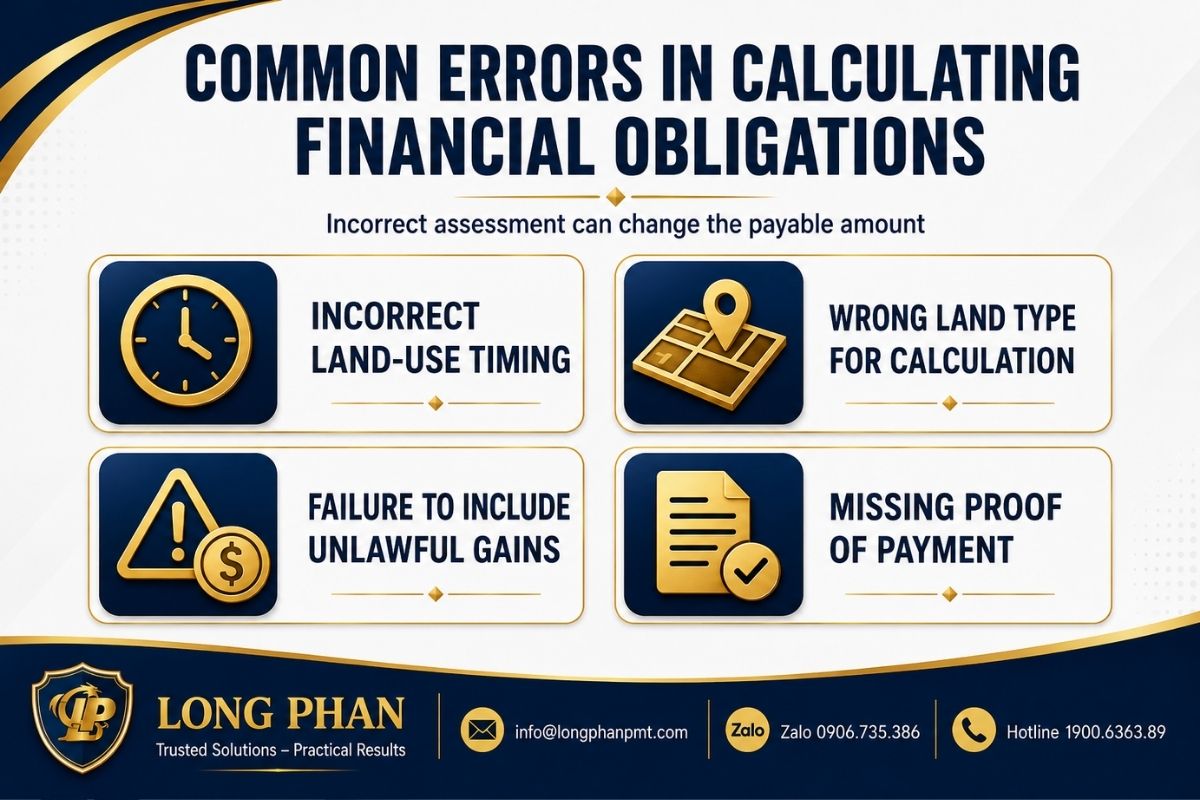
Under Clause 2, Article 10 of the Law on Land 2024 and Article 7 of Decree 102/2024/ND-CP, land type is determined by the actual use status where documentation does not prove it. This determination applies at the time of declaration and registration. Where existing documentation records a land type different from actual use, the land type is redetermined under the classification in Article 9 of the Law on Land. This also follows Articles 4, 5, and 6 of Decree 102/2024/ND-CP. An incorrect land type determination at this stage will cause the entire subsequent land use fee calculation to be wrong.
Under Point c, Clause 2, Article 139 of the Law on Land 2024, encroached land currently used for agricultural production or housing since before July 1, 2014 may be considered for Certificate issuance. This applies where the land does not fall within special-use forest or protection forest planning, and does not fall within public infrastructure planning. The land user must also fulfill the applicable financial obligation. The area within the recognized residential land limit is subject to a more favorable land use fee than the area exceeding the limit.
Article 12 of Decree 103/2024/ND-CP sets out the land use fee calculation for each time threshold for allocation under Article 140 of the Law on Land 2024. Where documentation proves that payment was made to use the land at the time of allocation, the land user is entitled to a significant exemption or reduction of the additional land use fee payable. Qualifying documentation includes receipts, payment slips, and invoices under Clause 5, Article 12 of this Decree.
>>See more: Easier Land Use Conversion Under New Law
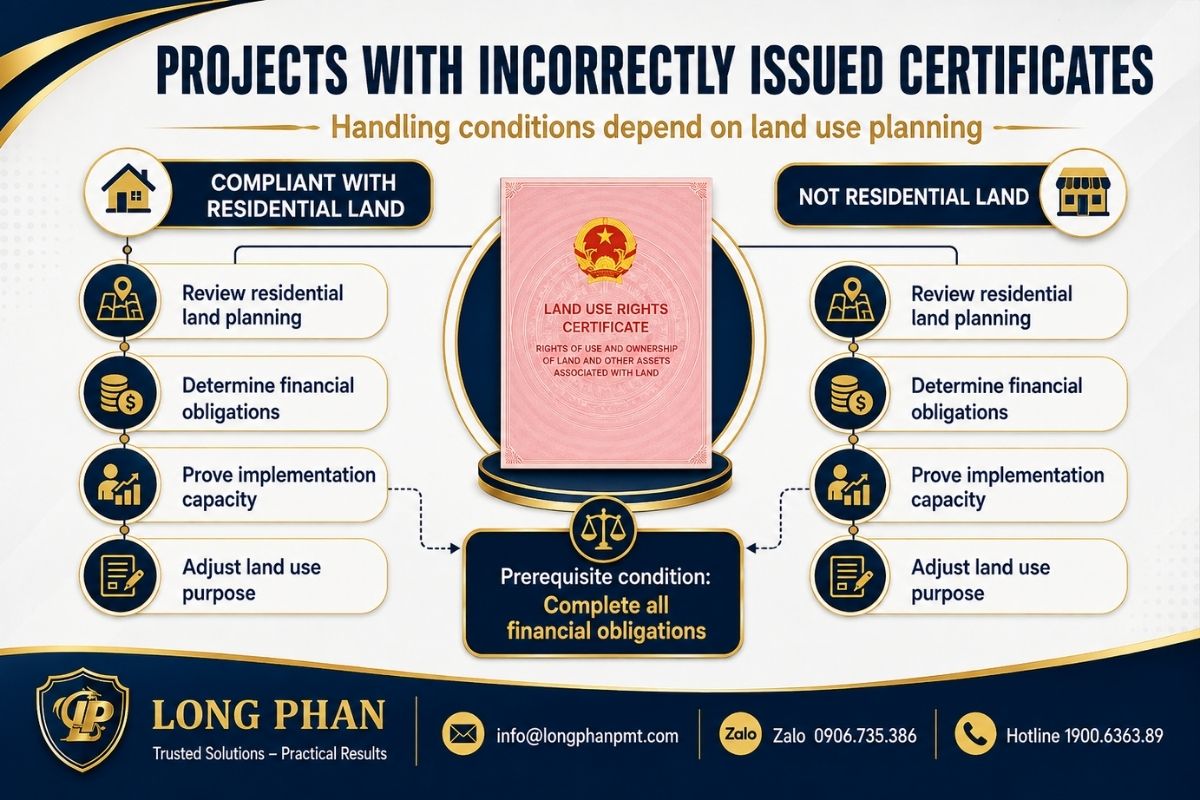
Financial obligations upon Certificate issuance are not determined identically for every case of undocumented land. The competent authority must consider the origin of land use, the time use began, the violation, whether the allocation was made with proper authority, and documentation of amounts already paid, before determining the amount payable. The three common groups are governed respectively by Articles 138, 139, and 140 of the Law on Land 2024. The corresponding land use fee calculations are set out in Articles 10, 11, and 12 of Decree 103/2024/ND-CP, as amended and supplemented by Decree 291/2025/ND-CP.
| Criteria | Violating Land, Including Encroachment (Article 139) | Land Allocated Without Proper Authority (Article 140) | No Documentation, Stable and Undisputed Use (Article 138) |
| Basis for calculating land use fee | Article 11, Decree 103/2024/ND-CP; land used for the wrong purpose also applies Clause 4a, Article 11, added by Decree 291/2025/ND-CP | Article 12, Decree 103/2024/ND-CP, as amended by Decree 291/2025/ND-CP | Article 10, Decree 103/2024/ND-CP; Article 9 mainly applies to cases with documentation under Article 137 or referenced cases |
| Amount to be returned for illegal gains | May arise for encroachment under Point c, Clause 8, Article 13, Decree 123/2024/ND-CP, if a remedial measure applies | Does not automatically arise merely because the allocation lacked proper authority; requires an independent administrative violation | Does not arise from a mere lack of documentation if the land user falls under Article 138, i.e. has not violated land law |
| Determining time threshold | Article 139 governs land law violations before July 1, 2014; each violation type and time of use affects recognition conditions and the land use fee | Main thresholds: before October 15, 1993; from October 15, 1993 to before July 1, 2004; from July 1, 2004 to before July 1, 2014; and from July 1, 2014 to before the Law on Land 2024 took effect | Three main thresholds: before December 18, 1980; from December 18, 1980 to before October 15, 1993; from October 15, 1993 to before July 1, 2014 |
| Dispute and planning conditions | Varies by case under Article 139; for example, encroached land under Clause 3 is only considered for a Certificate if used stably and consistent with statutory planning | Must meet the conditions of the applicable clause of Article 140; it cannot be generalized that confirmation of no dispute alone suffices, and some groups must also meet planning conformity conditions | Must generally be confirmed as undisputed by the commune-level People’s Committee where the land is located; Article 138 does not impose a general condition that all cases must conform to planning |
The process consists of five steps under Decree 101/2024/ND-CP on land registration and Certificate issuance, carried out sequentially from declaration to receipt of results.
Not every area of violating land has an opportunity to receive a Certificate. Under Clause 1, Article 139 of the Law on Land 2024, the following types of encroached land are subject to State recovery and are not eligible for a Certificate:
In parallel, Article 13 of Decree 123/2024/ND-CP requires the remedial measure of restoring the land to its original condition before the violation in these cases.
In practice, Long Phan Consulting has observed that many people confuse “meeting the time-of-use condition” with “meeting the land-location condition” when assessing their own eligibility for legalization. A plot that has been used stably for decades may still fall outside the scope of Certificate issuance if it lies within an announced public works safety corridor or construction boundary. Such a plot may also remain subject to forced recovery at any time under the locality’s plan. Checking the applicable planning, construction boundary, and safety corridor markers with the local land management authority should be done before filing the dossier, rather than relying solely on the actual duration of land use.
Determining the financial obligation when recognizing land use rights over land with a violating origin or land allocated without proper authority requires cross-checking several factors at the same time. These factors are the land’s origin, time of use, land type, recognized area, and documentation of amounts already paid. An incorrect determination of any single factor can result in an underpayment or overpayment of the financial obligation, directly affecting the Certificate issuance process. Common risks include the following.
Calculating financial obligations without sufficient legal experience may lead to incorrect payments or missed lawful exemptions and reductions. Where a land dossier involves multiple periods of land use or disputes over planning boundaries, land users should have the documents reviewed before filing the registration application. Long Phan Consulting provides the following services:
Clients may send their case documents via email at info@longphanpmt.com or via Zalo at 0906.735.386 for a preliminary assessment.
During procedures for recognition of land use rights arising from land violations, land users often encounter issues relating to payable amounts, the calculation of financial obligations, and additional remedial measures. The following frequently asked questions clarify these matters.
They may include three main amounts: land use fees calculated under Decree No. 103/2024/ND-CP; the amount of unlawful gains required to be surrendered under Decree No. 123/2024/ND-CP if the violation remains within the statute of limitations for administrative penalties; and registration fees and fees for issuance of the Certificate in accordance with local regulations.
No. Article 139 of the 2024 Law on Land only applies to violations occurring before July 1, 2014. Violations arising after this date are not eligible for consideration for issuance of a Certificate under the legalization mechanism and must be handled in accordance with the current regulations on administrative penalties for land violations.
Under Decree No. 123/2024/ND-CP, where several organizations or individuals jointly commit a violation on the same land parcel, the unlawful gains to be surrendered are divided equally among the violating parties. Amounts already paid into the State budget in connection with the unlawful land use are deducted when determining such gains.
It may qualify for an exemption or a significant reduction. Under Article 12 of Decree No. 103/2024/ND-CP, where the land user has documents proving that payment was made to an authority or organization in order to obtain land use rights at the time of allocation, the additional land use fee may be calculated more favorably than in cases where no such proof exists.
No. Land encroaching upon or occupying a public infrastructure safety corridor cannot be legalized merely because the land user is willing to make payment. Clause 1, Article 139 of the 2024 Law on Land provides for State recovery of such land without issuance of a Certificate, unless subsequent planning adjustments mean that the land is no longer within the protection corridor, construction boundary, or designated public-use area.
Yes. If the competent authority later determines that the financial obligations were calculated incompletely or on an incorrect legal basis, the land user may be required to pay the outstanding amount together with late-payment interest, even if a Certificate has already been issued.
The limitation period for imposing administrative penalties in the land sector is 02 years from the date the violation ends. Once this period has expired, the competent authority no longer has grounds to apply the remedial measure requiring surrender of unlawful gains. However, land use fees must still be paid in full when the Certificate is issued.
Additional financial obligations arising from the legalization of land with violations are not fixed amounts. They depend on correctly determining whether Articles 138, 139, or 140 of the 2024 Law on Land apply, the relevant period of land use, and the land category used as the basis for calculation. Errors at any stage may result in the dossier being returned or additional amounts being collected later. Clients who need a review of land violation dossiers or assistance in working with tax authorities or land registration authorities may contact Long Phan Consulting via Hotline 1900636389 for timely assistance.
📚 This article has been professionally reviewed based on the following legal documents: