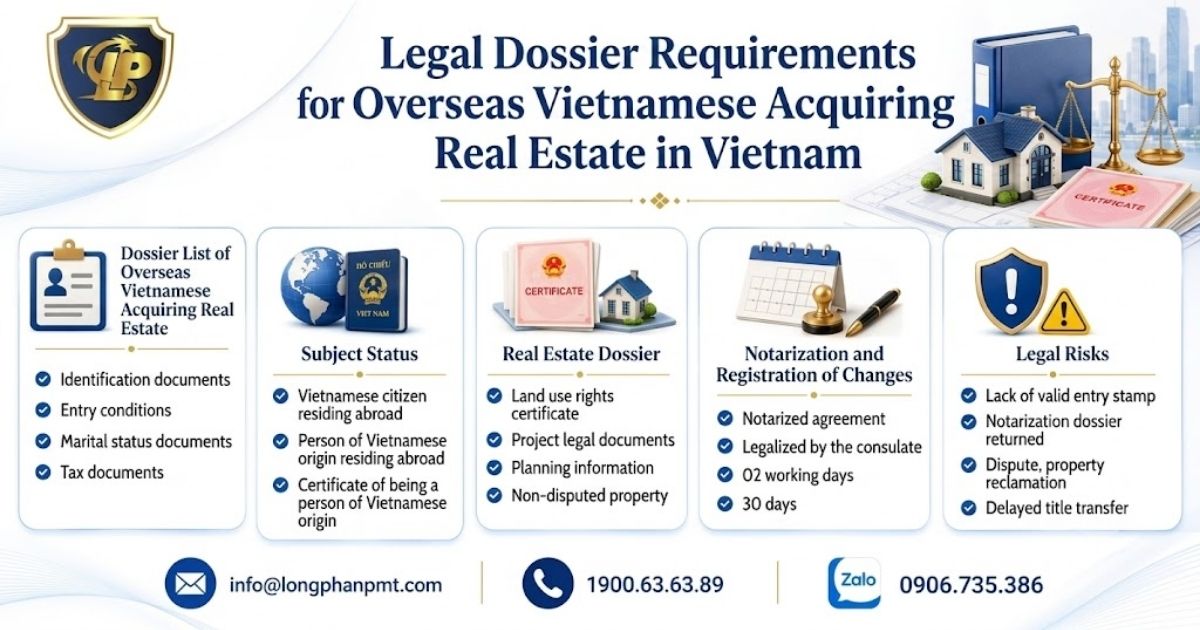

Land transfer restrictions for Vietnamese origin define the specific categories of land that individuals of Vietnamese descent residing abroad are not permitted to acquire by transfer under the Land Law. This analysis details the restricted land types, cases where acquisition is prohibited, and the relevant legal framework.

Agricultural land is the primary category that individuals of Vietnamese origin residing abroad are not permitted to acquire by transfer. This restriction on land transfer rights aims to protect the nation’s agricultural land resources.
Specifically, Article 9.2 of the Land Law 2024 classifies agricultural land to include:
However, an exception exists. According to Article 180.1 of the Land Law 2024, if an individual of Vietnamese origin abroad needs to use agricultural land for production in agriculture, forestry, aquaculture, or salt making, the State may consider leasing the land for them to implement these investment projects.
In summary, individuals of Vietnamese origin residing abroad cannot receive the transfer of agricultural land use rights, except when leased by the State to execute an investment project consistent with land use planning. These land transfer restrictions for Vietnamese origin are fundamental to national resource management.

>>> See more at: Conditions for overseas Vietnamese to buy property in Vietnam
Non-agricultural land not located within permitted projects is the second category subject to land transfer restrictions for Vietnamese origin. According to Article 9.3 of the Land Law 2024, the non-agricultural land group is diverse and includes:
Individuals of Vietnamese origin are not freely permitted to acquire all the above land types by transfer. Transfer is only allowed in specific cases.
Thus, individuals of Vietnamese origin may only acquire certain types of non-agricultural land in legally permitted situations, primarily land within housing development projects or industrial zones.
>>> See more at: The 5-year Vietnam visa: Conditions and application procedures
Land in restricted areas designated for national security and defense is subject to stringent management regulations to protect the nation and maintain security. Consequently, transactions involving land use rights in these areas are limited for certain parties, especially individuals of Vietnamese origin residing abroad.
Pursuant to Article 200 of the Land Law 2024, national defense and security land includes:
Note: According to Article 10.1 of Decree 102/2024/ND-CP, if an individual of Vietnamese origin residing abroad wishes to acquire land use rights in a restricted-access area, they must obtain formal opinions from the Ministry of Defense and the Ministry of Public Security. The individual must also submit a written request to the provincial-level People’s Committee where the land is located to receive permission for the transfer. These land transfer restrictions for Vietnamese origin are critical for national security.

Under the Land Law 2024 and Decree 102/2024/ND-CP, failure to comply with the correct procedures and obtain approval from competent authorities can render a land transfer transaction unlawful. This leads to a series of legal risks.
Understanding these land transfer restrictions for Vietnamese origin is essential to avoid severe consequences. To protect legal rights and prevent disputes, individuals should research current regulations and seek legal counsel before any transaction.
>>> See more at: Risks of Nominee Property Ownership in Vietnam
Long Phan Consulting Company provides comprehensive and professional solutions for land transfers for individuals of Vietnamese origin. Our experienced lawyers have a deep understanding of land law regulations. Our consulting services include:
Long Phan Consulting Company has an extensive network of partners nationwide, ensuring prompt and effective support for our clients. We also offer 24/7 consulting via our hotline and online channels.
To help clarify the land transfer restrictions for Vietnamese origin, we have compiled answers to common questions.
National defense and security land includes areas for military garrisons, headquarters, and bases; national defense structures and battlefields; military stations, ports, and information systems; and other facilities directly serving national defense and security.
(Article 200, Land Law 2024).
If a person of Vietnamese origin inherits land they are not permitted to acquire, the Land Law 2024 (specifically Article 44.3(a)) allows them to receive residential land use rights through inheritance, even if they do not otherwise qualify for homeownership in Vietnam. For other restricted land types, specific regulations may require the conversion of land use purpose or transfer to an eligible entity.
Restricted-access land areas typically include border communes, coastal communes, islands, and other areas identified by government decrees as affecting national defense and security.
(Article 10.1, Decree 102/2024/ND-CP).
An individual of Vietnamese origin found to have illegally transacted in restricted land may be fined from 20,000,000 VND to 50,000,000 VND and be compelled to return the land to the transferor.
(Article 20.1(a), Decree 123/2024/ND-CP).
When a person of Vietnamese origin wishes to acquire land in a restricted area, they must first obtain the formal opinion and approval of the Ministry of Defense and the Ministry of Public Security.
(Article 10.3, Decree 102/2024/ND-CP).
To determine if a land parcel is in a restricted zone, one should consult the provincial or district-level People’s Committee in the locality or seek professional legal advice from Vietnamese land law experts.
A clear understanding of the land transfer restrictions for Vietnamese origin is essential to avoid legal violations. If you have any questions regarding land transfer procedures, contact our hotline for a free consultation and receive the best support from our team of experts at Long Phan Consulting Company via hotline 1900.63.63.89.