Forms of Overseas Vietnamese housing investment are a topic of significant interest amid the strong development of Vietnam’s real estate market. From direct purchases to capital contributions through enterprises, Overseas Vietnamese have multiple options to own property in their homeland. However, the investment process also involves legal issues that require attention. This article analyzes the various investment forms and related legal regulations to help Overseas Vietnamese invest in housing safely and effectively.
Overseas Vietnamese housing investment forms
Conditions for Overseas Vietnamese Housing Investment in Vietnam
According to the Law on Housing 2023, the Land Law 2024, and Decree 95/2024/ND-CP, individuals of Vietnamese origin residing abroad (Overseas Vietnamese or Việt Kiều) are permitted to own housing in Vietnam if they meet specific legal conditions. The two main groups are Overseas Vietnamese who still hold Vietnamese citizenship and individuals of Vietnamese origin who have lost their citizenship. Each group has different conditions.
For Overseas Vietnamese (With Citizenship)
Overseas Vietnamese who retain their Vietnamese citizenship enjoy favorable conditions when investing in housing in Vietnam. Based on Article 3.3(b) of Decree 95/2024/ND-CP, to establish homeownership, this group needs:
A valid Vietnamese passport with a legal entry stamp into Vietnam at the time of signing the transaction.
Documents proving Vietnamese nationality, such as a citizen identity card or passport, as per Article 3.2(a) of Decree 95/2024/ND-CP.
Full civil act capacity under Vietnamese law (18 years or older, not legally incapacitated).
Proof of legitimate financial resources for payment (via bank statements, income records, assets, etc.).
Vietnamese citizens are not limited in the number of homes they can own and are entitled to long-term, stable use of residential land.
For Individuals of Vietnamese Origin (Without Citizenship)
Individuals of Vietnamese origin without citizenship can also pursue Overseas Vietnamese housing investment, but under stricter conditions. According to Article 3.2(b) and 3.3(c) of Decree 95/2024/ND-CP, the specific conditions include:
A valid foreign passport or equivalent legal document.
A Certificate of Vietnamese Origin issued by a competent Vietnamese authority.
A legal entry stamp into Vietnam at the time of the transaction.
Full civil act capacity and legitimate financial resources.
Fulfillment of financial obligations: registering ownership, declaring taxes, and paying fees.
Under Article 44.1 of the Land Law 2024, eligible individuals of Vietnamese origin can own a house attached to residential land use rights within approved housing development projects.
Direct Investment Forms
Direct investment is a common method for Overseas Vietnamese housing investment, allowing them to be named directly on the property title.
Direct Purchase of Real Estate
This is the most popular form of direct investment. The process involves these main steps:
Deposit (Optional): While not legally mandatory, a deposit contract is common practice to secure the transaction commitment.
Sign and Notarize the Contract: Under the Land Law 2024, a transfer contract for land use rights must be notarized or certified. This is typically done at a notary office in the locality of the property.
Declare Taxes and Fees: After notarization, the seller must declare personal income tax (2% of the transfer price), and the buyer pays the registration fee (0.5% of the property value).
Register Title Transfer: The final step is to register the change in ownership at the local Land Registration Office branch. The required dossier includes the notarized contract, original title certificate, and tax receipts.
Investment in Housing Construction
This form of Overseas Vietnamese housing investment involves developing a property from the project stage. According to Articles 20 to 23 of Decree 95/2024/ND-CP, the process includes:
Establish, Appraise, and Approve Construction Design: The investor is responsible for preparing the site and creating a design that complies with national technical standards.
Obtain a Construction Permit: The investor submits a dossier to the relevant authorities for a building permit.
Execute Construction and Business Operations: Construction proceeds according to the approved design. The project must be inspected and accepted upon completion.
Conduct Business and Exploit the Property: After final acceptance, the housing project can be sold, leased, or offered on a lease-purchase basis according to real estate business laws.
Direct housing investment
Indirect Investment Forms
Indirect methods offer alternative paths for Overseas Vietnamese housing investment.
Capital Contribution and Share Purchase in Real Estate Companies
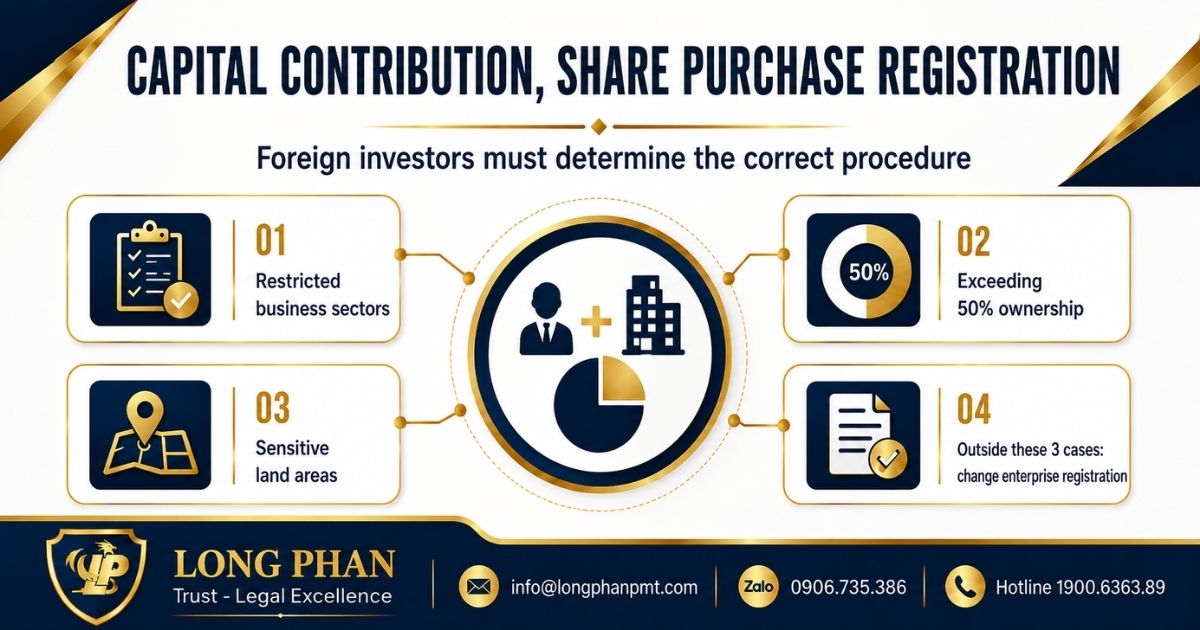
This is an effective indirect investment method. Under Article 25 of the Law on Investment 2020, an Overseas Vietnamese, as a foreign investor, can:
Purchase initial or additional shares of a joint-stock company.
Contribute capital to establish a limited liability company or partnership.
Acquire shares from existing shareholders.
This form of investment must comply with conditions for foreign investors under Article 65 of Decree 31/2021/ND-CP, including market access conditions and national security provisions if the company operates in sensitive areas. The investor must register the capital contribution at the Department of Planning and Investment.
Establishing a Real Estate Business
Establishing a dedicated real estate business provides direct control over investment activities. An Overseas Vietnamese can establish a 100% foreign-owned enterprise or a joint venture. Key requirements include:
Business Establishment Conditions: Meet the conditions for foreign investors under the Law on Investment and Law on Enterprises. Have a legal head office address in Vietnam. For brokerage or valuation services, a certified professional must be in charge.
Company Registration Dossier: Includes an application for enterprise registration, the company charter, a list of founding members, and notarized copies of personal identification.
Registration Procedure: Submit the dossier to the provincial Department of Planning and Investment. The processing time is typically 03 working days. After receiving the registration certificate, the company must complete subsequent steps like making a corporate seal and opening a bank account.
Key Considerations Before Investing
1. Conduct Thorough Legal Due Diligence Before any Overseas Vietnamese housing investment, verify the following:
The original Certificate of Land Use Rights.
The authenticity of the Certificate at the local land office.
Land use planning status to ensure the property is not in a restricted zone.
Any existing mortgages or transaction restrictions.
Any ongoing land disputes.
2. Ensure Transparency in Capital Flow and Control Risk Capital for Overseas Vietnamese housing investment must have a clear, legitimate origin, proven through bank records and tax documents. Investors must also manage five key risks:
Legal Risk: From incomplete due diligence or failure to meet tax obligations.
Market Risk: From price volatility and real estate bubbles.
Personal Financial Risk: From over-leveraging with debt.
Liquidity Risk: The inability to sell the asset quickly without a significant loss.
Partner Risk: From collaborating with unreliable developers or brokers.
Things Overseas Vietnamese need to note before investing in housing
Personal Income Tax: 2% of the transfer price, paid by the seller.
Registration Fee: 0.5% of the property value, paid by the buyer.
Notary Fee: Calculated based on the property value, with a maximum cap.
Fee for Issuing Title Certificate: Varies by locality.
Dossier Appraisal Fee: Set by local authorities.
Consulting Services at Long Phan Consulting Company
Given the complexities of Overseas Vietnamese housing investment, professional legal guidance is crucial. Long Phan Consulting Company offers comprehensive consulting services to help clients navigate this landscape safely. Our services include:
Advising on legal investment forms.
Analyzing ownership conditions and limitations.
Guiding the preparation of investment dossiers.
Drafting and reviewing transaction contracts.
Advising on legal procedures for notarization and ownership registration.
Analyzing and mitigating potential legal risks.
Providing long-term legal support throughout the investment process.
Our experienced team at Long Phan Consulting Company delivers optimal and secure legal solutions for every investment decision.
Frequently Asked Questions
Can Overseas Vietnamese buy social housing in Vietnam?
Yes, if they meet the specific eligibility criteria for income and beneficiary status set by the state for that housing type.
What are the key points when authorizing a representative in Vietnam?
Create a clear, notarized power of attorney specifying the scope and duration of authority. Choose a trustworthy and legally knowledgeable representative.
Can Overseas Vietnamese obtain a bank loan in Vietnam to buy a house?
Yes, if they meet the bank’s credit requirements, including proof of income and repayment capacity. Conditions may be stricter than for domestic citizens.
What are the regulations for transferring funds from abroad for real estate investment?
Funds must comply with foreign exchange regulations, be transferred through legal banking channels, and have documents proving the investment purpose and transparent origin.
Can Overseas Vietnamese sell or transfer their property in Vietnam?
Yes, they have the right to sell, transfer, gift, or bequeath housing in Vietnam, provided the property has a title certificate and no legal encumbrances.
Conclusion
The legal framework in Vietnam provides diverse and transparent forms of Overseas Vietnamese housing investment. Investors can choose direct methods like purchasing or building, or indirect methods like contributing capital or establishing a business. For detailed guidance on procedures and legal dossiers tailored to each investment form, please contact the hotline of Long Phan Consulting Company at 1900.63.63.89.
Facebook
Linkedin
Twitter
Pinterest
Phan Mạnh Thăng
Mr. Phan Manh Thang, CEO, is the founder of Long Phan Investment Consulting and Legal Services Company Limited. With over 13 years of experience in the fields of land and corporate law, CEO Phan Manh Thang has been advising and partnering with numerous clients throughout their business operations and enterprise expansion. Concurrently, he serves as the Managing Lawyer of Long Phan PMT Law Firm, established in 2019.
His specialized expertise and practical experience have consistently earned him the trust and high regard of his clients.