
Key considerations when authorizing real estate sales for Overseas Vietnamese require a clear understanding of legal regulations related to the form of authorization, property transfer conditions, and valid notarization procedures. Overseas Vietnamese (Việt Kiều) must clearly define the scope, duration, and content of the authorization to prevent disputes or abuse of power. Preparing a complete dossier and following the correct process will ensure the transaction is legal, secure, and protects their interests. This article provides a detailed guide on these important points.

When an Overseas Vietnamese authorizes the sale of real estate in Vietnam, preparing a complete and accurate dossier is crucial for a smooth, legal, and properly notarized transaction. The authorizer should prepare the following documents:
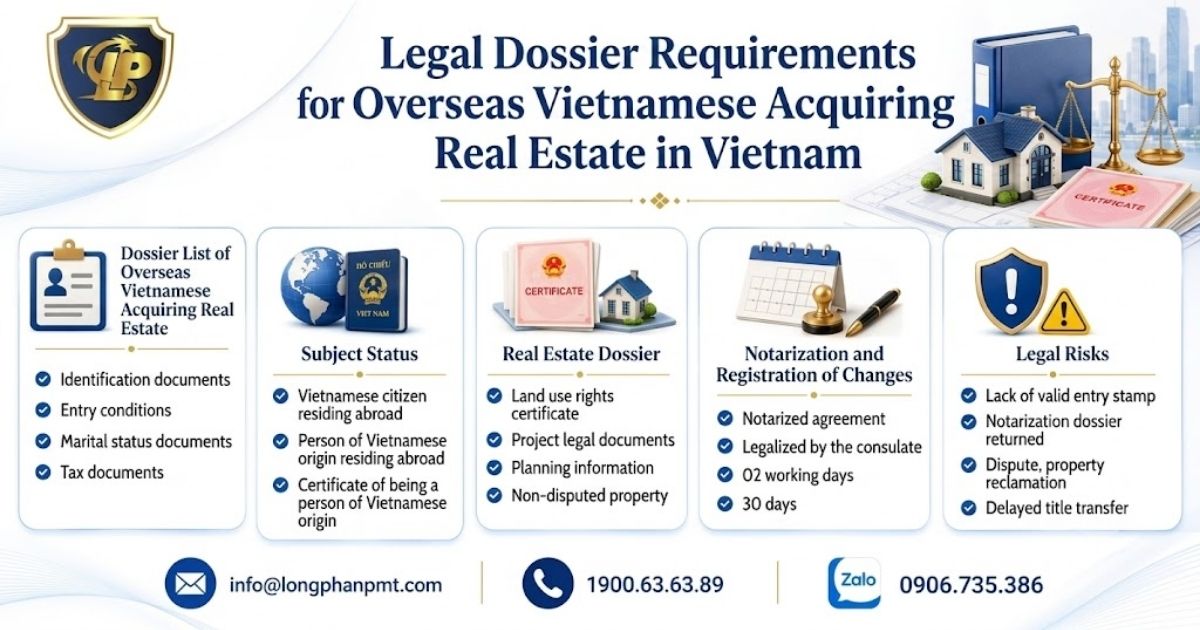
For an authorizer who is an Overseas Vietnamese still holding Vietnamese citizenship, the required documents under Article 3.2(a) of Decree 95/2024/ND-CP include:
For an Overseas Vietnamese of Vietnamese origin without Vietnamese citizenship, the required documents under Article 3.2(b) of Decree 95/2024/ND-CP are:
Note: Two notarized copies of all personal identification documents are needed for both the authorizer and the authorized person for notarization and record-keeping.
Property documents are essential for defining the asset’s value, ownership, and the specific details within the authorization document. You will need:
If documents are issued abroad, they must be translated, notarized, and undergo consular legalization for use in Vietnam.
Under the Civil Code 2015, an Overseas Vietnamese can authorize a property sale through two primary forms: a letter of authorization (a unilateral legal act) or an authorization contract (a bilateral legal act). The choice of form directly impacts the rights, obligations, and legal binding between the parties.
An authorization contract is an agreement between the authorizer and the authorized person to sell the property. This form requires the consent of both parties, and the contract must clearly define the scope of work, responsibilities, benefits, and duration of the authorization. It must be notarized or certified and is typically used for high-value assets or complex transactions requiring strong legal binding.
A letter of authorization is a unilateral legal act created by the authorizer to grant power to another person for specific tasks, including selling property. It does not require a mutual agreement. The authorizer can have it notarized at a Vietnamese diplomatic mission abroad or a foreign notary office, followed by consular legalization. While simpler and less costly, its content must be meticulously drafted to cover all necessary powers, such as signing contracts, receiving funds, and paying taxes.

Authorizing real estate sales for Overseas Vietnamese from abroad can be done through two main methods: direct authentication at a Vietnamese diplomatic mission or notarization at a foreign notary office followed by consular legalization.
An Overseas Vietnamese can sign the authorization document at a Vietnamese Embassy or Consulate. Under the Law on Notarization 2024, consular officers are authorized to authenticate signatures. This method is convenient because the authenticated document is legally valid for direct use in Vietnam without further consular legalization. The authorizer must appear in person with all required documents.
Alternatively, the authorization document can be notarized at a local foreign notary public. For this document to be valid in Vietnam, it requires additional steps:
For an authorization contract requiring both signatures, after the authorizer completes notarization abroad, the authorized person in Vietnam must also sign and have their signature notarized at a Vietnamese notary office. This dual-notarization process is necessary to validate the intent of both parties.
When drafting the authorization document, it is critical to specifically define and limit the scope of power. This is a key aspect of authorizing real estate sales for Overseas Vietnamese to ensure transparency and mitigate risk.
The scope typically includes negotiating prices, signing contracts, and filing documents. However, avoid granting the authorized person the power to receive payment directly into their own account. Instead, the authorization document should specify a designated bank account belonging to the authorizer for the buyer to transfer funds.
According to Circular 23/2014/TT-NHNN (amended by Circular 02/2019/TT-NHNN), if authorizing another person to use a payment account, the authorization must be in writing and comply with legal regulations. The account holder must not lease or lend their account for illicit activities like money laundering or fraud.
>>> See more at: A Guide to Property Authorization for Overseas Vietnamese in Vietnam
When authorizing real estate sales for Overseas Vietnamese, be aware of potential risks under the Civil Code 2015.

The process of authorizing real estate sales for Overseas Vietnamese is a complex legal procedure. Long Phan Consulting Company provides comprehensive consulting services to ensure the process is legal, transparent, and secure for clients abroad.
Our services include:
With our experienced team, Long Phan Consulting Company is committed to providing reliable and expert legal services to ensure your real estate transaction in Vietnam proceeds smoothly.
No, but it is a convenient solution that avoids the need for the owner to be physically present in Vietnam for the transaction.
The duration is as agreed by the parties. If not specified, an authorization contract is valid for one year from its establishment date (Article 563, Civil Code 2015).
Sub-authorization is only permitted with the original authorizer’s written consent or as allowed by law.
The authorizer can unilaterally terminate the authorization contract and file a lawsuit if there are signs of legal violation or abuse of power.
While not mandatory, specifying a minimum price is highly recommended to protect the authorizer’s financial interests.
Overseas Vietnamese must understand the key considerations when authorizing real estate sales for Overseas Vietnamese to ensure a smooth transaction and protect their legal rights. Professional consulting services help navigate the process correctly and avoid legal risks. Long Phan Consulting Company offers expert and reliable authorization consulting services. Contact our hotline at 1900.63.63.89 for a detailed consultation.