
The Overseas Vietnamese real estate mortgage process is governed by the Land Law 2024 and the Law on Housing 2023. Vietnam’s current legal framework facilitates property ownership and mortgage rights for Overseas Vietnamese who possess the required legal documents and meet statutory conditions. This analysis details the legal regulations and practical aspects of real estate mortgages for Overseas Vietnamese.
The increasing participation of Overseas Vietnamese in domestic investment and financial activities, including mortgage transactions, necessitates a clear understanding of the relevant legal provisions. The following are the conditions for an Overseas Vietnamese real estate mortgage in Vietnam.
An Overseas Vietnamese seeking an Overseas Vietnamese real estate mortgage must meet fundamental conditions stipulated in Article 28.1(h), Article 45 of the Land Law 2024, and Article 8.1(b) of the Law on Housing 2023:
Beyond property-related conditions, the Overseas Vietnamese individual must demonstrate financial capacity to repay the loan as assessed by the credit institution. The loan’s purpose must be legal, and the capital utilization and repayment plan must be feasible according to the lending bank’s regulations.
The ability to secure an Overseas Vietnamese real estate mortgage also depends on the individual’s nationality status. The Land Law 2024 provides specific regulations that differentiate the rights and mortgage conditions between Overseas Vietnamese who retain their Vietnamese citizenship and individuals of Vietnamese origin who no longer hold citizenship.
Overseas Vietnamese who are Vietnamese citizens possess land-related rights and obligations equal to those of domestic citizens. Specifically, Article 4.3 of the Land Law 2024 stipulates that Overseas Vietnamese who are citizens of Vietnam are entitled to the full range of land-related rights and obligations as domestic individuals. This represents a significant expansion of rights compared to the 2013 Land Law.
Consequently, Overseas Vietnamese with Vietnamese citizenship can directly purchase, sell, and mortgage real estate like domestic citizens. They have the right to be allocated or leased land by the State, have their land use rights recognized, be issued a Certificate, and receive, transfer, convert, lease, inherit, gift, mortgage, and contribute land use rights as capital.
Therefore, an Overseas Vietnamese person still holding Vietnamese citizenship is entitled to an Overseas Vietnamese real estate mortgage upon meeting the general conditions and the requirements for proof of homeownership under Article 3 of Decree 95/2024/ND-CP, issued by the Government on July 24, 2024.
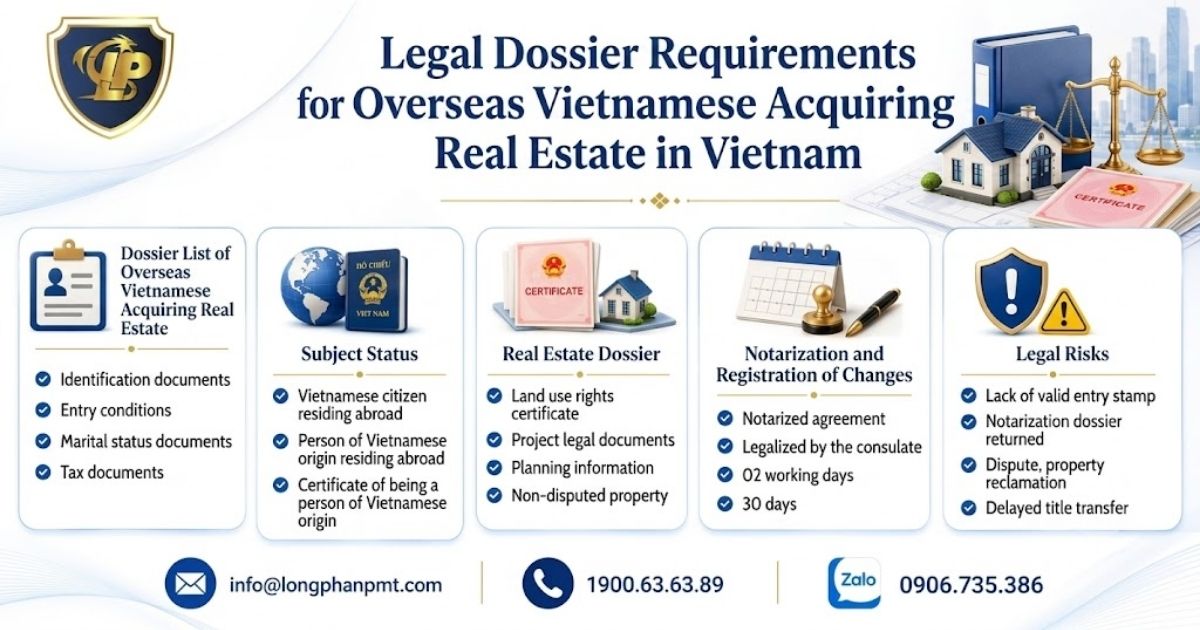
Individuals of Vietnamese origin who no longer hold Vietnamese citizenship are restricted to mortgaging houses and the associated land use rights. They cannot mortgage land use rights as a standalone asset. Article 44.1 of the Land Law 2024 specifies this right: an individual of Vietnamese origin residing abroad who is permitted to enter Vietnam is entitled to own housing attached to land use rights in Vietnam.
As a result, when executing a real estate mortgage, they are only permitted to mortgage the land use rights attached to the house, not the land use rights alone. This is a more restrictive provision compared to that for Overseas Vietnamese who retain their citizenship.
To prove their eligibility for homeownership, individuals of Vietnamese origin must present a valid passport with an entry stamp into Vietnam. They may also use a valid international travel document with a verified entry stamp at the time of signing the housing transaction, as per Article 3.3 of Decree 95/2024/ND-CP.

>>> See more at: Should overseas Vietnamese buy property in a real estate development project?
To execute an Overseas Vietnamese real estate mortgage, a complete set of legal documents must be prepared as required by the credit institution and Vietnamese law. The file includes personal identification, proof of income, collateral documentation, and loan-related papers. Preparing a complete and accurate dossier accelerates the bank’s appraisal and disbursement process.
Preparing these legal documents accurately is a critical step for a successful Overseas Vietnamese real estate mortgage.
When undertaking an Overseas Vietnamese real estate mortgage, individuals must pay close attention to document retention and the rights and obligations arising from the transaction. These are crucial factors for mitigating risk and ensuring the mortgage process is legal, secure, and effective.
The Overseas Vietnamese individual must carefully retain all records and documents related to the mortgage transaction, from the loan application to the final repayment.
Proper retention of all documents related to the credit and mortgage contracts is an indispensable step to protect legal rights and avoid future complications.
A clear understanding of one’s rights and obligations is essential to prevent legal risks such as default (being classified as a non-performing loan) and foreclosure on the mortgaged property. It is imperative to review the terms regarding the rights and duties of all parties in the credit and mortgage agreements before the transaction.
Rights of the Parties
Obligations of the Parties
To avoid default, create a detailed financial plan and account for potential risks affecting repayment capacity. In case of financial difficulty, proactively contact the bank to negotiate a revised repayment plan or loan restructuring instead of allowing the debt to become overdue.

>>> See more at: Real estate deposit procedure for overseas Vietnamese: A Guide
Long Phan Consulting Company provides specialized legal consulting services on Overseas Vietnamese real estate mortgage with a team of experienced experts. Our services include:
The consulting process at Long Phan Consulting Company is designed scientifically, starting with an analysis of each client’s specific legal situation. Our specialists will assess mortgage eligibility based on the Land Law 2024 and Law on Housing 2023, identify the appropriate type of mortgage, and forecast potential risks. We provide a detailed and transparent implementation roadmap with a specific timeline for each step.
To provide a clearer understanding of the Overseas Vietnamese real estate mortgage process, we have compiled answers to common questions.
An Overseas Vietnamese holding Vietnamese citizenship has land-related rights and obligations equal to a domestic citizen, allowing them to mortgage both land use rights and land-attached assets. Conversely, a person of Vietnamese origin without citizenship can only mortgage housing and its associated land use rights, not standalone land use rights. This is specified in Article 4.3 and Article 44.1 of the Land Law 2024.
In addition to the Certificate, other crucial documents include the real estate purchase and sale agreement, the property handover record, payment invoices and receipts from the property purchase, and, if applicable, the construction permit and design drawings.
To prove repayment capacity, an individual needs an employment contract and salary statements (for employees), bank account statements for the last 6-12 months, a business license and financial reports (for business owners), and documents proving income from rental properties, dividends, or interest.
The legal system ensures legality by requiring that the land has no ownership disputes, is not under distraint for judgment enforcement, has no restrictions on disposition, and is within its valid use term. Additionally, the land must not be slated for state recovery. These conditions are set forth in Article 28.1(h) and Article 45 of the Land Law 2024 and Article 8.1(b) of the Law on Housing 2023.
The Certificate of Mortgage Registration, issued by the land use rights registration office, is a critical legal document that proves the property has been lawfully mortgaged. It serves as official evidence of the security interest.
According to Article 321 of the Civil Code 2015, the mortgagor has the right to exploit the mortgaged asset, benefit from its yields and profits, invest to increase its value, and sell, exchange, or gift it, provided the new party is informed of the mortgage and the lender is notified.
Overseas Vietnamese can mortgage real estate in Vietnam in compliance with the Land Law 2024 and Law on Housing 2023, provided they meet all legal conditions. An Overseas Vietnamese real estate mortgage is a viable financial tool when navigated correctly. For detailed advice and professional support, contact Long Phan Consulting Company via hotline 1900.63.63.89 for assistance with all procedures efficiently and effectively.