
Standard Land Financial Obligation Audit for Enterprises in Vietnam is an imperative risk-mitigation strategy to protect cross-border M&A transactions, corporate pledges, and asset transfers from costly operational standpoints. Under the Law on Land, unfulfilled land liabilities serve as an immediate statutory barrier, freezing your right to transfer projects, lease space, or contribute land-linked equity. Overlooking hidden liabilities like 1/500 detailed planning adjustment penalties or incorrect land valuation methods subjects foreign investors to a severe 0.03% daily late payment interest charge and coercive tax enforcement. To systematically insulate your localized assets and embed a robust [corporate compliance framework] before commercial closing, the senior FDI experts at Long Phan Consulting provide this standardized financial evaluation roadmap.

Important legal note:
Periodic land financial obligation audits help control retroactive collection risks and secure project transactions. Land-related financial obligations do not merely arise at the specific moment an enterprise is allocated or leased land by the State. These liabilities can fluctuate dynamically throughout the project lifecycle whenever an enterprise adjusts detailed master plans, changes land use purposes, extends land use terms, or alters land rental payment structures, pursuant to Clause 3, Article 155 of the 2024 Land Law and Clause 2, Article 2 of Decree 103/2024/ND-CP.
Core liabilities such as land use fees, land rental fees, and additional payment obligations must be continuously verified against the compliance mechanisms of the 2024 Land Law and Decree 103/2024/ND-CP. Specifically, the fundamental bases for calculating land use fees and land rental fees are established pursuant to Clauses 1 and 2, Article 155 of the 2024 Land Law. Financial obligations arising from changes in land use purposes, term extensions, or land use duration adjustments are strictly regulated under Article 156 of the 2024 Land Law.
Furthermore, cases involving detailed planning modifications or transitions in land use forms fall directly within the scope of calculation, collection, and payment enforcement pursuant to Clause 2, Article 2 of Decree 103/2024/ND-CP. Consequently, foreign enterprises must never assume that historically settled payments constitute a definitive, unalterable liability.
Commercial triggers requiring an immediate financial reassessment include:
A construction investment project with unfulfilled land financial obligations faces immediate statutory restrictions regarding transfers, pledges, or equity contributions. Land users permitted to delay or record land liabilities as a debt must completely fulfill all outstanding financial obligations prior to exercising their rights to transfer, mortgage, or contribute land use rights as corporate capital, pursuant to Clause 5, Article 45 of the 2024 Land Law. For real estate project transfers, the transferring developer is legally obligated to fully complete all land-related financial obligations to the State, including land use fees, land rental fees, and all associated land taxes, charges, and fees, pursuant to Clause 3, Article 40 of the 2023 Law on Real Estate Business.
Corporate compliance teams must concurrently cross-examine land use fee notices, annual land rental fee notifications, state treasury vouchers, official exemption or reduction decisions, signed financial obligation determination minutes, late payment interest notices, and historical tax inspection or state audit conclusions. If a project dossier lacks verified payment receipts or relies on outdated, invalid valuation methodologies, the enterprise faces an immediate late payment interest charge of 0.03% per day calculated on the overdue balance, pursuant to Clause 2, Article 59 of the 2019 Tax Administration Law. This financial risk typically manifests as a critical deal-breaker during real estate M&A due diligence performed by foreign investors.
Routine land financial obligation audits are a fundamental pillar of internal corporate compliance governance. Land use fees, land rental fees, and associated state revenues constitute formal budgetary collections from land, pursuant to Clause 1, Article 153 of the 2024 Land Law. Implementing a systematic review allows enterprises to detect payment shortfalls early, isolate areas prone to retroactive collection, and clear legal bottlenecks before they stall commercial operations.
In the context of transactional M&A, an independent audit report serves as the baseline for foreign investors to determine the actual net asset value of a target project. Because the transferring developer must clear all outstanding land use fees, land rental fees, and related land taxes before a project can be legally assigned pursuant to Clause 3, Article 40 of the 2023 Law on Real Estate Business, any uncompleted obligation identified during due diligence will directly dictate corporate deal structuring. These outstanding liabilities are routinely transformed into strict conditions precedent (CPs), indemnity holdbacks, or direct downward purchase price adjustments.
Enterprises must execute these strategic audits prior to executing Memorandums of Understanding (MoUs), submitting formal project adjustment dossiers, negotiating asset-backed bank financing, transferring land use rights, or responding to initial state audit findings. Land users operating under deferred payment or debt-recording schemes remain restricted from executing transfers, commercial leases, mortgages, or equity contributions until all outstanding financial obligations are fully liquidated, pursuant to Clause 5, Article 45 of the 2024 Land Law.
The standardized corporate approach requires a systematic verification chain tracing back from source land dossiers and specific land valuation methodologies to physical bank vouchers and the underlying transactional rights of the economic organization. This comprehensive methodology remains the ultimate defense against compounding financial liabilities, particularly given that daily late payment interest charges accumulate relentlessly at 0.03% per day pursuant to Clause 2, Article 59 of the 2019 Tax Administration Law.
Enterprises must definitively verify the underlying legal foundation of the land plot before calculating or cross-referencing financial obligations. If the source title records are unclear, any subsequent calculations regarding land use fees, land rental fees, or retroactive payment provisions remain highly susceptible to critical error.
The core objective of this stage is to isolate the exact statutory mechanism under which the enterprise occupies the land. Distinguishing accurately between land allocation with land use fee collection, a land lease with annual rental payments, and a land lease with a one-off rental payment for the entire lease term directly dictates the corporate entity’s transactional and disposition rights.
Enterprises must initiate the review by examining the complete repository of instruments establishing land use rights and defining the project scope. This procedure is legally anchored in the user’s statutory obligations to utilize land strictly in accordance with its designated purpose, respect approved boundaries, execute mandatory land registrations, and fully discharge land financial obligations, pursuant to Clauses 1, 2, and 3, Article 31 of the 2024 Land Law.
The corporate dossier subject to immediate audit comprises the formal land allocation or land lease decision, the executed land lease contract, the Certificate of Land Use Rights and Ownership of Assets Attached to Land (LURC), the Investment Policy Approval, and any subsequent project amendment decisions. The state’s underlying legal basis for allocating or leasing land to a commercial project is tied strictly to the formal investment policy approval instrument, the investor recognition decision, or the verified results of a competitive bidding or auction process, pursuant to Clause 3, Article 116 of the 2024 Land Law.
Compliance teams must systematically cross-reference these documents against approved zoning plans, the designated land use purpose, the statutory land use term, and the actual physical utilization of the site. Whenever variations occur in land area, master plot boundaries, purpose of use, statutory duration, or the overarching form of land allocation or lease, the economic organization is legally required to execute a mandatory registration of land variation, pursuant to Points d, e, g, and h, Clause 1, Article 133 of the 2024 Land Law. Any unresolved variance between the physical project reality and the state’s historical title records will alter supplementary financial liabilities, requiring a comprehensive rectification of files before the final assessment of settled balances can occur.
The precise statutory form of land utilization acts as the primary determinant for the applicable land valuation and financial calculation methodologies. The 2024 Land Law clearly demarcates land allocation with land use fee collection from land leases structured around either annual rental payments or a one-off rental payment for the entire lease term, with the fundamental bases for calculating all land use fees and land rentals strictly governed pursuant to Clauses 1 and 2, Article 155 of the 2024 Land Law.
Corporate compliance frameworks must rigidly segregate these asset classes: land allocation with land use fee collection triggers a single, front-end land use fee liability; a land lease with annual rental payments introduces a recurring, periodically adjusted operating expense; and a land lease with a one-off rental payment establishes an entirely different corporate asset valuation with distinct statutory rights regarding transfers, mortgages, and joint-venture equity contributions. These variations in the disposition rights of local economic organizations are strictly codified pursuant to Clause 1, Article 33 and Clause 1, Article 34 of the 2024 Land Law.
An incorrect classification of these mechanisms will invalidate the entire land financial obligation audit report. In real estate project M&A transactions, such misclassifications serve as a primary source of transaction-stalling conditions precedent, post-closing price adjustments, or strict demands requiring the selling entity to completely liquidate legacy debts before the transaction can legally close.
Foreign investors and corporate entities must never rely exclusively on the text of a face-value LURC or land lease decision. Because land users carry an absolute statutory obligation to maintain land utilization in perfect alignment with its designated purpose, respect approved boundaries, and continuously satisfy land-related financial obligations pursuant to Clauses 1 and 3, Article 31 of the 2024 Land Law, the actual physical state of the site, updated zoning plans, and the master Investment Policy Approval must be evaluated concurrently to isolate hidden liabilities.
Compliance checklists must systematically examine the actual land area under active development, current real-world usage, the remaining years on the statutory land use term, 1/500 detailed master plan modifications, actual construction density, actual project functionality, and any specific square footage vulnerable to a non-compliance classification. When a project executes any modification affecting area, purpose, term, or its allocation and leasing structure, the enterprise must record a mandatory registration of land variation, pursuant to Points d, e, g, and h, Clause 1, Article 133 of the 2024 Land Law.
If an investment project has adjusted its 1/500 detailed master plan, changed its land use purpose, or secured an extension of its land use term, management must immediately re-appraise its land financial obligations. Where amendments to a land allocation or lease decision modify the project area, purpose, or term, the specific statutory timeline for calculating land use fees and land rentals is determined pursuant to Point c, Clause 3, Article 155 of the 2024 Land Law.
Furthermore, if a detailed planning adjustment mandates a re-determination of local land values, the pricing timeline is strictly governed pursuant to Point d, Clause 3, Article 155 of the 2024 Land Law. These critical planning junctures represent the most frequent triggers for substantial retroactive collection actions initiated during state tax inspections or government audits.
Enterprises must compile a granular inventory of all applicable land-related financial obligations before attempting to cross-examine historically settled balances. If the corporate compliance framework fails to properly segregate these liabilities, the resulting audit report will invariably omit critical exposures arising from land conversions, detailed planning modifications, or compounding late payment interest.
This structured inventory must capture both current historical liabilities and latent, high-probability contingent financial risks. For commercial housing developments, industrial zones, or land-linked assets placed as bank collateral, any failure to precisely record these line items will distort the underlying commercial transaction value.
Land use fees and land rental obligations constitute the twin pillars of corporate land liabilities, serving as formal budgetary collections derived directly from land utilization, pursuant to Points a and b, Clause 1, Article 153 of the 2024 Land Law. Compliance teams must rigidly separate these two categories because their underlying statutory triggers, land valuation methodologies, and legal consequences diverge completely.
The corporate audit inventory must explicitly isolate:
The baseline parameters for calculating all land use fees and land rental values are strictly anchored pursuant to Clauses 1 and 2, Article 155 of the 2024 Land Law. When executing a change of land use purpose or securing a term extension, the enterprise may face immediate supplementary payment obligations, pursuant to Clauses 1 and 2, Article 156 of the 2024 Land Law. Conflating these categories will lead management to miscalculate the asset’s transactional validity, as disposition rights including the right to transfer projects, execute mortgages, or contribute joint-venture equity vary fundamentally between land allocation, one-off rentals, and annual rental structures under Clause 1, Article 33 and Clause 1, Article 34 of the 2024 Land Law.
Beyond the primary land use and rental fees, corporate compliance frameworks must rigorously verify secondary tax and administrative line items that are frequently minimized or overlooked within internal corporate files. These supplementary collections remain formal state budgetary revenues derived from land administration, pursuant to Points e and h, Clause 1, Article 153 of the 2024 Land Law.
The audit matrix must systematically track:
Residential land, non-agricultural production and business land, and any non-agricultural land utilized specifically for commercial operations fall squarely within the statutory scope of local taxation, pursuant to Article 2 of the 2010 Law on Non-Agricultural Land Use Tax. Furthermore, registration fees must be calculated strictly against the state-directed registration fee pricing base and the corresponding statutory percentage rates, pursuant to Article 6 of Decree 10/2022/ND-CP. Compliance teams must cross-match every single historical payment against verified bank vouchers and official variation logs; focusing exclusively on core land use fee notices will cause the audit to omit recurring tax liabilities and administrative exposures.
Late payment interest represents an aggressive financial risk that automatically compounds the moment an enterprise receives an official financial notification but fails to liquidate the balance within the state-mandated timeline. The statutory calculation rate for late payment interest is rigidly set at 0.03% per day calculated on the entire overdue balance, pursuant to Clause 2, Article 59 of the 2019 Tax Administration Law.
To properly insulate corporate cash flow, the audit team must reconstruct a precise timeline verifying:
Pursuant to Clause 4, Article 59 of the 2019 Tax Administration Law, once an obligation remains unsettled for more than 30 days past its statutory due date, the tax authority will formally issue a notice of tax debt detailing the exact overdue principal and the accumulating number of days of default.
Where signs of retroactive collection exposures appear regarding land use fees or land rentals, the audit report must clearly segregate verified debts from liabilities that possess viable grounds for legal defense or administrative explanation. The entire mechanism governing the calculation, collection, payment, and administrative management of land use fees and land rentals across conversions, extensions, and planning modifications is strictly governed pursuant to Clause 2, Article 2 of Decree 103/2024/ND-CP. Isolating these factors is the ultimate prerequisite to protecting corporate cash flow and safeguarding the commercial structure of your transactions.

Enterprises must systematically verify the specific land valuation methodologies applied to their projects, as land use fees and land rental values constitute formal state budgetary revenues, pursuant to Points a and b, Clause 1, Article 153 of the 2024 Land Law. The statutory baseline for calculating land use fees mandates the verification of exact land area, the applicable land price, and official exemption or reduction policies; similarly, land rental calculations require the concurrent verification of the leased area, lease duration, extension periods, the specific land rental unit price, the chosen payment structure, and applicable state incentives, pursuant to Clauses 1 and 2, Article 155 of the 2024 Land Law.
Corporate compliance frameworks must rigidly distinguish between the official Land Price List and project-specific Custom Land Prices. Pursuant to Clause 1, Article 159 of the 2024 Land Law, the official Land Price List is strictly mandated to calculate land rentals for enterprises leasing land under the annual land rental payment structure, determine non-agricultural land use taxes, and calculate administrative fees or charges.
Conversely, project-specific Custom Land Prices must be applied to calculate land use fees for commercial organizations granted land allocation without an auction, determine land rentals for entities executing a one-off land rental payment, and re-calculate liabilities during project extensions, term adjustments, 1/500 detailed master plan modifications, or transitions between land use forms, pursuant to Clause 1, Article 160 of the 2024 Land Law.
All statutory land valuation procedures must strictly satisfy market-line principles, utilize approved mathematical methods, follow mandatory administrative sequences, and remain entirely objective, public, and transparent, pursuant to Clause 1, Article 158 of the 2024 Land Law. The legally recognized valuation frameworks comprise the Comparison Method, the Income Method, the Surplus Method, and the Land Price Adjustment Coefficient Method, pursuant to Clause 5, Article 158 of the 2024 Land Law.
Wherever a project-specific Custom Land Price is triggered to calculate land use fees or one-off land rentals, the competent Provincial People’s Committee is legally required to issue its formal land valuation decision within a strict timeline of 180 days from the official valuation benchmark date, pursuant to Clause 4, Article 155 of the 2024 Land Law. The underlying administrative regulations governing valuation execution, land price list formulation, and custom price determinations are detailed under Decree 71/2024/ND-CP.
Enterprises must systematically cross-examine official financial notifications, state treasury vouchers, and statutory exemption or reduction records. This reconciliation is essential because land use fees, land rental fees, land use taxes, and administrative charges are all formal state budgetary revenues, pursuant to Clause 1, Article 153 of the 2024 Land Law. Furthermore, compliance teams must verify that annual land rental rates have been applied stably in accordance with the mandatory 05-year statutory lease cycle, pursuant to Clause 2, Article 153 of the 2024 Land Law.
Official land use fee and land rental exemptions or reductions require a dedicated, isolated compliance review. The 2024 Land Law codifies specific eligible cases under Clause 1, Article 157, while explicitly stipulating that enterprises granted a full exemption from land use fees or land rental fees are completely absolved from executing formal land valuation or incentive calculation procedures, pursuant to Clause 3, Article 157 of the 2024 Land Law.
The administrative mechanics governing the computation, collection, and management of these balances are regulated under Decree 103/2024/ND-CP. Economic organizations allocated land, leased land, granted a change of land use purpose, or executing term extensions, planning modifications, and transitions between land use forms fall directly within this enforcement scope if they carry a statutory obligation to remit land use fees or land rentals, pursuant to Clause 2, Article 2 of Decree 103/2024/ND-CP.
If the reconciliation uncovers outstanding balances, daily late payment interest automatically accumulates at a rigid rate of 0.03% per day calculated on the overdue tax balance, pursuant to Clause 2, Article 59 of the 2019 Tax Administration Law. This framework allows enterprises to mathematically isolate settled amounts from outstanding debts, hidden liabilities, and balances requiring administrative justification.
Discharging land-related financial obligations is a mandatory legal prerequisite for exercising corporate transaction rights. Economic organizations are prohibited from executing project transfers, commercial leases, mortgages, or joint-venture equity contributions unless they possess a valid Certificate of Land Use Rights (LURC), the land is completely free of active disputes, the land use rights are not subject to asset distraint or blocking orders, the statutory land use term remains unexpired, and the property is not restricted by urgent temporary court injunctions, pursuant to Clause 1, Article 45 of the 2024 Land Law.
Furthermore, land users who have been permitted by competent authorities to defer or record land financial obligations as a debt face an absolute statutory barrier; they are completely restricted from transferring, mortgaging, or contributing land use rights as corporate capital until all outstanding liabilities are fully liquidated into the state treasury, pursuant to Clause 5, Article 45 of the 2024 Land Law.
Downstream transactional capabilities differ fundamentally based on the project’s underlying land use mechanism. Economic organizations granted land allocation with land use fee collection or holding a land lease with a one-off rental payment for the entire lease term possess full statutory rights to transfer, mortgage, or contribute land use rights and land-linked assets as corporate equity, pursuant to Clause 1, Article 33 of the 2024 Land Law.
Conversely, for projects operating under a land lease with annual rental payments, the enterprise’s transaction rights are strictly confined to the physical assets under lawful corporate ownership attached to the land and the contractual leasehold rights derived from the executed land lease contract, subject to the satisfaction of strict statutory compliance conditions, pursuant to Clause 1, Article 34 of the 2024 Land Law.
In the specialized context of real estate development transactions, these financial prerequisites are enforced with extreme rigidity. To execute a valid transfer of all or part of a real estate investment project, the transferring developer must possess an official land allocation decision, land lease decision, or land purpose conversion approval, while concurrently proving the absolute completion of all land-related financial obligations calculated for the project site encompassing all land use fees, land rental fees, and land-linked taxes, charges, and fees, pursuant to Clause 3, Article 40 of the 2023 Law on Real Estate Business.
The final audit report must explicitly structure settled amounts, payment shortfalls, official incentives, retroactive collection risks, and administrative mitigation schemes. This precision is required because the baseline parameters for calculating all land use fees and land rental values remain strictly tied to land area, specific land valuation methodologies, statutory durations, payment structures, and state incentive policies, pursuant to Clauses 1 and 2, Article 155 of the 2024 Land Law.
When executing a change of land use purpose, the corporate entity must immediately remit land use fees or land rental differentials calculated strictly against the specific land classification applied post-conversion. Similarly, when an enterprise secures an official land use term extension or duration adjustment, the land user falls within an immediate enforcement scope requiring the calculation and payment of land use fees or land rental fees for the exact duration of the extension or adjustment, pursuant to Clauses 1 and 2, Article 156 of the 2024 Land Law.
Furthermore, if a project executes a 1/500 detailed master plan modification that alters the underlying land use structure, relocates internal plot functionalities, or increases the approved land use coefficients resulting in an escalation of baseline land values—the enterprise is legally required to remit the supplementary financial differential to the State, pursuant to the enforcement mechanisms of Decree 103/2024/ND-CP. For projects operating under leasing structures, any detailed planning modification altering land use compositions, positions, or density metrics mandates an immediate, comprehensive re-calculation of land rental obligations, pursuant to Article 36 of Decree 103/2024/ND-CP.
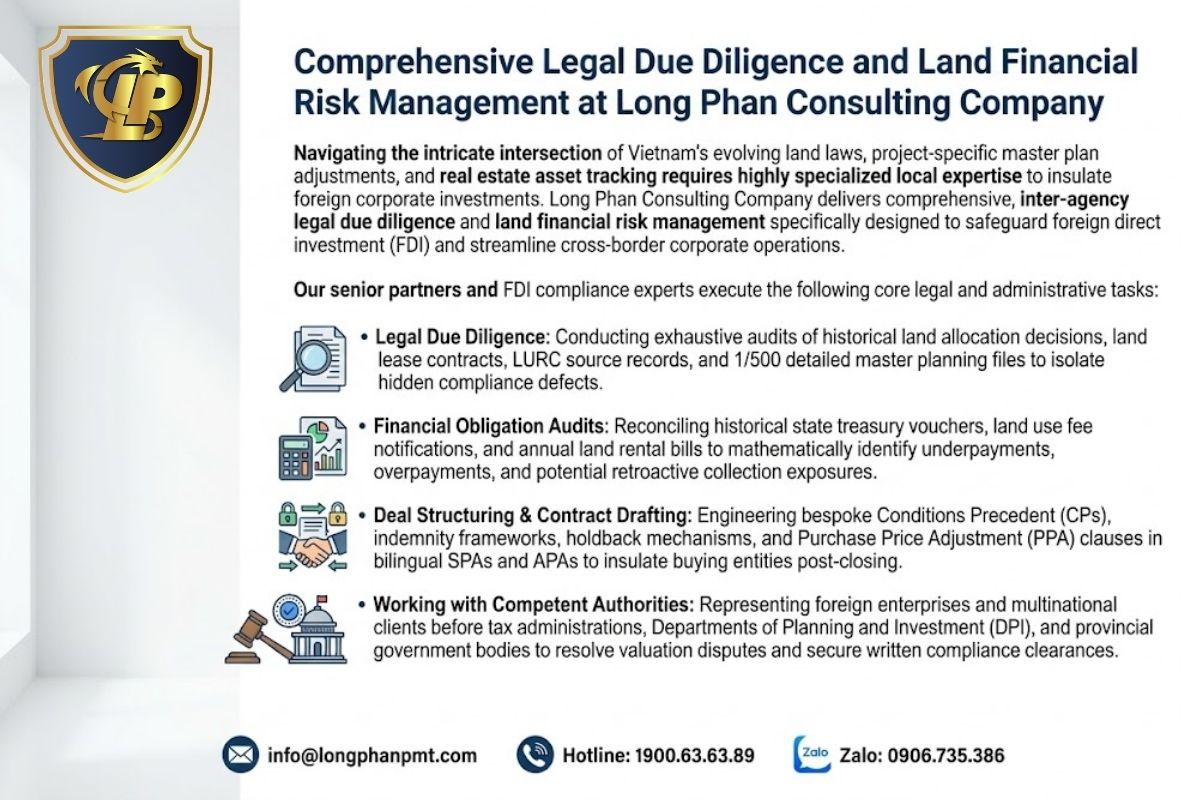
Navigating the intricate intersection of Vietnam’s evolving land laws, project-specific master plan adjustments, and real estate asset tracking requires highly specialized local expertise to insulate foreign corporate investments. Long Phan Consulting Company delivers comprehensive, inter-agency legal due diligence and land financial risk management specifically designed to safeguard foreign direct investment (FDI) and streamline cross-border corporate operations.
Our senior partners and FDI compliance experts execute the following core legal and administrative tasks:
Strict control over “Land Financial Obligations” not only helps businesses optimize cash flow but is also a prerequisite for protecting property rights in M&A transactions. Changes from the 2024 Land Law require investors to identify legal bottlenecks and risks of retroactive collection early to avoid project delays. The answers below focus on practical situations that business leaders frequently face when implementing the new regulations.
Businesses are not allowed to mortgage land use rights; they can only mortgage assets owned by them that are attached to the land and lease rights as stipulated in the land lease contract. This regulation applies to economic organizations that are leased land by the State and pay annual land rent as prescribed in Clause 1, Article 34 of the Land Law No. 31/2024/QH15.
Businesses are required to pay the difference in land use fees if the adjustment of the detailed planning changes the land use structure or increases the land use coefficient of the project. This amount is determined based on the specific land price at the time the state agency approves the planning adjustment, as stipulated in Article 14 and Article 36 of Decree No. 103/2024/ND-CP.
Businesses must pay an additional fee of 5.4% per year on the land use fee or land lease fee payable for the period not yet calculated from the time of actual land handover. This fee applies to projects that have received a land allocation decision but have not yet had specific land prices approved as stipulated in Clause 2, Article 50 of Decree No. 103/2024/ND-CP.
Businesses are only allowed to transfer projects when they have a land use certificate, the land is not subject to disputes or seizure, the land use period is still valid, and all financial obligations have been fulfilled. This is a mandatory condition for the application for land use change registration to be approved by the competent authority, according to Clauses 1 and 5 of Article 45 of the Land Law No. 31/2024/QH15.
Businesses must pay 50% of the land use fee no later than 30 days and the remaining 50% no later than 90 days from the date of issuance of the payment notice. Compliance with these deadlines helps investors avoid the application of tax enforcement measures as stipulated in Points a and b, Clause 4, Article 18 of Decree No. 126/2020/ND-CP.
Investors who transfer projects that have been exempted or reduced from land use fees must repay the State an amount corresponding to the preferential treatment received. In addition, the enterprise must pay an additional amount calculated at the late payment rate corresponding to the period of enjoying the preferential treatment, as stipulated in Clause 10, Article 17 of Decree No. 103/2024/ND-CP.
Businesses owing land use fees must pay late payment penalties at a rate of 0.03% per day on the amount of tax overdue. If the debt exceeds 90 days, the tax authorities will apply coercive measures such as freezing accounts or suspending the use of invoices, as stipulated in Point a, Clause 2, Article 16 of the Law on Tax Administration No. 108/2025/QH15.
Executing a meticulous land financial obligation audit for enterprises functions as a non-negotiable risk-management mechanism to insulate corporate assets, stabilize project budgets, and secure cross-border M&A transactions. Under the stringent parameters of the 2024 Land Law, neglecting to cross-reference historical title records, land valuation methodologies, and state treasury vouchers exposes foreign investors to immediate transactional freezes, severe 0.03% daily late payment interest penalties, and aggressive tax administration enforcement. Rather than viewing land liabilities as a static, historical line item, multinational executives must treat these obligations as dynamic operational variables that require routine verification.
Secure your localized assets and validate your compliance position by partnering with the elite corporate defense team at Long Phan Consulting Company. Contact our senior partners immediately via Hotline 1900636389 to engineer an unassailable financial strategy.
📚 This article is provided with professional consultation based on the following legal framework: