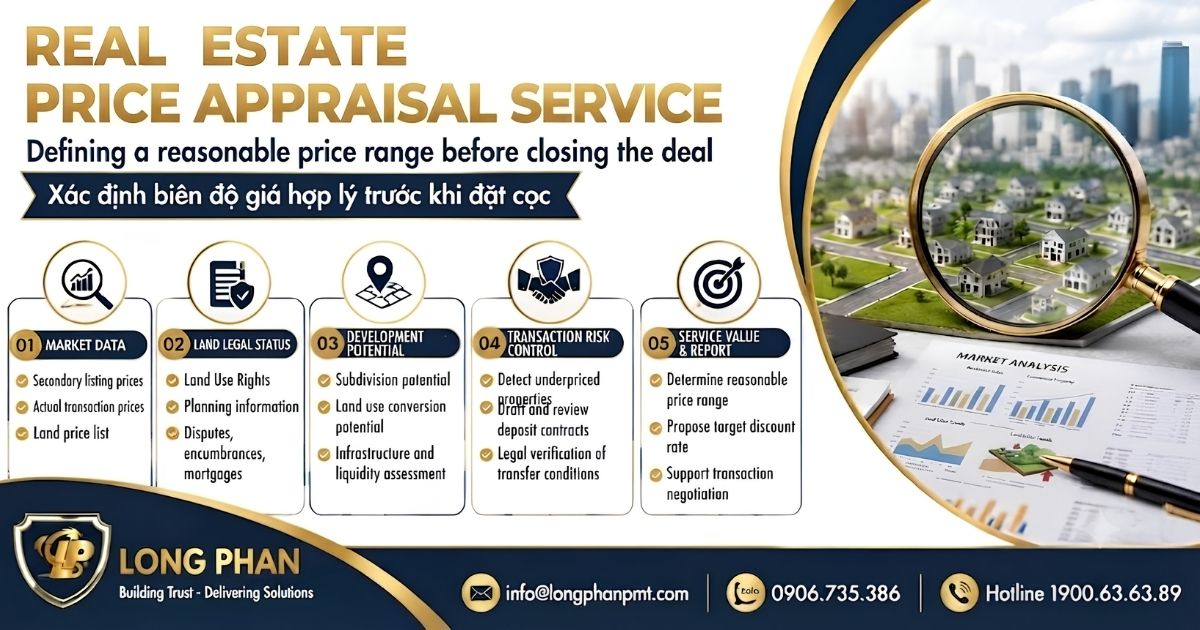
Long Phan Consulting treats a real estate price survey service as a necessary step before buying a land plot, since the listed price can be inflated by brokers, infrastructure rumors, or unclear legal status. The service goes beyond comparing prices: it collects and analyzes land use right market data to fix a reasonable price range before engaging Real Estate Brokerage support and signing a deposit. Without cross-checking the land price list, planning data, the Certificate, liquidity, and actual transaction prices, buyers can easily place a deposit based on one-sided information. This price survey and transaction due diligence should be carried out together with Long Phan Consulting.
Legal Notes:
Surveying land plot prices is not a matter of browsing a few listings and averaging them. It is the process of collecting and analyzing land use right market data to determine a reasonable price range before placing a deposit or signing a transfer contract. In terms of transaction nature, the real estate transfer price is agreed between the parties. This principle creates room for negotiation, but it also increases the risk of overpaying if the buyer lacks comparative data, as noted under Clause 1, Article 47 of the 2023 Law on Real Estate Business.
A valuation certificate may not immediately reflect a short-term price “fever” in a given area. By contrast, a market price survey helps investors identify prices being pushed up by brokers, infrastructure expectations, or unverified planning information.
Civil price surveys serve transaction decisions. The focus is on checking whether the asking price matches the legal status, location, exploitation potential, and liquidity of the land plot.
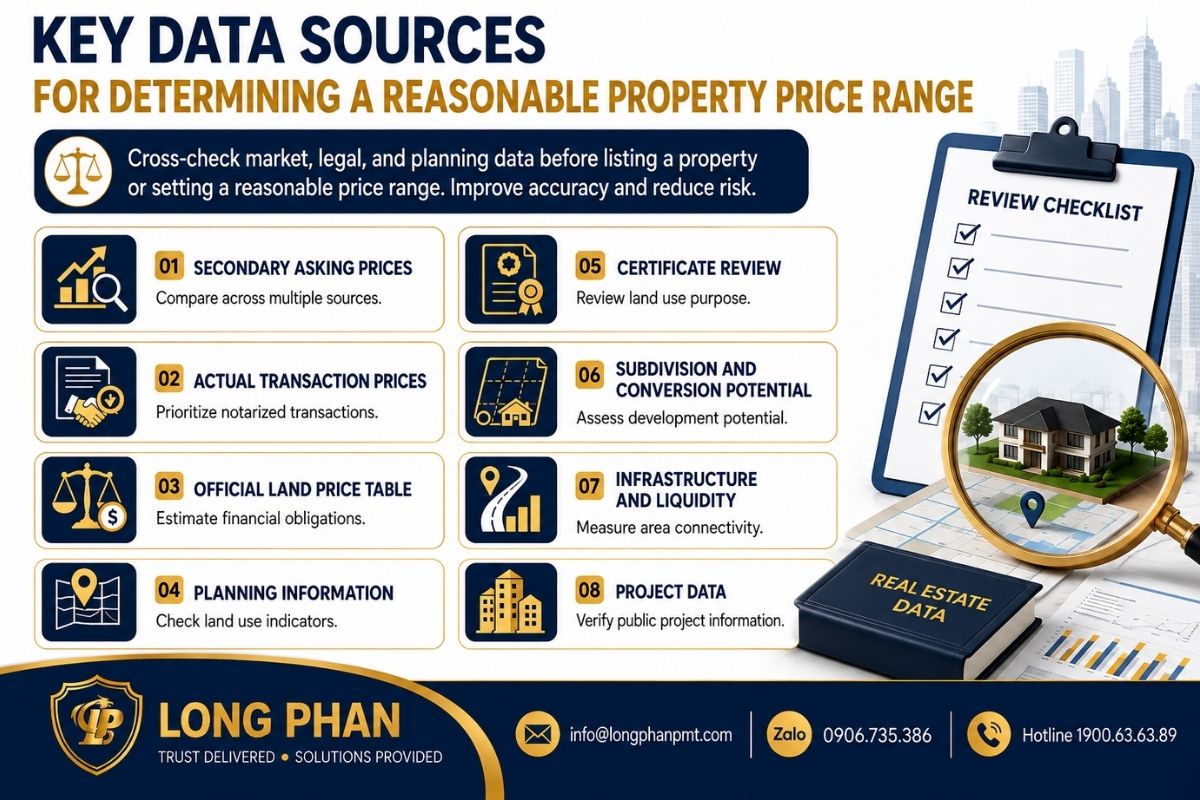
Price surveys typically require cross-checking the following factors:
Professional real estate valuation, by contrast, is a specialized activity governed by professional standards. Determining asset value is carried out by a valuation enterprise or valuation council under Clause 16, Article 4 of the 2023 Law on Prices. Notably, real estate valuation standards do not apply to land valuation performed under land law.
The land price list is not the same as the actual transaction price. Investors need to separate three layers of data: the land price list, the listed price, and the market-based land price.
The land price list serves state management, financial obligations, and certain cases of calculating land use fees. It is issued by the provincial People’s Committee under Clause 3, Article 159 of the 2024 Land Law, as amended by Clause 2, Article 8 of Decree No. 151/2025/ND-CP, effective from July 1, 2025.
The specific land price, on the other hand, is decided case by case for land allocation, land lease, or a permitted change of land use purpose. This authority rests with the Chairman of the provincial or commune-level People’s Committee under Point a and Point b, Clause 2, Article 160 of the 2024 Land Law. Authority to decide the specific land price is further governed by Point e, Clause 2, Article 5 of Decree No. 151/2025/ND-CP, effective from July 1, 2025.
During the transitional period, the land price list issued by the provincial People’s Committee under the 2013 Land Law continues to apply until December 31, 2025, under Clause 1, Article 257 of the 2024 Land Law. The commercial risk lies in the lag between the land price list and the market price. Relying solely on the land price list can lead investors to misjudge their financial obligations, profit margin, and a reasonable negotiating price.
>>> See more: Impact of Land Law 2024 on the Real Estate Market
A reasonable price range is only reliable when the data is cross-checked against the market, legal status, and planning. Buyers from other provinces, overseas Vietnamese, or small businesses need this process even more, to avoid relying on one-sided broker information. Citizens are entitled to access planning, land use plans, the land price list, and public land data under Clause 1, Article 24 of the 2024 Land Law and Clause 1, Article 55 of the 2024 Law on Urban and Rural Planning.
Items clients should review include:
A price survey report turns market data into negotiating leverage. Buyers not only know the price they should pay, but also identify where to hold back funds, request a discount, or add protective conditions in the deposit contract. A deposit is a security measure confirming that a contract will be entered into or performed. When the deposit amount is decided without adequate data, the depositor risks being locked into an unfavorable price and unsafe forfeiture conditions, as governed by Article 328 of the 2015 Civil Code.
A price survey report has practical value in three respects: determining a reasonable price range, identifying the land plot’s weaknesses, and proposing a target discount. It gives buyers a basis for negotiating on evidence rather than instinct.
A price lower than the market is not always an opportunity. In many land plot transactions, a low price compensates for legal, planning, or liquidity risk that the seller has not disclosed.
Signals to check immediately include:
If a transaction violates a condition for validity or a statutory prohibition, the contract risks being void. This risk should be assessed before placing a deposit, based on Article 117 and Articles 123 and 124 of the 2015 Civil Code.
A price survey does not replace legal due diligence. A land plot priced reasonably can still be unsafe if it lacks transfer conditions, is under dispute, or has restricted rights.
For land plots held by individuals, the land use right is only eligible for transfer when it has a Certificate, is free of disputes, is not under seizure, and is not subject to a temporary emergency measure. This is set out under Clause 1, Article 45 of the 2024 Land Law.
For project land plots, the conditions for transferring land use rights already equipped with technical infrastructure must be checked separately. A transfer to an individual for self-construction of housing is further restricted to specific urban areas under Clause 6, Article 31 of the 2023 Law on Real Estate Business.
Deposit risk should also be controlled through the deposit ratio and disbursement conditions. A real estate project developer may only collect a deposit of no more than 5% of the sale price once the property is eligible for business, under Clause 5, Article 23 of the 2023 Law on Real Estate Business.
The law does not require every land plot transaction to use a price survey service. From a risk management perspective, however, this step becomes necessary when market data lacks transparency or the transaction value is large enough to cause significant financial loss.
Investors should use a professional real estate price survey service in the following cases:

A land plot transaction should be assessed simultaneously for price, legal status, planning, and liquidity. Long Phan Consulting treats this as a pre-transaction risk control process, not merely a comparison of listed prices. The goal is to give clients reliable data before placing a deposit, negotiating, or signing a transfer contract.
Advisory services that can be provided include:
Clients may send documents, the Certificate, land plot information, or project materials via email at info@longphanpmt.com or Zalo at 0906.735.386 for a preliminary assessment.
Misjudging market information does not only cause financial loss; it can also expose investors to serious legal blind spots. Combining a real estate price survey service with a legal compliance review is therefore a necessary strategy to protect capital. The following answers address key risks when transacting off-plan property or receiving a transfer of a subdivided land plot.
Investors should only pay a deposit up to the statutory cap applicable to a project eligible for business. Market data helps investors decline unlawful capital-raising requests. A project developer may only collect a deposit of no more than 5% of the housing sale price. This ratio is set under Clause 5, Article 23 of the 2023 Law on Real Estate Business.
A business cannot buy a subdivided land plot in major cities to build housing for itself. Low-priced deals in this category carry a high risk of a void contract. The transferred land plot must not be located in a special-grade, grade I, grade II, or grade III urban area. This prohibition is strictly set under Clause 6, Article 31 of the 2023 Law on Real Estate Business.
A business is liable if it deliberately records a contract price that misrepresents reality. Analyzing market data helps investors set a safe declared price. A real estate business organization is liable for recording an untrue transaction price. This sanction applies under Clause 2, Article 47 of the 2023 Law on Real Estate Business.
An investor fully retains the right to withhold part of the contract value until receiving the Certificate. This clause ensures the developer performs its committed legal obligations. If the buyer has not yet been granted the Certificate, the seller may not collect more than 95% of the contract value. This payment cap is based on Clause 3, Article 25 of the 2023 Law on Real Estate Business.
Investors may continue applying the locality’s old land price list until the end of the transitional period. Checking this price list helps determine an accurate reasonable price range before negotiation. The land price list issued under the old law continues to apply until December 31, 2025. This transitional legal basis is set out under Clause 1, Article 257 of the 2024 Land Law.
A real estate price survey service helps investors control risk before committing funds, especially where the listed price is affected by brokers, planning, infrastructure, and the land plot’s legal status. Collecting and analyzing land use right market data should be carried out alongside checking the Certificate, disputes, mortgages, subdivision, use purpose conversion, and deposit conditions. Without independent data, buyers may accept a mispriced deal or unfavorable terms. Contact Hotline 1900636389 for Long Phan Consulting to help assess the transaction before you place a deposit.
📚 This article has been professionally reviewed based on the following legal documents: