
The impact of Land Law 2024 on land prices and the real estate market creates fundamental changes in property valuation and transaction mechanisms. The new law abolishes the land price framework, replacing it with an annually updated land price list to reflect actual market values. This analysis details the new regulations and the law’s effects on the 2025 real estate market.

Effective from January 1, 2025, the Land Law 2024 is a comprehensive reform, introducing significant changes to Vietnam’s real estate (RE) market.
The Land Law 2024 completely removes the land price framework, a pivotal change in Vietnam’s land valuation system. Instead, land price lists will be developed based on actual market values as stipulated in Article 159 of the Land Law 2024, no longer dependent on a government-issued framework. This regulation marks a transition from an administrative pricing mechanism to a market-based one, realizing the objective stated in Subsection 2, Section IV of Resolution 18-NQ/TW dated June 16, 2022.
Furthermore, under Clause 5, Article 158 of the Land Law 2024, guided by Articles 4, 5, 6, and 7 of Decree 71/2024/ND-CP (effective August 1, 2024), land valuation will use four scientific and transparent methods:
Abolishing the land price framework is the most significant impact of Land Law 2024. This change aligns land prices with their real value, protects citizens’ rights during state land recovery, and is expected to increase transparency and reduce corruption.
Another groundbreaking change in the Land Law 2024 is the annual update of the land price list, replacing the previous five-year cycle.
According to Clause 3, Article 159 of the Land Law 2024, provincial People’s Committees will formulate and submit the first land price list to the People’s Council for approval, to be published and applied from January 1, 2026. Annually, the People’s Committee must submit adjustments and supplements for approval, effective from January 1 of the following year. The Ministry of Natural Resources and Environment anticipates that each locality will have different adjustment margins, affecting the real estate market.
Annual updates will have a considerable impact of Land Law 2024 on property prices, project development costs, and land-related transactions. The new price list will directly affect individuals and households through the determination of auction starting prices. Real estate projects valued using the surplus method are not directly affected, but there is an indirect impact as higher land prices for citizens lead to higher land transfer costs for developers.
To enhance transparency and fair competition, the Land Law 2024 tightens regulations on land use rights auctions. A key change is the clear distinction between auctions for “clean land” (cleared sites) and bidding for investors on land that has not undergone site clearance.
Under Clause 6, Article 125 of the Land Law 2024, an auction is considered unsuccessful in cases including:
This replaces land allocation via administrative decision, creating a more transparent and competitive mechanism. According to Article 55 of Decree 102/2024/ND-CP (July 30, 2024), organizations participating in auctions must meet conditions including:
Individuals participating in auctions must meet conditions including ensuring the provisions of Clause 4, Article 125 of the Land Law 2024 and committing to establishing an economic organization if undertaking an investment project.
The stricter conditions, especially the 20% deposit, will filter for financially capable investors, helping to optimize state budget revenue and shape a stable, transparent, and sustainable real estate market.
Based on future guidance, such as that anticipated from Clause 4, Article 7 of the prospective Decree 151/2025/ND-CP dated June 12, 2025 (effective July 1, 2025), provincial People’s Committees have the authority to decide on land allocation without auction in specific cases under Article 124 of the Land Law 2024, provided certain conditions are met:
This provision offers flexibility for special projects while ensuring state oversight, balancing competitive land access with strategic public interest needs.

The law is expected to create a fairer, more transparent playing field. However, concerns exist that new regulations may inadvertently increase real estate prices. Below is an analysis of the positive and negative impacts.
The impact of Land Law 2024 extends beyond legal adjustments, creating comprehensive positive effects:
Despite its goals, the Land Law 2024 presents negative impacts that could drive up land and housing prices:
In summary, the impact of Land Law 2024 is multifaceted. It faces short-term challenges, including higher investment costs from market-based valuation, financial hurdles for SMEs, and remaining loopholes in controlling land speculation.

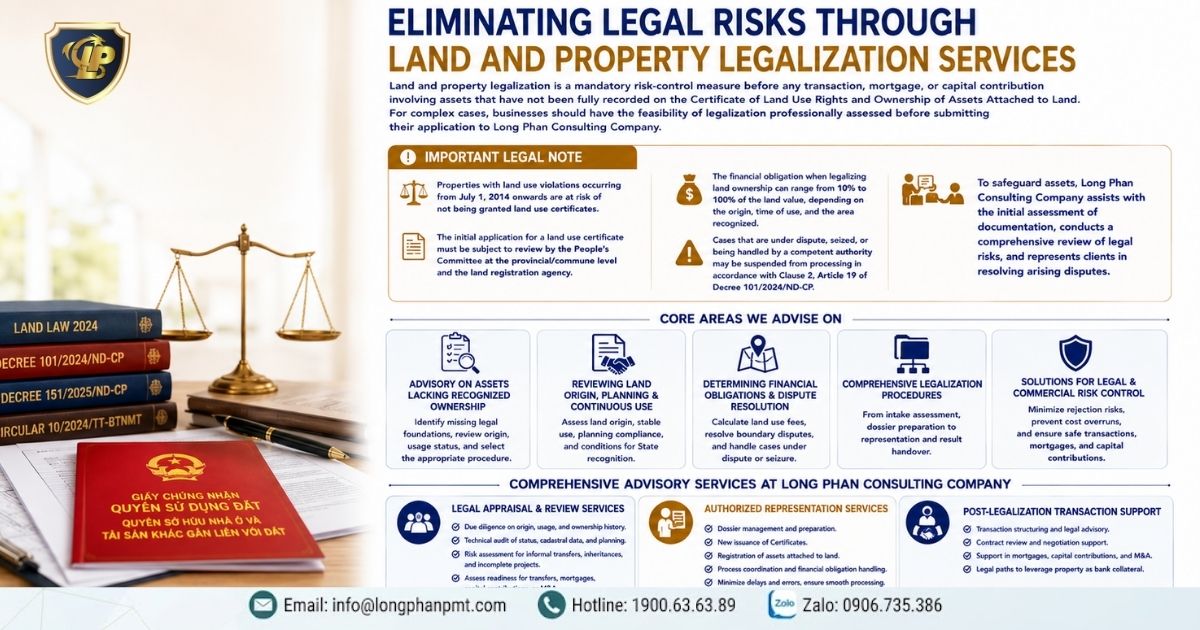
With the significant changes from the Land Law 2024, understanding legal regulations is critical. Long Phan Consulting Company provides comprehensive legal consulting and due diligence services for real estate projects. Our services include:
With the motto “Trust for Solutions,” Long Phan Consulting Company is committed to helping clients achieve legal compliance and optimize benefits in real estate transactions.
In 2025, transitional regulations will apply. According to Clause 1, Article 257 of the Land Law 2024, the land price lists issued under Land Law No. 45/2013/QH13 will remain in effect until December 31, 2025. Provincial People’s Committees can adjust these lists if necessary to match local conditions.
According to Point e, Clause 1, Article 160 of the Land Law 2024, the specific land price for compensation is determined using the valuation methods in Clause 5, Article 158 (comparison, income, surplus, coefficient). This ensures the price reflects actual market value based on the principles in Point a, Clause 1, Article 158. Therefore, the compensation price is a specific land price determined by market-based principles.
The deposit ensures the investor’s commitment to the auction. Clauses 3 and 4 of Article 125 of the Land Law 2024 require participants to meet the conditions of the Law on Property Auction. Referencing Article 39 of the Law on Property Auction 2016, the deposit amount is agreed upon by the auction organizer and the asset owner.
The main challenge is meeting the financial and experience requirements for auctions and bidding under Articles 125 and 126. The opportunity lies in increased transparency. The abolition of the price framework creates a fairer market where competent enterprises can access land without relying on personal connections.
It is not mandatory. Clause 3, Article 256 of the Land Law 2024 affirms that certificates issued before the law’s effective date remain legally valid. A new certificate is issued only upon request or when a transaction occurs.
The Land Law 2024 brings fundamental changes to land management, directly affecting land prices and the real estate market. The annual land price list and auction regulations will increase transparency but also raise investment costs. For expert legal advice on land matters, please contact Long Phan Consulting Company via hotline 1900 636389 for dedicated support.