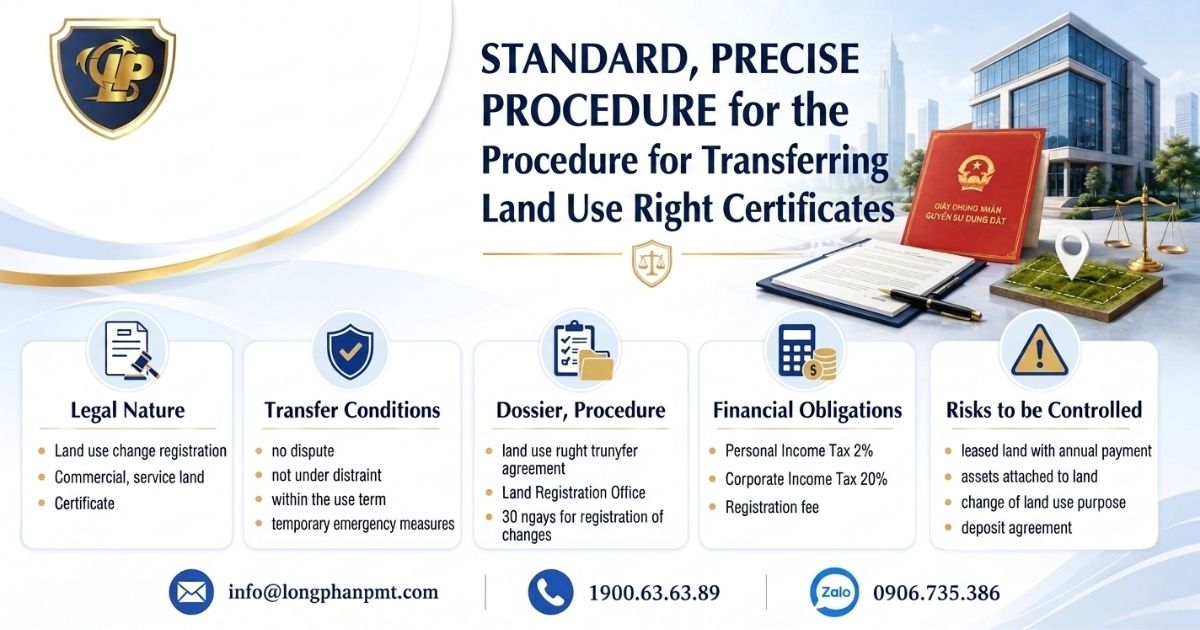

The transfer of assets attached to annually leased land is a common transaction for businesses that own factories or structures on State-leased land. This type of deal carries more binding conditions than transferring assets on land leased with a lump-sum payment. Unlike a lump-sum lessee, a party leasing land with annual rental payment does not hold full land-use rights, only rights over the assets on the land and the lease itself under the contract. Any sale must therefore meet conditions on both the asset and the seller, and follow the registration procedure under the current Law On Land. Long Phan Consulting sets out below the conditions, dossier, procedure, and legal risks involved in this transaction.
Legal Notes:
This transaction involves two distinct legal features: the nature of the underlying land-use right and the method chosen for transferring the asset. Both must be correctly identified before the parties proceed.
A party leasing land with annual rental payment does not hold the same full land-use right as a lessee who pays a lump sum for the entire lease term. It holds only ownership of the assets created on the land and the lease right under the still-effective contract. The obligation to pay annual land rent to the State continues to bind the transferee after the transaction, since the buyer keeps using the land under the signed lease contract. This is governed by Article 46 of the 2024 Land Law, which sets the conditions for selling assets attached to land and the lease right under a State land lease with annual rental payment.
Under Article 46 of the 2024 Land Law, a party leasing land with annual rental payment may transfer assets on the land in one of two ways:
Identifying the correct form from the outset helps the parties prepare the right dossier and avoid rejection when registering the change.
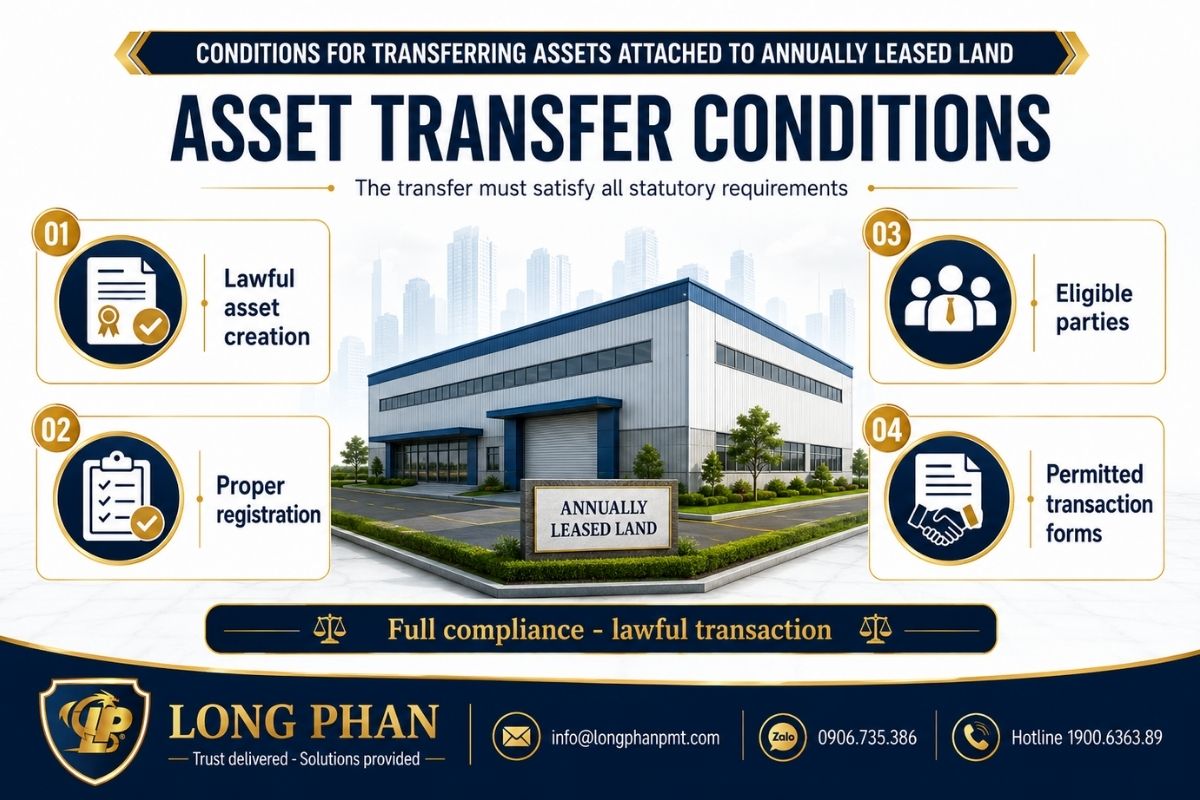
A business or individual seeking to sell assets on leased land must satisfy, at the same time, the conditions on the transferred assets and on the transferring party under Article 46 of the 2024 Land Law. Missing either condition risks rejection by the land registration authority, or may be treated as violating a statutory prohibition. This exposes the transaction to the risk of being declared invalid by a court under Article 123 of the 2015 Civil Code.
Assets attached to the leased land must be lawfully created and registered as required by law. Construction must also be completed in line with the approved detailed construction planning and the approved or accepted investment project. An exception applies where the transfer follows an effective court judgment or decision, an enforcement decision of a civil judgment enforcement agency, or a conclusion by a competent State inspection or examination authority. Legal basis: Point a and Point b, Clause 1, Article 46 of the 2024 Land Law.
Where the sale includes the transfer of the lease right under the land lease contract, the transferring party must also have advanced compensation, support, or resettlement funds. These funds must not yet have been fully offset against the payable land rent, under Point b, Clause 2, Article 46 of the 2024 Land Law.
Clause 1, Article 46 of the 2024 Land Law applies to economic organizations, individuals, overseas Vietnamese, and foreign-invested economic organizations currently leasing land with annual rental payment. Economic organizations and religious organizations, or their affiliates, that are leased land by the State with annual rental payment may sell assets they own that are attached to the land once they meet the corresponding conditions under Article 46, per Point c, Clause 1, Article 34 of the 2024 Land Law.
Where land is leased with annual rental payment for a project to build and operate infrastructure, the seller must also satisfy the conditions under Clause 1, Article 45 of the 2024 Land Law. The seller must also comply with the applicable requirements of the 2023 Law on Real Estate Business. Legal basis: Clause 5, Article 46 of the 2024 Land Law.
A public non-business unit leased land by the State with annual rental payment has no right to sell, mortgage, or contribute as capital the assets attached to the land or the lease right, unless it uses the land to build and operate industrial park or cluster infrastructure. Legal basis: Clause 2, Article 34 of the 2024 Land Law. This is an important point when dealing with a public non-business unit as seller, since the transaction may not be eligible to proceed at all.
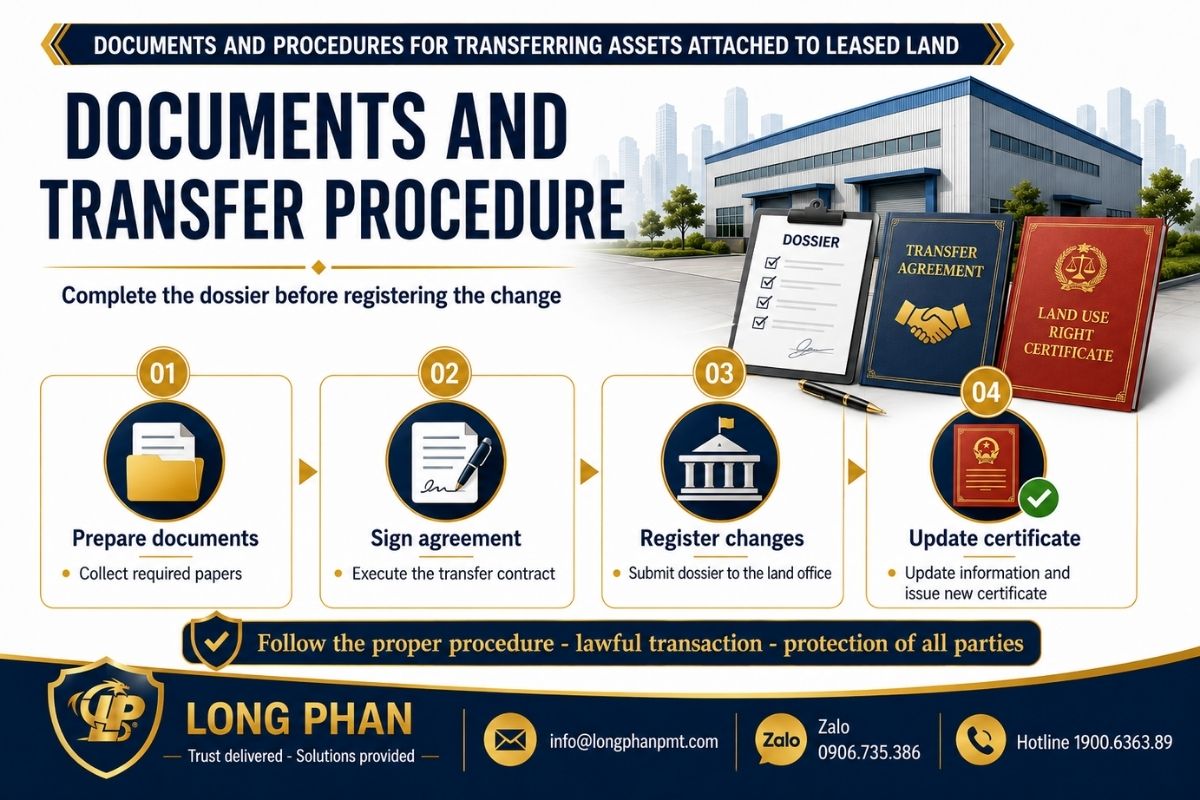
Once the parties confirm the transfer conditions are met, they must prepare the required dossier and register the change with the competent authority. This ensures the asset and the lease right are lawfully recorded for the transferee.
Legal basis for the registration dossier: Clause 1, Article 133 of the 2024 Land Law, and Article 29 of Decree 101/2024/ND-CP. Businesses should note that guiding documents implementing the 2024 Land Law have been amended since Decree 101/2024/ND-CP was issued. The specific dossier requirements should be verified against the documents in effect at the time of filing in each locality.
Legal basis: Clause 3, Article 46 of the 2024 Land Law governs the right to continue using the land and the transferee’s registration obligation. The registration procedure follows Article 37 of Decree 101/2024/ND-CP (the updated content should be verified against each locality’s current rules at the time of application). For example, in Ho Chi Minh City this is carried out under Sub-section VI, Section C, Part III of Appendix II issued together with Decision No. 44/2026/QD-UBND.
When only part of an asset attached to the land, being a construction work, is sold and that part meets the conditions for parcel splitting, the parties may carry out the parcel-splitting procedure. This allows the competent authority to issue a separate Certificate for the transferred portion. Legal basis: Clause 4, Article 46 of the 2024 Land Law.
Carrying out this transaction without carefully reviewing the conditions can expose both the seller and the buyer to significant legal consequences.
A transaction risks being declared invalid where assets are sold before construction is completed in line with the approved planning and investment project, or where the transferring party is not eligible to sell, for example a public non-business unit outside the exempted cases. This would violate the mandatory conditions under Clause 1 and Clause 2, Article 46, and Clause 2, Article 34 of the 2024 Land Law. Whether a specific transaction violates a statutory prohibition, and is therefore invalid under civil law, must be assessed case by case.
The transferee remains responsible for paying annual land rent to the State under the signed lease contract. In practice, if the transferring party still owes financial obligations to the State that are not clearly addressed in the transfer contract, disputes between the parties can easily arise. This can also create complications when the land authority confirms the change. A business receiving the transfer should require the seller to confirm its financial obligation status before signing the contract.
In practice, the auction of assets attached to annually leased land for civil judgment enforcement purposes must still be assessed against the conditions in Clause 1, Article 46 of the 2024 Land Law. This applies even though such a sale is exempted from the requirement to complete construction in line with the approved planning. The interpretation and application among enforcement agencies and auction organizations is not always fully consistent in certain cases, so auction participants should carefully verify the asset’s legal status before taking part.
Long Phan Consulting assists clients with legal matters involving the transfer of assets attached to annually leased land, including the following services:
Enterprises, clients, or investors seeking a preliminary assessment may send their documents via email at info@longphanpmt.com or Zalo/WhatsApp at +84 906 735 386.
Frequently Asked Questions on the transfer of assets attached to annually leased land address key issues businesses and investors should clarify before entering into a transaction. These include eligibility to sell assets, whether lease rights must also be transferred, the buyer’s continuing obligation to pay annual land rent, filing requirements, and restrictions on unfinished construction.
Yes, provided the assets and the transferring party meet the conditions under Clause 1, Article 46 of the 2024 Land Law: the assets are lawfully created, registered, and construction is completed in line with the approved planning and investment project. Where the sale includes the lease right, the additional conditions under Clause 2, Article 46 of the 2024 Land Law must also be met.
No. The land user may choose to sell only the assets attached to the land without transferring the lease right, or sell the assets together with the lease right under the land lease contract. Each option is subject to the separate conditions under Clause 1 and Clause 2, Article 46 of the 2024 Land Law.
In principle, no, except where the unit uses the land to build and operate industrial park or cluster infrastructure. Legal basis: Clause 2, Article 34 of the 2024 Land Law.
Yes. The transferee may continue using the land for its proper purpose for the remaining land-use term and must pay annual land rent under the signed lease contract, while also completing the land registration procedure. Legal basis: Clause 3, Article 46 of the 2024 Land Law.
The registration dossier for changes to land and assets attached to land is filed with the Land Registration Office or the competent receiving authority, under Article 133 of the 2024 Land Law and Decree 101/2024/ND-CP. Processing time depends on the locality and the type of asset, so applicants should contact the receiving authority or a consulting firm directly to confirm the current timeline.
In principle, no, except where the transfer is carried out under an effective court judgment or decision, an enforcement decision of a civil judgment enforcement agency, or a conclusion of a competent State inspection or examination authority. Legal basis: Point b, Clause 1, Article 46 of the 2024 Land Law.
The transfer of assets attached to annually leased land is subject to strict conditions on both the asset and the transferring party under current land law. It also requires strict compliance with the registration procedure for the asset to be lawfully recorded in the transferee’s name. Given the significant risk of contract invalidity and disputes over financial obligations if any condition is overlooked, businesses and individuals should carefully review the legal dossier before entering into the transaction. Long Phan Consulting stands ready to assess and carry out the procedure for each specific case; please contact hotline 1900636389 for consultation.
📚 This article has been professionally reviewed based on the following legal documents: