
Overseas Vietnamese buying project apartments in Vietnam demands precision regarding legal status and the asset ownership establishment process. Understanding current regulations helps clients optimize their rights, minimize dispute risks, and ensure safe investment cash flows. Long Phan Consulting Company provides a comprehensive legal solution system for clients to execute successful real estate transactions.

To better understand the concept of Overseas Vietnamese buying project apartments, buyers must grasp crucial considerations when participating in real estate project transactions to limit risks and make appropriate decisions. Essentially, this involves signing a sale contract with a developer to own an apartment within a project that has been planned and constructed for specific purposes, such as commercial housing, social housing, or an urban area.
Compared to buying individual (usually existing) houses, Overseas Vietnamese buying project apartments involves specific legal characteristics and procedures. Under Article 3 of the 2023 Law on Real Estate Business, this type includes both existing housing and off-plan housing. Off-plan housing is understood as housing currently under construction investment and not yet accepted for use.
The Nature of Buying a Project Apartment
>>>See more: Investing in Project Land: A Guide
When analyzing the pros and cons of two types of project apartments, buyers must particularly focus on legal and practical considerations to choose a format suited to their needs and financial capacity. Generally, project apartments are divided into two main groups: unformed projects (off-plan) and completed projects.
For this format, buyers must pay special attention to factors like legality, deployment progress, and construction quality to limit arising risks. This is viewed as a new real estate investment trend in a volatile market, attracting increasing interest due to its standout advantages over traditional house-buying methods.
Pros
The most prominent advantage is that the price is usually significantly lower than other types. This is considered an opportune time to own an apartment at a price closest to its actual market value. Furthermore, owners can proactively control their financial capacity via a payment schedule predefined in the agreement with the developer. Discount policies, incentives, and loan support from affiliated banks are critical factors to consider and vary by developer.
For instance, when buying Vinhomes apartments, buyers can access distinct preferential policies through a partnership with Techcombank. A significant advantage is the opportunity for early selection of apartments with the most suitable area, feng shui direction, design, and location, while reducing competitive pressure compared to when the project is completed.
Cons
A notable limitation is the risk arising during completion and handover, especially if the developer lacks experience or fails to guarantee management and construction capacity.
For completed project apartments, physical inspection of the work must be conducted alongside reviewing crucial legal factors to ensure rights and limit future disputes. These are fully finished works ready for use without waiting for construction.
Pros
A standout advantage is significant time savings; owners can move in immediately without waiting through a prolonged construction process. Buyers also avoid anxiety regarding construction progress or the developer’s deployment capacity. Before deciding, prospective owners can directly reference and experience the internal and external amenities of the urban area they wish to buy into, leading to better choices.
Cons
Buyers are usually restricted in altering the apartment’s structure, design, or feng shui elements. If renovation is desired, the process is not only time-consuming and labor-intensive but requires complex permission procedures from the building management board. Additionally, ownership costs are usually significantly higher than off-plan projects.
>>>See more: Real Estate Brokers Assisting Overseas Vietnamese in Checking Projects
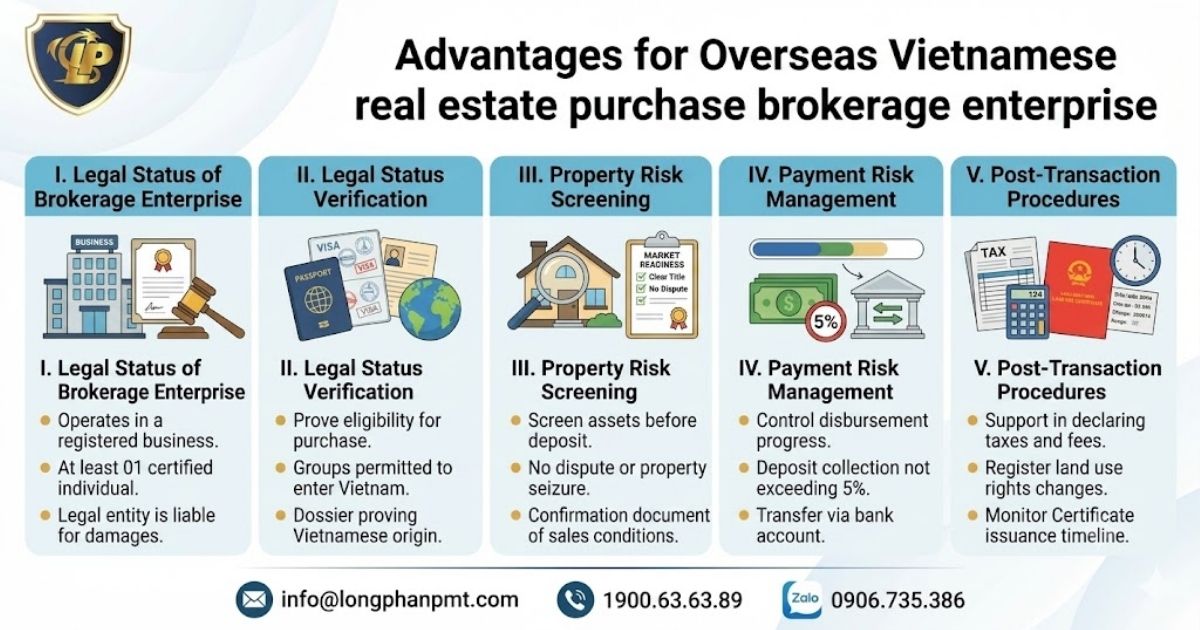
In the context of overseas Vietnamese purchasing apartments in development projects, legal verification is considered a crucial stage in any real estate transaction, whether it’s an apartment or land plot. A thorough legal review process will help you identify and eliminate potential risks, while ensuring legal ownership and the value of the property after the transaction is completed. The following verification steps are considered basic requirements and can be applied to most types of real estate.
In the process of overseas Vietnamese purchasing apartments in a project, the first step is to verify the seller by requesting the original ID card/Citizen Identification Card to compare with the information on the Land Use Right Certificate. Simultaneously, it is necessary to clarify the marital status of the seller; if the property is jointly owned by a married couple, the transfer contract must have the full signatures of all co-owners or be accompanied by a valid power of attorney as prescribed by law.
When overseas Vietnamese purchase apartments in a project, the next step is to carefully compare the information on the Land Use Right Certificate with the actual situation. The details to check include the plot number, map sheet number, area, land use purpose, and duration of use. For apartment buildings, it is especially important to clearly identify the privately owned area and the common areas to avoid future disputes.
Specifically, according to Article 45 Land Law 2024 A property is only eligible for transfer if it meets the following conditions:
When overseas Vietnamese purchase apartments in a project, a crucial step that cannot be overlooked is checking the zoning and land use plan. You can use the local zoning portal to check if the property is zoned for public works, parks, or roads. It’s also advisable to save a screenshot of the search results along with the date of the search for future reference.
In parallel with the above steps, during the process of overseas Vietnamese purchasing apartments in a project, customers need to check for “hidden” legal statuses such as mortgages, internal disputes, or other transfer restrictions. This can be done by submitting a request for information or sending a written request to the land data management agency as stipulated in Part VI, Appendix I of Decree 151/2025/ND-CP. The document confirming the latest legal status and changes provided by the Land Registration Office will be an important basis for assessing the legality of the property.
Furthermore, verifying outstanding financial obligations such as non-agricultural land use tax and maintenance fees (for apartments) is also crucial. Customers should request the seller to provide payment receipts or reconciliation statements for verification. Finally, all transactions must be conducted through notarized contracts and registered with the competent authority to ensure the highest legal validity and avoid risky methods such as handwritten agreements or informal declarations.
>>>See more: Considerations When Buying Houses in Real Estate Projects
For fully constructed apartments, legal checks must expand beyond the Certificate of Land Use Rights to dossiers related to construction quality and building management/operation.
Completion Dossier (Hồ sơ hoàn công): Request the developer/seller to provide the completion dossier, the acceptance minute for putting the work into use, and specifically, the fire prevention and fighting acceptance minute. These prove the work was built according to the permit and is safe.
Handover Minute and Area: Cross-reference the handover minute between the developer and the old owner, checking the actual usable area against the sale contract to see if there are significant discrepancies.
Equipment and Warranty: Check the inventory and condition of handed-over equipment and request warranty documents. Under Article 129 of the 2023 Housing Law, the minimum warranty period for an apartment building is 60 months from completion acceptance. Clarify the procedure for transferring warranty obligations to the new owner.
The 2% Maintenance Fund: Require the seller to provide receipts confirming full payment of this fee to the developer. Understand the Building Management Board’s activities, reviewing operating regulations and financial reports on fund usage. Article 152 of the 2023 Housing Law tightens the management of this 2% fund.
Operating Costs: Monthly fees (management, parking) and regulations on parking spot usage and common amenities (pools, gyms) must be clarified in the minute or contract appendix.
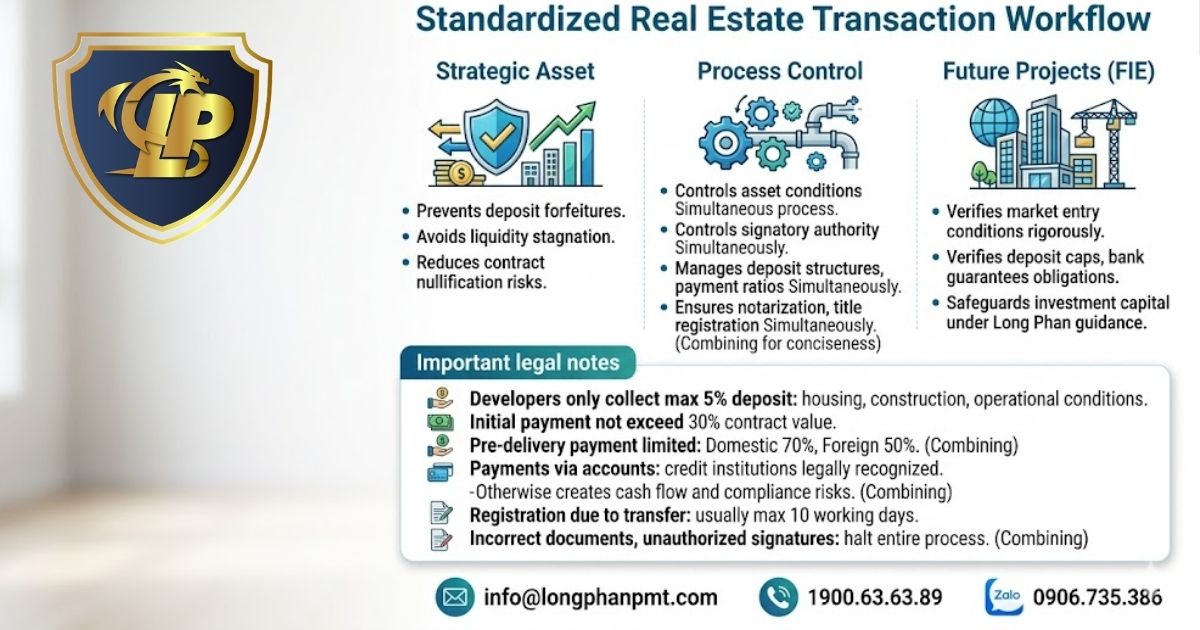
Statutory Payment Progress: Under Article 25 of the 2023 Law on Real Estate Business, the developer is NOT permitted to collect more than 95% of the contract value when the buyer has not yet been issued the Certificate. The remaining 5% is only paid after the competent state agency issues the certificate to the buyer.
In practice, overseas Vietnamese buying apartments in projects often face more risks than transactions involving apartments under construction compared to existing apartments. Therefore, the law has strict regulations to protect buyers. Consequently, you need to carefully assess the developer’s capabilities and fully verify the project’s legal status before making a deposit.
According to Article 24 of the 2023 Law on Real Estate Business, a project is only eligible to sell housing units under construction when it simultaneously meets several conditions, including:
Specifically, before selling or leasing future-built housing, the project investor must notify the Department of Construction in writing that the housing meets the conditions for sale or lease. Within 15 days from the date of receiving the notification along with the dossier, the Department of Construction is responsible for responding in writing to the investor regarding whether the housing meets the conditions for sale. If it does not meet the conditions for sale or lease, the reasons must be clearly stated (Clause 4, Article 24 of the 2023 Law on Real Estate Business, Article 8 of Circular 04/2024/TT-BXD, Clause 1, Article 26 of Decree 144/2025/NĐ-CP).
Financially, Articles 23 and 25 of the 2023 Law on Real Estate Business clearly stipulate the payment terms. The investor is only allowed to receive a maximum deposit of 5% of the selling price when the project meets the business conditions. Payments are made in installments: the first payment (including the deposit) must not exceed 30% of the contract value, and subsequent payments must be in accordance with the construction progress, but:
Another crucial factor in the process of overseas Vietnamese purchasing apartments in real estate projects is the developer’s obligation to provide a bank guarantee. According to regulations, before launching sales, the developer must obtain approval from a commercial bank to guarantee its financial obligations. When signing the contract, buyers have the right to request or reject this guarantee depending on their desired level of security. Furthermore, according to Article 48 of the 2023 Law on Real Estate Business, all payments from customers to the developer must be made through a bank account to ensure transparency and control over cash flow.

In the context of overseas Vietnamese buying apartments in projects, understanding project land plots is also essential because this is a popular type of investment but is subject to strict legal regulations, especially after the Law on Real Estate Business 2023 came into effect.
According to Article 31 of this law, developers are not allowed to transfer land use rights to individuals for self-construction of houses in areas classified as special, type I, II, and III urban areas (wards, districts, cities). For other areas, the Provincial People’s Committee will specify where land subdivision and sale is permitted. Therefore, you should request the developer to provide a confirmation document from the Provincial People’s Committee stating that the project meets the transfer requirements. This is a crucial legal basis to ensure the transaction is conducted in accordance with regulations and to minimize risks.
When overseas Vietnamese purchase apartments in a project, in addition to legal aspects, the project must also fully meet the requirements regarding technical infrastructure. Specifically, the investor needs to complete the infrastructure system according to the detailed plan, such as roads, water supply and drainage, electricity supply, and ensure synchronous connection with the general infrastructure of the area. At the same time, the project must have a handover certificate confirming the completion of the technical infrastructure construction in accordance with regulations.
Similar to future housing projects, the developer must also notify the Department of Construction in writing that the infrastructure is ready for sale or lease and receive written approval. Another element that needs clarification in the contract is the regulations regarding construction after receiving the land plot, such as the mandatory deadline for building the house, standards for house models and architectural design (if any), and penalties for delays in construction by the buyer. In Ho Chi Minh City, in addition to general regulations, customers should refer to Decision 100/2024/QD-UBND (replacing Decision 60/2017/QD-UBND) regarding the minimum conditions/area for land subdivision; and check any new guidelines (if any) before the transaction.
>>>See more: When to Use Real Estate Brokers for a Project to Increase Sales Efficiency
Unlike project land, transacting individual land (transferred by individuals/households) carries distinct characteristics requiring special attention to verify origins, current use, and planning conformity.
Land Use Purpose: Check the Certificate to ensure the purpose is “residential land” (đất ở). Absolutely avoid buying agricultural land, perennial crop land, or commercial/service land based on promises of future conversion, as this is highly risky.
Land Use Term and Splitting Conditions: Ensure the land use term is valid. If buying a portion of a larger plot, ensure the separated part meets minimum area and parcel splitting conditions per provincial regulations.
Field Cross-Referencing: Request an independent measurement unit to determine exact real-life boundaries and compare them with the cadastral map on the Certificate to detect shape/area discrepancies or encroachment.
Planning Boundaries and Access: Clearly identify alley/road planning boundaries (lộ giới) and construction protection corridors (power lines, drainage) to know which areas cannot have permanent structures built on them. If the plot lacks direct access to a public road, check the legality of the shared pathway.
Existing Structures: If there is a house/work on the land, demand the construction permit and completion dossier to ensure it was built lawfully.
After legal checks, the contract signing and payment phase demands extreme caution.
Payment: Do NOT hand over cash or transfer funds to a third party like a broker or trading floor. All payments must go directly into the exact bank account named after the seller (developer or individual on the Certificate). The transfer memo must be clear (e.g., “Payment for apartment [code] under Contract No. [number], installment [number]”). For transactions with developers, bank payments are MANDATORY (Article 48, 2023 Law on Real Estate Business).
Contract: All transfer contracts must be written and notarized/authenticated (with specific exceptions under Land and Housing laws). The contract must detail parties, asset info, price, and payment terms. Attach necessary appendices like floor plans and handover equipment lists.
Taxes and Fees: After notarization, parties declare and pay taxes (Personal Income Tax, Registration Fee, appraisal fees). Retain all receipts.
Title Transfer Registration: Submit the dossier at the land registration agency to execute the change registration procedure. Upon completion, you receive a new Certificate in your name, officially establishing lawful ownership.
Long Phan Consulting Company accompanies clients throughout the real estate transaction process in Vietnam. Our expert team executes the following in-depth tasks. We structure our professional support into the following key area:

Below, Long Phan Consulting Company provides some frequently asked questions related to overseas Vietnamese purchasing apartments in projects. We invite interested customers to refer to this information:
According to Article 45 of the 2024 Land Law, real estate can only be transferred when there is no dispute. Therefore, if the property is under dispute, the sale will not be legally recognized. If the transaction is attempted, the buyer may lose ownership or become embroiled in complex legal disputes. To ensure safety, you should carefully check the legal status of the property before signing a contract. This is a crucial step to avoid financial losses and legal risks in the future.
When buying an apartment under construction, buyers need to pay special attention to the developer’s bank guarantee. According to Article 26 of the 2023 Law on Real Estate Business, developers are only allowed to sell when they have a commercial bank guaranteeing their financial obligations. Buyers have the right to request the developer to provide the guarantee document to verify the project’s legality. This guarantee is the bank’s commitment to refund the deposit and other payments made if the developer fails to deliver the property on schedule. This ensures the buyer’s rights are protected and the transaction is more transparent.
According to Article 164 of the 2023 Housing Law, a housing purchase and sale contract must be in writing and notarized or certified. Notarization is a mandatory procedure to ensure the contract is legally valid and recognized by law. This is also an important basis for the parties to carry out the procedure of transferring ownership of the house. In addition, notarization helps prevent disputes and protect the legitimate rights and interests of both the buyer and the seller. However, some special cases stipulated by law may be exempt from notarization or certification.
Paying for real estate in cash is not recommended due to potential risks to security and transparency. To ensure your rights and easily prove the transaction, you should make payments through a bank. Bank transfers help control cash flow, minimize disputes, and provide clear legal grounds in case of problems. Especially for transactions involving the purchase of future-built housing from developers, the law mandates that all payments must be made through a bank, as per Article 48 of the 2023 Law on Real Estate Business. Therefore, choosing to pay through a bank is always the safest and most legal option.
When buying a completed apartment, checking the completion documents is a crucial step that buyers should not overlook. Buyers should request that the developer or seller provide complete completion documents along with the building acceptance certificate. These documents prove that the construction was carried out according to design and meets all legal requirements for handover. Particular attention should be paid to the fire safety acceptance certificate, as this is essential for ensuring the safety of lives and property. Thoroughly checking the completion documents will help buyers avoid legal risks and protect their legitimate rights.
The Housing Law of 2023 and the Land Law of 2024 officially recognize overseas Vietnamese as having the right to own houses attached to land use rights, with full rights to transfer, inherit, and lease them, just like domestic citizens. This means that overseas Vietnamese can directly register their names on the land title certificate (red book) without needing to go through relatives in Vietnam as before.
Conversely, foreigners (individuals without Vietnamese citizenship) are only permitted to own housing in commercial housing development projects, specifically apartments or detached houses (shophouses, villas), based on actual shophouse purchase experience from buyers. They are not allowed to own land use rights and are not permitted to purchase housing in defense or security areas.
The primary legal basis is Article 20 of the 2023 Housing Law and its implementing regulations. This clear distinction helps each entity determine the appropriate investment scope, avoiding unnecessary legal risks.
Preparing a transparent legal dossier and choosing a safe transaction structure is the key to successfully buying a project apartment in the homeland. Clients should leverage the open regulations from the 2024 Land Law to establish direct ownership, ensuring asset sustainability. To receive in-depth support regarding lawful real estate ownership strategies, please contact Long Phan Consulting Company immediately via Hotline 1900636389 for direct expert support.