The real estate deposit procedure for overseas Vietnamese acquiring property in Vietnam is a pivotal step. It secures legal rights and obligations for the transaction. A proper deposit provides peace of mind for overseas Vietnamese buyers. To execute this process safely and effectively, clients must understand the legal regulations and key considerations. This article provides a detailed guide to the property deposit process for overseas Vietnamese.
Current real estate deposit procedures for overseas Vietnamese
Eligibility Verification for Overseas Vietnamese Buyers
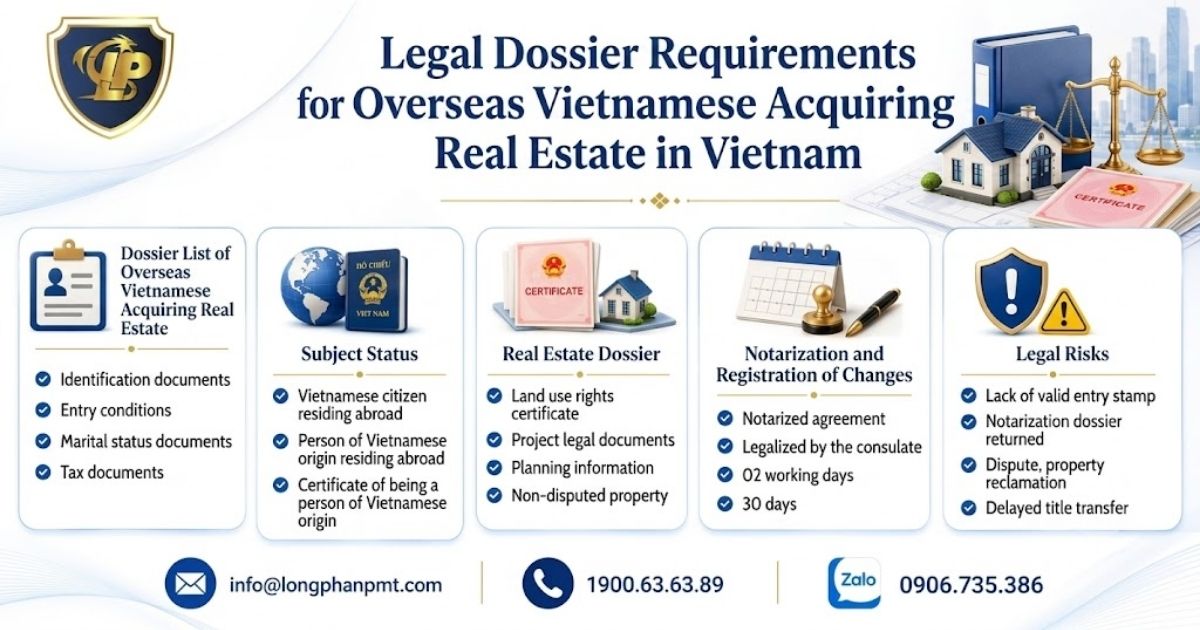
Before initiating a real estate deposit in Vietnam, the first and most critical step is to verify legal eligibility for property ownership. This ensures the transaction is lawful and avoids future complications. The current legal framework, particularly the Land Law 2024 and the Law on Housing 2023, clearly defines the subjects and conditions for property ownership by overseas Vietnamese.
Under current law, overseas Vietnamese can own housing and land use rights in Vietnam if they fall into one of the following categories:
Vietnamese citizens residing abroad: This is the most common case for individuals who retain their Vietnamese citizenship. With Vietnamese nationality, you have the same land-related rights and obligations as domestic citizens. This is specified in Clause 3, Article 4 of the Land Law 2024.
People of Vietnamese origin residing abroad without Vietnamese citizenship: This case is more complex. According to Clause 2, Article 8 of the Law on Housing 2023 and Article 28 of the Land Law 2024, individuals of Vietnamese origin who are permitted to enter Vietnam have the right to own houses attached to land use rights. They can purchase, lease-purchase housing in residential development projects; inherit land use rights; and receive gifted housing attached to land use rights from legal heirs. To prove this status, a Certificate of Vietnamese Origin issued by a competent Vietnamese authority and valid entry documents (visa or temporary residence card) are required.
Thoroughly checking your legal status before making a real-estate deposit in Vietnam helps avoid legal risks. We recommend consulting a lawyer or legal expert to confirm your eligibility.
Legal Due Diligence of the Property Before Deposit
A meticulous inspection of the property’s legal status is an indispensable step before making a real estate deposit in Vietnam. This protects your deposit and ensures a secure transaction. A solid deposit agreement must be based on accurate information about the asset and its owner.
Verify the Deposit Recipient’s Authority
Confirming the identity of the deposit recipient is paramount. You must ensure the person receiving the deposit is the legal owner or has a valid power of attorney.
If the recipient is the owner: Check their personal identification (ID card/CCCD) and compare it with the information on the Certificate of Land Use Rights and Ownership of Housing and Other Assets Attached to Land (LURC, also known as Red/Pink Book).
If the recipient is an authorized representative: Demand the original, notarized power of attorney. This document must explicitly grant the right to receive a deposit and conduct related real estate transactions. Verifying the scope of authorization is crucial.
Note the seller’s marital status: According to the Civil Code 2015 and Article 33 of the Law on Marriage and Family 2014, assets acquired during marriage are considered joint property. If the seller is married, you must require both spouses to sign the deposit agreement or obtain a legally valid written consent (notarized or certified) for the sale. This prevents future ownership disputes.
Accuracy of Information on the Original Certificate (LURC)
Carefully inspect the original LURC. You must verify the following details:
Owner Information: The name and ID number must match the seller’s identification.
Property Details: The address, plot number, map number, area, and land use purpose must match the physical property and your requirements.
Certificate Condition: Ensure the LURC is the original document, free from erasures or modifications.
Check for Mortgages, Encumbrances, and Disputes
Before committing to a deposit, you must verify the property is free from encumbrances.
Mortgage Status: A mortgage means the property is used as collateral for a loan. This restricts the owner’s right to dispose of the asset.
Request information from the seller: If the property is mortgaged, ask for a bank statement confirming the outstanding debt. The seller must commit in the deposit agreement to clear the mortgage before the transfer contract is notarized.
Independent verification: You can request an official extract of the property’s legal status, including mortgage information, from the local Land Registration Office. This is the most reliable verification method.
Dispute Status: Disputes involve conflicts over ownership or other rights related to the property. Purchasing a disputed property can entangle you in prolonged litigation.
Inquire with local authorities: Contact the cadastral official at the commune/ward People’s Committee (UBND) to ask about any known disputes or planning issues.
Obtain a written commitment: The deposit agreement must include a clause where the seller warrants the property is free from all disputes and accepts liability. This clause is your legal basis for claims if a dispute is discovered later.
Zoning and Planning Information
Checking zoning information is essential. The goal is to understand the property’s current legal status and future development plans to avoid risks of land acquisition or usage restrictions.
Methods to Check Planning Information:
At the Commune/Ward UBND: Request planning information or maps for the relevant land plot.
At the District Office of Natural Resources and Environment: Request an extract of the zoning map or land use plans.
Online Portals: Some localities provide online planning portals, such as the Ho Chi Minh City Planning Information Portal.
How to check land planning
Formalizing the Real Estate Deposit in Vietnam
For a real estate deposit in Vietnam, establishing a written agreement is a prerequisite for legal validity. While the Civil Code 2015 does not mandate notarization for deposit agreements, it is strongly recommended to enhance legal force.
A comprehensive Deposit Agreement should contain the following:
Party Information: Full name, ID/Passport number, and address of the depositor (Buyer) and the recipient (Seller).
Property Details: Property type, specific address, and all information from the LURC (certificate number, issuance date, plot number, area, use purpose, etc.).
Deposit Amount and Payment Method: Specify the deposit sum (in numbers and words), currency, and payment method (cash or bank transfer with account details).
Purpose of Deposit: Clearly state the deposit is to secure the future execution of the property transfer contract.
Purchase Price and Payment Schedule: State the total transfer price and the schedule for remaining payments.
Rights and Obligations of Parties: Detail the rights (e.g., demand documents, claim compensation) and obligations (e.g., timely payment, tax duties) for both buyer and seller.
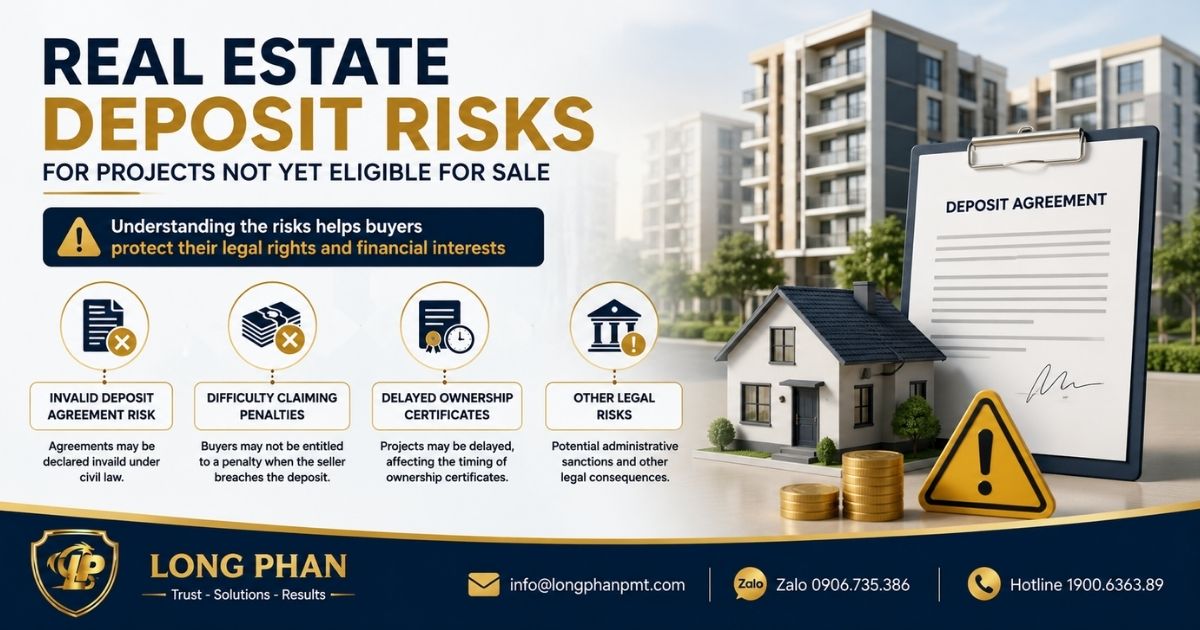
Breach of Contract Penalties:
If the buyer (depositor) refuses to proceed, they forfeit the deposit.
If the seller (recipient) refuses to proceed, they must return the deposit and pay a penalty (often a multiple of the deposit amount).
Dispute Resolution: Outline the method for resolving disputes, starting with negotiation and mediation, followed by resolution at a competent court.
Other Commitments: Include warranties that the property is free of disputes and encumbrances, and specify responsibilities for taxes and fees.
Note: Although not mandatory under law (Land Law 2024, Law on Housing 2023, Civil Code 2015, Law on Notarization 2014), notarizing or certifying the deposit agreement is highly advisable. A notary or competent official will verify the contract’s legality and the parties’ identities, minimizing legal risks.
The role of notarization of real estate deposit contracts
Payment of the Property Deposit
Payment is a critical part of the real estate deposit in Vietnam. To ensure financial security and clear proof of transaction, payment must be transparent.
Cash Payment: If paying in cash, a signed receipt is mandatory. The receipt should detail the amount, party information, property address, purpose of payment, time, date, and signatures of both parties. The signature of an objective witness is recommended.
Bank Transfer: This is the preferred method due to its transparency and clear record. The transfer description must be specific: “Deposit for property at [address]” from [Buyer’s Name] to [Seller’s Name]. Retain all bank statements and receipts as irrefutable proof of payment.
Legal Validity of the Deposit Agreement
The legality of the deposit agreement is crucial for a secure transaction.
First, ensure complete contract content: A detailed agreement with all core clauses is essential for legal validity.
Second, consider notarization or certification: This step enhances the legal value of the agreement, making it a strong piece of evidence.
Third, involve a witness: If not notarized, a witness (who is not a relative) provides an additional layer of validation.
Adhering to these legal points will secure your real estate deposit in Vietnam and protect your assets.
Expert Consulting Services on Real estate deposit procedure for overseas Vietnamese
Long Phan Consulting Company offers specialized services for the real estate deposit in Vietnam for overseas Vietnamese clients. Our experienced team provides comprehensive and secure solutions.
Our Core Services:
Legal Eligibility Assessment: We verify if your status (Vietnamese citizen or person of Vietnamese origin) meets the legal requirements for property ownership.
Property Due Diligence: We conduct in-depth checks on the property’s legal status, including ownership, marital status, LURC verification, encumbrances, and zoning.
Deposit Agreement Drafting: We draft detailed deposit agreements that protect your rights and comply with all relevant laws.
Secure Payment Guidance: We advise on secure payment methods to ensure you have complete legal proof of your real estate deposit in Vietnam.
Notarization/Certification Consulting: We provide advice on the benefits of notarizing your deposit agreement to enhance its legal standing.
Dispute Resolution Support: We offer legal assistance in the event of disputes arising from the deposit agreement.
We are committed to guiding you through every step, ensuring a safe, transparent, and effective process.
Frequently Asked Questions
What types of property can overseas Vietnamese buy in Vietnam?
Overseas Vietnamese (both citizens and those of Vietnamese origin) can purchase and own residential properties (apartments, individual houses) attached to residential land use rights. For other land types like agricultural or commercial land, ownership is generally restricted, but leasing is an option.
How do I prove my Vietnamese origin if I no longer have citizenship?
You need a Certificate of Vietnamese Origin issued by a Vietnamese representative office abroad (Embassy/Consulate) or a provincial Department of Justice in Vietnam. This must be accompanied by valid entry documents.
Must I return to Vietnam to sign the deposit agreement?
No. You can issue a power of attorney to a relative, friend, or law firm in Vietnam. The power of attorney must be notarized/certified abroad (typically at a Vietnamese Embassy/Consulate) or undergo consular legalization and Vietnamese translation.
Is notarization of the deposit agreement mandatory?
It is not mandatory by law. However, notarization or certification (at a commune-level UBND) is strongly recommended to guarantee legal validity, evidentiary value, and reduce future dispute risks.
What is the typical deposit amount?
There is no fixed rule; it is subject to negotiation. It commonly ranges from 5% to 10% of the total purchase price.
What if I discover a property dispute after making a deposit?
If the deposit agreement includes a warranty of a dispute-free title, you have the right to demand a full refund of your deposit plus compensation as stipulated in the contract. If negotiation fails, you can file a lawsuit.
Conclusion
The procedure for a real estate deposit in Vietnam for overseas Vietnamese requires diligence and a deep understanding of the law. From verifying ownership eligibility and property status to drafting a robust contract, every step is critical. For professional guidance, contact Long Phan Consulting Company at our hotline: 1900 636389 to receive comprehensive support and protect your interests.
Facebook
Linkedin
Twitter
Pinterest
Phan Mạnh Thăng
Mr. Phan Manh Thang, CEO, is the founder of Long Phan Investment Consulting and Legal Services Company Limited. With over 13 years of experience in the fields of land and corporate law, CEO Phan Manh Thang has been advising and partnering with numerous clients throughout their business operations and enterprise expansion. Concurrently, he serves as the Managing Lawyer of Long Phan PMT Law Firm, established in 2019.
His specialized expertise and practical experience have consistently earned him the trust and high regard of his clients.