Land Subdivision and Parceling Services help prevent application rejection, delayed transfers, administrative sanctions, and financial exposure arising from non-compliant land division activities in Vietnam. Under the Law On Land, investors must carefully verify Land Use Right Certificates, minimum parcel size rules, planning conditions, access requirements, and technical infrastructure standards before proceeding. Foreign investors also face the risk of having a private subdivision reclassified as an unauthorized real estate project or plot-based sale.
Long Phan Consulting assists clients in assessing land status, structuring compliant subdivision plans, preparing technical dossiers, and controlling regulatory risks throughout the transaction process.
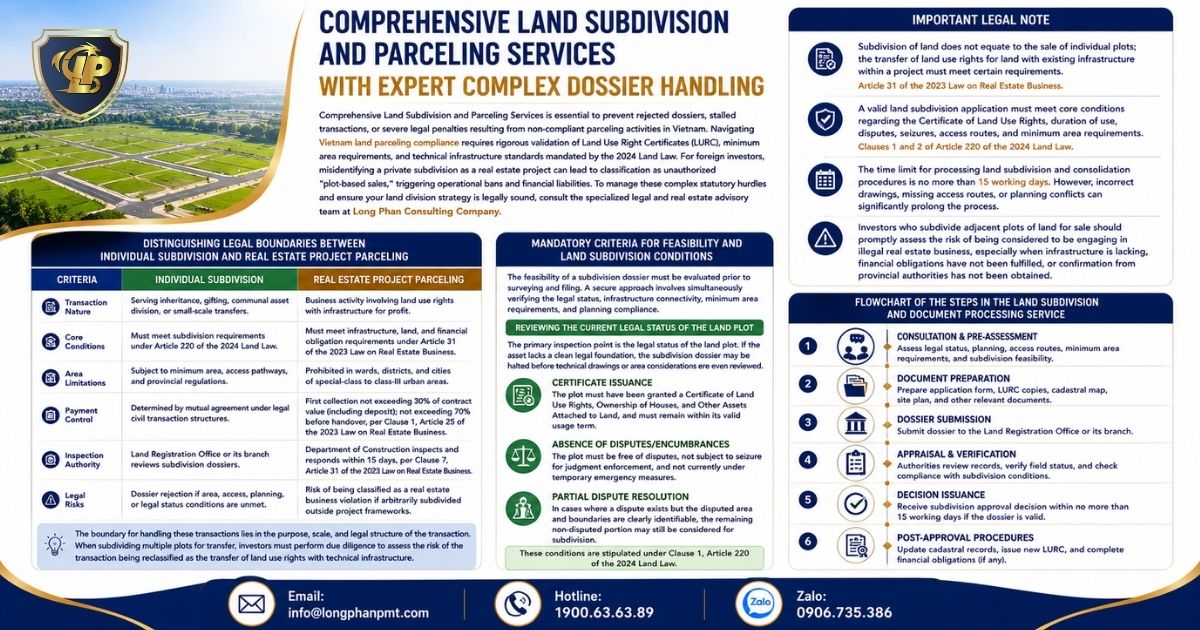
Key legal notes:
Investors should not assume that subdividing multiple adjacent plots for sale is a risk-free civil transaction. If the primary objective constitutes the business of land use rights with infrastructure for profit, the transaction may be subject to the strict regulatory framework governing real estate business.
The 2023 Law on Real Estate Business defines the transfer of land use rights with technical infrastructure within a project to individuals for self-construction of housing as a form of “plot-based sale”. This interpretation is codified under Point a, Clause 1, Article 28 of the Law on Real Estate Business 2023.
| Criteria | Individual Subdivision | Real Estate Project Parceling |
| Transaction Nature | Serving inheritance, gifting, communal asset division, or small-scale transfers. | Business activity involving land use rights with infrastructure for profit. |
| Core Conditions | Must meet subdivision requirements under Article 220 of the Law on Land 2024. | Must meet infrastructure, land, and financial obligation requirements under Article 31 of the 2023 Law on Real Estate Business. |
| Area Limitations | Subject to minimum area, access pathways, and provincial regulations. | Prohibited in wards, districts, and cities of special-class to class-III urban areas. |
| Payment Control | Determined by mutual agreement under legal civil transaction structures. | First collection not exceeding 30% of contract value (including deposit); not exceeding 70% before handover, per Clause 1, Article 25 of the 2023 Law on Real Estate Business. |
| Inspection Authority | Land Registration Office or its branch reviews subdivision dossiers. | Department of Construction inspects and responds within 15 days, per Clause 7, Article 31 of the 2023 Law on Real Estate Business. |
| Legal Risks | Dossier rejection if area, access, planning, or legal status conditions are unmet. | Risk of being classified as a real estate business violation if arbitrarily subdivided outside project frameworks. |
The boundary for handling these transactions lies in the purpose, scale, and legal structure of the transaction. When subdividing multiple plots for transfer, investors must perform due diligence to assess the risk of the transaction being reclassified as the transfer of land use rights with technical infrastructure.
The feasibility of a subdivision dossier must be evaluated prior to surveying and filing. A secure approach involves simultaneously verifying the legal status, infrastructure connectivity, minimum area requirements, and planning compliance.
Since August 1, 2024, the new legal framework on land requires stricter scrutiny of the current status of land use. Dossiers that fail to meet these requirements from the outset will incur unnecessary survey costs, time-consuming explanation periods, and risks of stalled transactions.
The primary inspection point is the legal status of the land plot. If the asset lacks a clean legal foundation, the subdivision dossier may be halted before technical drawings or area considerations are even reviewed.
Conditions requiring review include:
These conditions are stipulated under Clause 1, Article 220 of the Law on Land 2024. Accordingly, enterprises and investors should verify the status of freezes, seizures, or disputes before signing commitments to transfer any portion of a land plot.
Once legal conditions are satisfied, the dossier must demonstrate that the newly formed plots are capable of independent utilization. The most common risks involve insufficient access pathways, failure to meet minimum area requirements, or non-compliance with land use planning.
Indicators to verify include:
Requirements concerning access pathways, infrastructure, and minimum area are codified in Clauses 1 and 2, Article 220 of the Law on Land 2024. Additionally, transfers involving changes in land use purposes must be further verified under Articles 121 and 122 of the Law on Land 2024.
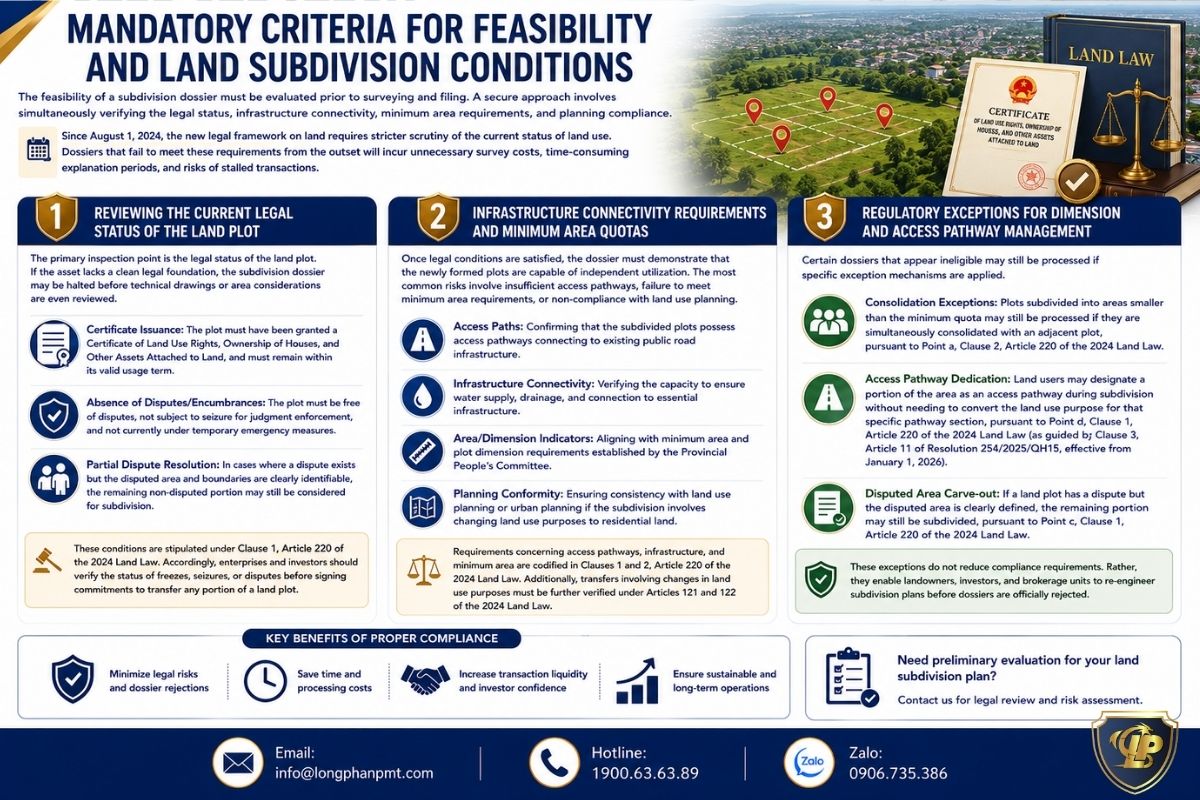
Certain dossiers that appear ineligible may still be processed if specific exception mechanisms are applied. This ability to distinguish between mechanical filing and strategic legal appraisal is what separates standard submissions from successful, optimized outcomes.
Relevant mechanisms for consideration include:
These exceptions do not reduce compliance requirements. Rather, they enable landowners, investors, and brokerage units to re-engineer subdivision plans before dossiers are officially rejected.
Subdivision dossiers must be standardized prior to submission, as form errors or missing technical documentation can significantly prolong transaction timelines. Competent reception authority lies with the “One-Stop” Department, the Land Registration Office, or its branches, in accordance with the spirit of Decree No. 151/2025/NĐ-CP regarding local administrative authority, decentralization, and delegation in the land sector.
Dossiers should be reviewed against these document groups:
Regarding form transitions, old-model Certificate templates are only permitted for use until December 31, 2024, pursuant to Clause 1, Article 44 of Circular No. 10/2024/TT-BTNMT. The administrative form system must be continuously updated according to the regulations of the Provincial People’s Committee in the land’s jurisdiction (Legal Basis: Clause 1, Article 15 of Decree No. 49/2026/NĐ-CP).
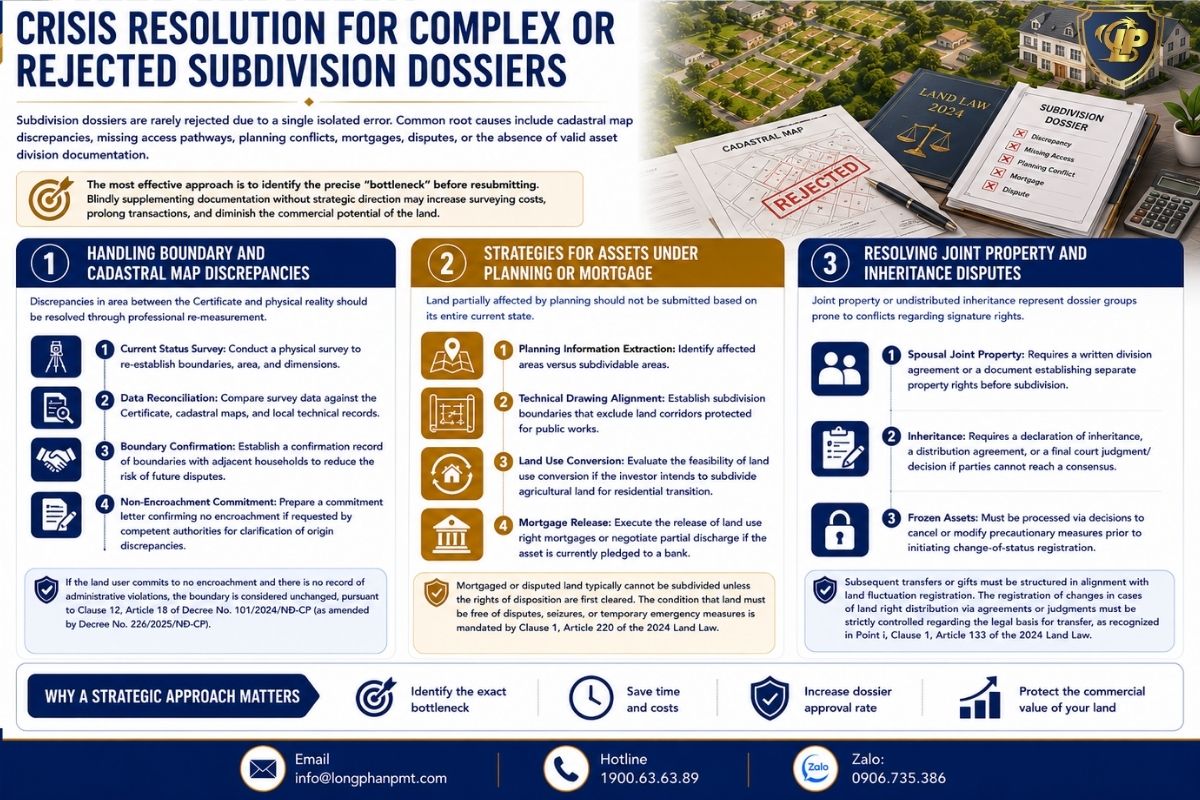
Subdivision dossiers are rarely rejected due to a single isolated error. Common root causes include cadastral map discrepancies, missing access pathways, planning conflicts, mortgages, disputes, or the absence of valid asset division documentation.
The most effective approach is to identify the precise “bottleneck” before resubmitting. Blindly supplementing documentation without strategic direction may increase surveying costs, prolong transactions, and diminish the commercial potential of the land.
Discrepancies in area between the Certificate and physical reality should be resolved through professional re-measurement rather than relying solely on explanations based on legacy records. If boundaries remain unchanged and no disputes exist, the area may be determined according to actual measurement data, pursuant to Clause 6, Article 135 of the Law on Land 2024.
The resolution sequence should be implemented as follows:
In cases where the land user commits to no encroachment and there is no record of administrative violations, the boundary is considered unchanged, pursuant to Clause 12, Article 18 of Decree No. 101/2024/NĐ-CP (as amended by Decree No. 226/2025/NĐ-CP).
Land partially affected by planning should not be submitted based on its entire current state. The secure strategy involves identifying the planning markers, safety corridors, and the portion of the area capable of independent exploitation.
Priority steps for this category include:
Mortgaged or disputed land typically cannot be subdivided unless the rights of disposition are first cleared. The condition that land must be free of disputes, seizures, or temporary emergency measures is mandated by Clause 1, Article 220 of the Law on Land 2024.
Joint property or undistributed inheritance represent dossier groups prone to conflicts regarding signature rights. Without the consensus of co-owners or co-heirs, the subdivision process may be halted at the identity verification stage.
Resolution paths should be tailored to the specific legal status:
Subsequent transfers or gifts must be structured in alignment with land fluctuation registration. The registration of changes in cases of land right distribution via agreements or judgments must be strictly controlled regarding the legal basis for transfer, as recognized in Point i, Clause 1, Article 133 of the Law on Land 2024.
Subdividing and parceling land is far more than a mere survey and administrative submission procedure. With dossiers involving complex planning, mortgage, inheritance, land use conversion, or real estate business factors, a single misstep can stall transactions and generate significant avoidable costs.
Long Phan Consulting Company adopts a “legal appraisal first, technical design second” approach. Our objective is to assist clients in early identification of feasibility, risk exposure, and appropriate land fluctuation registration strategies.
Our service process is designed to control dossiers from input until the new Certificate is received. Procedures at state agencies adhere to timelines stipulated by the Provincial People’s Committee per Clause 1, Article 15 of Decree No. 49/2026/NĐ-CP.
This sequence prevents premature submissions. For previously rejected dossiers, our focus is to trace the exact cause of rejection and restructure the subdivision plan.
Subdivision costs cannot be precisely determined without reviewing locations, proposed plot quantities, legal status, and survey requirements. Projects involving land use conversion also necessitate forecasting applicable financial obligations.
Long Phan Consulting Company supports clients through:
Clients may send Certificates, status drawings, and transaction documents via Email: info@longphanpmt.com or Zalo: 0906.735.386 for an initial feasibility assessment by Long Phan Consulting Company.
In practice, the legal assessment of projects and the implementation of comprehensive “land subdivision services” often reveal compliance blind spots that cause delays for businesses. Understanding payment limits, boundary exceptions, and response deadlines from government agencies is key to protecting investment cash flow. Legal experts have compiled key scenarios to help investors tightly control commercial risks.
Foreign-invested enterprises are only allowed to collect a maximum of 50% of the contract value before handing over the project. According to regulations, the initial payment must not exceed 30% of the contract value, including the deposit. Specifically, the total amount collected must not exceed 70% of the contract value before handing over the house or construction project, but not exceed 50% if the seller is a foreign-invested economic organization, based on Clause 1, Article 25 of the 2023 Law on Real Estate Business.
An organization is defined as engaging in small-scale real estate business when it simultaneously meets two stringent criteria regarding value and frequency. Specifically, the criteria for defining small-scale real estate transactions for organizations are a contract value not exceeding VND 300 billion and the number of transactions not exceeding 10 times per year, based on Point b, Clause 2, Article 7 of Decree No. 96/2024/ND-CP.
The investor is fully permitted to subdivide the land area that is not currently under dispute. In cases where a land plot is under dispute but the disputed area and boundaries can be determined, the remaining undisputed area and boundaries of that land plot are still permitted to be subdivided according to Point c, Clause 1, Article 220 of the Law on Land 2024.
Businesses are required to simultaneously consolidate the land area smaller than the minimum permitted area with an adjacent plot. If the subdivided plot has an area smaller than the minimum permitted area for subdivision, it is mandatory to simultaneously consolidate it with an adjacent plot, based on Point a, Clause 2, Article 220 of the Law on Land 2024.
The state agency must provide an official written response to the project investor within 15 days. The deadline for the provincial-level state management agency for real estate business to inspect and respond in writing regarding whether the land use rights with sufficient technical infrastructure are eligible for transfer to individuals for self-construction of housing is 15 days from the date of receiving the notification from the project investor, based on Clause 7, Article 31 of the 2023 Law on Real Estate Business.
The Land Registration Office or its branch office must refund and clearly inform the investor of the reason within the time limit specified by the Provincial People’s Committee in Clause 1, Article 15 of Decree No. 49/2026/ND-CP; and simultaneously with point e, Clause 3, Article 16 of Decree No. 49/2026/ND-CP.
Professional land subdivision services must be anchored in comprehensive legal appraisal, precise technical surveying, and strict adherence to real estate business regulations from the project’s inception. Factors such as the Land Use Right Certificate (LURC) status, dispute history, minimum area quotas, and infrastructure connectivity are decisive determinants for project viability. For complex dossiers, submitting without a strategic, compliant plan risks significant transaction delays and the potential classification of activities as unauthorized plot-based sales. To safeguard your investment, ensure your parceling strategy meets all statutory requirements by contacting the advisory team at Long Phan Consulting Company. Protect your capital and secure the legal status of your assets by consulting with our experts today via our hotline at 1900.63.63.89.
📚 This article is provided with professional consultation based on the following legal framework: