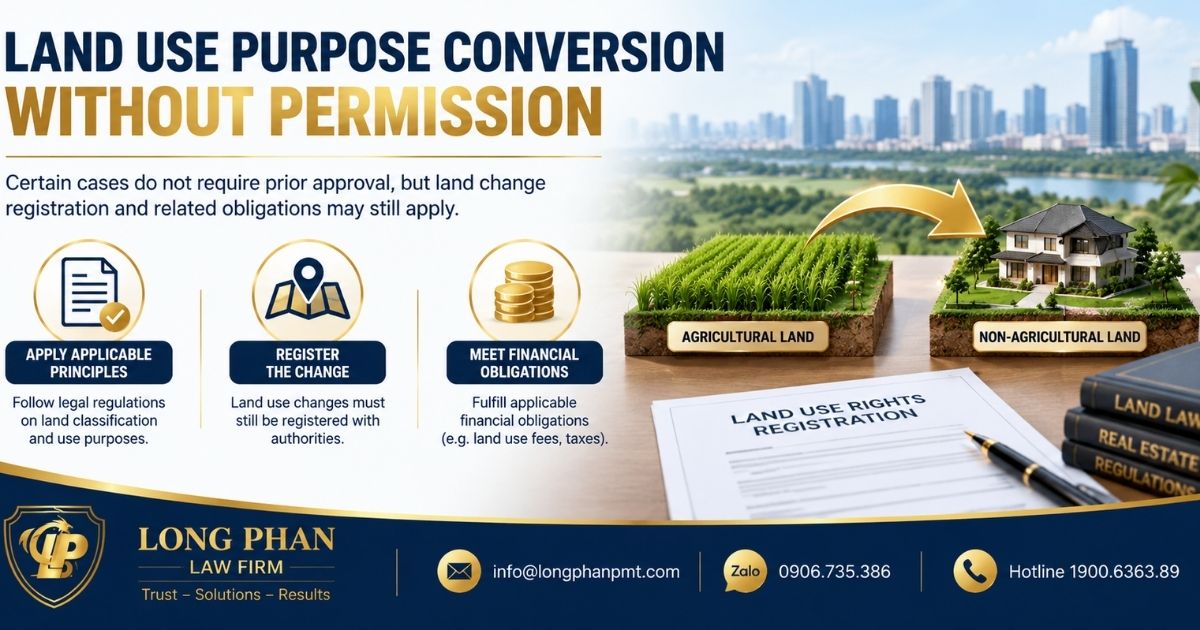

Selecting a secure FDI structure in industrial real estate is essential to avoid financial exposure, transaction delays, and loss of project control. Foreign investors must assess market access requirements, real estate business restrictions, and land-use approval authority under the Law On Land. Effective structuring requires comprehensive due diligence on industrial projects, land-related financial obligations, and licensing pathways before capital deployment. Whether using land subleases, joint ventures, or project transfers, each option creates different compliance consequences. Long Phan Consulting helps investors compare structures, manage regulatory risks, and build a sustainable industrial investment strategy.

Important legal note:
The selection of an appropriate FDI structure for industrial real estate projects is not merely a choice of investment vehicle; it dictates the investor’s legal capacity to exploit land, mobilize capital, and ensure the validity of the entire transaction. Many deals fail – even after the execution of a Memorandum of Understanding (MOU) or the payment of deposits – because investors adopt unsuitable models or fail to meet market access requirements.
For a Foreign – Invested Enterprise (FIE), investing in industrial real estate requires simultaneous compliance with multiple regulatory layers. Relying solely on the Law on Investment while overlooking land-use conditions or the restricted scope of real estate business may result in the denial of an Investment Registration Certificate (IRC) or the inability to commercially exploit the project.
Foreign investors must conduct a rigorous assessment of the following legal tiers:
In practice, the chosen investment structure determines whether an investor gains “Asset Control” or merely “Leasehold Exploitation Rights.” This distinction is a strategic cornerstone when choosing between land subleasing, joint ventures, or the M&A of a project company. Any misalignment in this structure may lead to the transaction being deemed a “sham” or a violation of investment conditions.
Furthermore, current regulations strictly limit the scope of real estate activities for FIEs. Investors are only permitted to engage in authorized activities, such as investing in infrastructure for sublease or acquiring projects for commercial operation, pursuant to Point b and Point g, Clause 3, Article 10 of the Law on Real Estate Business 2023.
For industrial park infrastructure projects, the authority to grant Investment Policy Approval now rests with the Provincial People’s Committee, pursuant to Point a, Clause 3, Article 25 of the Law on Investment 2025. While this decentralization significantly accelerates approval timelines, it necessitates higher standards for dossier completeness and the investor’s ability to demonstrate financial feasibility.
Selecting the correct investment structure directly dictates the speed of implementation, the level of land fund control, and the overall legal security of the deal. Each FDI model for industrial real estate is tailored to specific objectives, such as manufacturing, logistics, infrastructure development, or land fund M&A. Investors must simultaneously evaluate market access conditions, commercial exploitation rights, and land-related financial obligations before finalizing their investment model.
This is the most prevalent structure for manufacturing, logistics, and warehousing enterprises. This model allows investors to directly control operations without inheriting the historical legal liabilities of a target company.
Joint ventures are ideal when the Vietnamese partner possesses advantages in land funds, zoning, local relationships, or operational experience. Foreign investors leverage these assets to accelerate implementation and reduce initial land-related administrative burdens.
This corporate M&A structure provides rapid access to the land fund and existing legal framework of a target company. Instead of applying for a new project, the investor acquires control of an entity already operating or owning an industrial project.
This structure allows investors to take over an industrial project directly rather than buying the company that owns it. It is a preferred model for investment funds or infrastructure developers seeking rapid land fund expansion.
This model offers the highest level of control but requires the most significant financial and legal management capacity. The investor handles investment, land, zoning, construction, and environmental compliance throughout the project lifecycle.
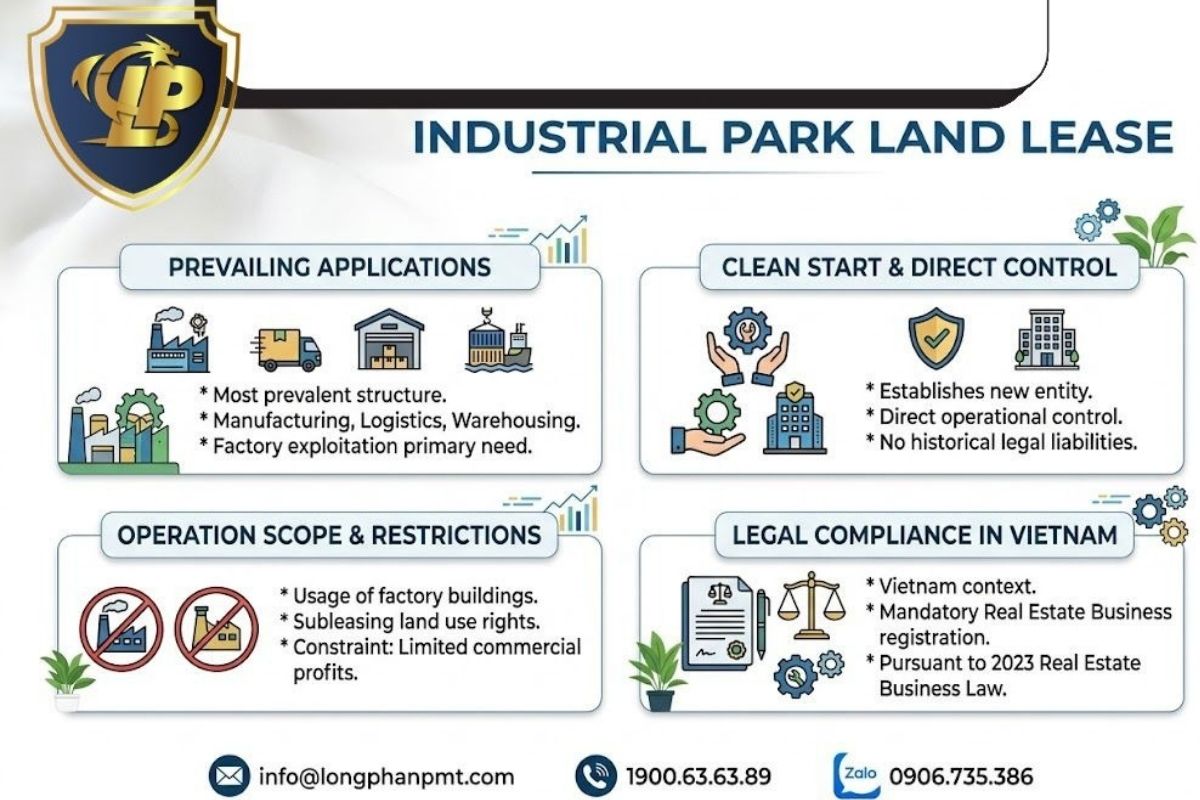
The following legal checklist serves as a mandatory filter before any capital disbursement, MOU execution, or share transfer. In Vietnam’s industrial real estate sector, oversights during the initial review can paralyze transactions during the IRC, ERC, or land-transfer approval stages. Legal counsel must evaluate each layer of conditions based on the investment objective and the specific Foreign-Invested Enterprise (FIE) scope.
| Review Subject | Compliance Requirements | Legal Basis |
| Investor Status | Classification of the investor as an individual, foreign entity, SPV, or offshore fund to determine market access procedures. | Clause 1, Article 8, Law on Investment 2025 |
| Business Registration | The entity must possess business lines for real estate, land subleasing, factory leasing, or logistics. | Clause 1, Article 9, Law on Real Estate Business 2023 |
| FIE Business Scope | FIEs may only conduct real estate activities within the scope permitted by law (e.g., infrastructure for sublease). | Points b & g, Clause 3, Article 10, Law on Real Estate Business 2023 |
| Land Legal Status | Verification of land rental payment structure (Annual vs. One-off) to assess transfer and mortgage rights. | Clause 1, Article 9, Decree No. 102/2024/ND-CP |
| Financial Obligations | The transferor must complete all land-related financial duties for the transferred portion before an M&A. | Clause 3, Article 40, Law on Real Estate Business 2023 |
| National Security | Projects on islands, border communes, or coastal areas require defense and security clearance. | Clause 3, Article 10, Decree No. 102/2024/ND-CP |
| Land Use Term | Industrial project terms depend on the investment duration, but total land use shall not exceed 70 years. | Clause 4, Article 202, Law on Land 2024 |
This checklist should not be treated as a mere administrative procedure. The real value of Legal Due Diligence lies in detecting conflicts between commercial objectives and legal limitations before funds are transferred into a transaction.
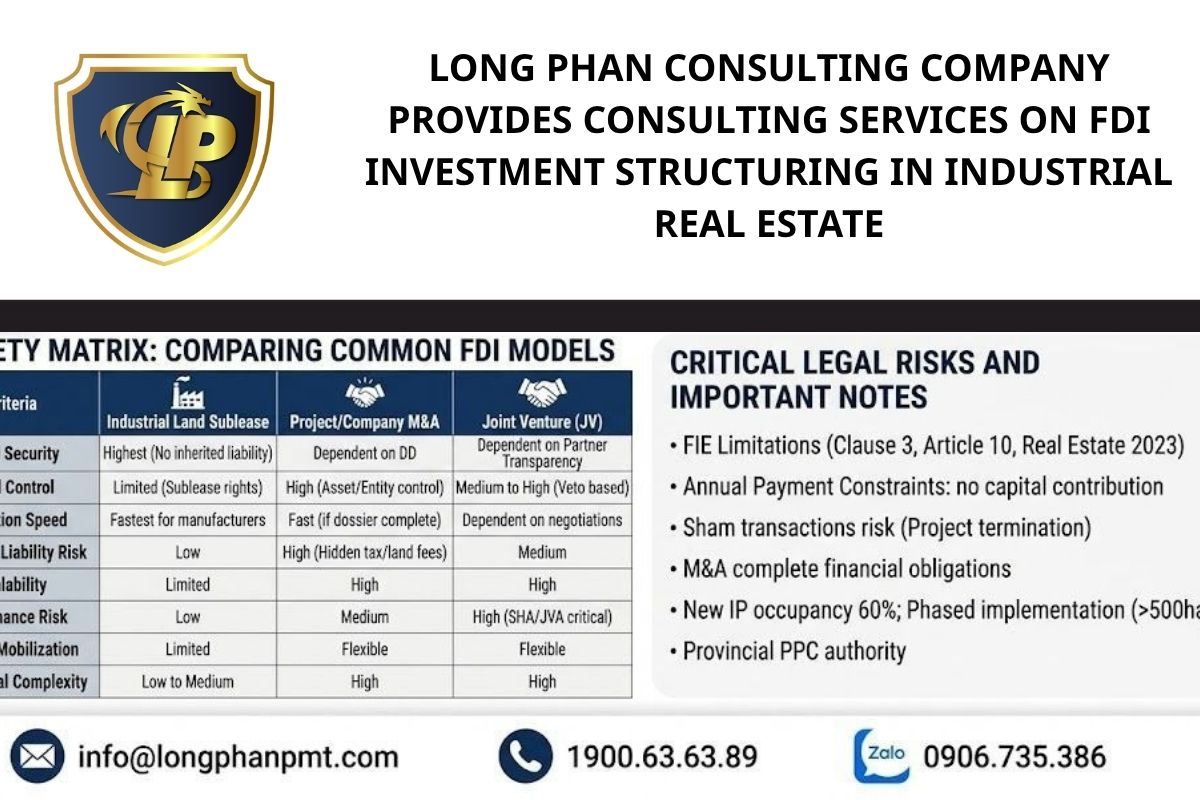
No “perfect” FDI structure exists; selection depends on the trade-off between speed, control, and risk appetite. While manufacturers prioritize rapid deployment, infrastructure funds typically prioritize long-term land control and commercial exploitation rights.
| Criteria | Industrial Land Sublease | Project/Company M&A | Joint Venture (JV) |
| Legal Security | Highest (No inherited liability) | Dependent on Due Diligence | Dependent on Partner Transparency |
| Land Control | Limited (Sublease rights) | High (Asset/Entity control) | Medium to High (Veto based) |
| Execution Speed | Fastest for manufacturers | Fast (if dossier is complete) | Dependent on negotiations |
| Financial Liability Risk | Low | High (Hidden tax/land fees) | Medium |
| Scalability | Limited | High | High |
| Governance Risk | Low | Medium | High (SHA/JVA critical) |
| Capital Mobilization | Limited | Flexible | Flexible |
| Procedural Complexity | Low to Medium | High | High |
For manufacturing enterprises requiring immediate operations, subleasing land use rights with existing infrastructure is often the safer choice, as it bypasses risks related to land origin and shareholder disputes. Conversely, Corporate M&A offers rapid scale but requires verifying that the target company is not using land with “annual” rental payments, as such land cannot be used for capital contribution pursuant to Clause 1, Article 34 of the Law on Land 2024.
The most profound risks in industrial FDI do not always stem from purchase prices or project timelines, but rather from legal structures that fail to reflect the true nature of the transaction. Misalignment in M&A, joint ventures, or pre-closing deposits can lead to voided agreements, project stagnation, or the total loss of capital control.
Proxy structures (nominee arrangements) are often utilized to circumvent market access restrictions or land use limitations. This represents a severe risk as the legal record does not reflect the actual beneficiary.
In industrial zones, manufacturing investors typically only have the right to lease the land use rights associated with the infrastructure. This right does not equate to the right to transfer land use rights, unlike infrastructure developers or entities with full land rights.
A common mistake is viewing land sublease contracts as assets that can be freely transferred, mortgaged, or contributed as capital. If the land is leased with annual payments, the business only has the right to sell or lease the legally owned assets on the land; it is not permitted to transfer or contribute the land use rights as capital, according to Clause 1, Article 34 of the 2024 Land Law.
In M&A projects involving companies, a crucial point of scrutiny is the method of land lease payment. If the payment method (a lump sum or annual payments) is not clearly defined, investors may misvalue the asset and acquire non-transferable rights.
An MOU, term sheet, or deposit cannot replace the legal conditions of a project. Transferring funds before verifying land finance obligations, planning, environmental conditions, and transfer conditions can put the investor at a disadvantage in negotiations.
The law strictly prohibits the falsification of documents or the intentional misrepresentation of information regarding real estate projects, as stipulated in Clause 2, Article 8 of the 2023 Law on Real Estate Business. Therefore, all data in the data room must be cross-referenced with the original records at the competent authority.
For construction projects under construction, the investor is only allowed to collect a deposit of no more than…5%The selling price or lease-purchase price is determined according to Clause 5, Article 23 of the 2023 Law on Real Estate Business. This limit needs to be carefully checked if the transaction structure includes a deposit or reservation fee.
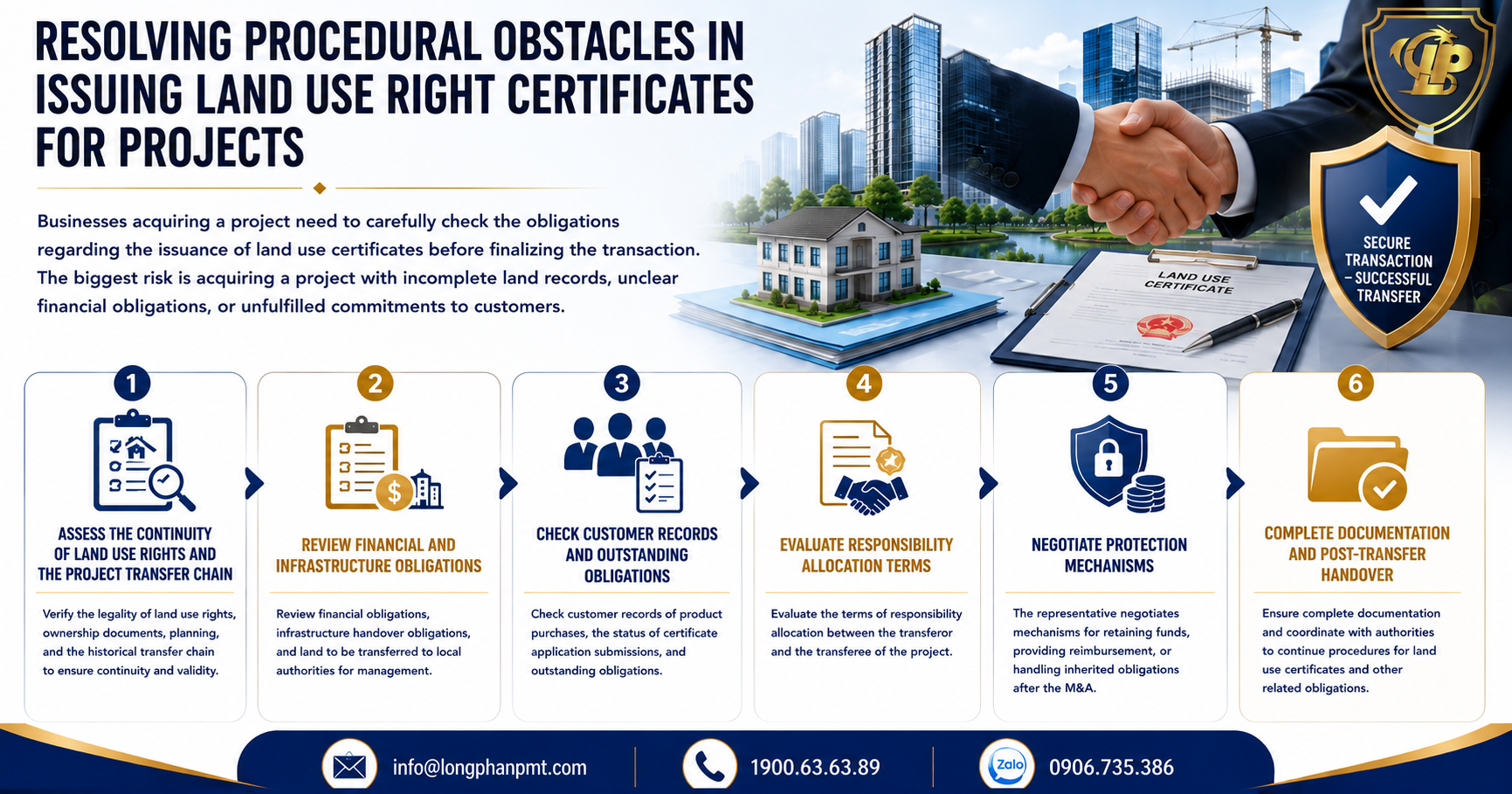
Land financing obligations are a hidden risk in many industrial park M&A deals. A project with complete planning documents may still be rejected if the transferor has not completed land lease payments or related financial obligations.
When transferring all or part of a real estate project, the transferring investor is required to fulfill their financial obligations regarding land to the State according to Clause 3, Article 40 of the 2023 Law on Real Estate Business. This is a condition that needs to be checked before signing a SPA or making installment payments.
If the project is behind schedule, the investor will only be granted a maximum extension of land use rights 24 months. After this period, the State may reclaim the land without compensation for the land, assets attached to the land, and remaining investment costs, in accordance with Clause 8, Article 81 of the 2024 Land Law.
A secure FDI structure cannot be built solely from M&A contracts or IRC documents. Investors need to implement a synchronized roadmap from investment objectives, legal due diligence, transaction design to licensing procedures and post-investment governance.
In practice, many transactions fail not because of a lack of capital, but because of incorrect legal procedures. Particularly with industrial real estate, signing a Spam Agreement (SPA) or disbursing funds before completing the Legal Due Diligence often creates irreparable risks later on.
Investors need to clearly define their core objectives from the outset to choose the appropriate structure. Each objective will entail different legal requirements and licensing strategies.
Common targets include:
Incorrectly defining objectives can lead to the selection of the wrong industry, capital structure, or investment profile that does not meet market access requirements.
This is a fundamental check before proceeding with any transaction. Investors need to assess the equity ownership ratio, restricted business sectors, and applicable conditions for foreign-invested economic organizations.
In the event that an M&A transaction results in foreign investors holding more than [amount] shares, 50% of charter capital Investors must register their share purchase before any change in shareholders, as stipulated in Point b, Clause 3, Article 21 of the 2025 Investment Law.
For projects located in sensitive areas such as coastal, border, or island regions, the dossier must also obtain opinions from the Ministry of National Defence and the Ministry of Public Security, as stipulated in Clause 3, Article 10 of Decree No. 102/2024/ND-CP.
Legal Due Diligence is a crucial step in determining the safety of the entire transaction. The goal is not just to check the paperwork, but to comprehensively assess the legality of the land use rights and the feasibility of transfer.
The document groups that need to be reviewed include:
If the target business is leasing land on an annual payment basis, investors need to be especially cautious because the law does not permit contributing capital in the form of land use rights in this case, according to Clause 1, Article 34 of the 2024 Land Law.
After completing the due diligence, investors need to design a trading structure that matches their desired level of control and the ability to allocate risk among the parties involved.
Commonly used contract sets include:
For joint ventures or M&A, veto clauses, anti-dilution, deadlock, and divestment mechanisms should be designed from the outset to avoid governance disputes after disbursement.
Following structure finalization, the enterprise must implement or adjust the IRC/ERC and register capital contributions.
Competent Authorities: For industrial park projects, the Management Board of Industrial Parks, Export Processing Zones, or Economic Zones is the direct authority for issuing Investment Registration Certificates, pursuant to Point b, Clause 3, Article 34 of Decree No. 96/2026/ND-CP.
Industrial real estate FDI in Vietnam is governed by a complex intersection of investment, land, and real estate business laws. Even minor errors in structure design or due diligence can result in the loss of commercial exploitation rights. Long Phan Consulting Company partners with foreign institutional investors and infrastructure funds to engineer secure investment structures and optimize long-term operational viability.
For a preliminary evaluation of your legal structure or project risks, please forward your project dossiers and draft agreements to our specialists via Email: info@longphanpmt.com or Zalo/WhatsApp: 0906.735.386
Navigating the development of industrial real estate projects involves specific legal hurdles regarding documentation transitions and land use terms. Leveraging “legal safety buffers” allows foreign investors to protect profit margins and optimize capital structures. The following expert insights address critical compliance strategies.
Yes. Foreign investors have the right to propose that competent authorities re-determine the operational term of the project. This mechanism is implemented during the adjustment of the Investment Policy or the Investment Registration Certificate for the acquired project. This entitlement allows enterprises to restart the project timeline to meet financial projections, pursuant to Clause 6, Article 52 of the 2025 Law on Investment.
Investors purchasing real estate are only required to pay an initial installment of no more than 30% of the contract value, including the deposit. For sellers that are Foreign-Invested Enterprises, the total payment prior to the handover of the property must not exceed 50% of the contract value. This strict requirement compels infrastructure developers to design legally compliant collection schedules pursuant to Clause 1, Article 25 of the 2023 Law on Real Estate Business.
No. Infrastructure developers are exempt from financial obligations for shared areas. Specifically, the investor does not have to pay land rent for land used to construct shared technical infrastructure within the industrial park. Foreign-Invested Enterprises must accurately delineate these boundaries to optimize investment costs pursuant to Clause 3, Article 202 of the 2024 Law on Land.
State authorities will continue to process project transfer dossiers according to the regulations of the previous law for all validly submitted files. However, if the new regulations offer a more favorable financial structure, enterprises have the right to withdraw and resubmit their dossiers. Resubmissions made after the new laws take effect must comply entirely with the updated regulations pursuant to Clause 3, Article 83 of the 2023 Law on Real Estate Business.
Yes. Infrastructure developers are entitled to change their land rental payment method to increase the liquidity of the land fund. An industrial park developer paying annual rent may proactively switch to a one-off payment for the entire area or specific portions of the commercial land. This mechanism allows Foreign-Invested Enterprises to expand their mortgage rights pursuant to Clause 3, Article 202 of the 2024 Law on Land.
Developers are subject to a ceiling on deposits to ensure the safety of capital mobilization transactions. Real estate businesses may only collect a deposit of no more than 5% of the selling or lease-purchase price for future-formed construction works. Foreign-Invested Enterprises must strictly review all pre-execution agreements to comply with the ratios stipulated in Clause 5, Article 23 of the 2023 Law on Real Estate Business.
Industrial real estate FDI is only truly secure when the transaction structure is engineered to align with investment objectives, land fund control requirements, and the specific legal conditions applicable to Foreign-Invested Enterprises. Investors must meticulously verify land financial obligations, project transfer conditions, and exploitation limits across sublease, joint venture, and M&A models to avoid the risk of voided transactions or loss of control post-disbursement. For specialized advisory on investment structuring, Legal Due Diligence, and FDI licensing roadmaps, contact the Hotline at 1900636389 of Long Phan Consulting Company.
📚 This article is provided with professional consultation based on the following legal framework: