
Arising costs when overseas Vietnamese buy real estate in Vietnam include taxes, state fees, and legal service remunerations under current regulations. The 2024 Land Law and the 2023 Law on Real Estate Business have expanded asset ownership rights for Vietnamese residing abroad. Individuals must accurately determine financial obligations to optimize their investment budget. In the following article, Long Phan Consulting Company provides detailed information on these cost categories.

When researching arising costs when overseas Vietnamese buy real estate in Vietnam, it is first necessary to clearly determine which Overseas Vietnamese subjects are permitted to own housing under the law. Buying real estate in Vietnam is permitted under specific business forms and purposes, depending on the nationality status of the Overseas Vietnamese, pursuant to Clauses 2 and 3, Article 10 of the 2023 Law on Real Estate Business.
For Overseas Vietnamese Retaining Vietnamese Nationality
Under Clause 2, Article 10 of the 2023 Law on Real Estate Business, Overseas Vietnamese who are Vietnamese citizens (under nationality laws) and permitted to enter Vietnam may conduct real estate business in the following forms:
For People of Vietnamese Origin (No Longer Holding Vietnamese Nationality) Residing Abroad
Pursuant to Clause 3, Article 10 of the 2023 Law on Real Estate Business, people of Vietnamese origin residing abroad who are permitted to enter Vietnam may conduct real estate business in the following forms:
>>>See more: Construction Permits for Overseas Vietnamese Guide Construction Permits for Overseas Vietnamese Guide
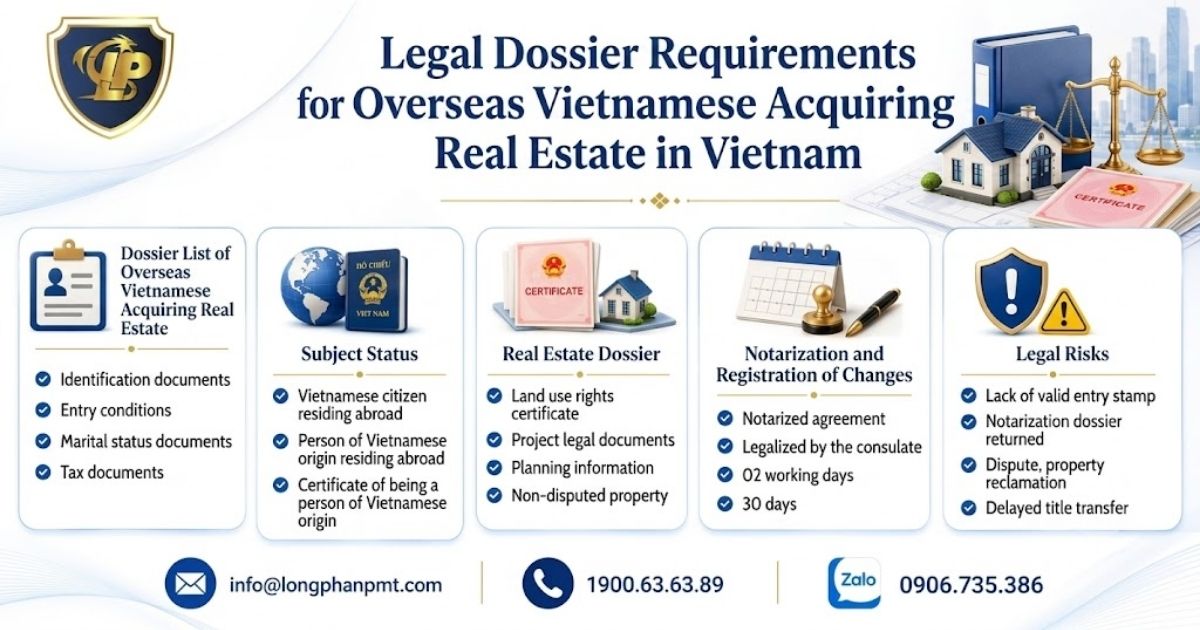
An important issue related to additional costs incurred when overseas Vietnamese purchase real estate in Vietnam is meeting all the conditions required for the recognition of housing ownership rights. Pursuant to Clause 2 and Clause 3, Article 3 of Decree No. 95/2024/ND-CP on conditions for purchasing real estate in Vietnam, overseas Vietnamese wishing to buy houses or land in Vietnam must provide documents proving that they are eligible individuals to own housing in Vietnam, as follows:
In addition, overseas Vietnamese who wish to purchase real estate in Vietnam must also provide documents proving their eligibility to own housing in Vietnam, as follows:
>>>See more: Overseas Vietnamese Buying Real Estate in Vietnam: Opportunities and Risks
The registration fee is a critical factor directly affecting arising costs when overseas Vietnamese buy real estate in Vietnam, as it forms part of the total cost of ownership. It is the amount the asset receiver must pay when registering ownership/use rights with competent state agencies. Conventionally, the buyer pays this fee. However, parties can agree in the transfer contract that the seller will bear this cost as part of the transaction.
The registration fee is a critical factor directly affecting the total cost of ownership. It is the amount the asset receiver must pay when registering ownership/use rights with competent state agencies. Conventionally, the buyer pays this fee. However, parties can agree in the transfer contract that the seller will bear this cost as part of the transaction.
Collection Rate and Calculation Formula:
Calculation Value (Clause 1, Article 7, Decree 10/2022/ND-CP)
Important Note: If the transfer price on the contract is higher than the State’s regulated price, the calculation value will be the price recorded on the contract.
Special cases:
Accurately determining the price used for calculating the registration fee helps all parties properly estimate costs and fulfill financial obligations promptly.
Pursuant to Article 159 of the 2024 Land Law, the new land price framework will directly affect taxes and land use fees. Buyers should update local land price rates to accurately calculate net cash flow after deducting expenses. Financial transparency will facilitate smoother transactions with tax authorities.
Another notable arising cost is the PIT incurred when buying, selling, or transferring real estate. This is a mandatory financial obligation paid to the state budget when income arises from a transfer. PIT declaration and payment are executed at the competent tax agency where the real estate is located.
3. Time of tax determination: The time for tax calculation is when the transfer contract becomes legally effective. If the contract stipulates that the buyer pays the tax on behalf of the seller, the time of tax determination is when the ownership registration procedures are carried out.
In addition, the law also provides for certain cases where Personal Income Tax (PIT) is exempted when transferring real estate, pursuant to Article 4 of the 2007 Law on Personal Income Tax (as amended and supplemented by Clause 3, Article 2 of the 2014 Law amending and supplementing a number of articles of tax laws):
>>>See more: Investment Potential of Land Plots in Vietnam for Overseas Vietnamese
Regarding arising costs when overseas Vietnamese buy real estate in Vietnam, notary fees and notary remuneration play an important role in ensuring the legal validity of real estate purchase contracts. Real estate purchase contracts must be notarized by a notary office to ensure legal enforceability.
When carrying out this procedure, customers are required to pay notary fees as prescribed. According to Clause 2, Article 4 of Circular 257/2016/TT-BTC, the notary fee for contracts and transactions is determined based on the value of the property or the value of the contract or transaction.
How to determine the price for charging:
The fee-calculated value = total value of land use rights + assets attached to the land.
This value is agreed upon by the parties; if it is lower than the price set by the Provincial People’s Committee, the fee will be calculated according to the Provincial People’s Committee’s rate.
Notary fee schedule: Notary fees are applied according to a progressive fee schedule based on the value of the property/contract. This is in accordance with point a7, clause 2, Article 4 of Circular 257/2016/TT-BTC.
Note: In cases where the land price or property price agreed upon by the parties is lower than the price stipulated by the competent state authority at the time of notarization, the notarization fee will be calculated as follows:
The value of land use rights and the value of assets used for calculating notarization fees = Land area and number of assets specified in the contract/transaction x Land price and asset price as stipulated by the competent state authority.
Among arising costs when overseas Vietnamese buy real estate in Vietnam, brokerage fees (if any) are a factor that needs to be carefully calculated in advance to avoid exceeding the planned budget.
Real estate brokerage fees are part of arising costs when overseas Vietnamese buy real estate in Vietnam incurred when clients use intermediary services to find buyers and facilitate transactions. This fee is entirely based on a civil agreement between the seller and the broker, as recorded in the brokerage service contract.
According to Article 63 of the 2023 Law on Real Estate Business, the remuneration and commission for real estate brokers are regulated as follows:
The payment of brokerage fees usually takes place after the seller has received the deposit from the buyer or after the transfer procedures are completed at the notary office, depending on the terms of the signed agreement.
One of the unavoidable components of arising costs when overseas Vietnamese buy real estate in Vietnam is the fee for applying for a land use right certificate after the transaction is completed. This is a mandatory administrative fee applied when individuals or organizations request the competent state agency to issue a new, amend, or transfer ownership of a land use right certificate (pink/red book). This fee does not depend on the value of the real estate but is only intended to cover the administrative costs of processing and managing the application.
According to Circular 85/2019/TT-BTC, this fee is not calculated as a percentage (%) of the asset value, but is specifically regulated by the Provincial People’s Council for each area.
In reality, the fees charged to individuals and households are usually quite low, commonly ranging from 30,000 to 500,000 VND, depending on geographical location and local economic conditions.
In addition to the Certificate issuance fee and the registration fee, individuals engaging in the purchase and transfer of real estate should also pay attention to two other important administrative costs: dossier appraisal fees and cadastral measurement (land survey) fees. Among the additional costs incurred by overseas Vietnamese when purchasing real estate in Vietnam, expenses related to the title transfer process often include multiple smaller charges that need to be carefully calculated.
The dossier appraisal fee is used to cover the cost of reviewing and verifying applications for changes in land use rights. Meanwhile, the cadastral measurement fee only arises when it is necessary to re-measure the land plot to serve as a basis for adjusting or updating information in the cadastral records, especially in cases where accurate maps are unavailable or land boundaries have changed.
Dossier appraisal fee for the issuance of the Certificate of land use rights
Cadastral measurement fee for the issuance of the Certificate of land use rights
The cadastral measurement fee is one of the additional costs incurred by overseas Vietnamese when purchasing real estate in Vietnam. It is a cost for preparing a new land plot extract or an updated cadastral map to serve the issuance, re-issuance, or registration of changes to the Certificate.
Applicable cases:
Purpose of the fee: To pay for the services of authorized units conducting land surveys, field measurements, and preparing technical drawings that clearly define land boundaries, shape, and area.
Fee rates: These vary by locality and are determined by the provincial People’s Councils, depending on specific areas and terrain conditions.
 Types of costs incurred when overseas Vietnamese buy real estate in Vietnam
Long Phan Consulting Company provides comprehensive legal solutions to help you execute safe transactions, particularly in managing arising costs when overseas Vietnamese buy real estate in Vietnam to ensure full transparency and compliance. Dedicated experts will directly handle administrative and technical barriers throughout the buying and selling process.
We structure our professional support into the following key area:

To help our customers better understand arising costs when overseas Vietnamese buy real estate in Vietnam, Long Phan Consulting Company provides a summary and answers to some frequently asked questions.
The law also stipulates several cases where personal income tax is exempted when selling real estate, according to Article 4 of the Personal Income Tax Law 2007 (supplemented by Clause 3, Article 2 of the Law amending and supplementing a number of articles of the Laws on taxation 2014):
Yes, however, the scope of authority of a foreign authorized representative will be limited by their legal capacity and the conditions of their real estate ownership in Vietnam.
Based on Article 138 of the 2015 Civil Code, you have the right to choose an individual as your representative. However, to ensure enforceability when signing at the Land Registration Office, the authorized person should be a Vietnamese citizen with full legal capacity to avoid complex explanations regarding the ownership conditions of foreigners as stipulated in Article 4 of the 2024 Land Law.
You have the right to unilaterally terminate the power of attorney contract at any time, but you must notify the authorized party and any third parties (if any) in writing. According to Article 569 of the 2015 Civil Code, if the power of attorney is for a fee, you must pay the fee corresponding to the work performed and compensate for damages; if there is no fee, you must still give the authorized party reasonable notice.
Yes, according to Clause 4, Article 3 of the 2008 Vietnamese Nationality Law and Point b, Clause 2, Article 8 of the 2023 Housing Law, Vietnamese citizens residing abroad who are permitted to enter Vietnam are entitled to own houses attached to land use rights in Vietnam; and have the right to use residential land acquired through the transfer of land use rights in housing development projects as stipulated in Article 44 of the 2024 Land Law.
Based on point b, clause 2, Article 41 of the 2024 Land Law, which specifically stipulates the rights and obligations of Vietnamese people residing abroad and foreign-invested economic organizations using land to implement investment projects in Vietnam, Vietnamese people residing abroad who are granted land leases by the State with annual rent payments may mortgage their owned assets attached to the land at credit institutions permitted to operate in Vietnam when granted land leases by the State with annual rent payments.
In practice, to ensure transparency and avoid legal risks, real estate transactions should be settled through bank transfers. This helps to prove the source of funds and ensures that transfers from abroad comply with foreign exchange regulations.
Accurately determining the arising costs when overseas Vietnamese buy real estate in Vietnam helps investors avoid financial and legal risks and commits to accompanying Overseas Vietnamese in making costs transparent and accelerating legal progress.
If you require in-depth support regarding title transfer procedures or real estate appraisals, please contact hotline 1900636389 immediately to receive consultation from the expert team at Long Phan Consulting Company.