
Select real estate on a budget while ensuring appreciation potential is not merely a financial equation but demands a strategy to optimize future appreciation potential. Without a clear orientation, buyers easily fall into a state of being over leveraged while achieving poor investment efficiency. In this article, Long Phan Consulting Company analyzes solutions to help you select real estate on a budget while ensuring sustainable added value.

To select real estate on a budget effectively, buyers should determine a property choice based on their real financial capacity rather than simply relying on the total amount of money they currently possess.
The true budget for real estate investment is not simply your currently available cash, but must be determined by the formula: True Budget = Available Cash + Borrowing Capacity – Arising Costs. Comprehensive calculation helps investors avoid “running out of capital” during the transaction and asset exploitation process.
Arising costs to anticipate include: taxes and title transfer fees prescribed by law; brokerage fees (if transacting via an intermediary); repair, renovation, or finishing costs; and crucially, bank loan interest for at least the first 12–24 months, the phase where financial pressure is usually highest.
A vital principle when budgeting is not to use your entire available funds for the investment. Instead, allocate only 70–80% of your total budget, keeping the remainder as a contingency fund to handle arising risks or market fluctuations, thereby ensuring the investment’s safety and sustainability.
An important step to select real estate on a budget is identifying and filtering market segments that match the buyer’s financial capabilities. Not every budget level can invest in all types of real estate. Attempting to “stretch” into a higher segment than your determined budget often leads to negative consequences, such as having to choose poor-quality products, unfavorable locations, or unclear legalities, thereby increasing risks and reducing efficiency.
Therefore, investors must clearly identify the segment suited to their financial capacity to optimize profit opportunities.
Choosing the right segment based on your budget not only controls financial risks but creates a foundation to maximize the real estate’s future appreciation potential.
>>> See more: Pre-purchase real estate transparency checking services
When trying to select real estate on a budget, investors should focus on areas that show strong potential for future price appreciation. Real estate appreciation potential does not stem from intuition or luck but depends on specific foundations such as infrastructure, urban planning, and economic-demographic development. Accurately assessing these factors helps investors choose areas capable of sustainably increasing in value over time.
Evaluating infrastructure development is essential when buyers select real estate on a budget, as improved transportation and public facilities can significantly increase property value. Traffic infrastructure and amenities directly impact real estate value. Areas near highways, ring roads, key traffic routes, or inter-regional connections usually appreciate faster. Notably, when a public infrastructure project is deployed, local real estate prices typically rise in tandem with construction progress.
Urban planning information also plays a crucial role for those who want to select real estate on a budget, as planning changes can strongly influence property prices.
Planning is a legal factor dictating the real estate’s long-term development orientation. Investors should prioritize residential land parcels or land capable of being converted to residential use according to planning. Concurrently, avoid land stuck in suspended planning, public land, or areas with restricted usage rights. For safety, it is mandatory to thoroughly check land use and construction planning at competent agencies before investing.
To select real estate on a budget with long-term benefits, investors should consider areas with strong economic performance and stable population growth. An area with good economic growth and increasing population density creates real housing demand, thereby boosting real estate value.
Areas near industrial parks, schools, commercial centers, or public amenities naturally attract residents. When there are “actual residents” and high density, the real estate’s liquidity will also be higher, making it easier to sell or exploit in the future.
Besides location, another key principle to select real estate on a budget is focusing on properties that have clear potential for value growth over time. A good asset must not only guarantee legal safety but also possess room for exploitation and value improvement.
First, prioritize products with clear legalities and complete documents as prescribed, especially lawful land use rights free of disputes, limiting risks during transactions and transfers. Next, select real estate capable of being renovated or upgraded such as old houses that can be repaired, expanded, or functionally optimized thereby increasing the actual value compared to the purchase price.
Additionally, cash flow generating products are worth considering, such as real estate that can be leased, commercially exploited, or possesses the potential for parcel separation/subdivision under the law. These factors not only increase asset value but create a stable revenue stream, enhancing long-term investment efficiency.

Learning how to analyze the market is vital for investors who want to select real estate on a budget and identify good properties offered at reasonable prices. In real estate investment, “buying at the right price” is a key factor determining profit margins. Accurately identifying market prices will help investors recognize properties with true value and identify opportunities to buy below cost.
Accurately determining the market value of a property is a fundamental step when buyers select real estate on a budget. To establish an accurate valuation, it’s necessary to compare at least 5–10 similar properties in the same area, with similar characteristics in terms of location, size, legal status, and condition. From there, calculate the average price of these properties to establish a general price level. This will be a crucial basis for investors to assess whether a property is being offered at a high, low, or appropriate price for the market.
After determining the market price, decision-making should be based on the price difference. If the product is priced approximately 10–20% lower than the market average, this could be a good opportunity; however, further legal and risk assessments are necessary before making a decision.
If the price is in line with the market, it should only be considered if the property has a clear advantage in terms of location or development potential. Conversely, for properties priced higher than the average but lacking outstanding features, investors should consider discarding them to avoid reducing investment efficiency.
Legal checking is an unskippable step before any investment decision to ensure lawful ownership and minimize arising risks. An asset, regardless of a prime location or attractive price, harbors dispute risks or cannot be legally transacted if its legality is unclear.
Fundamentally, investors must review these factors: the real estate must have a separate Red/Pink Book ensuring lawful use rights; no disputes with third parties; not distraught for judgment execution; not subject to state recovery; and the land use purpose must align with actual exploitation needs.
Furthermore, pay special attention to the asset’s transaction history to detect anomalies (multiple transfers in a short time, opaque transactions), while cross-referencing planning to avoid overlapping zones or future development projects. Thoroughly checking these factors ensures safety and sustainable legal value for the investment.
Besides choosing the right product and area, determining the appropriate buying strategy directly dictates the profit margin. A clear strategy helps investors proactively control risks and fully leverage market appreciation opportunities.
Currently, three popular strategies are applied by many investors:
Choosing a strategy must be based on the individual’s financial capacity, risk appetite, and specific investment goals, ensuring long-term efficiency and safety.
>>> See more: Solutions for Approaching Strategic Investors in Real Estate
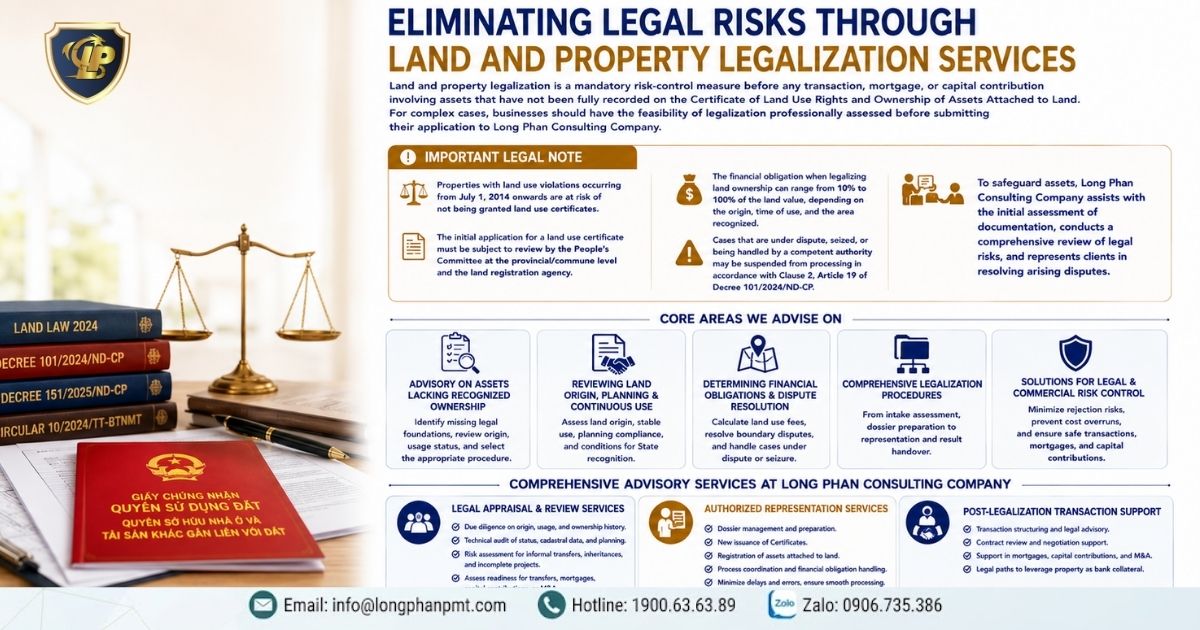
In the process of selecting real estate on a budget while ensuring appreciation potential, the companionship of an in-depth legal consulting unit is the pivotal factor helping investors limit risks and optimize efficiency. We structure our professional support into the following key area:

Below are some frequently asked questions about how to select real estate on a budget; please refer to them:
To check if a property is subject to seizure for enforcement of a judgment, buyers can verify the property’s legal information in several ways. Customers can visit the Land Registration Office or its branch office where the property is located to request information on the land’s legal status through a land data request form. This agency will inform them whether the property is subject to seizure for enforcement of a judgment, mortgaged, has restricted transfer rights, or is involved in a dispute.
The ideal loan amount should range from 30–50% of the property value. Borrowing more than 70% of the actual budget can easily lead to a sell-off when the market fluctuates or floating interest rates rise, losing the opportunity to wait for long-term property value appreciation.
It is necessary to carefully check the actual area against the land title deed and the current state of the building to see if it violates the building boundary. Renovations and repairs that alter the load-bearing structure or floor area require a building permit to complete the completion procedures and update the property in the land title deed before transferring ownership at a high price.
(Legal basis: Article 89 of the 2014 Construction Law, as amended and supplemented in 2020)
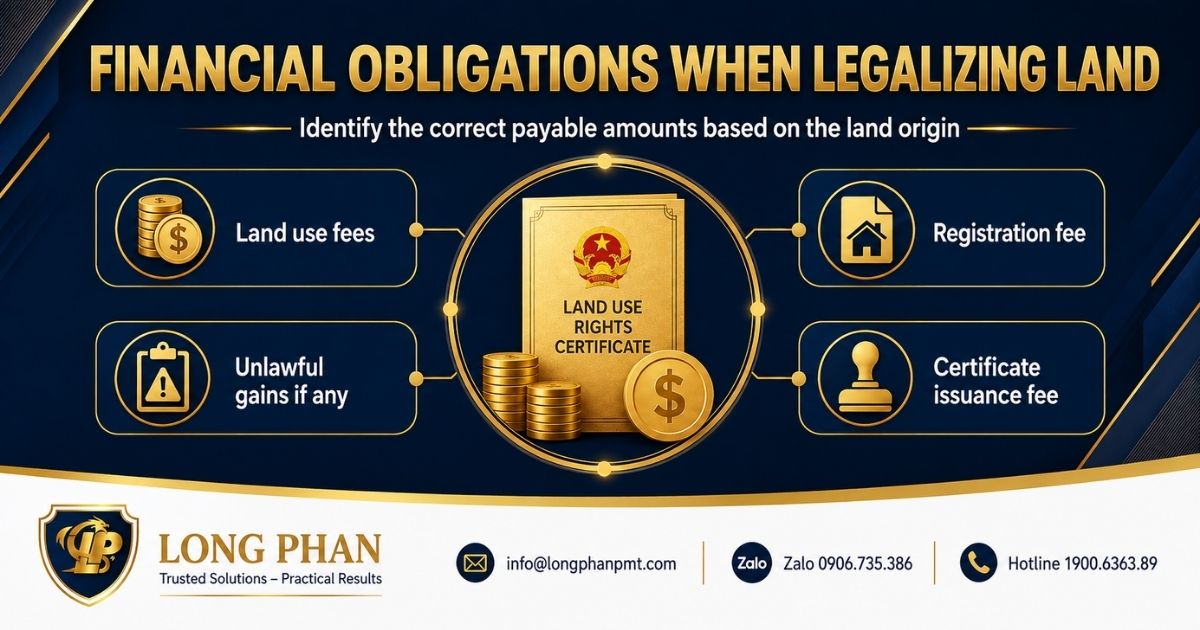
The land use fee payable when changing land use purpose is determined by subtracting the value of the previous agricultural land from the value of the residential land after conversion. Specifically, the following calculations are needed:
If the value of the land before the transfer is greater than or equal to the value of the land after the transfer, then no land use fee needs to be paid.
(Legal basis: Clauses 1 and 2 of Article 8 Decree 103/2024/ND-CP)
Properties near industrial zones have great potential due to the real housing demand from professionals and workers. However, it is necessary to choose a location within a 1-3 km radius to avoid noise and dust pollution, while still being close enough to generate income from building rental properties or providing supporting services.
To determine the correct market price, it is necessary to compare at least 5–10 similar properties in the same area, with similar factors such as location, size, legal status, condition, and surrounding amenities. From this data, an average price can be calculated as a reference point. In addition, it is advisable to combine information from land management agencies, state-issued land price lists, and data from reputable real estate exchanges to gain a multifaceted perspective.
Buyers can conduct basic legal checks themselves, but to ensure safety and avoid overlooking risks such as zoning issues, disputes, or restrictions on land use rights, it is advisable to use professional legal consulting services, especially for high-value transactions.
Selecting real estate on a budget while ensuring appreciation potential demands a combination of financial calculation, market assessment, and strict control over legal factors.
Should you require in-depth support, please contact Long Phan Consulting Company via Hotline 1900636389 for swift and accurate advice on selecting real estate to optimize profits and mitigate risks.
>>> See more: Approaches to Sourcing Foreign Real Estate Buyers