
Property authorization for overseas Vietnamese is a critical process. It enables expatriates to conduct real estate transactions in Vietnam through a representative. This property authorization mechanism provides a convenient path for overseas Vietnamese to own assets in their homeland. This article provides a detailed guide for successful property authorization.

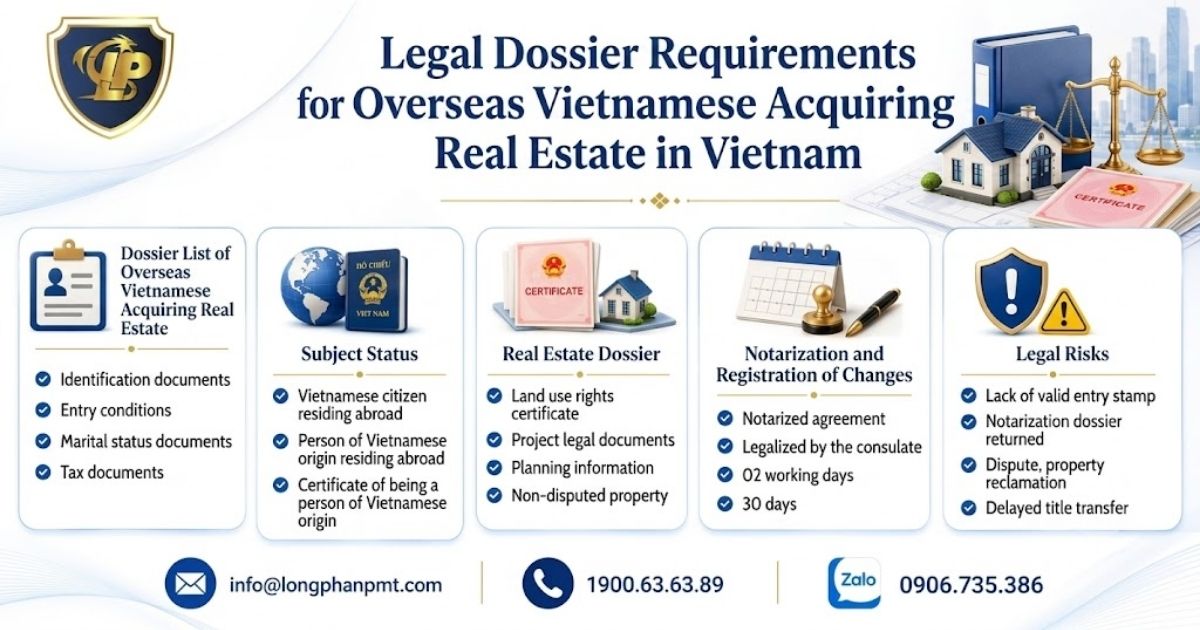
Preparing a complete dossier is the first step in property authorization for overseas Vietnamese. To ensure legality and facilitate the transaction, you must collect documents according to Vietnamese law. This documentation forms the basis for competent authorities to verify the principal’s rights and property details, ensuring the transaction is transparent and lawful.
For an overseas Vietnamese to authorize a property purchase, proving eligibility to own real estate in Vietnam is a prerequisite. Current laws differentiate the required documents based on the principal’s citizenship status. This ensures only legally permitted individuals engage in property transactions, protecting all parties’ legitimate interests.
>>> See more:

Documents related to the real estate are indispensable for property authorization. Preparing these papers accurately allows the agent to execute procedures related to the property purchase. They serve as evidence of the asset’s information and status, securing the principal’s interests.
The process for property authorization must comply with current regulations, notably the Civil Code 2015 and the Law on Notarization 2014. For overseas Vietnamese, this authorization is typically performed through an agent in Vietnam.
Article 138 of the Civil Code 2015 states: “An individual or legal entity may authorize another individual or legal entity to establish and perform civil transactions.” This provision allows individuals to authorize others for civil transactions, including property purchases and the registration for ownership certificates. For overseas Vietnamese to authorize a purchase and obtain a certificate in their name, the process involves specific steps.
Below is the detailed procedure:
Step 1: Prepare the Necessary Dossier
Collect a complete set of legally required documents. This includes:
Step 2: Draft the Authorization Document
The authorization document is the core of this transaction. Ensure its contents are:
Step 3: Notarize the Authorization Document
After drafting, the document must be notarized to become legally valid. If you are in Vietnam, this is done at a competent Public Notary Office or Private Notary Office. The notary will verify the parties’ identification and the document’s content before certifying the signatures and legal compliance.
Step 4: Execute Transactions and Procedures in Vietnam
The agent will use the notarized authorization document to represent you in all property transactions and procedures in Vietnam. This includes:
>>> See more at: Do the authorization contracts need to be notarized or authenticated?
For overseas Vietnamese unable to return to Vietnam, executing the property authorization at a Vietnamese diplomatic or consular mission abroad is the solution. This ensures the legal validity of the authorization document. The notarization function of these missions is specified in Article 78 of the Law on Notarization 2014.
If you are a Vietnamese person residing abroad and wish to authorize a property purchase, you can certify the authorization document at a Vietnamese diplomatic or consular mission.
The detailed process is as follows:
Step 1: Draft the Authorization Document
First, draft a power of attorney for the property purchase. This document must specify the scope of authorization, such as signing contracts, applying for the Certificate of Land Use Rights (Red/Pink Book), and other related tasks. Professional assistance in drafting is recommended to ensure the document is complete, accurate, and effective under the Civil Code 2015.
Step 2: Submit and Certify at the Diplomatic/Consular Mission
Take the drafted document to the Embassy or Consulate of Vietnam in your country of residence. A consular or diplomatic officer will certify the document. Under Article 78 of the Law on Notarization 2014, these missions are authorized to certify authorization documents, but not to directly notarize real estate transfer contracts in Vietnam.
Step 3: Transfer the Authorization Document to Vietnam
After certification, send the document to your agent in Vietnam. Ensure the transfer is secure and timely so the agent can proceed with the next steps.
Step 4: The Agent Executes Procedures in Vietnam
Upon receiving the certified document, the agent in Vietnam will act on your behalf. This includes:
When undertaking property authorization for overseas Vietnamese, pay close attention to several factors to protect your interests and mitigate risk. Understanding the scope, form, and duration of the power of attorney will lead to a clear and effective plan. These considerations are based on the Civil Code 2015 and Land Law 2024.
The scope is the core of the property authorization document. Define precisely the powers you grant to the agent. This prevents the agent from overstepping authority and avoids disputes. The scope can include:

Under the Civil Code 2015, authorization can take the form of a unilateral power of attorney or a bilateral authorization contract. The chosen form affects the rights and obligations of the parties.
To ensure absolute security, the agent is not permitted to sub-authorize (secondary authorization) any third party without explicit written consent from the principal. This is critical to:
A clear agreement on remuneration must be specified in the authorization document or contract. This transparency protects the agent’s legitimate interests and maintains a clear relationship. Remuneration can be structured as:
The term of authorization must be clearly defined in the document. This sets the period during which the agent can exercise the granted powers. The term can be:
If no term is specified, the authorization is effective until terminated by law, such as unilateral termination by one party under the Civil Code 2015.
Despite careful planning, disputes can arise during the property authorization process. Specifying a clear dispute resolution mechanism in the authorization document is an effective preventative measure. Common forms include:
Long Phan Consulting Company provides professional services to assist overseas Vietnamese with property authorization in Vietnam. Our team of experienced lawyers and experts offers comprehensive solutions to ensure your transactions are secure and compliant with the law.
Our services include:
Overseas Vietnamese must retain Vietnamese nationality to enjoy the same full land use rights as domestic citizens. Individuals of Vietnamese origin without Vietnamese nationality may purchase housing attached to residential land if permitted to enter Vietnam.
The Land Law 2024 expands the types of land that overseas Vietnamese (with Vietnamese nationality) can receive through transfer, including agricultural and non-agricultural land, with no residential land area limit.
Yes, if you are a Vietnamese citizen holding Vietnamese nationality, you can authorize a relative in Vietnam to purchase agricultural land under the Land Law 2024.
The document must clearly state the specific rights granted to the agent, such as signing contracts, submitting applications for land use right certificates, and other related procedures.
Yes, notarization is mandatory to ensure the document’s validity, certify the signatures, and confirm the legality of its content.
You can have the document certified at a Vietnamese Embassy or Consulate in your country of residence, according to Article 78 of the Law on Notarization 2014.
The certified document must be sent to the agent in Vietnam to proceed with the property purchase and title registration procedures.
The agent cannot sub-authorize a third party unless explicitly permitted in writing by the principal.
Yes, it is advisable to clearly state the remuneration terms in the authorization document or contract to ensure transparency and protect the agent’s rights.
Long Phan Consulting Company is committed to delivering high-quality service, helping clients conduct property authorization transactions with transparency, security, and efficiency. Contact us via our hotline at 1900.63.63.89 for detailed and expert consultation on the process of property authorization for overseas Vietnamese. We are ready to resolve any issues and ensure the success of your real estate investments.