Real estate price trend analysis should be conducted before signing, extending, or renegotiating a lease, because a seemingly competitive rent may hide management charges, VAT, fit-out costs, reinstatement duties, and future escalation exposure. Enterprises should translate market findings into precise lease terms on rent adjustment limits, review periods, renewal options, sublease rights, and early termination mechanisms, instead of depending only on isolated quotations. With Real Estate Brokerage insight and advisory support from Long Phan Consulting, businesses can control total occupancy costs and build a safer lease structure.
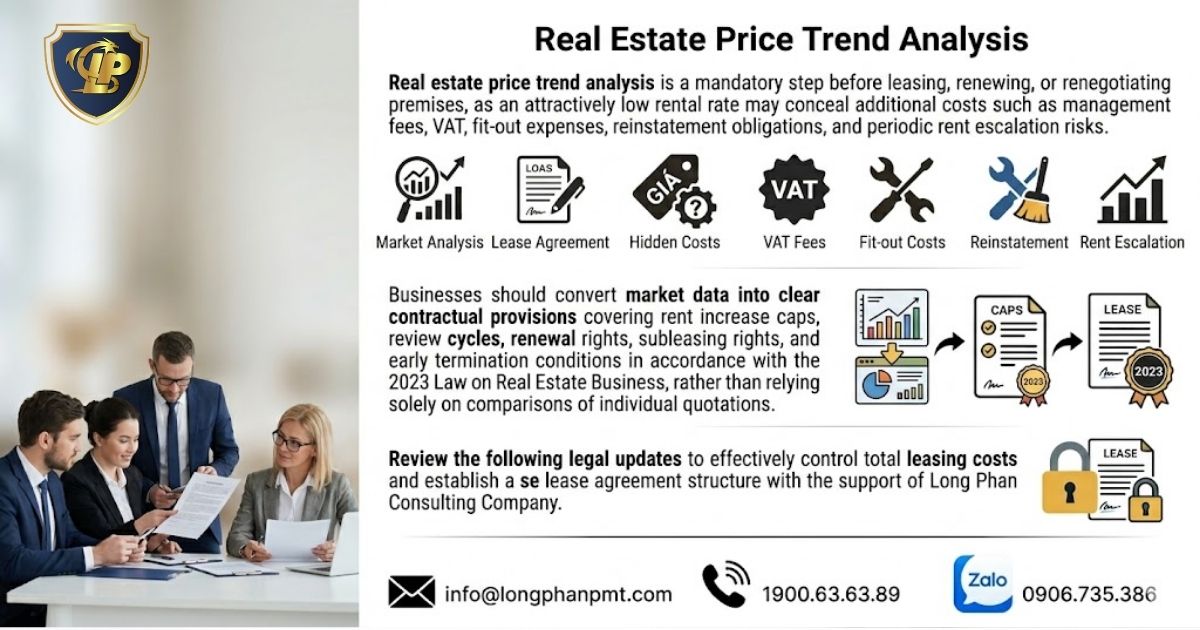
Important legal note:
Real estate price trend analysis empowers enterprises to avoid securing premises based solely on isolated quotes from landlords or brokers. Actual rental rates are influenced by supply, occupancy rates, business sectors, infrastructure, foot traffic, and lease term commitments.
For retail chains, F&B outlets, clinics, or corporate offices, the primary risk is not the isolated “monthly rent.” The true risk lies in the total lease cost throughout the Commercial Lease Agreement lifecycle, encompassing operations, renovations, licensing, and Exit Costs.
Enterprises must quantify the following elements prior to negotiations:
Therefore, price analysis transcends mere market surveying. It serves as the foundation for establishing a Rent Cap, a Rent Review Cycle, and binding early termination conditions within the contract.
Corporate tenants must anticipate that property owners may pass increased land-related costs into the rental price. This risk is especially pronounced in multi-year contracts containing vague rent adjustment clauses.
The State Land Price Framework issued by the Provincial People’s Committee under the previous regime remains applicable until December 31, 2025, pursuant to Clause 1, Article 257 of the Land Law 2024. Entering the new cycle, the State Land Price Framework will be constructed, adjusted, amended, supplemented annually, and published for application starting January 1 of the following year, pursuant to Clause 1, Article 16 of Decree No. 71/2024/ND-CP.
The commercial impact lies in the landlord’s input costs. The annual State Land Price Framework is utilized to calculate land rent when the State leases land with annual rental payments, pursuant to Point b, Clause 1, Article 159 of the Land Law 2024. Consequently, the commercial lease requires a clear Rent Cap and rent review formula to block anomalous cost fluctuations.
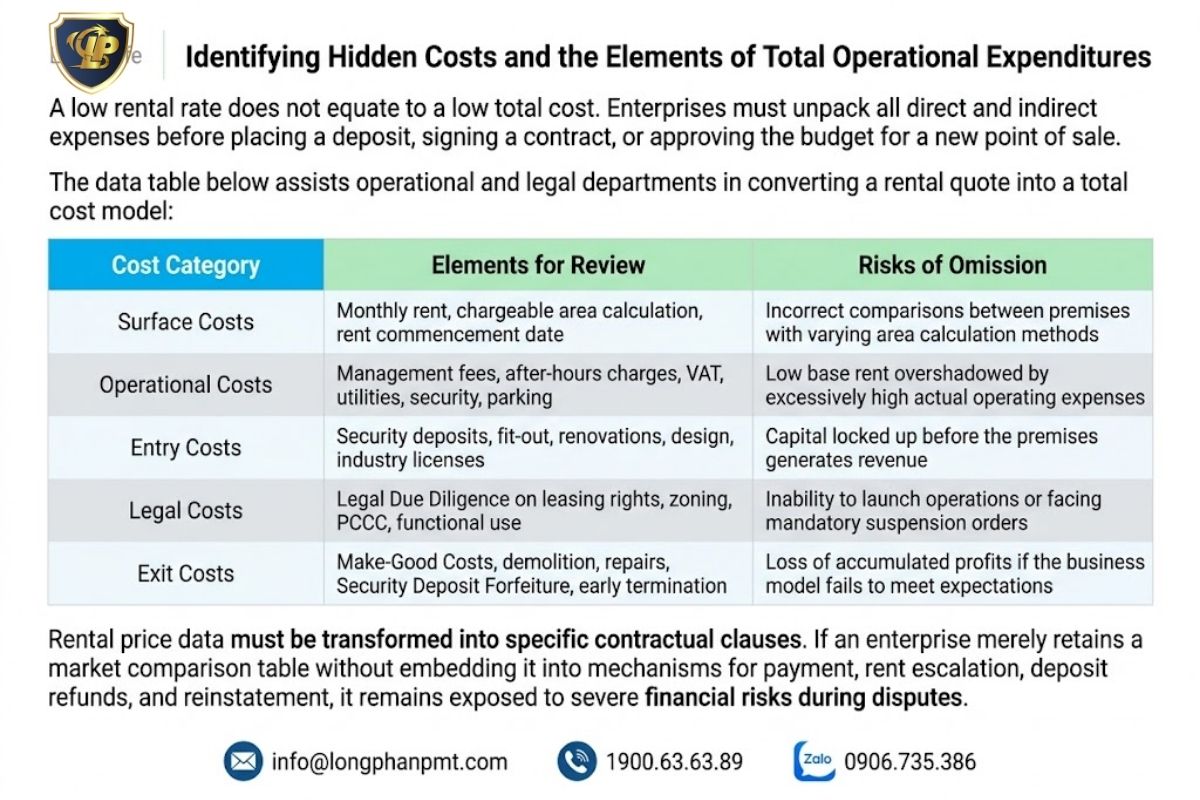
A low rental rate does not equate to a low total cost. Enterprises must unpack all direct and indirect expenses before placing a deposit, signing a contract, or approving the budget for a new point of sale.
The data table below assists operational and legal departments in converting a rental quote into a total cost model:
| Cost Category | Elements for Review | Risks of Omission |
| Surface Costs | Monthly rent, chargeable area calculation, rent commencement date | Incorrect comparisons between premises with varying area calculation methods |
| Operational Costs | Management fees, after-hours charges, VAT, utilities, security, parking | Low base rent overshadowed by excessively high actual operating expenses |
| Entry Costs | Security deposits, fit-out, renovations, design, industry licenses | Capital locked up before the premises generates revenue |
| Legal Costs | Legal Due Diligence on leasing rights, zoning, PCCC, functional use | Inability to launch operations or facing mandatory suspension orders |
| Exit Costs | Make-Good Costs, demolition, repairs, Security Deposit Forfeiture, early termination | Loss of accumulated profits if the business model fails to meet expectations |
Rental price data must be transformed into specific contractual clauses. If an enterprise merely retains a market comparison table without embedding it into mechanisms for payment, rent escalation, deposit refunds, and reinstatement, it remains exposed to severe financial risks during disputes.
Analyzing real estate price trends must stem from comparable data, not market sentiment. Enterprises must isolate location, business models, foot traffic, lease terms, and accompanying costs before evaluating a premises.
The analysis process should be standardized into three steps for joint utilization by site development, operations, and legal departments:
Lacking standardization, enterprises risk falsely comparing premises offering low rent but demanding high operational costs. Consequently, leasing decisions can distort the entire cash flow model.
Enterprises should not compare rental prices across premises merely because they share a city. Rental rates must be stratified according to central proximity, infrastructure, customer accessibility, and the intended business function.
Four distinct data layers should be isolated:
Legally, the land price constitutes the monetary value of land use rights per unit of land area, pursuant to Clause 19, Article 3 of the Land Law 2024. Therefore, rental data must be cross-referenced against land characteristics, construction functionality, and commercial exploitation viability.
Market data holds value only when integrated into the contract via explicit formulas. The phrase “adjusted according to market price” lacks safety without defining the reference market, data sources, and the tenant’s right of objection.
Enterprises should establish periodic rent adjustment mechanisms using the following structure:
If parties lack an agreement or the agreement remains ambiguous, the rental price is determined by the market price at the location and time of contract execution, pursuant to Clause 2, Article 473 of the Civil Code 2015. This necessitates a specific pricing formula within the contract, preventing disputes after investing in premises renovations.
A legal due diligence check of the property must be conducted before making a deposit or finalizing the rental price. A property with a good price but lacking the necessary legal documentation may prevent a business from opening, obtaining operating licenses, or incurring renovation costs.
The initial inspection checklist should focus on risk groups that are likely to directly impact the right to utilize the site:
The appraisal process not only protects internal legal compliance. It forms the basis for businesses to negotiate prices, deposit refund conditions, termination rights, and liability allocation if the premises are deemed unsuitable for operation.
Businesses should request legal documentation from the lessor before transferring the deposit. The minimum requirement is that the property must have legal ownership or usage rights, and must not be subject to disputes, seizures, or suspensions of transactions.
Construction projects put into business must have documents proving legal ownership and land use rights, be free from ongoing disputes, not be subject to seizure, and not have their transactions suspended, according to Clause 1, Article 14 of the 2023 Law on Real Estate Business. In addition, real estate businesses must publicly disclose real estate information, restrict ownership rights, and regulate mortgage status, according to Clauses 1 and 4, Article 6 of the 2023 Law on Real Estate Business.
For land whose usage period has expired but has not yet been reclaimed, the competent authority will consider extending or reclaiming it according to the new regulations, as stipulated in Clause 2, Article 258 of the 2024 Land Law. This applies to land previously leased from the State. July 1, 2004, The entity wishing to sublease must demonstrate that at least the remaining paid lease term is complete.5 years, according to Clause 1, Article 260 of the 2024 Land Law.
If land records are unclear, businesses should not use low lease prices as a reason to accept the risk. The risk of land reclamation, transaction restrictions, or the inability to lease can disrupt the entire operational plan.
Having legally valid property rights doesn’t necessarily mean it’s suitable for operation. For F&B establishments, clinics, training centers, showrooms, or high-traffic service facilities, the major risks lie in fire safety, building functionality, and obtaining the necessary business permits.
Businesses need to review the following sets of documents before signing a contract:
If the premises do not meet fire safety requirements or functional needs, a low rent becomes commercially unviable. Businesses may lose renovation costs, deposits, and opening dates if the contract does not clearly define responsibilities.
Real estate price trend analysis results must be converted into cash flow protection clauses. If data stops at price comparison tables, enterprises remain exposed to unexpected rent hikes, Security Deposit Forfeiture, or lease non-renewal.
A property lease contract constitutes an agreement where the lessor delivers the property for the lessee to use during a specified term, and the lessee pays rent, pursuant to Article 472 of the Civil Code 2015. For real estate business transactions, the contract must clarify the rental price, payment method, handover deadline, and liability for breaches, pursuant to Clause 2, Article 45 of the Real Estate Business Law 2023.
Enterprises must prioritize clause clusters directly impacting operational budgets:
Robust negotiation structures help enterprises control costs before signing, during operations, and when exiting the premises.
A Rent Cap acts as a mandatory profit margin control tool. Enterprises should never accept fixed escalation clauses or “adjusted to market price” terms without a defined maximum limit.
Safe contractual mechanisms should incorporate three components:
The Rent-Free Fit-Out Period must be codified as a contractual obligation, not merely a commercial incentive. This clause must specify the rent calculation commencement date, construction scope, renovation rights, and remedies for delayed handovers.
For lease-purchase transactions or future-formed real estate, enterprises must enforce statutory payment limits. Advance payments in lease-purchases cannot exceed 50% of the contract value, pursuant to Clause 6, Article 3 of the Real Estate Business Law 2023. Initial payments for future-formed real estate cannot exceed 30% of the contract value, pursuant to Clause 1, Article 25 of the Real Estate Business Law 2023.
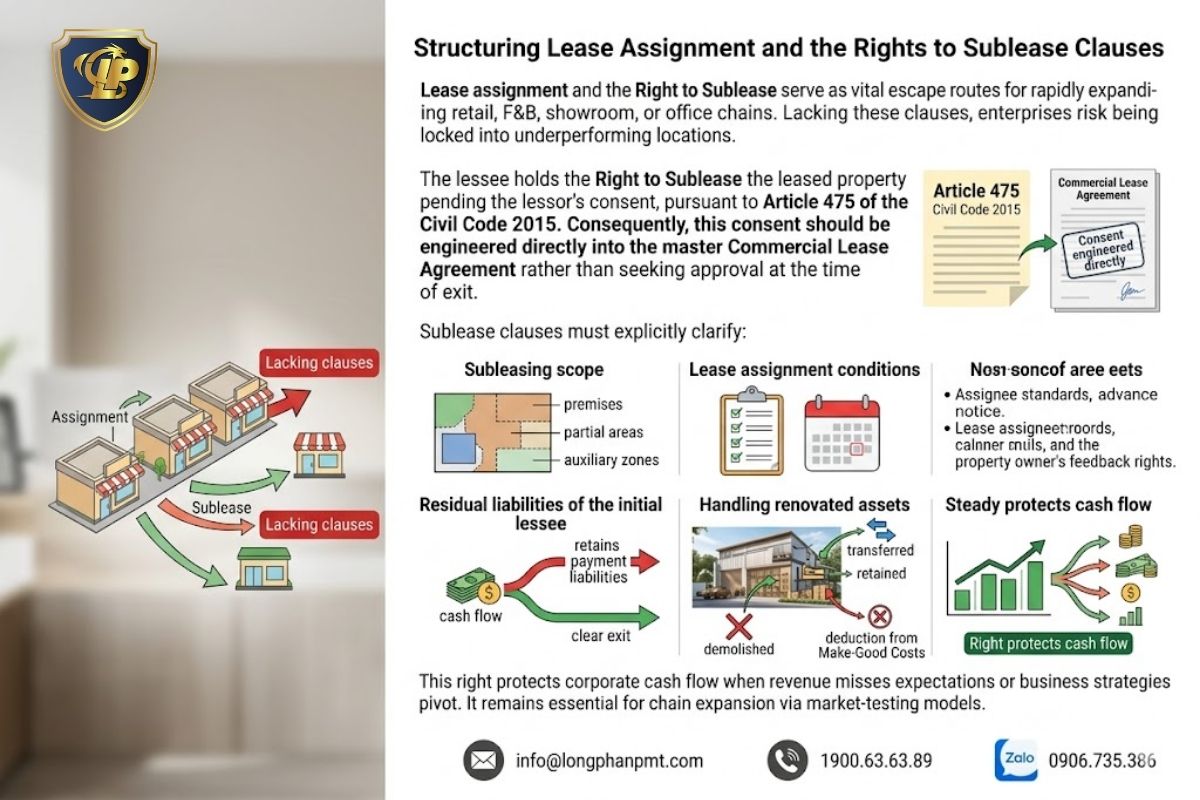
Lease assignment and the Right to Sublease serve as vital escape routes for rapidly expanding retail, F&B, showroom, or office chains. Lacking these clauses, enterprises risk being locked into underperforming locations.
The lessee holds the Right to Sublease the leased property pending the lessor’s consent, pursuant to Article 475 of the Civil Code 2015. Consequently, this consent should be engineered directly into the master Commercial Lease Agreement rather than seeking approval at the time of exit.
Sublease clauses must explicitly clarify:
This right protects corporate cash flow when revenue misses expectations or business strategies pivot. It remains essential for chain expansion via market-testing models.
A Commercial Lease Agreement signed before the Real Estate Business Law 2023 took effect does not automatically require resigning. However, amendment annexes executed after the new law’s effective date require rigorous compliance review.
Real estate business contracts established under the Real Estate Business Law 2014 prior to the effective date of the Real Estate Business Law 2023 shall continue execution under previous regulations. When amending or supplementing contracts after the new law takes effect, the amended contents must comply strictly with the Real Estate Business Law 2023, pursuant to Clause 9, Article 83 of the Real Estate Business Law 2023.
Enterprises renegotiating legacy contracts must examine the following risk points:
Signing a brief annex solely on rental prices risks forfeiting the opportunity to restructure all legal liabilities. The renewal phase acts as the optimal timeframe to renegotiate Rent Caps, assignment rights, and an Exit Strategy.
An Exit Strategy must be engineered upon contract execution, not delayed until the premises operate at a loss. Enterprises must strictly control security deposits, repair costs, Make-Good Costs, and compensation liabilities.
Sanction risks require precise quantification prior to committing to long-term leases:
Lacking clear quantification of these risks, enterprises may suffer Exit Costs far exceeding the initial low rental benefits.
The obligation to restore premises conditions frequently triggers severe disputes during lease termination. Demolition, repair, and restoration expenses can rapidly accumulate into massive Make-Good Costs.
The contract must document the initial handover condition using handover minutes, photographs, technical floor plans, and asset inventories. This establishes the baseline to determine which items require Reinstatement Costs and which assets can be retained or transferred.
Enterprises must explicitly regulate the following components:
Detailed reinstatement clauses directly minimize the risk of Security Deposit Forfeiture. For F&B chains, clinics, or showrooms, this provision serves as a vital safeguard for exit budgets.
The right to unilaterally terminate must function as a defense mechanism when premises become unusable. Such scenarios typically arise from functional mismatches, lacking Fire Prevention and Fighting (PCCC) Approvals, or lessor handover breaches.
Lessees hold the right to unilaterally terminate the contract if lessors deliver properties failing agreed conditions or rendering them unusable, pursuant to Point b, Clause 2, Article 20 of the Real Estate Business Law 2023. Enterprises must stipulate that “unusable” includes failing to secure operating licenses due to the lessor’s legal faults.
A safe Early Termination mechanism requires:
The Statute of Limitations for Initiating a Lawsuit regarding contract disputes is 03 years from the date the entitled party knows or should know their rights were violated, pursuant to Article 429 of the Civil Code 2015. Enterprises must archive evidence starting from handover, renovation, and operations.
A Commercial Lease Agreement transcends a mere pricing arrangement; it serves as a sophisticated risk allocation framework balancing market expenditures, legal premises compliance, operational rights, and the tenant’s Exit Strategy. Vietnam’s evolving legal landscape demands rigorous foresight. Long Phan Consulting Company assists foreign enterprises in auditing leasing data, executing Legal Due Diligence, and transforming real estate price trends into enforceable contractual clauses. This strategic approach empowers executive boards to maintain cash flow visibility, enforce a strict Rent Cap, and neutralize dispute risks long before contract execution.
Core advisory operations include:
Clients may forward their draft lease contracts, rental quotes, and the premises’ legal dossiers via Email at info@longphanpmt.com or via Zalo/WhatsApp (+84 906 735 386) for a preliminary legal evaluation by our attorneys.
The process of “analyzing real estate price trends” and negotiating commercial lease agreements always involves many complex legal risks arising from operational practices. A thorough understanding of current regulations helps investors establish a solid defense mechanism and optimize hidden costs. Core legal issues from a business compliance perspective are thoroughly addressed through in-depth legal grounds.
Yes, businesses have every right to claim compensation for lost expected profits. When the lessor breaches contractual obligations causing damage, the lessor must compensate for all actual material damages incurred, as well as any commercial benefits that the lessee would have been entitled to, in accordance with Clauses 1 and 2 of Article 419 of the 2015 Civil Code. Businesses need to retain valid revenue documents to prove the extent of this loss of commercial benefits.
The maximum time limit for a business to file a lawsuit is 3 years. The People’s Court has jurisdiction to hear and resolve disputes arising from lease agreements at the request of the parties to protect their rights, with a statute of limitations of 3 years from the date the person entitled to claim knows or should have known that their legitimate rights and interests have been violated, as stipulated in Article 429 of the 2015 Civil Code.
Yes, the lessee has the full right to unilaterally terminate the contract in this situation. The lessee has the right to unilaterally terminate the contract if the lessor delivers the property in a condition not as agreed upon or if the property is unusable, according to Point b, Clause 2, Article 20 of the 2023 Law on Real Estate Business. A property that does not meet fire safety standards is considered unusable for business purposes as initially agreed.
The maximum initial payment rate is 30 percent of the contract value. For transactions involving properties under construction, the initial payment must not exceed 30 percent of the contract value, including the deposit, as stipulated in Clause 1, Article 25 of the 2023 Law on Real Estate Business. Investment enterprises need to closely monitor this disbursement rate to ensure legal compliance and minimize the risk of capital misappropriation.
The new rental price will be determined based on the market price at the exact location and time of signing the adjustment agreement. An exception to this is when the parties have no agreement or an unclear agreement; in such cases, the rental price will be based on the market price at the exact location and time of signing the contract, as stipulated in Clause 2, Article 473 of the 2015 Civil Code. Businesses need to establish a clear pricing formula to avoid potential disputes.
The property owner is obligated to return the deposit and pay an additional penalty for breach of contract. Conversely, if the party receiving the deposit refuses to fulfill the contract, they must return the deposited property plus a penalty equivalent to the value of that property, unless otherwise agreed upon by both parties, as stipulated in Clause 2, Article 328 of the 2015 Civil Code. Investors should clearly specify this penalty in the initial deposit agreement.
Real estate price trend analysis enables enterprises to control total leasing expenditures, uncover hidden costs, evaluate premises legal compliance, and translate market data into enforceable contractual clauses. As the Real Estate Business Law 2023 and the new State Land Price Framework elevate transparency requirements, corporate tenants must audit leasing rights, PCCC compliance, functionality, Rent Caps, renewal rights, and their Exit Strategy prior to disbursing deposits. To mitigate the risk of Security Deposit Forfeiture, unforeseen rent escalations, or operational paralysis, contact the senior corporate attorneys at Long Phan Consulting Company immediately via Hotline 1900636389.
📚 This article is provided with professional consultation based on the following legal framework: