
Under the Law on Enterprises and Businesses: Legal Nature and Conflict Risks of the Legal Representative Position is more than a mere administrative title; it is a pivotal role that dictates a company’s ability to execute transactions, resolve disputes, and safeguard corporate assets against third parties. Risks materialize when signing authority is not strictly governed by the Corporate Charter, internal resolutions, and financial regulations. In such environments, friction between capital contributors, executive management, and controlling shareholders can escalate into tangible legal liabilities.
Important legal note:
The legal representative of a company is not just an administrative title. This position directly determines the ability to establish transactions, handle disputes, and protect the company’s assets against third parties.
Risks arise when the power to sign is not controlled by the company’s charter, internal resolutions, and financial regulations. In such cases, conflicts between investors, managers, and controlling shareholders can translate into actual legal damages.
The legal representative is an individual who, on behalf of the enterprise, exercises the rights and obligations arising from transactions. This person also represents the enterprise before arbitration panels, courts, and other competent authorities as stipulated in Clause 1, Article 12 of the 2020 Enterprise Law.
The core powers of this position should be viewed from a risk control perspective:
Businesses are liable for civil rights and obligations established by their representatives acting on behalf of the legal entity, as stipulated in Clause 1, Article 87 of the 2015 Civil Code. Therefore, selecting a representative is a management decision, not a formality.
Conflicts typically emerge when the authority to sign, control capital, and manage operations are not aligned within the same interest structure. For instance, a founder may retain signing rights without holding a controlling stake, leading to disputes with majority shareholders.
In family-owned businesses or multi-founder startups, a representative might utilize their signing power to control cash flows, legal dossiers, or material contracts. Without a robust approval mechanism, shareholders often only discover risks after a detrimental transaction has already been executed. A more severe risk occurs when the representative holds a personal interest in a partner company, which serves as the foundation for related-party transactions. These must be strictly regulated via the Charter, internal resolutions, and pre-approval workflows.
The structure of the legal representative role must reflect the ownership model, the degree of decentralization, and the capacity for transaction control. For startups with multiple founders, family-owned enterprises, or companies preparing for capital injection, the choice between a single representative and multiple representatives creates vastly different governance outcomes.
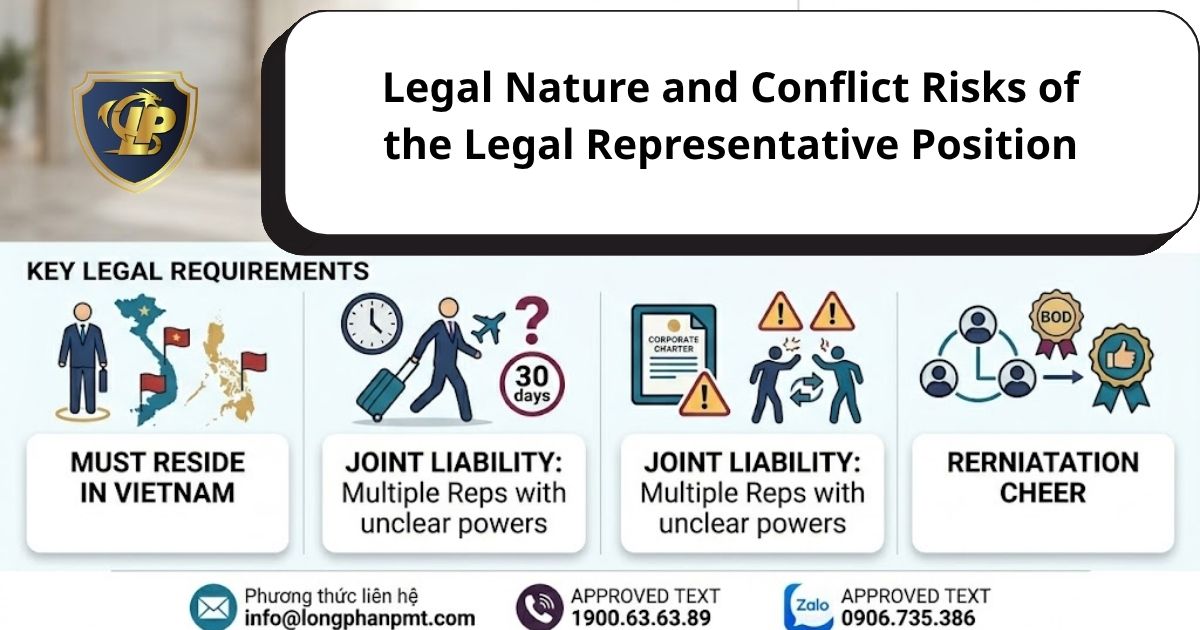
While Vietnamese law allows Limited Liability Companies and Joint Stock Companies to appoint one or more legal representatives under Clause 2, Article 12 of the 2020 Law on Enterprises, the entity must always maintain at least one representative residing in Vietnam pursuant to Clause 3, Article 12 of the same Law.

An appropriate model should be selected based on operational capacity, ownership ratios, individual reputation, compliance history, and the ability to manage conflicts of interest. A legal representative should not be chosen solely based on a director title or internal relationships.
| Model | Advantages | Risks | Suitability |
| Single Representative | Rapid decision-making, centralized responsibility, and simplified control over legal dossiers. | High dependency on one individual; potential for operational paralysis if the individual is uncooperative or absent. | Small companies, simple shareholder structures, or where the owner directly manages operations. |
| Multiple Representatives | Operational flexibility; allows for decentralization across finance, legal, and business departments. | High risk of overlapping signing authority; difficulty in determining final accountability. | Multi-founder startups, family businesses, or enterprises with institutional investors and multiple branches. |
The multiple representative model is only secure when the Corporate Charter explicitly defines specific titles, the scope of signing authority, and coordination mechanisms. Without these safeguards, flexibility can quickly devolve into jurisdictional conflict.
When an enterprise utilizes multiple representatives but the Charter fails to clearly partition their respective rights and obligations, each individual may be deemed to have full authority when dealing with third parties. Consequently, it becomes difficult for the enterprise to repudiate an unfavorable transaction.
The primary financial risk lies in the mechanism of joint and several liability. All legal representatives must be held jointly and severally liable for any damages caused to the enterprise if the Charter does not clearly delineate their powers, pursuant to Clause 2, Article 12 of the 2020 Law on Enterprises. Therefore, the Charter must specify the number, management titles, and specific duties of each representative, as this is a mandatory requirement under Point g, Clause 2, Article 24 of the 2020 Law on Enterprises.
The company’s charter is the ultimate tool for controlling power within the business. If this document only lists job titles without assigning transaction authority, the representative may wield signing power beyond the shareholders’ expectations.
An effective defense mechanism must combine the charter, financial regulations, internal resolutions, and contract approval process. The goal is to control the transaction beforehand, avoiding reactive responses after the asset has been subject to collateral.
Businesses need to define the authority of representatives to sign transactions according to each value level and type of asset. The charter must include provisions on the rights and obligations of the legal representative as stipulated in Point g, Clause 2, Article 24 of the 2020 Enterprise Law.
The following items should be included in the charter or financial regulations to control signing authority:
If these mechanisms exist only through verbal agreements, the ability to demonstrate the limitations of authority will be weak. Businesses need to translate internal limitations into written governance documents that can be presented to banks and partners.
Transactions with related parties represent the highest risk area for agents. The signatory may prioritize personal interests, the interests of an affiliated company, or a close-knit group of shareholders over the interests of the business.
Contracts between the company and its managers, legal representatives, or related parties must be approved by the competent governing body. This authority rests with the Board of Members, Board of Directors, or General Meeting of Shareholders, as stipulated in Clause 1, Article 86 and Clause 1, Article 167 of the 2020 Enterprise Law.
If a transaction is not properly approved, the risk is not limited to internal disputes. The contract may be declared invalid by the Court, and the signatory and related parties may be jointly liable for compensation in accordance with Clauses 4 and 5 of Article 86 and Clause 5 of Article 167 of the 2020 Enterprise Law.
Therefore, the regulations need to clearly define the criteria for identifying stakeholders, the mechanism for disclosing interests, and the voting procedure. Stakeholders should not participate in the decision-making process for approving such transactions.
Internal limitations are only a strong defense when they are clearly designed and reasonably publicized. If third parties are unaware of these limitations, the business may have difficulty denying adverse transactions.
A representative is only permitted to establish and execute transactions within the scope of their representation as stipulated in the company’s charter or decisions of competent authorities, as per Clause 1, Article 141 of the 2015 Civil Code. This provides the legal basis for businesses to control their signing authority.
Transactions exceeding the scope of representation this does not create any rights or obligations for the business regarding the portion exceeding its authority. However, the business, they may still be bound if they consent, are aware of it but do not object, or are at fault for causing the third party to be unaware of the overstepping of authority, as stipulated in Clause 1, Article 143 of the 2015 Civil Code.
To mitigate this risk, businesses should clearly define the authorization levels for banks, major partners, and the legal department. All significant contracts should include evidence of internal prior approval before signing.
When internal conflicts compromise cash flow, legal dossiers, or signing authority, the enterprise must transition from informal negotiations to formal governance mechanisms. Replacing a Legal Representative in Vietnam requires a valid internal resolution followed by the mandatory registration of changes with the competent authorities.
The objective is not merely a change in personnel; the enterprise must preserve representational integrity, prevent detrimental transactions, and avoid legal vacuums when interacting with partners, financial institutions, or government agencies.
The governing body should consider the removal, dismissal, or replacement of a representative when signs of power abuse, failure to hand over records, loss of trust, or conflicts of interest emerge. This is a strategic management decision aimed at mitigating damages before a dispute escalates.
Pursuant to Point b, Clause 1, Article 13 of the 2020 Law on Enterprises, a representative must remain loyal to the interests of the enterprise and is prohibited from misusing their position, information, or business opportunities for personal gain. Any breach of this fiduciary duty renders the representative personally liable for damages to the company under Clause 2, Article 13.
Furthermore, if a company has only one representative and that individual is absent from Vietnam for more than 30 days without delegating authority, the governing body be it the owner, the Members’ Council, or the Board of Directors must appoint a replacement pursuant to Clause 5, Article 12 of the 2020 Law on Enterprises. In cases of severe deadlock, a Court or competent jurisdictional body may appoint a representative to ensure litigation continuity under Clause 7, Article 12.
Replacing a representative is a multi-step legal process that involves the synchronization of internal documents and external filings. The process should follow this standardized sequence:
Regarding transitional provisions, pursuant to Article 121 of Decree No. 168/2025/ND-CP, an ERC containing an old ID number remains valid and does not require immediate replacement solely due to an ID change. However, when a change of representative occurs, the enterprise is mandated to update all dossiers to the current ERC format according to Point b, Clause 2, Article 119 of the same Decree.
Controlling a legal representative requires a sophisticated integration of the Corporate Charter, internal resolutions, financial regulations, and statutory filings. Long Phan Consulting Company assists enterprises in designing bespoke governance frameworks that eliminate the risks of power abuse, conflicts of interest, and control disputes. For companies preparing for capital injection or navigating multi-shareholder dynamics, we provide the technical expertise to secure signing rights before critical transactions occur.
Our comprehensive governance and risk control services include:
For a preliminary evaluation of your corporate governance structure and representational risks, please submit your current dossiers to our experts via Email: info@longphanpmt.com or WhatsApp/Zalo: +84 906 735 386.

Establishing a mechanism to control the “company’s legal representative” is a crucial requirement for protecting the company’s assets and operational stability. Risks related to transactions exceeding authority or conflicts of interest often arise from shortcomings in the company’s charter regarding the delegation of authority. Effective management of specific legal situations helps investors prevent unnecessary internal disputes.
All representatives are jointly liable for damages caused to the business if the company’s charter does not clearly specify the division of rights and obligations. This regulation aims to protect the business’s interests against abuses of power or irresponsible management. This is based on Clause 2, Article 12 of the 2020 Enterprise Law
Businesses are required to maintain at least one legal representative residing in Vietnam throughout their operation. This regulation aims to ensure continuity of representation in establishing transactions and working with state agencies. This is stipulated in Clause 3, Article 12 of the 2020 Enterprise Law.
The Board of Members or the Board of Directors must immediately appoint a replacement if the sole representative is absent for more than 30 days without authorization. The appointment of a replacement also applies when the representative is detained or prohibited from holding office by a court. This authority is stipulated in Clause 5, Article 12 of the 2020 Enterprise Law.
Contracts between a company and its representatives or related parties must be approved by the Board of Directors or the Board of Members with proper authority. Without approval, the transaction risks being declared invalid by the Court, and the signatory will be jointly liable for damages. This regulation is stipulated in Clause 1, Article 86 and Clause 1, Article 167 of the 2020 Enterprise Law.
Businesses can continue to use their old business registration certificates containing the old ID card information without being required to immediately go through the renewal procedure. However, businesses are required to update their new identification number when other changes to the business registration details occur. This is in accordance with Article 121 of Decree No. 168/2025/ND-CP.
The representative is personally liable for damages when violating the duty of loyalty or using the company’s assets and information for personal gain. Liability for compensation also arises if the representative fails to properly perform their assigned rights and obligations, causing losses to the company. This legal basis is established in Clause 2, Article 13 of the 2020 Enterprise Law.
The Legal Representative in Vietnam must be selected and managed as a critical safeguard for corporate assets and internal control. Enterprises must standardize their Charters, define representational thresholds, and strictly follow statutory registration procedures for any personnel changes. Proactive governance prevents ultra vires acts and costly shareholder disputes that can jeopardize the company’s financial health. For strategic oversight and compliance management, contact our hotline at 1900636389 for expert assistance from Long Phan Consulting Company
📚 This article is provided with professional consultation based on the following legal framework: