
Real estate brokerage fees when selling housing and land must be clearly determined to help owners and investors proactively plan civil transaction costs. Brokerage activities play a role in connecting supply and demand, ensuring the physical asset’s liquidity on the market. Grasping legal regulations and commercial practices assists clients in optimizing profits. In the following article, Long Phan Consulting Company provides insights into the factors affecting the determination of real estate brokerage fees when selling properties.

Before examining how real estate brokerage fees are applied in practice, it is necessary to understand what a real estate broker is and the role they play in property transactions.
Real estate brokerage is a commercial intermediary activity in the real estate sector. Under Clauses 2 and 11, Article 3 of the 2023 Law on Real Estate Business, real estate brokerage is a form of real estate service business. It involves acting as an intermediary for parties in buying, selling, transferring, leasing, subleasing, or lease-purchasing real estate. The broker performing this act does not directly participate in the contract as a buyer or seller but plays a coordinating role in the transaction.
The scope of professional, full-package apartment brokerage services encompasses multiple stages, from surveying to finalizing procedures. This work requires a profound understanding of the apartment market in urban areas and the ability to analyze actual planning data. Pursuant to Article 62 of the 2023 Law on Real Estate Business, specific activities in the real estate brokerage sector include:
Vietnamese law strictly regulates the operating conditions for subjects conducting real estate brokerage services in general and apartment brokerage services in particular. These regulations aim to standardize service quality and protect consumers. The primary legal basis governing this issue is the 2023 Law on Real Estate Business and its guiding documents.
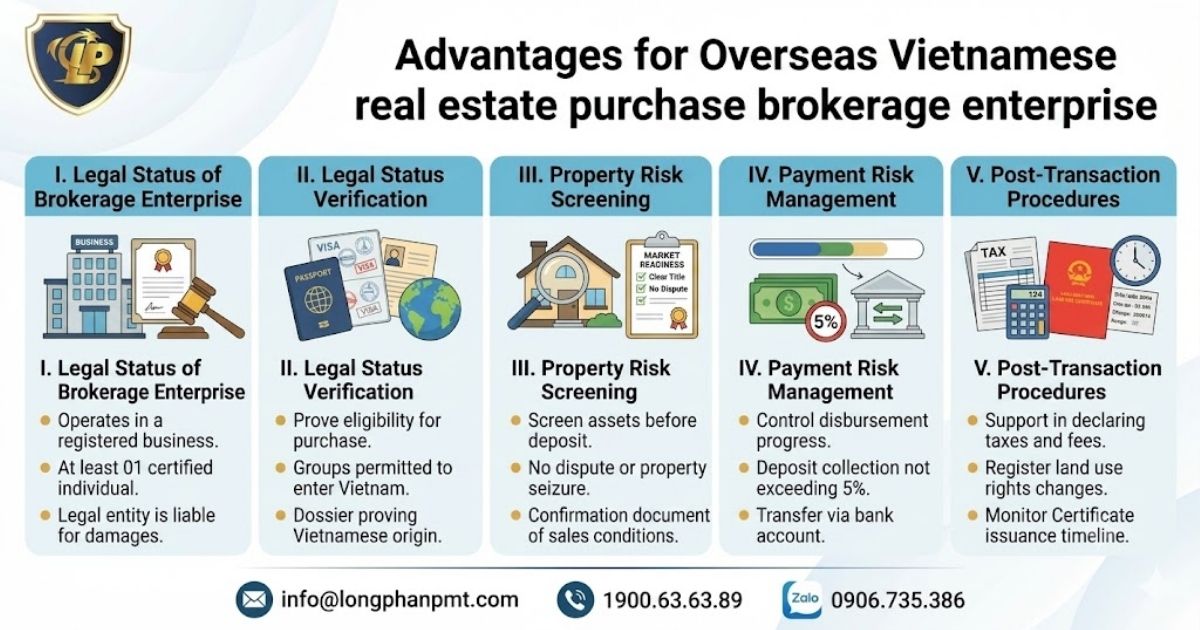
Under Article 61 of the 2023 Law on Real Estate Business, organizations and individuals conducting real estate brokerage services must meet the following conditions:
For Organizations (Enterprises)
For Individuals Practicing Brokerage
Complying with these conditions is a mandatory requirement for a brokerage unit to operate legally. Clients have the right to request the brokerage unit to provide legal evidence proving full compliance before transacting.
>>>See more: Authorization for Real Estate Brokers to Sign Contracts
When executing housing and land transactions, determining the brokerage fee is a common concern to ensure reasonable and transparent costs. The costs are regulated as follows:
First, Remuneration in Real Estate Brokerage: Pursuant to Article 63 of the 2023 Law on Real Estate Business, brokers receive remuneration as agreed upon by the parties:
Second, Commissions when Executing Real Estate Brokerage: Under Article 63 of the 2023 Law on Real Estate Business:
>>>See more: Role of Real Estate Brokers in Land Transactions
Determining which party is responsible for paying the real estate brokerage fees is a crucial point that must be agreed upon.
The obligation to pay the fee usually falls on the party hiring the brokerage service, most commonly the seller or the lessor. However, the law allows parties to freely agree that the buyer pays the fee or that both parties share the cost (Clause 2, Article 63, Law on Real Estate Business 2023). In specific segments like commercial space leasing, the lessee may pay the remuneration to the broker to find a prime location.
Clients must clearly record the subject responsible for payment in the written agreement or brokerage contract to avoid future disputes. Without a clear agreement, the party that signed the brokerage hiring contract first is obligated to pay the remuneration under the Civil Code. Financial transparency helps the closing process run smoothly, uninterrupted by minor financial conflicts.
Market practice shows that the seller paying the fee attracts more brokers to push the inventory, thereby shortening the asset’s liquidity timeframe. After identifying the responsible party, Clients must apply specific methods to calculate the payable amount accurately.
To avoid disputes and protect the rights of all parties, it is essential to understand how to determine real estate brokerage fees when selling property, based on market practices and legal regulations. Clients should base their fee calculations on the listed transfer value and the actual market value. This process should be transparent from the initial stages of signing the brokerage service contract to ensure the rights of both parties.
Various fee calculation methods are applied depending on the transaction type:
Applying specific formulas makes fee determination transparent and easy to control.
When determining the real estate brokerage fees, consider factors like asset value, transaction difficulty, and the scope of brokerage services. The fee is heavily influenced by geographic location, asset legality (whether a Pink Book exists), and market conditions (land fever frozen market). Extremely high-value assets (over 100 billion VND) usually incur lower percentage rates (under 1%) because the absolute value of the remuneration is already very high.
Conversely, hard-to-sell real estate or properties requiring complex technical dossier processing will demand higher fees to compensate for the broker’s effort. Once the appropriate formula and rate are determined, negotiation skills play a decisive role in optimizing costs for the Client.

When determining real estate brokerage fees for selling property, reasonable negotiation can help both parties optimize costs while ensuring a successful transaction.
Negotiating brokerage fees is an art of negotiation based on the principle of mutual benefit between the property owner and the broker. Clients should not focus solely on forcing fees down to the lowest possible level, as this can discourage brokers. Instead, focus on establishing a reward and penalty system based on performance and transaction completion time.
Equipping yourself with negotiation skills is crucial for achieving an agreement on real estate brokerage fees when selling a property. You should prepare information on average fees in the area to use as leverage when negotiating with real estate agencies.
Make commitments to assist with procedures or provide transparent information to reduce the workload for brokers, thereby negotiating better fees. Sincerity and professionalism in your work will help you find enthusiastic and reputable collaborators.
When determining real estate brokerage fees for selling property, choosing the right fee model will help optimize costs and ensure benefits for the owner. Depending on whether you need a quick or slow sale, you can choose a percentage-based fee or a premium-based fee to incentivize brokers. If you need to sell urgently, a bonus in addition to the fixed fee often yields immediate results in finding potential buyers.
Customers should carefully consider the profit margin to choose a model that does not negatively impact their personal financial plans.
One crucial aspect in determining real estate brokerage fees when selling property is carefully reviewing the terms of the brokerage contract. The contract must be in writing and contain detailed clauses regarding the parties involved, service fees, payment methods, and completion deadlines.
Customers should pay particular attention to the “exclusive brokerage” clause to avoid being overly bound to a single agency if they perform inefficiently. Any changes to fees or transaction terms must be confirmed by a contract addendum signed by both parties.
To minimize legal risks, when determining real estate brokerage fees for selling property, parties should carefully review the terms related to fees and payment obligations. Carefully check the timing of fee payment obligations: at the time of signing the deposit agreement, at the time of notarization, or upon completion of the transfer of ownership registration. Clients should also clarify whether the brokerage fee includes personal income tax for the broker, notarization fees, and document service fees.
Clearly defining liability for compensation when either party breaches the agreement is a necessary legal safeguard to protect your rights. To ensure these agreements comply with legal regulations and avoid potential risks, using professional consulting services is the optimal choice.
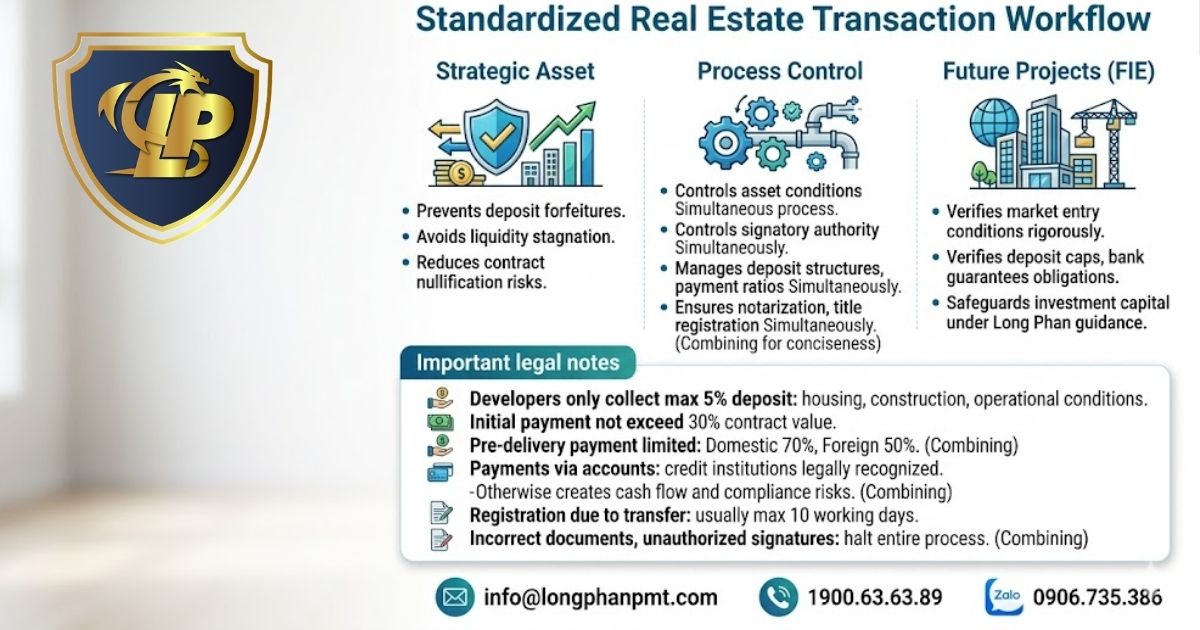
Long Phan Consulting Company provides comprehensive solutions to assist clients in establishing and executing real estate brokerage transactions. Our expert team ensures accuracy and maximizes the protection of our clients’ lawful interests. We structure our professional support into the following key area:

Below are common inquiries regarding determining real estate brokerage fees when selling:
According to Article 63 of the 2023 Law on Real Estate Business, real estate brokerage businesses are entitled to brokerage fees and commissions as stipulated in the contract signed with the brokered party. The amount of fees and commissions is mutually agreed upon by the parties and is not dependent on the price of the brokered transaction.
Real estate brokers are responsible for the information, documents, and scope of work they provide or perform under the brokerage contract as stipulated in Clause 1, Article 65 of the 2023 Law on Real Estate Business, amended and supplemented in 2024. In case of disputes arising from intentional fault or professional error of the broker, the broker may be liable for damages as stipulated in Article 131 of the 2015 Civil Code and the agreement in the contract. Conversely, brokers are not responsible for issues outside the scope of the services committed to.
According to Article 63 of the 2023 Law on Real Estate Business, as amended in 2024, the timing of brokerage fee payment is determined by agreement between the parties in the real estate brokerage contract. Typically, the fee is paid when the transaction is completed or when specific conditions are met, such as signing the sales contract, notarizing the transfer, or successfully transferring ownership, depending on the agreed terms.
Customers should immediately gather evidence (text messages, emails, audio recordings, promotional materials), then send a formal written notice to the brokerage firm requesting an explanation and remediation. If the issue is not resolved satisfactorily, customers have the right to file a lawsuit in the competent court to claim compensation for damages as stipulated in Article 65 of the 2023 Law on Real Estate Business.
Yes. According to Clause 7, Article 44 of the 2023 Law on Real Estate Business, real estate brokerage contracts belong to the group of real estate business contracts for which the Government prescribes model contracts. Parties involved in the transaction are responsible for complying with the main contents of the prescribed model to ensure consistency and protect their legal rights, avoiding clauses that violate the law.
Guiding the determination of real estate brokerage fees when selling properties requires an understanding of the law and actual market fluctuations. Establishing a transparent remuneration agreement not only protects finances but also promotes rapid, safe transactions.
Should you require in-depth support or appraisal of a brokerage contract, please contact Long Phan Consulting Company via Hotline 1900636389 to receive direct expert advice on real estate brokerage fees.