
Legal risks when real estate brokers provide false information to clients arise from dishonest communication regarding the transaction object or the asset’s legal status. Accurately identifying these violations helps minimize financial damage and prevents severe sanctions from state agencies. In the following article, Long Phan Consulting Company provides information on the legal risks associated with brokers providing false information and the consequences for individual brokers and brokerage organizations.

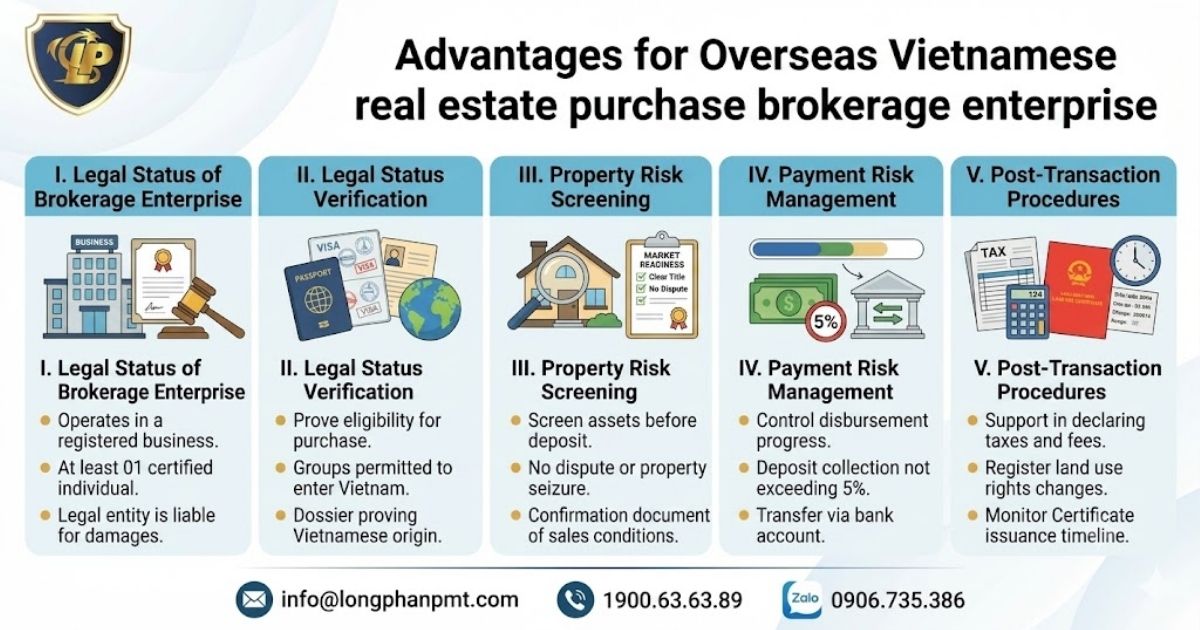
Understanding the concept and nature of misinformation is essential to analyze the legal risks when real estate brokers provide false information to clients in real estate transactions. Providing false information in real estate brokerage is the act of presenting data, parameters, or statuses that do not align with the asset’s objective reality. The nature of this act violates the principles of honesty, openness, and transparency in civil transactions and real estate business. Under current laws, brokers are responsible for providing real estate dossiers and information, and must bear responsibility for their authenticity.
Information discrepancies can occur through falsely asserting facts or remaining silent regarding an asset’s legal defects. When a broker commits this act, the client’s trust is exploited to establish transactions that are not based on voluntary intent and full understanding. This is a strictly prohibited act that directly infringes upon state management order over the real estate market and the property rights of individuals and organizations.
Brokers act as an intermediary bridge but are not permitted to exceed professional ethics and legal regulations for personal gain. Providing false information not only affects a single transaction but causes chain reactions impacting market stability.
>>>See more: How to Verify a Real Estate Brokerage Firm
Identifying common forms of misinformation helps clarify the legal risks when real estate brokers provide false information to clients during property transactions. These violations rarely stem from mere carelessness; they often involve careful calculation by the perpetrator. Understanding the root causes helps determine the level of fault and the corresponding legal liability.
One of the most serious situations leading to legal risks when real estate brokers provide false information to clients involves incorrect legal information regarding land titles, zoning plans, or existing disputes. This is the most severe violation, directly leading to the risk of total asset loss for the client. Brokers often advertise real estate as having a Certificate of Land Use Rights (Red/Pink Book) when, in reality, it only has handwritten papers or is mortgaged at a bank. Information regarding land use and construction planning is frequently falsified to pass off agricultural or public land as urban residential land to inflate prices.
Misrepresenting the value or development potential of a property may create significant legal risks when real estate brokers provide false information to clients. Inflating an asset’s value or potential is another common risk. Many brokers use “price inflation” techniques or spread fake news about upcoming infrastructure projects to create artificial scarcity. Clients are often promised unrealistic profit margins or high-end internal amenities not present in the project’s approved 1/500 planning. This targets the client’s investment psychology, prompting decisions based on groundless financial data.
Providing inaccurate details about ownership rights or the parties involved in the transaction can lead to serious legal risks when real estate brokers provide false information to clients. Risks also arise from providing inaccurate information about the owner or the right to dispose of the asset.
Brokers may conceal co-ownership statuses or the fact that the true owner is not present in Vietnam, leading to unauthorized transactions. Impersonating developers or using legal entities lacking real estate business functions to sign deposit contracts are common violations. This drags clients into prolonged disputes when related parties file lawsuits.
The act of concealing or failing to disclose essential information also contributes to legal risks when real estate brokers provide false information to clients. Concealing technical defects, feng-shui issues, or outstanding financial obligations (like land taxes or maintenance fees) is also considered providing false information. Brokers may intentionally ignore that the real estate is subject to a judgment execution decision or temporary emergency measures. This lack of transparency hides risks that could render the transaction void, causing irreparable damage to the buyer.

To better understand the issue, it is necessary to examine the underlying causes that lead to legal risks when real estate brokers provide false information to clients. Discrepancies in real estate data are not random but rather the result of both subjective and objective factors in the broker’s professional process. Below are some common causes of misinformation in the market today.
A lack of proper legal verification is a common factor contributing to legal risks when real estate brokers provide false information to clients. Many freelance brokers lack the habit or skills to look up information at competent agencies like the Land Registration Office or Urban Management Office. They merely forward unverified information from sellers or social media without conducting dossier reviews. This carelessness leads to unintentionally, yet disastrously, transmitting false data to clients.
In some cases, brokers intentionally exploit or deceive customers, which directly results in legal risks when real estate brokers provide false information to clients. This is a highly subjective cause, where brokers willingly sacrifice professional ethics to earn quick commissions. Orchestrating fake buying scenarios, creating artificial “waves,” or using shills to rush clients into signing are sophisticated tactics. These acts show signs of constituting the crime of Fraudulent Appropriation of Property or Deceiving Clients under the Penal Code.
Limited professional competence combined with high sales pressure can increase the likelihood of legal risks when real estate brokers provide false information to clients. Limited professional expertise and pressure to meet sales targets also contribute to increased legal risks when real estate brokers provide inaccurate information to clients. The majority of brokers today have not received formal training in land law, leading to misinterpretations of contract terms or procedures for obtaining land titles.
Furthermore, pressure from sales targets at trading floors forces brokers to take risks and exaggerate the truth to close deals at all costs. Fierce competition in the market pushes many brokers down the path of illegal practices, disregarding the long-term interests of their clients.
To mitigate these causes, the law has established a framework of mandatory rights and obligations for brokers. Compliance with these standards acts as a legal safeguard protecting both brokers and clients from potential disputes.
>>>See more: Role of Real Estate Brokers in Land Transactions
Clearly defining the rights and obligations of brokers is important in preventing legal risks when real estate brokers provide false information to clients. Under Articles 64 and 65 of the 2023 Law on Real Estate Business:
Businesses providing real estate brokerage services have the following rights
Individuals practicing as real estate brokers have the following rights
Obligations of real estate brokerage businesses and individuals practicing real estate brokerage.
Businesses providing real estate brokerage services have the following obligations
Individuals practicing as real estate brokers have the following obligations
>>> See more: When is a broker considered to have completed their obligations
Various liabilities may arise as legal risks when real estate brokers provide false information to clients, affecting both their professional reputation and legal standing. A severe consequence is that the transaction contract may be declared void. Deposit or sale contracts established based on information deception will be declared void by the court under the Civil Code. Consequently, parties must return what they received, and the broker loses all rights to their commission. This not only destroys their reputation but forces the broker to participate in prolonged litigation as a party with related rights and obligations.
Legal systems impose sanctions to address legal risks when real estate brokers provide false information to clients and to ensure transparency in brokerage activities. Violations of the obligation to provide information will be severely punished, depending on the nature and extent of the actual damage caused. Based on point c, clause 3, Article 4 and point b, clause 3, Article 59 of Decree No. 16/2022/ND-CP, the penalties for failing to provide, providing incomplete, or providing dishonest information and documents about real estate being brokered are as follows:
Fine amount:
Remedial measures: Requiring the provision of accurate information to customers (according to point g, clause 5, Article 59 of Decree No. 16/2022/ND-CP).
Civil liability (Compensation for damages): The broker must compensate the client for all actual damages in two forms:
Criminal liability: In cases where the fraudulent act is serious and causes significant damage, the offending individual may be prosecuted for the crime of Fraudulent Appropriation of Property (Article 174 of the 2015 Penal Code).
One major consequence of legal risks when real estate brokers provide false information to clients is the possibility that the transaction contract may be declared invalid.. This is because a deposit contract or sales contract established on the basis of fraudulent information will be declared void by the court according to the provisions of the Civil Code.
In that case, the parties must return to each other what they have received, and the broker will lose all right to receive commission fees. This not only damages reputation but also forces the broker to participate in lengthy legal proceedings as a party with related rights and obligations.
In serious cases, legal risks when real estate brokers provide false information to clients may result in the revocation of professional licenses or even criminal prosecution.
For systematic violations or those causing particularly serious consequences, the broker’s real estate brokerage license will be permanently revoked. In cases of fraudulent conduct to misappropriate large sums of money, the broker may be prosecuted for the crime of “Fraudulent appropriation of property.” This is the highest level of risk, leading to the loss of freedom and the complete termination of the individual’s business career.
To mitigate legal risks when real estate brokers provide false information to clients, measures are needed to identify and prevent misinformation in transactions.
Customers should cross-check the information provided by the broker with original legal documents such as the land title certificate, land allocation decision, or construction permit. Using online planning lookup tools or contacting local authorities directly is a mandatory step to verify the information. A professional broker will always be ready to provide alibis and documents proving the legal status of the property transparently.
Clients should independently verify the information. To thoroughly control risks, partnering with specialized legal consulting firms is a smart choice for legitimate investors and brokers. Long Phan Consulting Company We provide legal and technical solutions to give you peace of mind in all complex real estate transactions.
>>>See more: Role of Real Estate Brokers in Asset Valuation
To assist clients in mitigating legal risks when brokers provide false information, Long Phan Consulting Company offers comprehensive legal risk control consulting in real estate brokerage activities. We structure our professional support into the following key area:

The following, Long Phan Consulting Company some frequently asked questions regarding the legal risks involved when real estate brokers provide false information to clients. Please feel free to refer to them if you are interested:
Based on point d, clause 2, Article 59 of Decree 16/2022/ND-CP, individuals practicing independent real estate brokerage without a certificate or with an expired certificate will be fined from 40 million to 60 million VND. If this act is accompanied by providing false information about the real estate, the penalty will be applied according to clause 3, Article 59 of Decree 16/2022/ND-CP, with a fine from 60 million to 80 million VND and revocation of the professional certificate (if any) for 6 to 9 months.
Customers have the right to reclaim their deposit and claim compensation equivalent to the deposit value (deposit penalty) as stipulated in Clause 2, Article 328 of the 2015 Civil Code if the seller or authorized broker provides misleading information that causes the customer to be confused about the subject of the transaction. Providing false planning information is considered a breach of the obligation of honesty, resulting in the invalidity of the civil transaction due to deception, as per Article 127 of the 2015 Civil Code.
Brokers are still subject to penalties and liability for compensation because the law stipulates that brokers have an obligation to provide complete and truthful documentation and “are responsible for the documentation and information they provide,” as stipulated in Clause 1, Article 65 of the 2023 Law on Real Estate Business. Failing to verify information with the homeowner before providing it to clients is considered a lack of professional responsibility.
Clients have the right to unilaterally terminate the brokerage contract and are not required to pay commission fees if they can prove that the broker violated the obligation to provide accurate information according to Article 428 of the 2015 Civil Code. If the discrepancy in area causes damage to the investment decision, the broker must also compensate the client for the incurred costs based on Article 65 of the 2023 Law on Real Estate Business.
Real estate brokers are responsible for the information, documents, and scope of work they provide or perform under the brokerage contract as stipulated in Clause 1, Article 65 of the 2023 Law on Real Estate Business, amended and supplemented in 2024. In case of disputes arising from intentional fault or professional error of the broker, the broker may be liable for damages as stipulated in Article 131 of the 2015 Civil Code and the agreement in the contract. Conversely, brokers are not responsible for issues outside the scope of the services committed to.
The legal risks associated with real estate brokers providing false information are a pressing issue requiring vigilance from investors and accountability from practitioners. Long Phan Consulting Company is committed to providing in-depth advisory services to help you identify and eliminate information traps in the market.
To protect your assets and lawful rights, please contact Hotline 1900636389 for direct support from our experts.