
Authorizing house transactions for Overseas Vietnamese helps Vietnamese residing abroad execute real estate transactions without being physically present. This process requires thorough preparation of legal dossiers and verification of the actual asset status. Risks of disputes or contract invalidation often arise from formal errors in the authorization document. The following content provides detailed information on authorizing house transactions for Overseas Vietnamese from the expert team at Long Phan Consulting Company.

Under the 2015 Civil Code, in activities authorizing house transactions for Overseas Vietnamese, you can authorize real estate sales in Vietnam through two main forms: a Power of Attorney (giấy ủy quyền – a unilateral legal act) and an Authorization Contract (hợp đồng ủy quyền – a bilateral legal act). Choosing the appropriate form directly impacts the rights, obligations, and degree of legal binding between parties in the real estate transaction.
An authorization contract is an agreement between the principal and the authorized representative to execute a real estate sale transaction. This form requires the consensus of both parties. The contract content must clearly stipulate the scope of work, rights, obligations, responsibilities, and authorization duration.
The contract must be lawfully notarized or authenticated under Vietnamese law, especially when concerning real estate transactions. This form is typically applied in cases involving high-value assets, complex content, or requiring a high degree of legal binding between parties.
Contract contents usually include clauses on the authorization scope, execution time, and parties’ rights/obligations. It clearly regulates the signing of the transfer contract, receiving sale proceeds, and executing legal procedures related to transferring land use rights and land-attached assets. In practice, this contract type is used for high-value transactions or when parties need to establish a tighter legal bond.
A Power of Attorney is a unilateral legal act created by the principal to grant another person the right to execute one or specific tasks, including selling real estate. Unlike a contract, this form does not require a mutual agreement; the principal simply notarizes/authenticates it as prescribed, and the authorized representative only needs to sign to confirm acceptance.
Overseas Vietnamese can notarize a Power of Attorney at a Vietnamese diplomatic mission abroad or a local notary office in their host country. Afterward, this document must undergo consular legalization under Vietnamese law to ensure its legal validity for domestic transactions.
The prominent advantage of a Power of Attorney is its relatively simple procedure, saving time and costs. However, to limit legal risks, the content must be meticulously drafted, clearly defining the exact scope of authorization (including rights to sign sale contracts, receive money, pay taxes, and execute other related legal procedures).
>>>See more: Real Estate Power of Attorney in Vietnam Guide
Overseas Vietnamese can execute real estate sale authorization from abroad via two main methods: direct authentication at a Vietnamese diplomatic mission abroad, or notarization at a foreign notary office followed by consular legalization. Each method has distinct characteristics and processes but is recognized by Vietnamese law if the proper sequence and procedures are followed.
Overseas Vietnamese can visit a Vietnamese Embassy or Consulate abroad to sign the authorization document directly before a consular officer. Under Article 73 of the 2024 Notary Law, consular officers have the authority to authenticate signatures on authorization documents. This is a convenient method because, once authenticated, the document can be used directly in Vietnam without further consular legalization.
The principal must be physically present and present full dossiers such as a passport, the authorization text, and documents related to the real estate in Vietnam (if requested). The consular officer will verify identity, check civil behavioral capacity, and authenticate the signature. If the authorized party is not present to sign simultaneously, they will sign supplementarily at a notary office in Vietnam. The document only takes effect when it contains both parties’ signatures and is authenticated as prescribed.
Overseas Vietnamese can also establish an authorization document at a notary public (or equivalent agency) in their host country. In this case, for the document to be legally valid in Vietnam, further steps regarding consular legalization must be executed.
Crucial Note: If an Authorization Contract requires the authorized party’s signature, after the principal completes foreign notarization, the authorized party in Vietnam must also sign the contract and re-notarize it at a domestic notary office where they reside. Thus, the contract is considered notarized twice in two locations to ensure full legal validity. This dual notarization is necessary to clearly confirm the participating parties’ will and ensure the document’s legality, playing a vital role in limiting risks for high-value real estate transactions.
Only after completing all these steps is the authorization document recognized as valid for use in Vietnam for transactions transferring land use rights and housing ownership.
When creating a real estate sale authorization document, Overseas Vietnamese must specifically define and clearly limit the authorized party’s scope. This is crucial to ensure transparent transfers and minimize future risks and disputes.
The authorization scope usually includes rights like: negotiating prices, signing transfer contracts, submitting dossiers at competent state agencies, and receiving legal documents after completing procedures. However, you should avoid setting an authorization scope that allows the representative full authority to receive payment cash directly (especially without absolute trust) to limit asset misappropriation risks.
Instead of allowing the representative to receive money directly, you can specifically designate a payment account for the buyer to transfer funds into. This account information should be clearly recorded in the authorization text, including the account holder’s name, account number, and bank name. Prioritizing an account opened at a domestic bank facilitates swift transactions and easier cash flow control.
If you wish to authorize another person to use your payment account, you must:
To remotely track and control transaction progress, the authorization document should also clearly stipulate the representative’s obligation to report dossier processing status and provide information/receipts proving payment and contract conclusion.

The dossier’s composition plays a decisive role in the legality of the entire process of Overseas Vietnamese authorizing real estate transactions in Vietnam. You must clearly separate documents proving the subject’s status from those directly related to the authorization content. Missing any required document can lead to rejection or supplementary requests from functional agencies, prolonging processing times.
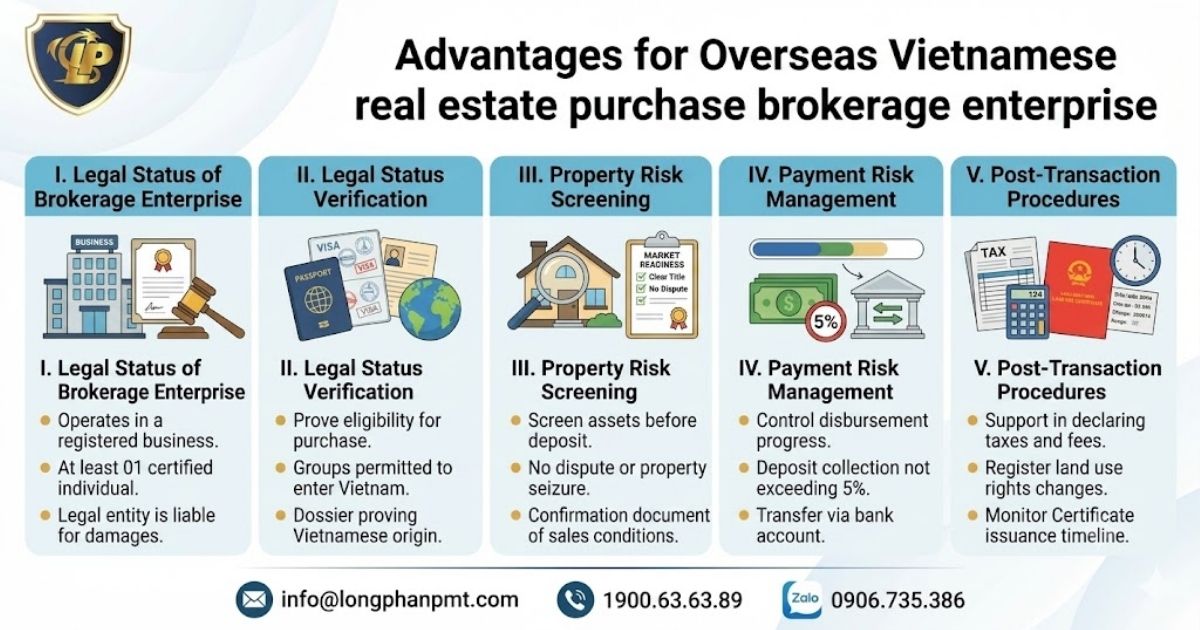
In the process of authorizing overseas Vietnamese to buy and sell real estate in Vietnam, proving ownership of the property in Vietnam is a prerequisite. Current legal regulations clearly distinguish the types of documents required, depending on the nationality and legal status of the authorizing party.
In the context of authorizing overseas Vietnamese to buy and sell houses, this regulation aims to ensure that only those who meet the legal requirements are allowed to participate in real estate transactions, thereby contributing to protecting the legitimate rights and interests of all parties involved throughout the entire transaction process.
For Vietnamese citizens residing abroad
When carrying out the procedure for Vietnamese citizens residing abroad to authorize the purchase and sale of real estate in Vietnam, customers need to prepare a passport or other identification document proving Vietnamese nationality, such as a Citizen Identity Card or National Identity Card, as stipulated in Point a, Clause 2, Article 3 of Decree 95/2024/NĐ-CP.
In the process of authorizing overseas Vietnamese to buy and sell houses, these documents are intended to prove that you are a Vietnamese citizen and, according to the 2024 Land Law, Vietnamese citizens have the right to own houses and the right to use land as stipulated. You need to prepare two notarized copies of each document, applicable to both the authorizing party and the authorized party. This is to accurately verify the identity and legal basis of the parties involved in the authorized house and land purchase transaction.
For people of Vietnamese origin who no longer have Vietnamese citizenship
According to the provisions of the 2024 Land Law, people of Vietnamese origin who no longer hold Vietnamese citizenship but are permitted to enter Vietnam have the right to own houses attached to land use rights in Vietnam.
To prove this right when carrying out the procedure for Vietnamese citizens residing abroad authorizing the purchase and sale of real estate in Vietnam, customers need to prepare a Certificate of Vietnamese Origin issued by a competent Vietnamese authority, along with valid entry documents (visa or temporary residence card) as stipulated in Point b, Clause 2, Article 3 of Decree 95/2024/NĐ-CP.
Similarly, two notarized copies of these documents are required for both the grantor and the grantee. Clear proof is crucial to ensuring the legality of a power of attorney transaction for purchasing real estate.
Documents related to the real estate are indispensable, providing the authorized party a basis to execute procedures and serving as evidence of the asset’s status.
>>>See more: Overseas Vietnamese Buying Houses Online via Brokers
The procedure must comply with the 2015 Civil Code and the 2024 Notary Law. For Overseas Vietnamese, this is usually executed via an authorized receiver in Vietnam. Article 138 of the 2015 Civil Code states: “Individuals and legal entities may authorize other individuals and legal entities to establish and execute civil transactions.”
Step 1: Prepare the necessary documents
Customers are required to gather all necessary documents as stipulated by law. This includes:
Step 2: Draft the authorization document
The power of attorney is the core of this transaction. Please ensure the content of the document includes:
Step 3: Notarize the power of attorney document
After the power of attorney is drafted, the next step is notarization to make the document valid. Clients can have the notarization done themselves if they are in Vietnam; the power of attorney will be notarized at an authorized Notary Office or Notarial Office. The notary will verify the identification documents of all parties and the content of the document before notarization, confirming the signatures and the legality of the content.
Step 4: Complete transactions and procedures in Vietnam
The authorized representative will use the notarized power of attorney to represent you in real estate transactions and related procedures in Vietnam. This includes:
>>>See more: Distinguishing between brokerage authorization contracts
Long Phan Consulting Company provides comprehensive solutions supporting safe house transaction authorization for Overseas Vietnamese. We maximize client protection through our team of highly experienced experts. We structure our professional support into the following key area:
With a team of experienced legal professionals in real estate and international law, Long Phan Consulting Company is committed to providing reputable, in-depth, and timely services, accompanying overseas Vietnamese through every legal step to ensure that authorized real estate sales transactions in Vietnam proceed smoothly, legally, and according to proper procedures.

Below, Long Phan Consulting Company provides some frequently asked questions related to the procedure for authorizing overseas Vietnamese to buy and sell houses. We invite interested clients to refer to this information:
Yes, however, the scope of authority of a foreign authorized representative will be limited by their legal capacity and real estate ownership conditions in Vietnam. Based on Article 138 of the 2015 Civil Code, you have the right to choose an individual as your representative, but to ensure enforceability when signing at the Land Registration Office, the authorized representative should be a Vietnamese citizen with full legal capacity to avoid complex explanations regarding foreign ownership conditions as stipulated in Article 4 of the 2024 Land Law.
While not mandatory, it is extremely necessary to protect your financial interests. According to Article 562 of the 2015 Civil Code, the content of the authorization is agreed upon by the parties; clearly stating the minimum selling price or the maximum buying price helps prevent the representative from arbitrarily deciding on the price, which could cause financial losses.
The law does not specify a maximum time limit but prioritizes the agreement of the parties. According to Article 563 of the 2015 Civil Code, unless otherwise agreed and the law provides otherwise, the power of attorney contract is valid for one year from the date of establishment of the authorization.
Notary fees depend on the regulations of the Vietnamese diplomatic mission abroad or the fees charged by the notary office in the host country.
You have the right to unilaterally terminate the power of attorney contract at any time, but you must notify the authorized party and any third parties (if any) in writing. According to Article 569 of the 2015 Civil Code, if the power of attorney is for a fee, you must pay the fee corresponding to the work performed and compensate for damages; if there is no fee, you must still give the authorized party reasonable notice.
There are differences in the required documents proving eligibility. You need to provide a Certificate of Vietnamese Origin as stipulated in Article 4 of the 2008 Vietnamese Nationality Law and Article 3 of Decree 95/2024/ND-CP. This document serves as the basis for the notary public to determine that you are eligible to own housing and land use rights in Vietnam as a citizen, in accordance with the new spirit of the 2024 Land Law.
Perfecting the authorization process for Overseas Vietnamese requires a profound understanding of the 2024 Land Law and 2023 Housing Law. Establishing the document in the correct form and scope helps you avoid complex legal disputes. Proactively preparing dossiers and choosing appropriate notarization methods ensures safe, transparent transactions. Please contact Hotline 1900636389 to receive professional consulting from Long Phan Consulting Company.