


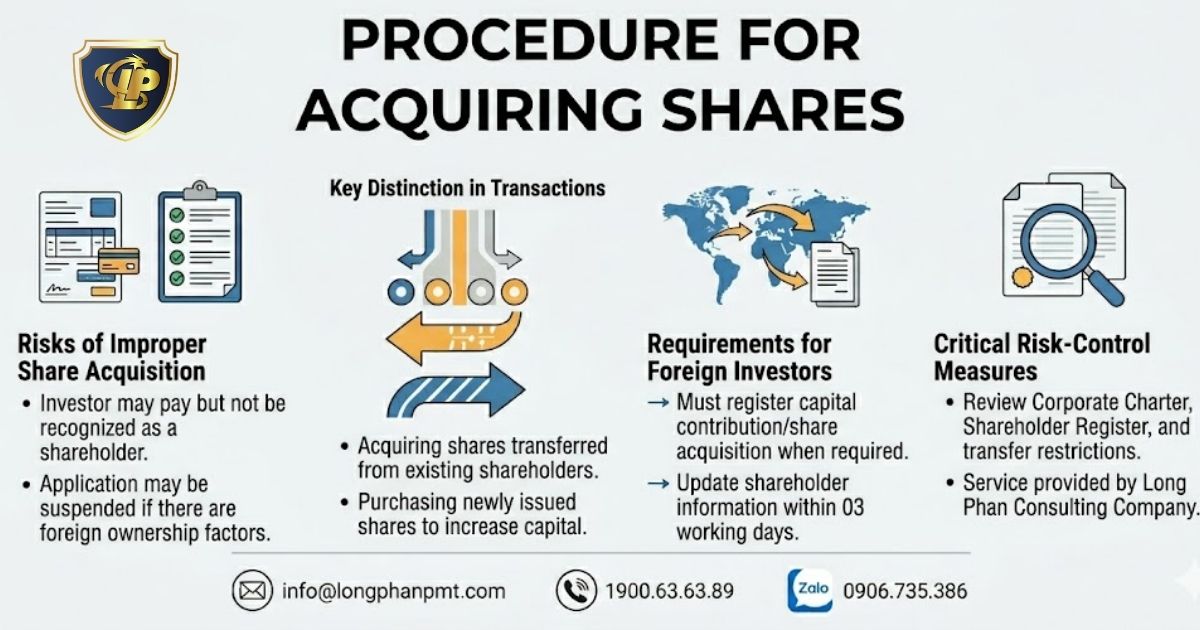
Procedure for Acquiring Shares must be properly structured to prevent investors from paying without being recorded as shareholders or facing suspended filings due to foreign ownership issues. The transaction should distinguish share transfers from existing shareholders and subscriptions for newly issued shares that raise charter capital. Foreign investors must complete share acquisition registration where required under the Law on Investment and update shareholder records within the prescribed timeline. Long Phan Consulting assists with reviewing the Charter, Shareholder Register, transfer limitations, and transaction compliance controls.
Key legal notes:
Investors must accurately determine the underlying transactional structure prior to executing a Term Sheet or a Share Purchase Agreement (SPA). Selecting an incorrect structure can result in misaligned tax liabilities, non-compliant internal corporate procedures, rejected regulatory approvals, and delays in the legal recognition of share ownership.
Conceptually, a share acquisition operates either as a secondary share transfer from existing shareholders or as a primary share acquisition via an additional share issuance by the target company. Investors hold the statutory right to select either a primary subscription or a secondary transfer structure pursuant to Clause 1, Article 74 of Decree No. 96/2026/NĐ-CP; notably, acquiring primary shares constitutes a capital contribution that directly increases the company’s charter capital pursuant to Clause 18, Article 4 of the 2020 Law on Enterprises.
| Evaluation Metric | Secondary Share Transfer | Primary Share Acquisition |
| Legal Substance | Acquisition of existing shares directly owned by current shareholders | Subscription to new shares issued additionally by the company |
| Charter Capital Impact | Does not alter the company’s registered charter capital | Increases the registered charter capital upon valid issuance |
| Transactional Object | Shares and accompanying shareholder rights held by the seller | Newly issued shares directly distributed by the target company |
| Primary Risk Exposure | Failure to be validly recorded in the official Shareholder Register | Phantom capital schemes, non-compliant issuance procedures, or incomplete capital contributions |
For institutional buyers, this structural classification dictates all post-closing administrative filings. If the transaction involves foreign investment, a comprehensive evaluation of mandatory M&A approval and registration requirements must be conducted prior to releasing any funds.
A secondary share transfer entails the acquisition of shares directly from current equity owners. This transactional format alters the specific ownership of the shares but does not expand the total charter capital of the target enterprise.
Management must verify three primary checkpoints before initiating any financial disbursement:
Where a foreign investor is involved, the payment for the transfer of share ownership must strictly comply with foreign exchange management regulations via authorized capital bank accounts, unless the payment is executed through asset swaps or alternative non-cash settlement methods permitted under Clause 5, Article 35 of the 2020 Law on Enterprises.
Subscribing to an additional share issuance requires the investor to inject capital directly into the target entity in exchange for newly created shares. This mechanism successfully expands the registered charter capital only when the underlying issuance and subsequent capitalization are executed in strict accordance with statutory requirements.
The most critical hazard under this structure is the inflation of phantom capital. The law strictly prohibits the fraudulent declaration of inflated charter capital, the failure to fully remit registered capital contributions, or the intentional overvaluation of non-cash capital assets pursuant to Clause 5, Article 16 of the 2020 Law on Enterprises (as amended by the 2025 Law on Enterprises).
At a minimum, investors must audit the following operational risk categories:
Consequently, subscribing to an additional share offering must be treated as a complex corporate capitalization process rather than a basic bilateral purchase agreement.
Pre-transactional legal due diligence (LDD) is the mandatory operational mechanism used to determine whether target shares are legally eligible for transfer. For institutional investors, the primary compliance risk is not the execution of the SPA, but rather the total failure to secure valid, legally recognized ownership of the shares post-closing.
Investors must systematically audit the primary corporate records maintained at the target company’s principal office, including the Charter, internal operational regulations, official Shareholder Register, asset titles, and the minutes of the Board of Directors or Board of Members. This corporate documentation inspection and retention obligation is explicitly established under Clause 1, Article 11 of the 2020 Law on Enterprises.
The scope of the pre-closing LDD must encompass:
Omitting a comprehensive legal due diligence review exposes investors to the hazard of purchasing shares that are contractually restricted, subject to third-party claims, or legally ineligible for recording. This omission represents the primary cause of post-closing transaction failures in local M&A deals after funds have been wired.
Not all share classifications can be freely transferred on the open market. Investors must accurately classify the target shares prior to executing binding agreements, with particular emphasis on the shares held by founding shareholders and those categorized as voting preferred shares.
| Share Classification | Permissible Transferability | Regulatory Risks and Controls |
| Common Shares | Freely transferable by default | Subject to specific restrictions within the corporate Charter or separate shareholder agreements during the initial incorporation phase |
| Shares of Founding Shareholders | Restricted during the first 03 years from incorporation | Requires verification of the exact issuance date of the initial ERC and compliance with internal approval procedures |
| Voting Preferred Shares | Absolutely non-transferable to third parties | Transferees face total non-recognition of shareholder status if transactions violate statutory prohibitions |
| Dividend or Redeemable Preferred Shares | Dependent on the Charter and specific issuance terms | Requires careful auditing of financial rights, residual voting restrictions, and redemption conditions |
The primary legal risk of non-compliance is contract invalidation or the total inability to exercise actual shareholder rights. Signatories to an invalidated transaction and any related parties face joint and several liability for all resulting financial damages, and must return all illegally obtained profits to the target enterprise pursuant to Clause 5, Article 167 of the 2020 Law on Enterprises.
The Shareholder Register is the definitive corporate document that establishes whether an investor is legally recognized by the enterprise. Consequently, investors must never disburse the full purchase price before cross-referencing the physical Shareholder Register against the corporate Charter and the executed transfer documentation.
The closing verification workflow must include:
In limited liability companies, outstanding equity stakes must be formally offered to all existing members in proportion to their current holdings prior to any external transfer, pursuant to Point a, Clause 1, Article 52 of the 2020 Law on Enterprises (as amended by the 2025 Law on Enterprises). The same regulatory control logic must be deployed in joint-stock M&A transactions whenever the target Charter institutes explicit rights of first refusal or transfer limitations.
When corporate disputes arise, any shareholder or group of shareholders initiating derivative litigation on behalf of the enterprise bears absolute liability for the accuracy, legitimacy, and truthfulness of all supporting evidence and documentation submitted to the court, pursuant to Clause 4, Article 115 of the 2020 Law on Enterprises (as amended by the 2025 Law on Enterprises).
Foreign investors must evaluate more than just the commercial purchase price and their targeted ownership percentage. The primary legal focus is determining whether the transaction requires formal regulatory M&A approval before the share acquisition can be legally finalized.
The target enterprise receiving foreign inbound capital must submit a single complete dossier to the competent investment registration authority where its principal headquarters is located, provided the transaction falls under mandatory registration categories. This administrative workflow is strictly enforced pursuant to Clause 3, Article 76 of Decree No. 96/2026/NĐ-CP.
The application dossier must accurately reflect the underlying commercial substance of the transaction, the investing entity, and the target enterprise. Pursuant to Clause 4, Article 76 of Decree No. 96/2026/NĐ-CP, the core required documentation includes:
If the transaction is executed without securing formal M&A approval prior to signing the definitive SPA, the investor’s application may be indefinitely suspended post-payment. This represents a catastrophic risk in transactions involving sectors with strict market entry restrictions or sensitive real estate assets.
The permissible Foreign Ownership Limit (FOL) cannot be determined through simple commercial negotiations. Investors must rigorously analyze the registered business lines, active operational scopes, statutory market entry conditions, and maximum ownership caps applicable to the target company.
When acquiring corporate shares, foreign direct investment (FDI) must strictly satisfy all regulatory criteria regarding charter capital ownership ratios, permissible investment formats, specific operational scopes, and domestic partner capacities pursuant to Clause 3, Article 8 and Clause 2, Article 21 of the 2025 Investment Law. Furthermore, the transaction must not engage in any prohibited business lines or sectors that have not yet been opened to foreign market access under Clause 2, Article 17 of Decree No. 96/2026/NĐ-CP.
| Market Access Level | Statutory Legal Implications | Required Compliance Actions |
| Prohibited Access | Foreign entities are completely barred from acquiring shares in the sector | Formally exclude the business line from the target or restructure the corporate scope |
| Conditional Access | Must satisfy exact FOL caps, investment forms, partner capacities, and operational scopes | Verify all statutory conditions are fully met prior to executing the definitive SPA |
| Unrestricted Access | Governed by general corporate and investment regulations | Conduct standard verification of enterprise registrations, UBO structures, and capital bank flows |
For economic organizations established prior to March 1, 2026, if a foreign investor subsequently acquires a charter capital ownership stake exceeding 50% or gains dominant control, the target entity must satisfy the same regulatory market entry conditions as a foreign investor when acquiring shares in other enterprises, pursuant to Clause 2, Article 104 of Decree No. 96/2026/NĐ-CP. However, if the target entity already holds more favorable market entry conditions formally recorded in an existing Investment Registration Certificate, those grandfathered rights remain fully protected under Clause 9, Article 52 of the 2025 Investment Law.
In multi-tiered corporate structures, the FOL must be calculated by evaluating both the direct investing entity and the ultimate controlling structure behind it. Focusing solely on the superficial share percentage stated in the SPA will lead to an incorrect assessment of market entry compliance.
A share acquisition within an enterprise holding land use rights in sensitive geographic regions must be treated as a highly regulated investment control filing. The underlying compliance risk extends beyond the land titles themselves to the fundamental ability to secure formal M&A approval.
The sensitive geographic zones requiring rigorous scrutiny include:
The share transaction is subject to mandatory national defense and security reviews if the target economic organization holds land use rights certificates within these designated zones, pursuant to Point c, Clause 3, Article 21 of the 2025 Investment Law. Consequently, the M&A registration dossier must include verified land title documentation proving compliant usage in border or coastal areas pursuant to Clause 4, Article 76 of Decree No. 96/2026/NĐ-CP.
Adopting a strategy of “closing the deal now and legalizing the paperwork later” will jeopardize the entire M&A timeline. If a registration or amendment dossier is found to contain fraudulent declarations or untruthful statements, the Business Registration Authority is legally empowered to revoke the issued Enterprise Registration Certificate pursuant to Clause 1, Article 68 of Decree No. 168/2025/NĐ-CP.

Share acquisition procedures must be executed through a highly regulated risk-mitigation workflow rather than a basic payment schedule. For institutional buyers, each operational stage must be tied to verified documentation, valid corporate signatures, and enforceable title recognition.
The standardized workflow comprises the following 06 steps:
If an enterprise registration dossier was formally submitted to the Business Registration Authority but had not received final approval prior to July 1, 2025, the application must be processed under the updated administrative frameworks set forth in Article 117 of Decree No. 168/2025/NĐ-CP.
A Principle Agreement or Term Sheet serves as a vital legal mechanism to lock in the transactional architecture prior to executing the definitive Share Purchase Agreement (SPA). This preliminary framework enables investors to enforce strict conditions precedent, regulate document delivery timelines, and maintain a clear exit pathway if mandatory regulatory approvals are denied.
The core contractual clauses subject to rigorous negotiation must include:
Enterprises that do not hold state capital and formally executed cross-ownership investments or share acquisitions prior to July 1, 2015, are protected against retroactive divestment mandates; however, these entities are strictly prohibited from increasing their existing cross-ownership percentages pursuant to Clause 1, Article 218 of the 2020 Law on Enterprises.
The actual disbursement of capital represents the primary point of regulatory control within a share acquisition transaction. If capital flows violate foreign exchange management laws or if the mandatory M&A approval remains incomplete, the investor cannot secure legal recognition as a shareholder.
For foreign investors, all payment transactions transferring ownership of corporate shares or equity stakes must be routed through authorized capital bank accounts in strict compliance with foreign exchange management regulations, unless the consideration is settled via asset swaps or alternative non-cash mechanisms explicitly permitted under Clause 5, Article 35 of the 2020 Law on Enterprises.
The closing transaction dossier must be categorized into three distinct operational sets:
The administrative timeline required to secure a formal M&A approval depends heavily on the accuracy of the dossier, the targeted business lines, and underlying land characteristics. Consequently, investors must never execute non-refundable payment obligations before the investment registration authority grants its formal approval.
Following the physical execution of transfer documents, the transaction has not reached legal completion. The purchasing investor remains legally exposed until their title is recorded in the physical Shareholder Register and the corresponding corporate changes are updated on the National Enterprise Registration System.
An unlisted joint-stock company must notify the competent Business Registration Authority of any changes to its foreign shareholders within 03 working days from the receipt of the transfer information or the occurrence of the modification, pursuant to Clause 3, Article 176 of the 2020 Law on Enterprises (as amended by the 2025 Law on Enterprises).
| Required Administrative Action | Competent Authority / Record Location | Governing Statutory Framework |
| Update the Shareholder Register | Target Enterprise Internal Records | Validates the buyer’s status as a shareholder of record to exercise voting and dividend rights |
| Notify Foreign Shareholder Changes | Business Registration Authority | Mandatory 03-working-day filing timeline pursuant to Clause 3, Article 176 of the 2020 Law on Enterprises (as amended by the 2025 Law on Enterprises) |
| File Corporate Registration Updates | Business Registration Authority | Procedural filing compliance pursuant to Clause 2, Article 52 of Decree No. 168/2025/NĐ-CP |
| Declare Ultimate Beneficial Owners | National Enterprise Registration System | Mandatory reporting compliance pursuant to Clause 2, Article 80 of Decree No. 168/2025/NĐ-CP |
| Retain Comprehensive UBO Dossiers | Target Enterprise Internal Archives | Mandatory retention period of at least 05 years following company dissolution or bankruptcy pursuant to Point h, Clause 1, Article 216 of the 2020 Law on Enterprises (as amended by the 2025 Law on Enterprises) |
Enterprises incorporated prior to July 1, 2025, must explicitly disclose and supplement their ultimate beneficial owner information during their very next corporate registration update or notification filing, pursuant to Clause 1, Article 3 of the 2025 Law on Enterprises. Therefore, compliant UBO registers should be compiled prior to submitting any post-closing M&A dossiers.
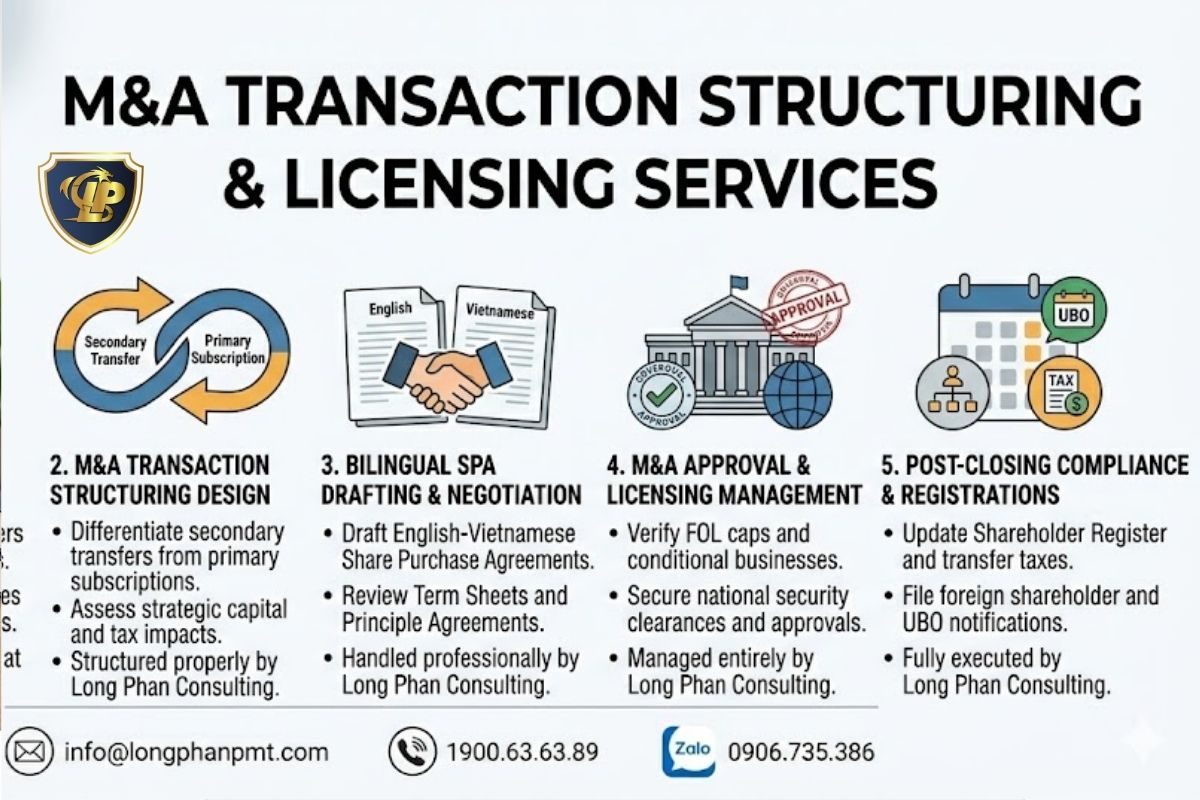
Share acquisition transactions can face regulatory failure even if commercial terms are aligned, provided the underlying corporate architecture, share titles, and foreign market entry conditions are poorly engineered. Long Phan Consulting Company provides expert legal counsel to help international investors structure compliant M&A transactions that ensure clear corporate governance rights and valid title recognition.
Our core M&A legal services include:
Foreign corporate clients and institutional buyers are invited to forward their transaction frameworks, target charters, shareholder registers, or draft SPAs via Email (info@longphanpmt.com) or Zalo/WhatsApp (+84 906 735 386) for an expert preliminary evaluation by the legal team at Long Phan Consulting Company.
Foreign investors must secure formal regulatory M&A approval whenever the transaction triggers the statutory thresholds established under investment laws. Corporate executives must audit foreign ownership limits, conditional sectors, and target asset locations before executing an SPA. Inbound investors must satisfy these market entry criteria pursuant to Clause 3, Article 8 and Clause 2, Article 21 of the 2025 Investment Law, and ensure the target does not operate within prohibited business lines under Clause 2, Article 17 of Decree No. 96/2026/NĐ-CP.
The target enterprise must compile a comprehensive administrative dossier that accurately details the investor identity, transaction structure, and target company profiles. The share acquisition application must be submitted to the competent investment registration authority where the target’s headquarters is located pursuant to Clause 3, Article 76 of Decree No. 96/2026/NĐ-CP. The core dossier comprises a formal registration application, corporate identity proofs of all parties, the executed Principle Agreement, and verified land use rights titles if the target operates in border or coastal zones pursuant to Clause 4, Article 76 of Decree No. 96/2026/NĐ-CP.
No, cross-border equity transactions are subject to absolute banking controls via the local foreign exchange framework. All payments transferring ownership of corporate shares or equity stakes involving foreign entities must be executed through authorized bank accounts in accordance with foreign exchange management regulations, unless settled via permissible asset swaps or alternative non-cash mechanisms recorded under Clause 5, Article 35 of the 2020 Law on Enterprises. Utilizing non-compliant cash flows invalidates the transaction and blocks subsequent corporate registration updates.
An unlisted joint-stock company must report modifications to its foreign shareholder register within a highly condensed regulatory window. The target company must submit a formal notification to the competent Business Registration Authority within a maximum of 03 working days from the date it receives the transfer records or from the effective date of the change, pursuant to Clause 3, Article 176 of the 2020 Law on Enterprises, as amended by the 2025 Law on Enterprises.
No, adopting a strategy of executing an SPA and closing the transaction with the intention of handling regulatory licensing later introduces fatal legal defects. Making untruthful or fraudulent declarations within corporate registration updates is strictly prohibited under Clause 4, Article 16 of the 2020 Law on Enterprises, as amended by the 2025 Law on Enterprises. If a breach is discovered, the Business Registration Authority holds the statutory power to completely revoke the company’s issued Enterprise Registration Certificate pursuant to Clause 1, Article 68 of Decree No. 168/2025/NĐ-CP.
A share acquisition expands the registered charter capital only when structured as a primary share acquisition via an additional share offering distributed directly by the company. If the buyer executes a secondary share transfer from existing shareholders, the transaction merely swaps the equity owners without altering the total capital volume. Investors may choose either an additional subscription or a secondary transfer format pursuant to Clause 1, Article 74 of Decree No. 96/2026/NĐ-CP; structurally, subscribing to a primary share offering constitutes a capital contribution that increases the registered charter capital under Clause 18, Article 4 of the 2020 Law on Enterprises.
The Shareholder Register is the definitive corporate document required to prove an investor’s legal status and rights within a joint-stock company. Prior to closing, buyers must inspect the target’s Charter, internal governance records, shareholder register, asset titles, and internal corporate minutes pursuant to Clause 1, Article 11 of the 2020 Law on Enterprises. If the target company fails to record the buyer’s name in the Shareholder Register, the investor cannot legally exercise voting rights or collect dividend distributions.
Successfully executing a strategy to buy shares in a Vietnamese company requires comprehensive control over every regulatory stage from initial transaction structuring and legal due diligence to securing formal M&A approvals, implementing UBO registrations, and validating entries in the Shareholder Register. Within cross-border M&A, the primary risk is not the commercial valuation, but rather the statutory capability to enforce legal ownership, meet tight foreign shareholder notification deadlines, and clear national security reviews.
Corporate buyers must thoroughly audit the target Charter, draft SPAs, FOL caps, land records, and capital account flows before releasing any funds. To systematically eliminate compliance defects and secure your inbound capital, contact the corporate Long Phan Consulting Company immediately via Hotline 1900636389 for an elite pre-execution transactional review.
📚 This article is provided with professional consultation based on the following legal framework:


