Investment projects in economic concentration zones are a key form of investment, contributing to socio-economic development, attracting domestic and foreign capital, and improving resource and labor efficiency. Compliance with technical regulations and legal standards in Vietnam ensures project legality. In the following article, Long Phan Consulting Company will provide information on mandatory conditions under the law.
Investment projects in economic concentration zones
What is an economic concentration zone?
Economically: Economic concentration is understood as reducing the number of independent competing enterprises in the market through mergers (broad sense) or internal growth by expanding production capacity.
Legally: The Competition Law does not define economic concentration but lists acts considered as such. According to Article 29 of the Competition Law 2018, forms include:
Merger: Transferring all assets/rights/obligations to another enterprise and terminating the merged enterprise.
Consolidation: Transferring all assets/rights/obligations to form a new enterprise and terminating the consolidated enterprises.
Acquisition: Directly/indirectly buying capital/assets sufficient to control another enterprise or a business line.
Joint Venture: Contributing assets/rights/obligations to form a new enterprise.
Conform to the master plan, land use planning, and sector planning approved by competent authorities.
Be in the list of sectors allowed for investment in the respective zone.
Legitimate investment sectors and professions
Investors can only operate in non-prohibited sectors (Article 6 Law on Investment 2020). For conditional business lines (Article 7), specific conditions (legal capital, practice certificates, environment, fire safety) must be met.
Investor requirements
Both domestic and foreign investors are allowed.
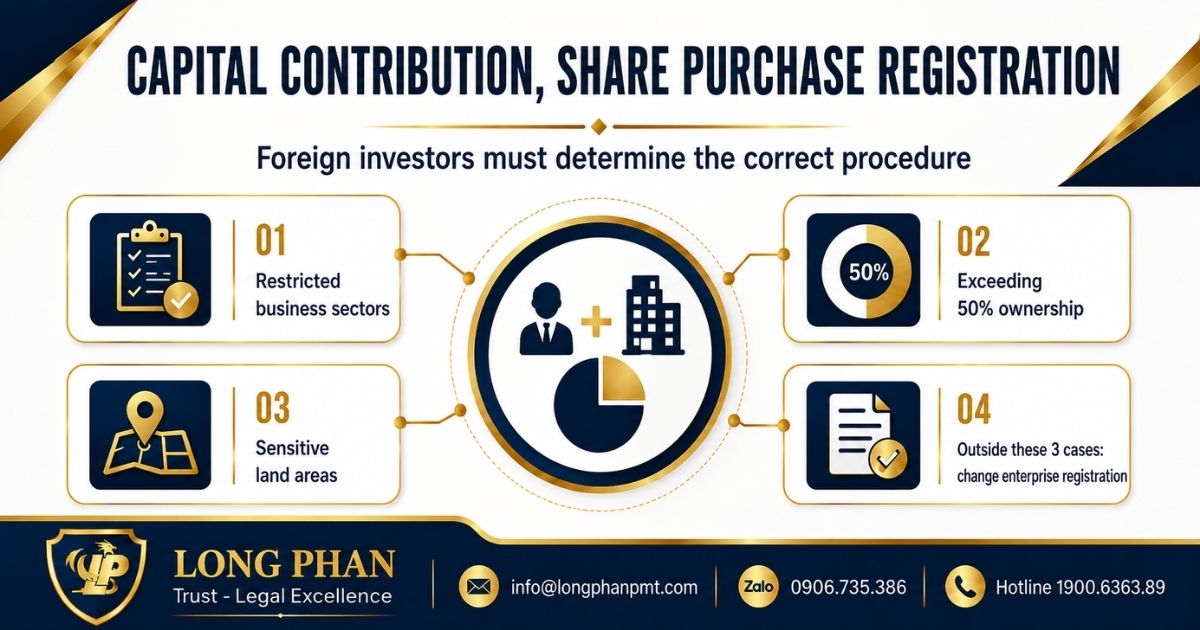
Foreign investors: Must meet market access conditions if investing in restricted sectors (Article 9 Law on Investment 2020) and perform Investment Registration Certificate procedures (Article 37).
Land conditions
Projects must have a legal location within the zone and conform to national/regional/provincial planning (Article 33 Law on Investment).
Investors can lease land/workshops from infrastructure developers. The land use term must not exceed the zone’s operation term (Article 202 Land Law 2024).
Environmental and construction conditions
Must have an Environmental Impact Assessment (EIA) or environmental protection plan.
Comply with standards on construction density, height, setbacks, technical safety, and fire prevention.
Specific conditions vary depending on the type of economic zone.
To optimize operational efficiency and maximize tariff incentives, a thorough understanding of the specific conditions for each economic model is crucial. In particular, the industrial park investment segment requires careful preparation in terms of financial capacity and environmental protection plans according to the following specific standards:
Investing in industrial parks
According to Article 62 Decree 31/2021/ND-CP (amended by Decree 239/2025/ND-CP), projects mainly include:
No residential inhabitants allowed (except for expert accommodation per planning).
Investing in export processing zones
According to Article 62 of Decree 31/2021/ND-CP, as amended by Point a, Clause 24, Article 1 of Decree 239/2025/ND-CP, investment projects in export processing zones must:
Production of goods primarily for export:Production activities are not limited to the domestic scale but also aim to reach the global market, with the core focus being on supplying strong export products to the global market, contributing to export turnover and enhancing the value of Vietnamese brands on the international economic map.
Or provide services to support export activities:We not only focus on products but also expand our capacity to provide logistics services and supporting solutions, aiming to remove all barriers and create the most favorable conditions for the smooth flow of goods from domestic markets to global markets.
Subject to strict customs, warehousing, and import/export controls.: operates within a strict legal framework, in which the entire supply chain – including warehousing management and import/export processes – is directly monitored, ensuring smooth operation while fully complying with technical barriers and legal regulations.
Investing in economic zones
According to Article 14 Decree 35/2022/ND-CP, EZs must:
Conform to regional/provincial planning.
Be able to mobilize resources for infrastructure and production.
Ensure socio-economic efficiency, environmental protection, and national defense/security.
Incentives: High incentives on CIT (10% for 15 years), import tax, and land rent (Decree 320/2025/ND-CP, Decree 291/2025/ND-CP).
Investing in high-tech zones
Must meet Article 31 Law on High Technology 2008:
Focus on R&D, high-tech incubation, and training.
Meet criteria on high-tech content, R&D ratios, and human resources.
Mergers and acquisitions advisory services at Long Phan Consulting Company.
Long Phan Consulting Company provides comprehensive consulting services for organizations and individuals wishing to enter the manufacturing market in Vietnam. We have a deep understanding of the procedures and requirements for M&A transactions to best protect our clients’ interests. Our consulting services include:
Providing advice on selecting strategies and forms of restructuring;
Analyze and evaluate investment projects to identify eligible incentives;
Providing advice on adjusting investment plans to maximize benefits from the policy.
Drafting and finalizing the application dossier for investment incentives;
Monitor the progress of file processing and resolve any arising issues;
Consultation on procedures for receiving preferential treatment after licensing.
Long Phan Consulting Company provides investment consulting services for projects in economic zones.
Some frequently asked questions when carrying out investment projects in economic concentration zones
Below, Long Phan Consulting Company provides some frequently asked questions related to investment projects in economic concentration zones. We invite interested clients to refer to this information:
Does the government encourage organizations and individuals to raise capital and attract investors to implement investment projects in in economic concentration zones anh industrial parks?
According to the legal provisions in Article 24 of Decree 35/2022/ND-CP regulating finance for industrial parks and economic zones, the State strongly encourages organizations and individuals to mobilize capital and attract investors to implement investment projects in industrial parks and economic zones.
Organizations and individuals with outstanding achievements in mobilizing ODA funds, preferential credit funds, and other technical assistance, as well as encouraging investors to implement investment projects in industrial parks and economic zones, will be commended and rewarded according to regulations issued by the provincial People’s Committee.
What factors are considered when deciding to invest in or support investment for the operation of industrial parks and economic zones?
According to Article 23 of Decree 35/2022/ND-CP, decisions on investment or investment support for the operation of industrial parks and economic zones are based on the state budget balance, the urgency of the project, and its conformity with relevant planning. Provincial People’s Committees may decide on investment or investment support and assign experienced and capable agencies and organizations to act as the investor for projects constructing technical and social infrastructure inside and outside the industrial park boundaries, and projects constructing technical and social infrastructure within the economic zone to serve the operation of industrial parks and economic zones, in accordance with the law on public investment.
How many forms of economic concentration are there?
According to Article 29 of the 2018 Competition Law, economic concentration includes the following forms:
Business mergers;
Business merger;
Acquiring a business;
Joint ventures between businesses;
Other forms of economic concentration as prescribed by law.
What actions are considered violations of regulations on economic concentration?
According to Article 44 of the 2018 Competition Law, violations of regulations on economic concentration include:
The company did not notify authorities of the economic concentration.
Businesses that carry out economic concentration without receiving notification of the preliminary assessment results from the National Competition Commission as stipulated in Clause 2, Article 36 of the 2018 Competition Law;
Businesses that are subject to formal assessment of economic concentration but proceed with economic concentration before the National Competition Commission issues a decision as stipulated in Article 41 of the 2018 Competition Law;
Businesses that fail to fulfill or inadequately fulfill the conditions set forth in the decision on economic concentration as stipulated in point b, clause 1, Article 41 of the 2018 Competition Law;
Enterprises engage in economic concentration in cases stipulated in point c, clause 1, Article 41 of the 2018 Competition Law;
Businesses engaging in economic concentration are prohibited under Article 30 of the 2018 Competition Law.
What is the current preferential corporate income tax rate in the Economic Zone?
Based on point d, clause 1, and point c, clause 4, Article 19 of Decree 320/2025/ND-CP, the preferential corporate income tax rate is typically 10% for 15 years, with a 4-year exemption and a 50% reduction in tax payable for the following 9 years (depending on the specific location and sector).
Conclusion
Mastering the conditions for investment projects in economic concentration zones helps enterprises optimize resources. Long Phan Consulting Company is ready to support clients in overcoming legal barriers. Contact hotline 1900636389 today.
Facebook
Linkedin
Twitter
Pinterest
Luật sư Nguyễn Thu Hương
Lawyer Nguyen Thu Huong is a leading expert in the field of investment and licensing for foreigners. With extensive knowledge of investment laws and the complex regulations related to licensing procedures, she has successfully assisted numerous businesses and foreign investors in establishing their operations in Vietnam.