FDI enterprise eligibility for real estate intermediary services is a significant interest for international investors entering the Vietnamese market. Long Phan Consulting Company provides technical expertise to ensure foreign-invested economic organizations strictly comply with the Law on Real Estate Business 2023. Foreign investors must satisfy market access conditions and formal establishment procedures to operate legally in this sector.
Regulations for FDI enterprise eligibility for real estate intermediary services
What are FDI enterprises?
FDI stands for “Foreign Direct Investment,” a term commonly used in international economic activities. Therefore, FDI enterprises can be understood as businesses with direct investment capital from foreign countries.
According to Article 21 of the 2020 Investment Law, the forms of investment by FDI enterprises in Vietnam include:
Investing in the establishment of economic organizations in Vietnam.
Investing by contributing capital, purchasing shares, or acquiring stakes in other businesses.
Investment in the form of a BCC contract (also known as a business cooperation contract).
Implement the investment project.
New forms of investment and types of economic organizations as stipulated by the Government.
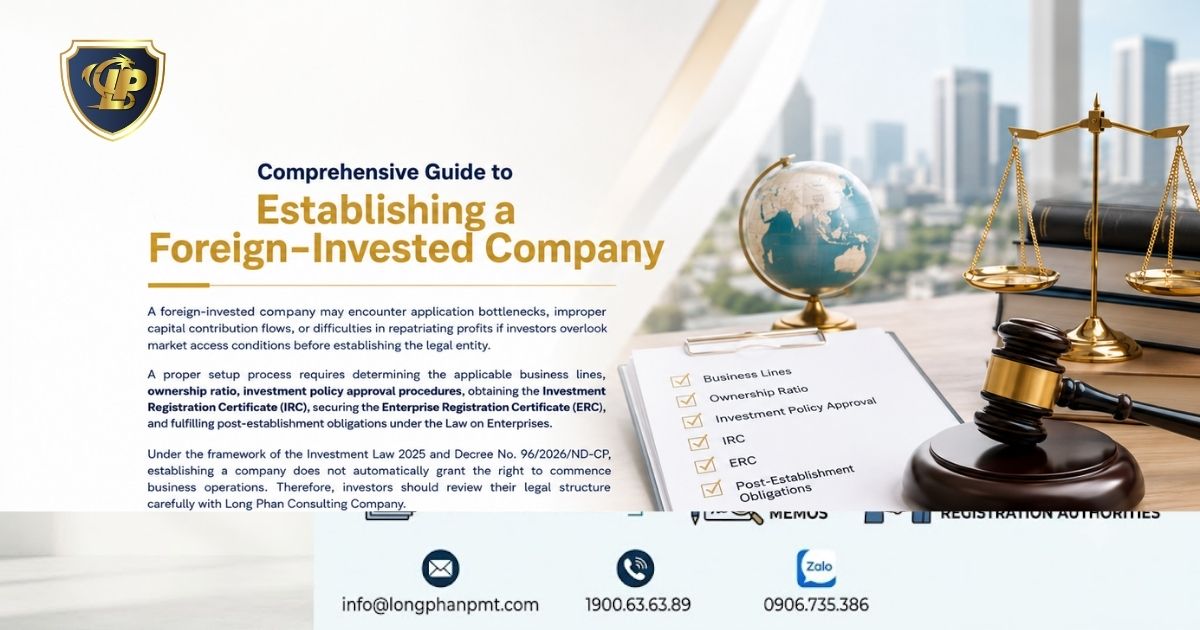
Legal characteristics of economic organizations implementing FDI projects: FDI enterprises operating in Vietnam are subject to both investment law and enterprise law. This means that enterprises must comply with both the Investment Registration Certificate (IRC) issuance process and the Enterprise Registration Certificate (ERC) procedure.
Conditions for establishing FDI enterprises in Vietnam
To establish an FDI enterprise in Vietnam, the following factors must be fully converged:
Foreign Ownership Requirement The enterprise must be established or have capital contributed/owned by a foreign investor as prescribed in Clause 19, Article 3 of the Law on Investment 2020. Since an FDI enterprise requires direct investment capital from abroad, establishing an FDI enterprise in Vietnam naturally necessitates execution or capital contribution/ownership by a foreign investor.
Compliance with Prohibited Business Lines To be permitted to operate in Vietnam, an FDI enterprise must not conduct business in prohibited industries as prescribed in Clause 1, Article 6 of the Law on Investment 2020, supplemented by Clause 2, Article 2 of the Law amending the Law on Planning, Law on Investment, Law on PPP Investment, and Law on Bidding 2024. Specifically:
Business in narcotic substances stipulated in Appendix I of the Law on Investment 2020.
Business in chemicals and minerals stipulated in Appendix II of the Law on Investment 2020.
Business in specimens of wild flora and fauna derived from nature as specified in Appendix I of CITES; specimens of endangered, precious, and rare forest plants, forest animals, and aquatic products of Group I derived from nature as specified in Appendix III of the Law on Investment 2020.
Prostitution business.
Buying and selling humans, tissues, corpses, human body parts, or human fetuses.
Business activities related to human cloning.
Business in firecrackers.
Business in debt collection services.
Business in buying and selling national treasures.
Business in exporting relics and antiques.
Investment Project and Investment Registration Certificate (IRC) According to Point c, Clause 1, Article 22 of the Law on Investment 2020, before establishing an economic organization, a foreign investor must have an investment project and carry out procedures for granting or adjusting the Investment Registration Certificate (IRC), except for the establishment of innovative startup small and medium-sized enterprises (SMEs) and innovative startup investment funds in accordance with the law on supporting SMEs.
Therefore, foreign investors wishing to establish or contribute capital to an FDI enterprise must perform procedures to obtain or adjust the Investment Registration Certificate, with the exception of establishing innovative startup SMEs and innovative startup investment funds.
Exceptions for Strategic Technology Projects (Effective 2025) According to Point c, Clause 1, Article 22 of the Law on Investment 2020, as added by Clause 4, Article 6 of the Law amending the Law on Bidding; Law on PPP Investment; Law on Customs; Law on VAT; Law on Import/Export Tax; Law on Investment; Law on Public Investment; and Law on Management and Use of Public Assets 2025: Foreign investors are allowed to establish an economic organization to implement an investment project before carrying out procedures for granting or adjusting the Investment Registration Certificate for the following projects:
New investment projects establishing innovation centers or research and development (R&D) centers.
Investment projects constructing big data center infrastructure, cloud computing infrastructure, mobile infrastructure of 5G or higher, and other digital infrastructure in the strategic technology sector as decided by the Prime Minister.
Investment projects in the strategic technology sector or manufacturing strategic technology products as decided by the Prime Minister.
Application Submission Procedure
Submit the dossier for the Investment Registration Certificate to the Investment Registration Authority as prescribed in Article 39 of the Law on Investment 2020.
After being granted the Investment Registration Certificate, the enterprise submits a dossier to the Business Registration Office – Department of Finance.
Conditions for establishing FDI enterprises in Vietnam
Conditions for a business to be allowed to provide real estate brokerage services
According to Article 9 of the 2023 Law on Real Estate Business, the conditions for organizations and individuals to conduct real estate services are that they must establish an enterprise in accordance with the law on enterprises or establish a cooperative or union of cooperatives in accordance with the law on cooperatives, except for the following two cases:
Individuals engaged in small-scale real estate business are not required to establish a real estate business enterprise, but they must declare and pay taxes in accordance with the law.
Organizations and individuals selling houses, construction works, or floor areas within construction works for non-commercial purposes, or selling, leasing, or lease-purchasing houses, construction works, or floor areas within construction works on a small scale, are not required to comply with the provisions of this Law but must declare and pay taxes as prescribed by law; in the case of individuals selling or lease-purchasing houses, construction works, or floor areas within construction works, they must also carry out notarization and certification as prescribed in Clause 5, Article 44 of the 2023 Law on Real Estate Business.
At the same time, real estate businesses must meet the following conditions:
Not during the period when real estate business activities are prohibited, temporarily suspended, or halted by a court judgment or decision, or a decision of a competent state agency;
Ensure the ratio of outstanding credit and corporate bond balances to equity capital is maintained.
Real estate businesses operating through real estate projects must have equity capital of no less than 20% of the total investment for projects with a land area of less than 20 hectares, and no less than 15% of the total investment for projects with a land area of 20 hectares or more, and must tell guarantee. The ability to raise capital to implement investment projects; in cases where a real estate business simultaneously undertakes multiple projects, it must have sufficient equity capital to allocate to…tell guarantee.The above-mentioned percentage for each project will be used to implement all projects.
Long Phan Consulting Company provides real estate brokerage services for FDI businesses
Given the complexity of the legal system for real estate investment and business, finding a professional consulting firm is essential. Long Phan Consulting Company provides comprehensive legal solutions, supporting FDI businesses from the market entry stage to stable operation.
The following are the specific services that will be provided to you when using Long Phan Consulting Company services:
Legal experts analyze market access conditions for foreign investors to determine optimal entry strategies into the real estate service sector.
Consulting FDI enterprise eligibility for real estate intermediary services.
Consultants draft and review brokerage, consultancy, and management contracts to ensure they meet mandatory legal templates and protect investor interests.
Advisors represent clients in administrative procedures for obtaining IRCs and ERCs, managing the complex documentation required by the Department of Finance.
Long Phan Consulting Company provides real estate brokerage services for FDI businesses
Frequently Asked Questions About FDI enterprise eligibility for real estate intermediary services
Below are some frequently asked questions about FDI enterprise eligibility for real estate intermediary services; please refer to them:
Are FDI enterprises providing real estate brokerage services required to establish a real estate exchange?
Not mandatory. FDI enterprises can choose to operate brokerage services independently or in combination with exchange services. However, if they only operate brokerage services, they must have at least one individual with a real estate brokerage license.
(Legal basis: Clauses 1 and 2, Article 61 of the 2023 Law on Real Estate Business.)
Can foreign investors be granted a Real Estate Brokerage License in Vietnam to work in FDI enterprises?
Permitted. Foreign individuals are granted a Real Estate Brokerage Certificate if they meet the following conditions: possess full civil capacity; have a high school diploma or higher; and have passed an examination on real estate brokerage knowledge. However, foreign individuals must comply with regulations regarding work permits when working in Vietnam.
(Legal basis: Article 70 of the 2023 Law on Real Estate Business.)
Is there a ceiling on the real estate brokerage fees charged by FDI companies?
The law does not specify a maximum amount. Real estate brokerage fees and commissions are agreed upon by both parties in the contract and are not dependent on the price of the brokered transaction (for fees) or as a percentage of the contract value (for commissions). However, all fees must be clearly stated in the signed service contract.
(Legal basis: Article 63 of the 2023 Law on Real Estate Business.)
What is the procedure for changing a real estate brokerage company from a Vietnamese enterprise to a foreign direct investment (FDI) enterprise when a foreign investor contributes capital to the company?
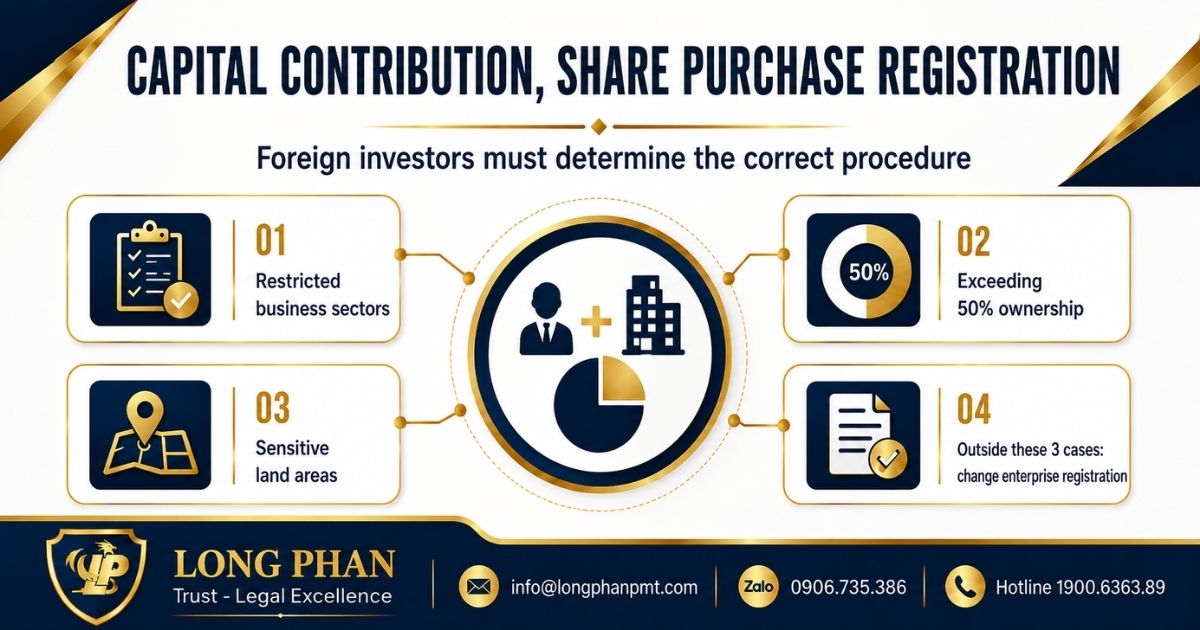
Businesses need to register the purchase of capital contributions/shares with the Department of Finance if the foreign investor holds more than 50% of the charter capital or invests in industries with market access conditions for foreign investors. After approval, the business proceeds with the procedure for changing members/shareholders.
(Legal basis: Article 26 of the 2020 Investment Law.)
Is it mandatory for real estate brokerage service contracts between FDI enterprises and individual clients to be notarized?
Real estate service contracts (including brokerage) must be in writing. According to regulations, contracts for the purchase or lease-purchase of houses, construction works, or floor areas within construction works where the parties involved are individuals must be notarized or certified. For real estate business contracts and real estate service contracts where at least one party is a real estate business enterprise, notarization or certification is required at the request of the parties. Notarization or certification of contracts is at the discretion of the parties; it is not legally mandated, except when the parties so desire to enhance the legal validity and security of the transaction.
(Legal basis: Clause 4, Article 44 of the 2023 Law on Real Estate Business.)
Determining whether an FDI enterprise is permitted to provide real estate intermediary services depends entirely on meeting the stringent conditions regarding legal status and scope of operations as stipulated in the 2023 Real Estate Business Law. To ensure compliance with legal regulations and optimize the investment process, please contact us immediately. LongPhan Consulting Companyvia Hotline 1900636389 to receive timely support from our team of experts.
Facebook
Linkedin
Twitter
Pinterest
Phan Mạnh Thăng
Mr. Phan Manh Thang, CEO, is the founder of Long Phan Investment Consulting and Legal Services Company Limited. With over 13 years of experience in the fields of land and corporate law, CEO Phan Manh Thang has been advising and partnering with numerous clients throughout their business operations and enterprise expansion. Concurrently, he serves as the Managing Lawyer of Long Phan PMT Law Firm, established in 2019.
His specialized expertise and practical experience have consistently earned him the trust and high regard of his clients.