
Can Foreign Investors Invest in High-Tech Zones in Vietnam? The investment must comply with Vietnamese laws regarding direct investment, project registration, and market access conditions under the Law on Investment 2020 and guiding documents. At the same time, foreign investors can also enjoy investment incentives if the project is located in a high-tech zone under current regulations. The following article by Long Phan Consulting Company will provide a specific analysis of legal regulations on this issue for Clients.

According to Article 18 of the 2025 Investment Law, foreign investors invest in high-tech zones in Vietnam in various forms.
Establishing a 100% foreign-owned economic organization is a common form in FDI projects in Vietnam. This allows foreign investors to fully control business operations, apply scientific and technological advances, and use management experience for optimal efficiency.
>>>See more: Procedures for granting Investment Certificates to foreign investors
According to Article 22 of the 2025 Investment Law, a BCC contract is a form of investment signed between domestic investors in accordance with civil law and relevant laws. BCC contracts signed between domestic and foreign investors, or between foreign investors, must follow the procedures for obtaining an Investment Registration Certificate as stipulated in Article 26 of the 2025 Investment Law.
The parties to a BCC contract establish a coordinating committee to implement the BCC contract. The functions, duties, and powers of the coordinating committee are agreed upon by the parties. During the implementation of the BCC contract, the parties may agree to use assets formed from the business cooperation to establish enterprises in accordance with the law on enterprises.
According to Clause 5, Article 3 of the 2025 Investment Law, an expansion investment project is an investment project that develops an existing investment project by expanding its scale, increasing capacity, innovating technology, reducing pollution, or improving the environment.
When foreign investors expand existing high-tech projects, they must comply with the investment project implementation principles stipulated in Article 29 of the 2025 Investment Law and are entitled to investment incentives as stipulated in Clause 5 of Article 14 and Clause 2 of Article 17 of the 2025 Investment Law.
Understanding the process and basic conditions not only helps investors optimize their time but also minimizes future legal risks. This process is structured through several important stages, with the initial preparation phase playing a crucial role in shaping the entire project.
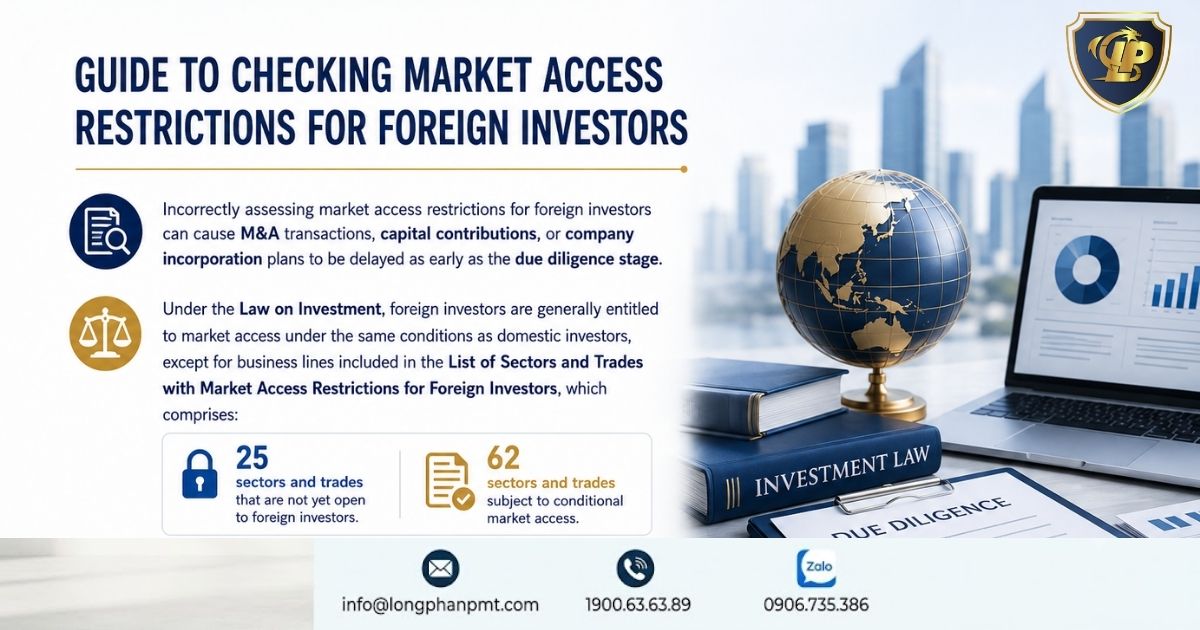
First, foreign investors need to determine whether the investment activities in the high-tech zone fall under the category of sectors with restricted market access for foreign investors as stipulated in Articles 6, 7, and 8 of the 2025 Investment Law. If it falls under the category of restricted market access for foreign investors, the investor will not be able to invest directly.
According to Article 26 of the 2025 Investment Law, foreign investors must apply for an Investment Registration Certificate from the competent authority in order to be allowed to implement their investment project.
The competent authority to issue Investment Registration Certificates to foreign investors in high-tech zones, as stipulated in Article 27 of the 2025 Investment Law, is the High-Tech Zone Management Board, except in the following case: The investment registration authority where the investor implements the investment project and establishes or plans to establish an operating office to implement the investment project shall issue Investment Registration Certificates for the following investment projects:
According to Article 33 of Decree 168/2025/ND-CP, after obtaining an IRC, enterprises established in Vietnam by foreign investors shall carry out the procedures for issuing ERCs and conduct business in accordance with the provisions of enterprise law.
Land users are entitled to lease land and infrastructure within high-tech zones when they meet the conditions stipulated in Article 45 of the 2024 Land Law and proceed to the competent authority to carry out the procedures for applying for land and infrastructure lease. The process of land allocation and leasing for high-tech zones is a crucial factor in ensuring sustainable and efficient land management. According to the regulations in Section I, Part III, Appendix I of Decree 151/2025/ND-CP, this process is carried out in the following specific steps:
Step 1: Determine land use needs
First, businesses, organizations, or individuals intending to invest in the high-tech zone must determine their land use needs for their project. This includes preparing an application for land allocation or lease and submitting it to the competent state agency. This application must include information about the project, its scale, the technology intended to be used, and the socio-economic benefits the project will bring.
Step 2: Document review
After receiving the application, the competent authority will conduct an assessment to check the legality and feasibility of the project, as well as its conformity with the local land use plan. This is to ensure that the project is implemented without negatively impacting the environment and the lives of the surrounding community.
Step 3: Decide whether to allocate or lease land.
If the application is approved, the competent authority will issue a decision to allocate or lease land to the investing organization or individual. This decision will specify necessary information such as land area, lease term, land use purpose, and commitments regarding project implementation.
Step 4: Contract signing
Once the decision is issued, the state and the organization or individual will proceed to sign a land lease contract. This contract needs to clearly stipulate the rights and obligations of the parties, the lease term, the land lease price, and commitments regarding project implementation. The contract should also specify clauses for handling contract violations and the responsibilities of each party during implementation.
Step 5: Project Implementation
After signing the contract, the investing organization or individual will begin implementing the project in accordance with the agreed-upon regulations. During the implementation process, the investing organization or individual must comply with the provisions of the law and the requirements of competent state agencies.
Step 6: Inspection and Monitoring
Authorities will conduct inspections and supervise the land use and project implementation by investing organizations and individuals. This aims to ensure that activities within the high-tech zone are carried out in accordance with the law, without negatively impacting the environment and surrounding communities.
The process of allocating and leasing land for high-tech zones is not only a way to attract investment but also an opportunity to develop infrastructure and enhance domestic production capacity. The government can apply preferential policies on land lease prices and tax exemptions for businesses operating in the high-tech sector to encourage investment in these areas.
The construction and development of high-tech zones is a crucial part of the country’s economic development strategy. To ensure that operations within these zones run smoothly and efficiently, the land allocation and leasing process must be transparent, fair, and in strict compliance with the law.
They must meet environmental requirements, national defense and security requirements, fire safety requirements, technical regulations, or market access conditions if these conditions are specifically stipulated in legal documents.

According to Articles 14, 15, 17 of the Law on Investment 2025, incentives focus on tariffs and resource costs:
To ensure success and sustainability:
In the context of Vietnam increasingly opening its investment market and becoming a strategic choice for many foreign investors wishing to access the Vietnamese high-tech market without requiring a direct legal presence, Long Phan Consulting Company provides comprehensive and flexible solutions for investors in this field, specifically including:

>>>See more: Indirect investment advisory services for foreign investors
Below, Long Phan Consulting Company provides some frequently asked questions regarding investment in high-tech zones in Vietnam for foreign investors. We invite interested clients to refer to this information:
Yes. According to Article 33 of the 2025 Investment Law, foreign investors have the right to transfer part or all of a project to another investor. However, the transferee must also fully meet the conditions regarding financial capacity and corresponding high-tech standards. This procedure must be assessed and approved by the High-Tech Park Management Board for adjustment of the Investment Registration Certificate.
According to Article 204 of the 2024 Land Law, which regulates land use for high-tech zones, the State typically leases land with annual rent payments or a one-time payment for the entire lease period for investment in the construction and operation of high-tech zone infrastructure. The land use term in a high-tech zone is based on the operating term of the investment project but not exceeding 70 years.
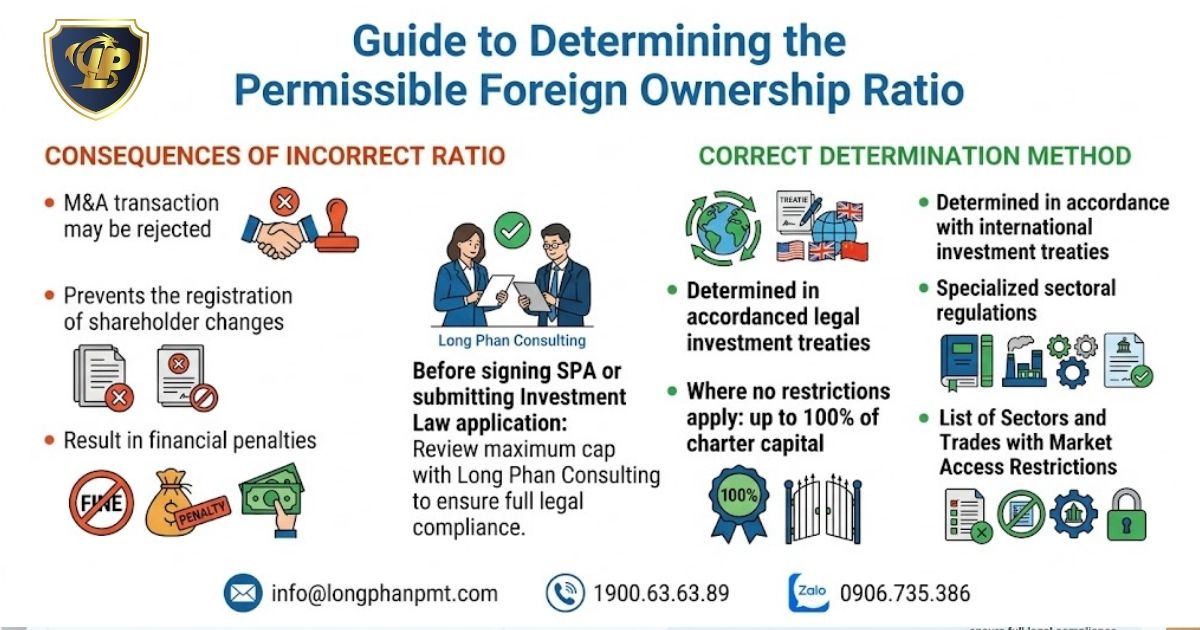
The maximum foreign ownership ratio depends on the specific business sector. According to Clause 38, Article 3 of Decree 155/2020/ND-CP, the foreign ownership ratio is the total percentage of shares or capital contributions held by all foreign investors and economic organizations with foreign investors holding more than 50% of the charter capital in a public company, securities company, securities investment fund management company, or securities investment fund, or securities investment company.
According to Clause 1, Article 139 of Decree 155/2020/ND-CP, public companies operating in industries and business sectors included in the list of restricted market access sectors for foreign investors shall comply with the regulations on foreign ownership in that list. In cases where the list of conditional market access sectors does not specifically stipulate the percentage of charter capital ownership by foreign investors in an economic organization, the maximum foreign ownership percentage in the company shall be 50% of the charter capital.
According to Article 14 of Decree 10/2024/ND-CP, the State encourages the construction of housing and public utility facilities to serve workers in high-tech industrial parks. However, these facilities must be planned in a separate functional area (Housing and Service Area), not within the high-tech product manufacturing area. Investors can directly invest or cooperate with infrastructure units to implement these projects.
Essentially, used machinery imported into Vietnam must comply with Decision 18/2019/QD-TTg, amended and supplemented by Decision 28/2022/QD-TTg (not exceeding 10 years of age). However, according to Article 6 of Decision 18/2019/QD-TTg, amended and supplemented by Decision 28/2022/QD-TTg, for investment projects in high-tech industrial parks, if the machinery, even if used, has high remaining technological efficiency or is a complete production line necessary for the project, you may apply for special approval from the Ministry of Science and Technology for import.
According to Article 81 of the 2024 Land Law, land may be reclaimed when enterprises seriously violate land use purposes, fail to fulfill financial obligations, cause serious environmental pollution, or when the State reclaims land to implement important projects serving national interests.
Investing in high-tech zones is a sustainable development strategy for FDI enterprises in Vietnam. Clients need to master regulations on priority sectors and market access conditions to enjoy optimal tax incentives. Long Phan Consulting Company is ready to provide legal solutions and professional administrative representation. Please contact Hotline 1900636389 today for detailed advice.