
A key question for many citizens is whether the new law will simplify land separation. Major changes in land management authority after July 1, 2025, introduce new regulations that facilitate this process. The new rules simplify procedures, shorten processing times, and increase transparency. This creates an opportunity for citizens to use land legally and more effectively. This article by Long Phan Consulting Company provides a detailed analysis of the legal issues involved in the land separation process.

To execute a land separation, the land parcel must comply with specific conditions outlined in Article 220 of the Land Law 2024 and subsection 3, Section I, Part C, Appendix V of Decree 151/2025/NĐ-CP. These include:
Effective July 1, 2025, Decree 151/2025/NĐ-CP revolutionizes the land management system by decentralizing authority to two local government levels. The authority to resolve a land user’s land separation request will, depending on the case, fall to either the Commune-level People’s Committee or the Provincial-level People’s Committee.
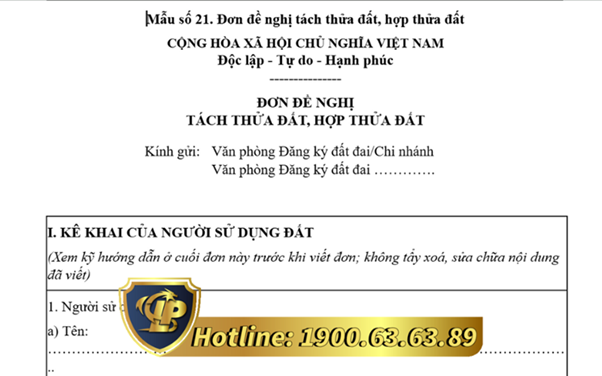
As per subsection 1, Section I, Part C, Appendix V of Decree 151/2025/NĐ-CP, the land user must prepare one set of application documents for land separation, including:
According to subsection 2, Section I, Part C, Appendix V of Decree 151/2025/NĐ-CP and subsection 7, Section B, Part II of Decision 2304/QĐ-BNNMT, land users can submit their dossier at:
Based on Section I, Part C, Appendix V of Decree 151/2025/NĐ-CP, the land separation procedure from July 1, 2025, is as follows:
Step 1: Dossier Submission The land user submits the dossier to the competent authority. The receiving officer checks the documents and issues an appointment slip for returning the result if the dossier is valid. If submitted at a One-Stop-Shop, the dossier is forwarded to the appropriate Land Registration Office or its branch.
Step 2: Dossier Reception and Verification The Land Registration Office or its branch reviews the dossier, verifying:
Step 3: Dossier Return (If Applicable) If the dossier is incomplete, the authority returns it with instructions for completion within a specified time.
Step 4: Confirmation on Application and Drawing For a valid dossier, within 05 working days of receipt, the Land Registration Office confirms eligibility and parcel information on the Application for Land Separation. The office also certifies the Land Separation Drawing to complete the registration process and issue new certificates for the resulting parcels.
Step 5: Land Variation Registration and Result Delivery If the land separation involves a change in land user, the procedure for registering land and asset variations must be followed. The Land Registration Office updates the cadastral records and land database, issues new Land Use Rights Certificates for the separated parcels, and delivers them to the grantee.
>>> See more at:
Recent legal changes offer clear benefits to land users, making the land separation procedure more accessible.
According to Part V, Appendix I of Decree 151/2025/NĐ-CP, from July 1, 2025, the state will cover the cost of cadastral surveying. Therefore, clients will only need to pay the fee for issuing the new certificate when undertaking a land separation.
Based on administrative procedure code 1.012784, subsection 7, Section B, Part II of Decision 2304/QĐ-BNNMT, and Section I, Part A, Appendix V of Decree 151/2025/NĐ-CP, submission methods are expanded:
As per administrative procedure code 1.012784 and subsection 7, Section B, Part II of Decision 2304/QĐ-BNNMT issued on June 23, 2025, the processing time for land separation is:
To navigate the land separation procedure smoothly, land users must understand the process and comply with all conditions. With years of specialized experience in land law, Long Phan Consulting Company offers expert support for all procedures related to land separation, ensuring efficiency and speed. Our services include:
Long Phan Consulting Company is committed to providing reliable services. Clients can be confident in the legal validity and effectiveness of our support.
>>> See more at: Land subdivision registration services for individual households and individuals
Land users often face practical issues regarding the land separation procedure. Here are answers to some common questions.
Yes. Article 562 of the Civil Code 2015 allows a land user to authorize another person to perform land-related tasks on their behalf. You must prepare a Power of Attorney or Authorization Contract that is properly notarized or certified. The authorized person will then have the full right to submit documents, work with authorities, and receive the results on your behalf.
The core procedure and prerequisite conditions in Article 220 of the Land Law 2024 apply generally to all land types. The key difference lies in the minimum area allowed after separation, which is specified separately for agricultural and residential land in decisions made by the Provincial People’s Committee.
Yes. Based on Section I, Part C, Appendix V of Decree 151/2025/NĐ-CP, the law permits combining administrative procedures to save time. You can proceed with the land separation and land transfer procedures concurrently.
This information is stipulated in a decision by the People’s Committee of the province or city where the land is located. You can look it up on the official electronic portal of the Provincial People’s Committee or contact the local Land Registration Office branch for precise information.
No. The resolution period is calculated in “working days,” which excludes Saturdays, Sundays, and public holidays as defined in Article 112 of the Labor Code 2019.
Streamlining the dossier, eliminating survey fees, and shortening the timeline for land separation have removed traditional barriers. With a constantly evolving legal framework for land, clients must stay updated to avoid risks. Long Phan Consulting Company is ready to provide fast and effective support for your land separation procedure. Contact us immediately via our hotline at 1900636389 for detailed consultation and timely assistance.