
Legal Mistakes That Cause Business License Applications to Be Rejected are often rejected due to legal deficiencies in the submitted documents, even when the company has prepared all required forms. In essence, the application process must be standardized in accordance with the Enterprise Registration Certificate, ensuring proper signing authority, legal capacity of the applicant, business name, headquarters address, registered business lines, charter capital, and compliance with sector-specific requirements. Otherwise, the application may be subject to amendment requests within three working days or expose the business to penalties of up to VND 100,000,000.
Businesses should review their application dossiers in line with the latest legal updates before submission to minimize the risk of rejection, license revocation, or inability to commence operations in practice, with professional support from Long Phan Consulting Company.

Key legal notes:
The initial exposure to regulatory risks during the process of business registration involves the legal capacity of the founders, the authorized signatories, and the designated agents submitting the dossier. Legally, an application is only deemed valid when all statutory forms are complete and the enclosed information is fully declared in strict compliance with local regulations, pursuant to Clause 20, Article 4 of the Law on Enterprises 2020.
Under Clause 25, Article 4 of the Law on Enterprises 2020, an “enterprise founder” is defined as any individual or organization that establishes or contributes capital to establish an enterprise. Consequently, foreign investors must conduct comprehensive preliminary verifications of legal capacity, identity documentation, and signing authority from the outset, rather than merely reviewing basic template forms.
Corporate registration dossiers are frequently rejected by the Provincial Business Registration Office when the signing individual lacks proper authority or when the submitting agent fails to present a valid Power of Attorney (POA). This remains a prevalent compliance error in dossiers executed by internal accountants, human resources personnel, or third-party agencies lacking rigorous legal oversight.
To mitigate these risks, the following document categories must be thoroughly reviewed prior to submission:
Regulatory Relief Note: Foreign investors are not required to automatically initiate an administrative update for existing corporate records solely because historical documents list older identity card numbers. Pursuant to Article 121 of Decree No. 168/2025/NĐ-CP, previously issued certificates containing historical identity information retain full legal validity and remain effective.
Not all individuals and organizations possess an unrestricted right to establish and manage commercial entities. Enterprises must actively screen out prohibited categories of actors before submitting their dossier, as ignoring these statutory restrictions can trigger severe enforcement actions after the certificate is issued.
The primary restricted categories requiring compliance screening include:
Pursuant to Clause 1 and Clause 2, Article 17 of the Law on Enterprises 2020, all individuals and organizations retain the right to establish, contribute capital, purchase shares, and manage enterprises, except where explicitly barred by law. If an application is executed by an individual or entity subject to these legal prohibitions, the enterprise faces the total revocation of its Enterprise Registration Certificate, pursuant to Point b, Clause 1, Article 212 of the Law on Enterprises 2020.
The Provincial Business Registration Office maintains the statutory authority to approve or reject proposed corporate names to prevent duplicates or misleading titles, pursuant to Clause 2, Article 14 of Decree No. 168/2025/NĐ-CP. A dossier may be rejected even if the applicant’s eligibility is sound, provided the chosen name, headquarters address, or business sectors fail to meet precise statutory criteria. These errors often stem from preparing applications based solely on commercial preferences rather than cross-referencing the national registration database and specialized statutory laws.
A corporate name serves as both a commercial brand and a primary legal benchmark in the registration dossier. If the proposed name duplicates, misleads, or conflicts with specialized laws, the authorities will issue a formal request for amendment.
Foreign investors must audit the following risk indicators prior to submission:
Pursuant to Article 42 of the Law on Enterprises 2020, the headquarters of an enterprise must be a verified physical location within the territory of Vietnam, clearly defined by administrative boundaries and equipped with functional contact details. If the address is purely nominal or defective, the enterprise faces substantial operational gridlocks when registering for corporate taxes, opening local commercial bank accounts, or receiving mandatory state notifications.
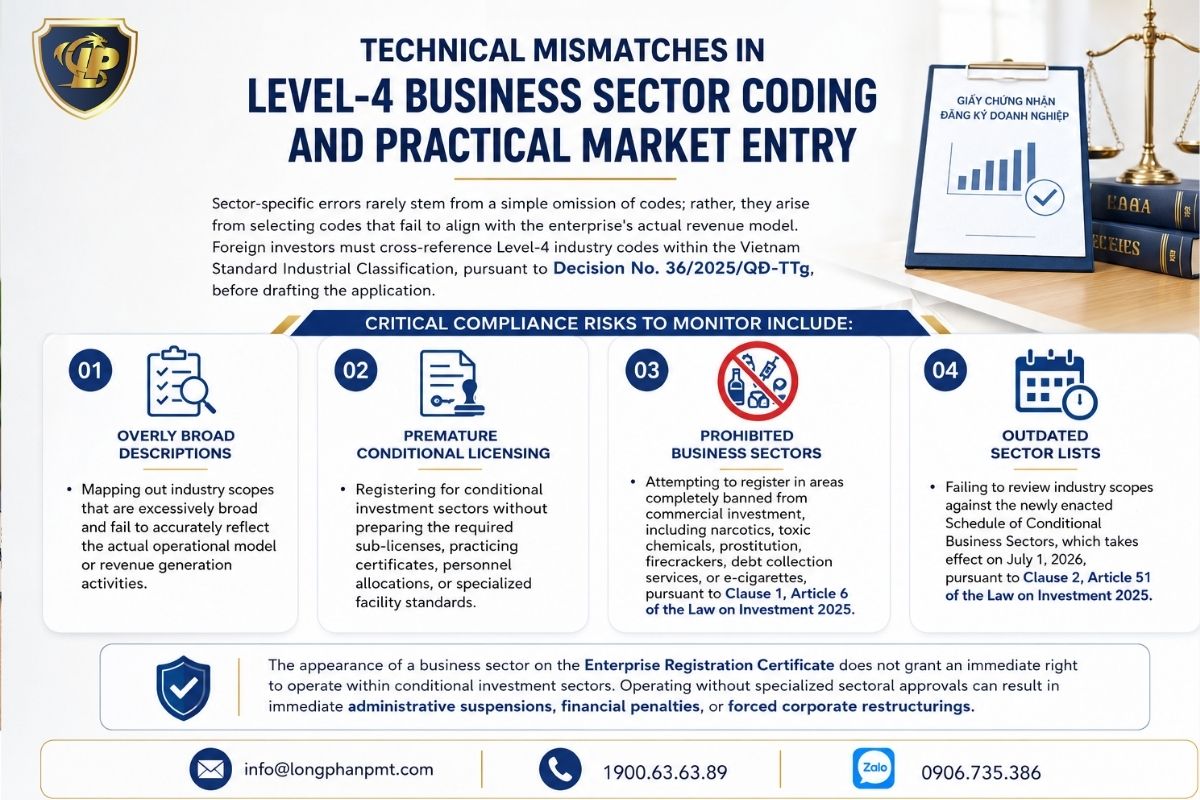
Sector-specific errors rarely stem from a simple omission of codes; rather, they arise from selecting codes that fail to align with the enterprise’s actual revenue model. Foreign investors must cross-reference Level-4 industry codes within the Vietnam Standard Industrial Classification, pursuant to Decision No. 36/2025/QĐ-TTG, before drafting the application.
Critical compliance risks to monitor include:
The appearance of a business sector on the Enterprise Registration Certificate does not grant an immediate right to operate within conditional investment sectors. Operating without specialized sectoral approvals can result in immediate administrative suspensions, financial penalties, or forced corporate restructurings.
Charter capital is not merely a statistical placeholder recorded on a business registration application. It serves as the primary statutory benchmark establishing shareholder liability, corporate capacity to execute business operations, and the overall structural credibility of the legal entity.
Severe compliance exposures arise when enterprises artificially overstate their financial capacity to enhance their corporate profile without possessing the actual capability to inject the funds, or when they fail to meet the absolute minimum capital requirements mandated by specialized sectoral laws. In highly regulated frameworks – such as real estate, private security services, logistics, education, international travel agencies, or employment placement services-the registration dossier must be rigorously audited for both its stated charter capital and its compliance with distinct, sector-specific financial criteria.
Foreign investors must clearly distinguish between charter capital and legal capital or minimum capital requirements. Charter capital represents an internal capitalization commitment among shareholders, whereas legal capital is a mandatory, statutory prerequisite required to legally operate in specific regulated sectors.
Members of limited liability companies and shareholders of joint-stock companies must fully inject the exact asset types they committed to contribute within 90 days from the date of issuance of the Enterprise Registration Certificate, pursuant to Clause 2, Article 47, Clause 2, Article 75, and Clause 1, Article 113 of the Law on Enterprises 2020.
| Violating Conduct | Primary Administrative Fine | Statutory Foundation |
| Overstatement of charter capital valued under VND 10 billion | VND 20,000,000 to VND 30,000,000 | Clause 1, Article 47 of Decree No. 122/2021/NĐ-CP |
| Overstatement of charter capital valued at VND 100 billion or above | VND 80,000,000 to VND 100,000,000 | Clause 5, Article 47 of Decree No. 122/2021/NĐ-CP |
Artificially inflating capitalization figures to satisfy commercial bidding criteria, secure commercial leases, or negotiate with local partners creates compounded legal exposure. The enterprise will not only face steep administrative fines but also remains legally bound to fulfill the total asset contribution liabilities and financial obligations arising directly from the overstated figures.
Foreign direct investment (FDI) projects cannot utilize the standard application workflow designated for domestic entities. Prior to initiating business registration, foreign investors must systematically analyze market access barriers, foreign ownership limits (FOL), permitted forms of investment, and the precise scope of planned corporate operations.
The following structural benchmarks must be verified before drafting any application documents:
Bypassing this specialized FDI review results in an entity that exists on paper but is legally barred from executing its intended investment model. This structural failure typically manifests as a disconnect among industry scopes, capitalization tiers, foreign ownership percentages, and specialized sectoral approvals.
Electronic filing failures rarely stem from substantive legal issues; instead, they are primarily triggered by data discrepancies between the digital fields entered directly into the system and the scanned documents attached to the application. The National Business Registration Portal serves as the exclusive, mandatory online channel for executing remote business registrations, publishing corporate notices, and retrieving official corporate registration records, pursuant to Clause 8, Article 4 of the Law on Enterprises 2020.
To navigate the electronic platform successfully, enterprises must implement a dual-track technical and compliance review process:
When an online application is returned due to a digital signature failure or a defective attachment, the entire structural data flow must be re-audited. Modifying a single isolated file without verifying the broader logic between digital web forms, cryptographic signatures, and physical legal documents will result in repeated processing freezes on the portal.
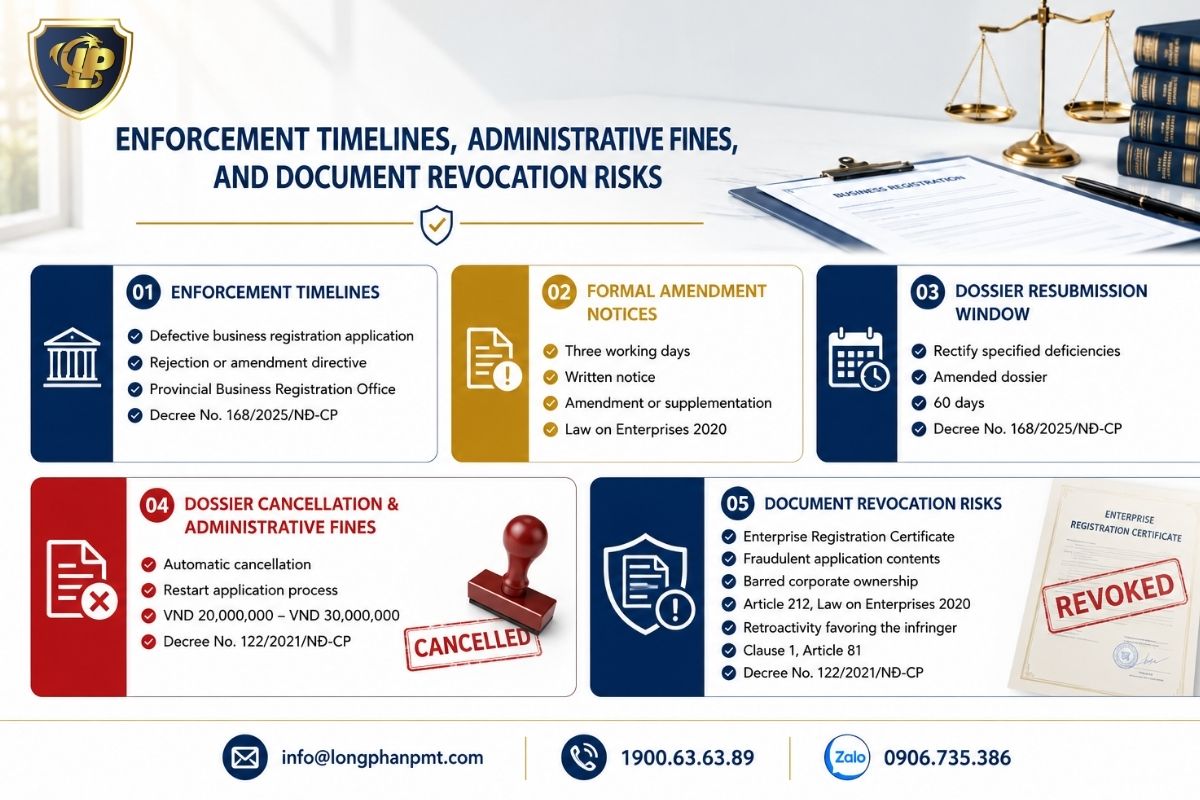
Submitting a defective business registration application extends far beyond simple administrative delays. Material inaccuracies expose the enterprise to immediate financial penalties, mandatory data rectifications, or the total revocation of its Enterprise Registration Certificate post-issuance. The Provincial Business Registration Office maintains explicit statutory jurisdiction to receive applications, evaluate dossier validity, and issue or deny corporate registrations, pursuant to Clause 1, Article 21 of Decree No. 168/2025/NĐ-CP. Consequently, any structural deviation within the submitted data serves as immediate legal grounds for a rejection or an amendment directive.
Defective applications are systematically processed through the following statutory phases:
Regarding administrative sanctions, making dishonest or inaccurate declarations within a corporate registration dossier triggers a fine ranging from VND 20,000,000 to VND 30,000,000, pursuant to Article 43 of Decree No. 122/2021/NĐ-CP. This risk typically arises when entities use outdated personal identification records, misstate actual operational dimensions, or list industry scopes that do not match their true business activities.
In critical scenarios, an enterprise faces the total revocation of its Enterprise Registration Certificate if the contents of the application are found to be fraudulent or if the entity was established by individuals explicitly barred from corporate ownership. This enforcement action is executed pursuant to Point a and Point b, Clause 1, Article 212 of the Law on Enterprises 2020.
However, regulatory enforcement must respect the principle of retroactivity favoring the infringer. If a compliance violation occurs prior to the effective date of a new regulation but is reviewed after its enactment, the handling authority will apply the newer provisions if they remove legal liability or impose a lighter administrative penalty, pursuant to Clause 1, Article 81 of Decree No. 122/2021/NĐ-CP.
Navigating a successful enterprise registration in Vietnam requires seamless alignment among corporate structures, operational sectors, capitalization tiers, legal representatives, and specialized laws. The legal specialists at Long Phan Consulting Company assist foreign investors in managing structural risks from the initial planning stages, moving far beyond basic document drafting to ensure long-term compliance.
Our comprehensive corporate advisory and representation services include:
Foreign investors can submit their proposed application drafts, corporate records, and target industry scopes via Email at info@longphanpmt.com or through Zalo at 0906.735.386 for a comprehensive preliminary evaluation.
Risks when applying for a business license often arise in boundary situations: foreign investors, conditional business sectors, high declared capital, or inconsistent electronic documents. The following questions focus on the points most likely to result in application rejection, penalties, or inability to operate despite having a Business Registration Certificate.
No, a business cannot operate immediately if its registered business activities fall under conditional investment and business sectors. The business must meet and maintain the specialized conditions throughout its operation. Businesses should review all required specialized licenses because the new list of conditional investment and business sectors will only take effect from July 1, 2026, according to Clause 2, Article 51 of the 2025 Investment Law.
Businesses must amend and supplement their application within 60 days from the date the provincial business registration authority issues a notice requesting amendments and supplements. If the application is not resubmitted within this period, the application will be canceled. This is a critical deadline to avoid restarting the registration process, as stipulated in Clause 3, Article 32 of Decree No. 168/2025/ND-CP.
The business registration authority must review the validity of the application and issue the business registration certificate within 3 working days from the date of receipt. If the application is invalid, the business registration authority must notify the business founder in writing of the necessary amendments and additions, in accordance with Clause 5, Article 26 of the 2020 Enterprise Law.
Businesses that provide false or inaccurate information in business registration documents may be fined from VND 20,000,000 to VND 30,000,000. This risk can result in application rejection and affect the legal validity of information after licensing, according to Article 43 of Decree No. 122/2021/ND-CP.
Inflating registered capital can result in fines of up to VND 100,000,000, depending on the amount of inflated capital. Inflating registered capital by less than VND 10 billion is punishable by a fine of VND 20,000,000 to VND 30,000,000, according to Clause 1, Article 47 of Decree No. 122/2021/ND-CP. Inflating registered capital by VND 100 billion or more is punishable by a fine of VND 80,000,000 to VND 100,000,000, according to Clause 5, Article 47 of Decree No. 122/2021/ND-CP.
The business registration authority may reject a proposed name if the business name is identical to or confusingly similar to an existing registered name. The decision of the business registration authority is final to prevent business name conflicts in the registration system, according to Clause 2, Article 14 of Decree No. 168/2025/ND-CP. Businesses are also prohibited from using names that violate specialized regulations, according to Clause 4, Article 14 of Decree No. 168/2025/ND-CP.
A business may have its business registration certificate revoked if the information declared in the registration application is fraudulent or if the business is established by a person prohibited from establishing a business. This is the most serious legal consequence of submitting false information or false statements, according to Points a and b, Clause 1, Article 212 of the 2020 Enterprise Law.
Securing a business registration in Vietnam must be approached as a systematic alignment of an entire corporate structure, rather than a mere administrative exercise of filling out template forms. Foreign investors must exercise simultaneous control over applicant eligibility, signatory authorization, corporate naming, headquarters zoning, industry mapping, capitalization tiers, conditional licensing, and electronic data flows to avoid dossier rejections, financial fines, or operational blocks. Minor clerical or structural mismatches within a filing can trigger substantial rectification expenses and the severe risk of certificate revocation. To proactively mitigate compliance exposure and optimize your corporate framework prior to filing, contact our regulatory helpdesk via contact the senior corporate attorneys at Long Phan Consulting Company immediately via Hotline 1900636389.
📚 This article is provided with professional consultation based on the following legal framework: