
An International Conference Permit is required when businesses plan to publicize an event, sell tickets, or invite foreign speakers before receiving formal approval. This process generally requires securing a Decision on Permission to Organize an International Conference or Seminar in Vietnam under Decision No. 06/2020/QD-TTg, with dossiers submitted at least 30 or 40 days before the event, depending on the competent authority.
To avoid event suspension, cancellation expenses, and reputational exposure, businesses should assess the event format, sponsors, speaker backgrounds, presentation materials, and Legal Updates with support from Long Phan Consulting.
Important legal note:
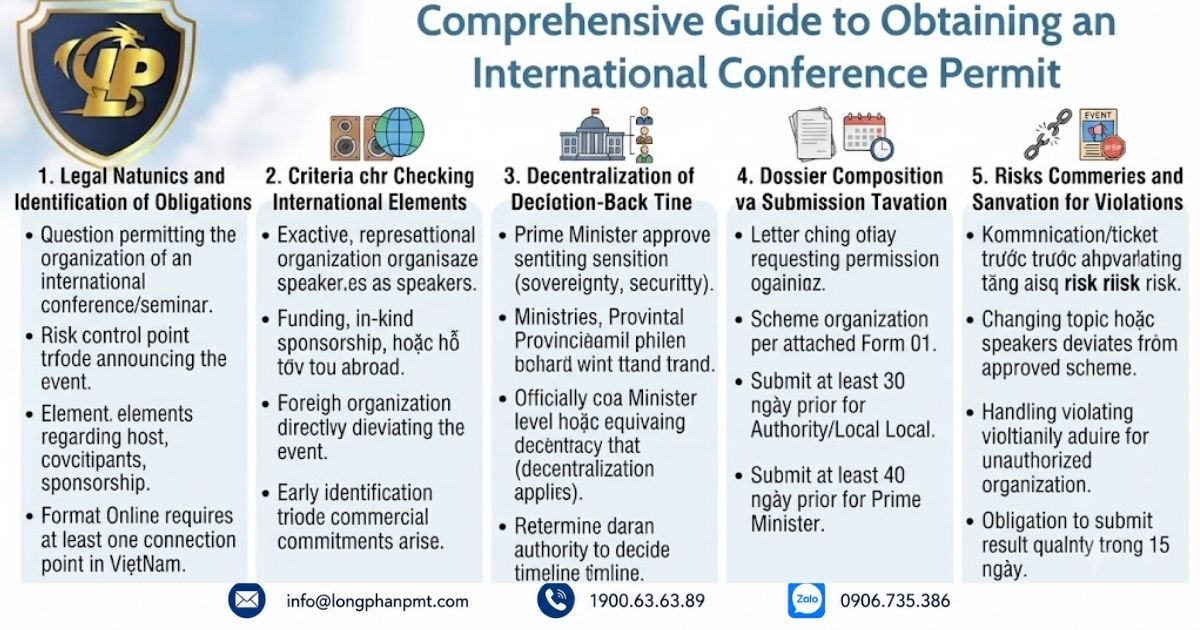
An international conference permit in Vietnam should not be mistaken for a mere administrative formality. For businesses, this Decision approving the organization of an international conference or seminar serves as a mandatory risk-control point that must be satisfied before publicizing the event, executing venue contracts, inviting guest speakers, or accepting foreign sponsorship.
An event does not automatically qualify as an “international conference” simply because foreign nationals are in attendance. However, when an event involves foreign elements—such as the organizing entity, participants, funding sources, or an online format with at least one connection point within Vietnam—the organizing unit must evaluate its obligations according to Clause 1, Article 2 of Decision No. 06/2020/QĐ-TTg.
Businesses must identify and address the following criteria to determine if they are subject to this licensing procedure:
Proactive assessment allows businesses to clarify their legal obligations before any media campaigns commence. Failure to conduct this evaluation may result in the event being classified as improperly organized, potentially leading to administrative sanctions or forced suspension.
Not every activity involving foreign elements requires a formal international conference permit in Vietnam. Businesses must accurately classify their event types to avoid unnecessary filings or, conversely, failing to satisfy other specialized regulatory requirements.
Determining the correct approving authority is the decisive factor in the timeline for obtaining an international conference permit in Vietnam. Submitting an application to an improper agency can cause significant delays in the review cycle, necessitate the re-submission of the Event Organization Scheme, and negatively impact media scheduling.
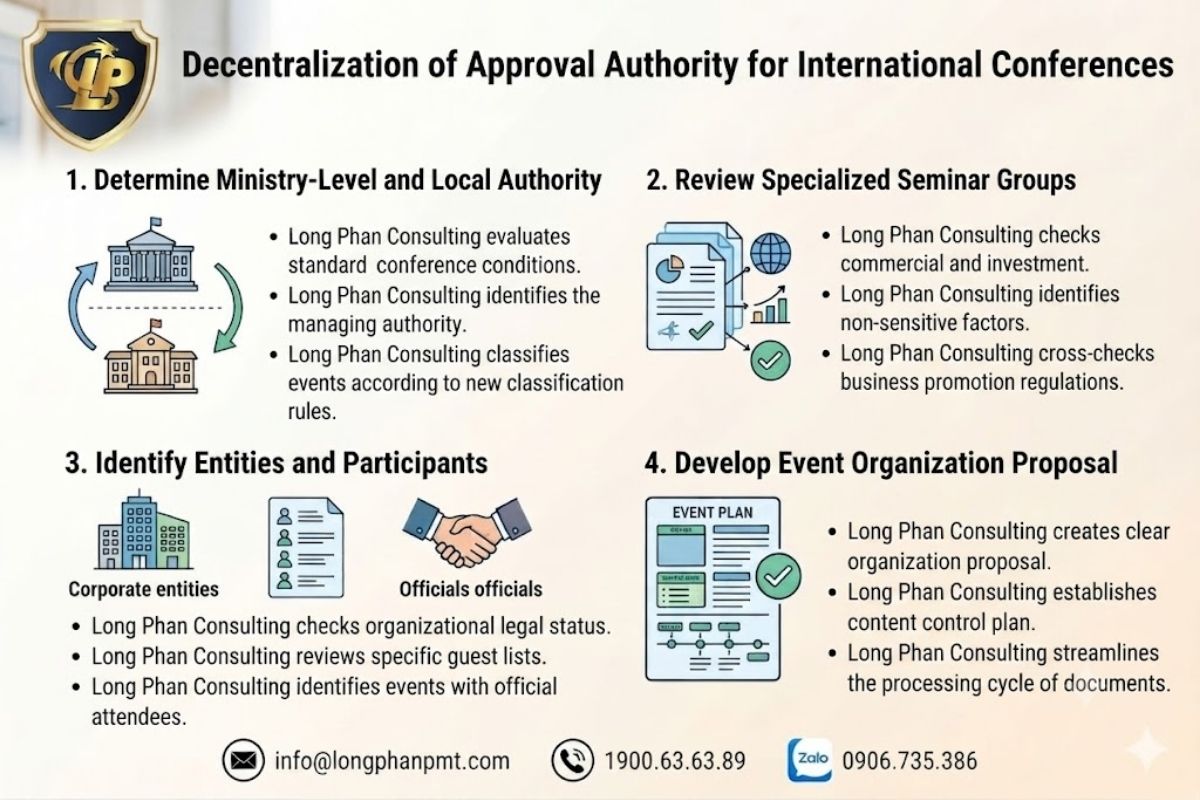
Authority is currently decentralized based on the nature of the event, thematic content, and the professional rank of invited guests. While sensitive content remains under the jurisdiction of the Prime Minister, the majority of commercial events are processed by relevant Ministries, government agencies, or provincial-level People’s Committees.
| Event Category | Competent Authority | Legal Basis |
| Content involving national sovereignty, security, defense, ethnicity, religion, human rights, or state secrets | Prime Minister | Point b, Clause 1, Article 3, Decision No. 06/2020/QĐ-TTg |
| Standard conferences and seminars | Head of the agency or locality authorized to decide on the organization | Clause 2, Article 3, Decision No. 06/2020/QĐ-TTg |
| Events involving foreign Ministers (or equivalent rank) or international organizations | Minister, Head of ministerial-level agency, or Chairperson of the Provincial People’s Committee | Clause 1, Article 16, Decree No. 134/2025/NĐ-CP |
Organizations should perform a thorough jurisdictional analysis before finalizing event dates. This assessment establishes the foundation for determining filing deadlines, the appropriate receiving agency, and the strategy for justifying content.
Events under the jurisdiction of the Prime Minister involve high levels of policy, security, or foreign affairs risk. Businesses must avoid treating these applications as routine commercial events, as the scope of review and criteria for assessment are significantly more stringent.
The following thematic groups require scrutiny at the highest level of government:
Events within these categories must be processed under the authority of the Prime Minister, pursuant to Point b, Clause 1, Article 3 of Decision No. 06/2020/QĐ-TTg. For businesses, the primary risk lies not in the event title, but in the actual substance of the discourse and the materials disseminated to the public.
The vast majority of international conferences dedicated to commerce, education, research, investment promotion, or specialized media do not fall under the purview of the Prime Minister. In such cases, businesses must identify the appropriate governing body based on the event’s location, sector, and organizing entity.
Categories typically governed by ministerial or local authorities include:
For standard events, authority is determined under Clause 2, Article 3 of Decision No. 06/2020/QĐ-TTg. Specifically, events featuring Ministers or equivalent ranks are currently governed by the decentralization provisions in Clause 1, Article 16 of Decree No. 134/2025/NĐ-CP. This structure allows businesses to expedite processing; however, applicants must still submit a clear Event Organization Scheme, a specific guest list, and a robust content control plan.
Decree No. 134/2025/NĐ-CP introduces significant shifts in authority regarding events featuring foreign officials of Ministerial rank or equivalent. The primary objective of this reform is to further decentralize approval power to Ministries, central government agencies, and provincial authorities.
Businesses must be mindful of two transition scenarios:
Decree No. 134/2025/NĐ-CP took effect on July 1, 2025, according to Clause 1, Article 22 of the Decree. For large-scale event projects, this transition date directly influences the “legal Gantt chart.” Businesses must verify filing dates, application statuses, and the receiving agency to avoid misdirection of authority.
The dossier for an international conference permit in Vietnam serves more than just administrative purposes; it acts as a comprehensive evidentiary document proving the legality of the event’s theme, guest list, funding sources, and the organizer’s capacity for risk management.
Businesses should prepare documentation with the intent of facilitating immediate review, rather than merely meeting minimum disclosure requirements. The core components of the dossier are defined in Point a, Clause 1, Article 4 of Decision No. 06/2020/QĐ-TTg:
For non-governmental projects, businesses should not assume that prior project approval equates to automatic authorization for the event. If a standardized Form 01 Scheme is absent, or if the project approving agency differs from the event licensing authority, the procedure must still be executed in accordance with Point b, Clause 1, Article 4 of Decision No. 06/2020/QĐ-TTg.
>>> See more: Who is eligible to rent official residence? Conditions for renting official residence?
A valid application must help government agencies clearly identify who is organizing the event, for what purpose, if there are any international elements involved, and what management risks are involved. For businesses, missing any piece of information can lead to requests for additional information, delaying the event’s progress.
The documents requiring review include:
Businesses should check the guidelines of the respective receiving agency before choosing whether to submit their application in person, online, or by mail.
The event proposal should not be drafted as an event introduction. It is a legal document for the competent authority to assess content risks, funding sources, guest list, and document review responsibilities.
The items requiring thorough explanation include:
The obligation to organize the event in accordance with the approved content and plan is stipulated in Point a, Clause 2, Article 4 of Decision No. 06/2020/QD-TTg. Therefore, businesses should view the plan as a legally binding commitment, not a document that can be arbitrarily changed during the event’s operation.
>>> See more: Food Safety Certificate consulting service in Vietnam
The procedure for obtaining an international conference permit in Vietnam must be integrated into the event schedule as an independent legal milestone. Businesses should avoid treating this as a post-event check, especially after speakers, venues, and media budgets have already been finalized.
The standard procedure comprises four distinct phases:
For businesses, the primary operational risk involves time management. If the dossier is submitted too close to the event date, requests for supplementary documentation can render the planned event timeline unfeasible.
The consultation phase is the stage most difficult for businesses to control within the licensing process. Therefore, the Event Organization Scheme must be sufficiently clear to prevent the receiving agency from requiring multiple rounds of clarification.
| Processing Stage | Appraisal Role | Legal Timeline |
| Receiving Agency | Verifies authority, file completeness, and necessity for consultation. | Pursuant to Clauses 1 & 2, Art. 5 of Decision 06/2020/QĐ-TTg. |
| Consulted Specialized Agencies | Evaluates content, participant composition, foreign elements, or sector-specific management risks. | No more than 15 days (Clauses 1 & 2, Art. 5 of Decision 06/2020/QĐ-TTg). |
| Agencies for Events with Ministers | Provides feedback for new decentralization decisions. | No more than 10 days (Clause 2, Art. 16 of Decree 134/2025/NĐ-CP). |
| Ministry of Foreign Affairs/Public Security | Participates in appraisal when security or foreign element risks arise. | Subject to the request of the competent authority (Clause 2, Art. 16 of Decree 134/2025/NĐ-CP). |
Businesses should proactively prepare explanatory dossiers regarding speakers, funding sources, themes, and publication materials. This approach minimizes delays when state agencies require further risk assessment.
International event schedules must be built backward from the legal timeline, not just from the venue rental date or media launch date. A safe management approach is to lock down the licensing timeline before significant costs are incurred.
The key control points include:
Businesses should add a buffer time for revising the plan, adding speakers to the list, and adjusting communication materials. Without this margin, the cost of canceling, changing venues, or postponing the campaign could far exceed the initial compliance costs.
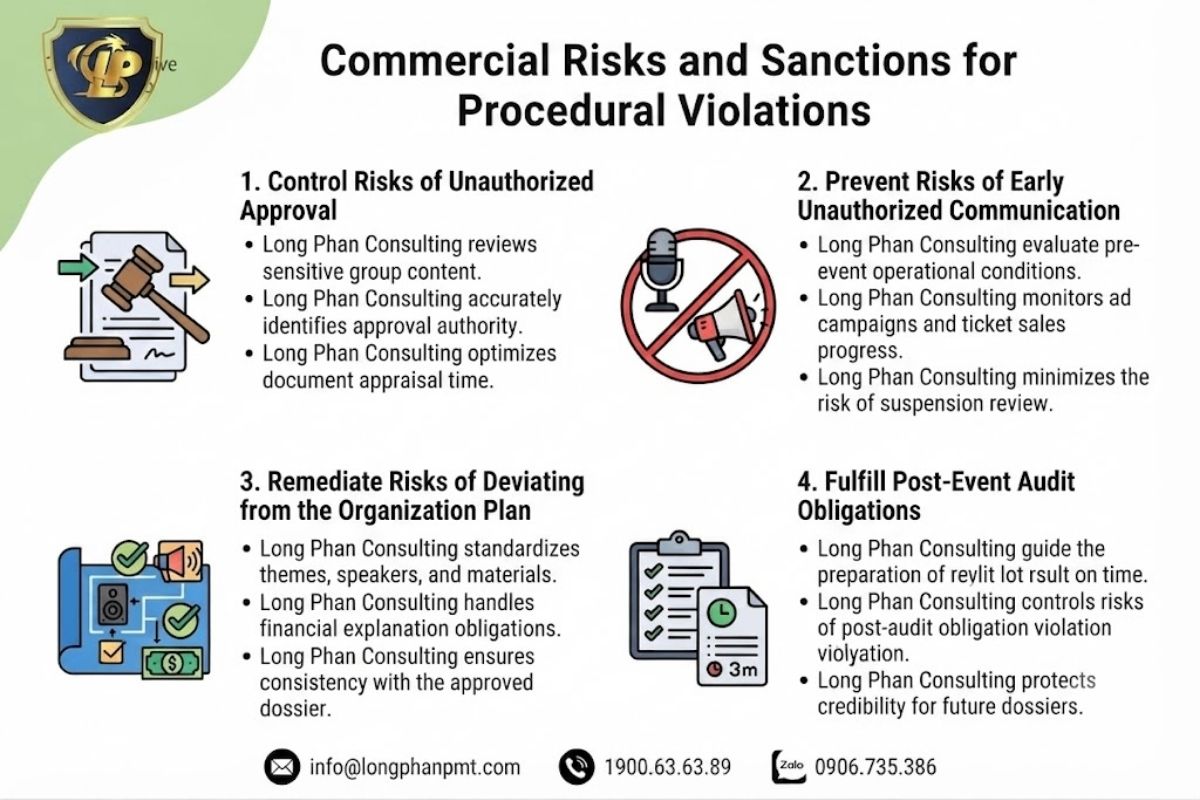
Violating the procedures for obtaining an international conference permit in Vietnam can disrupt an entire event campaign. Risks extend beyond merely having a dossier returned; they encompass the costs of venue cancellation, ticket refunds, speaker scheduling changes, and reputational damage among partners.
Competent authorities reserve the right to recommend the suspension of any conference or seminar upon detecting signs of violation. Organizations and individuals that facilitate unauthorized events may face consequences under the laws governing administrative sanctions, as stipulated in Clause 3, Article 7 of Decision No. 06/2020/QĐ-TTg.
| Risk Category | Practical Indicators | Legal and Commercial Consequences |
| Improper Authority | Submitting dossiers to local authorities for sensitive content. | Mandatory adjustments, extended review cycles, and disrupted schedules. |
| Premature Media | Announcing events or selling tickets prior to written approval. | Increased risk of suspension due to unauthorized event organization. |
| Scheme Deviation | Altering themes, speakers, or funding sources post-approval. | Accountability obligations and administrative sanction risks. |
| Reporting Failure | Neglecting to submit post-event results as required. | Violation of post-audit obligations, impacting future licensing dossiers. |
Businesses must treat licensing as a prerequisite for event operation rather than a post-media administrative task. The more parties involved, the higher the level of damage should an event be suspended.
Early media coverage often creates reverse commercial pressure on the legal department. Once tickets have been sold, venue contracts signed, or speakers announced, the ability to adjust documentation to government requirements is significantly reduced.
The behaviors that need to be monitored before written approval is granted include:
When there are signs of illegal organization, the management agency may propose suspension or administrative sanctions in accordance with Clause 3, Article 7 of Decision No. 06/2020/QD-TTg.
The approved event plan serves as the legal operating standard for the event. Businesses should not unilaterally change the content, materials, or participants without reassessing the licensing risks.
Situations that are likely to lead to suspension include:
Post-licensing operational discipline is just as important as the application phase. A small change to speakers, materials, or sponsorship can lead to additional accountability obligations.
The procedure for obtaining an international conference permit requires businesses to simultaneously control the authority, documentation, content, sponsorship, and organizational schedule. Long Phan Consulting assists clients in building a compliance process from the event design phase to post-permit reporting.
The service is implemented with a focus on reducing the risk of rejection, event suspension, or cancellation fees. The emphasis is on standardizing the organizational plan, protecting legal arguments, and controlling the actual operational aspects.
Legal due diligence and document structuring preparation:
Legal representatives handle specialized administrative procedures:
Operational risk management after licensing and deposit reporting:
Your company can submit event documents, proposed projects, or speaker lists via email: info@longphanpmt.com Or contact Long Phan via Zalo: (+084) 0906.735.386 for a preliminary assessment.
Compliance risk management is a top priority for protecting brand reputation when conducting large-scale international outreach events. Mastering the legal regulations concerning the “International Conference Permit – Dossier & Procedures” will empower boards of directors to proactively prevent the risk of event suspension. The following in-depth insights are designed to resolve the most practical challenges faced by businesses today.
Businesses are not automatically required to obtain a permit if the event does not meet the constituent elements stipulated by law. The obligation to obtain a permit becomes mandatory when the event features the participation of or receives sponsorship from foreign sources. Organizations must meticulously audit speaker composition and funding sources to initiate licensing procedures in accordance with Clause 1, Article 2 of Decision No. 06/2020/QĐ-TTg.
Businesses are entirely exempt from the procedure for obtaining an international conference permit for press conferences. International press conferences are explicitly excluded from the scope of standard conference and seminar management mechanisms. You need only comply with specialized regulations regarding press operations without the requirement for a permit under Clause 1, Article 1 of Decision No. 06/2020/QĐ-TTg.
Businesses are strictly required to establish at least one connection point within Vietnam when organizing an international online conference. The law does not permit events to be hosted entirely on the internet without domestic infrastructure. The mandatory requirement is to maintain at least one terminal point within the territory of Vietnam, pursuant to Clause 1, Article 2 of Decision No. 06/2020/QĐ-TTg.
State agencies are required to issue an authorization decision within a maximum of 20 days. This timeline applies specifically to events featuring Ministerial-level officials. The deadline for issuing the permit is no more than 20 days from the receipt of a complete dossier, in accordance with Clause 2, Article 16 of Decree No. 134/2025/NĐ-CP.
Businesses will face the risk of event suspension and administrative sanctions. Publicly promoting or selling tickets prior to receiving written approval is considered an unauthorized organization. Regulatory agencies possess the authority to recommend that competent bodies consider the suspension of the conference, pursuant to Clause 3, Article 7 of Decision No. 06/2020/QĐ-TTg.
Businesses are required to submit a result report within 15 days. This is a compulsory obligation for state agencies to conduct post-audit verification of compliance with the Event Organization Scheme. The deadline for report submission is within 15 days from the conclusion of the conference, as per Point c, Clause 2, Article 4 of Decision No. 06/2020/QĐ-TTg.
An international conference permit in Vietnam is a critical legal condition that must be secured before a business publicly announces an event, invites speakers, accepts sponsorship, or executes commercial commitments. In essence, businesses must prepare a dossier to obtain a formal decision authorizing the organization of the event, while strictly adhering to jurisdictional authority, filing timelines, and the approved Event Organization Scheme. Deviations regarding topics, guest lists, funding sources, or the timing of media outreach may lead to event suspension and damage to your reputation. Contact our Hotline at 1900636389 for dedicated support from Long Phan Consulting Company.
📚 This article has been professionally reviewed based on the following legal documents: