Businesses selling alcohol without a license may face fines, confiscation of goods, and interruptions to F&B operations during regulatory inspections. A business registration certificate only serves as an initial condition and cannot replace a retail alcohol license or the required registration for on-site alcohol consumption.
Through Legal Updates, establishments should accurately classify their business model, including on-premise sales or e-commerce, to manage compliance risks, product origin requirements, and sales restrictions for eligible customers. Early document review helps reduce operational losses and strengthen compliance with Long Phan Consulting.
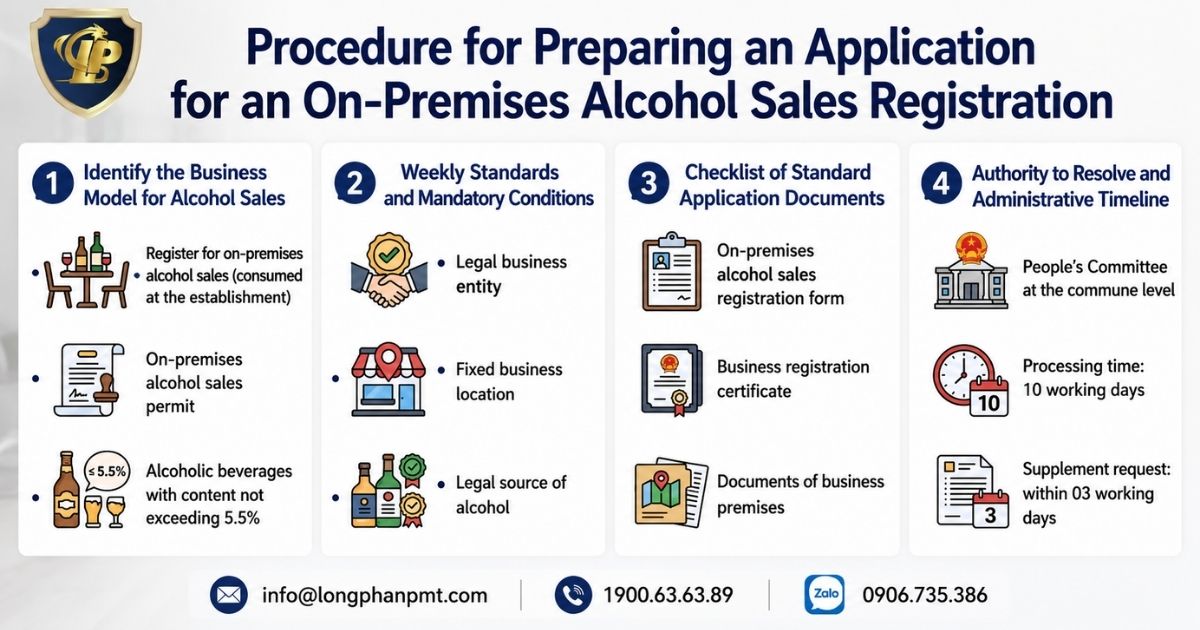
This flowchart provides detailed instructions on the steps to standardize legal documentation for alcoholic beverage distribution and retail establishments to ensure safe operating conditions.
Important legal note:
Wine from 5.5 degrees or higher. It must be controlled through a specialized licensing or registration model, not solely based on business registration.
Individuals selling alcohol without a license may be fined.10,000,000 to 15,000,000 VND. The organization may be fined.20,000,000 to 30,000,000 VND.
Unauthorized wholesale or distribution of alcohol may be subject to increased penalties twice compared to the standard penalty framework.
Selling alcohol online requires a mechanism to verify that buyers are qualified 18 years old and cashless payments are permitted, otherwise multi-tiered penalties may arise.
The Enterprise Registration Certificate does not replace specialized alcohol licenses. For F&B enterprises, operational risks frequently arise when the actual sales model diverges from the registered business lines.
Enterprises must classify their operations based on alcohol concentration, sales methods, and distribution channels prior to launching. Models prone to regulatory penalties include:
Retail Outlets, Alcohol Agencies, and Mini-marts: Facilities selling bottled alcohol for off-site consumption.
Restaurants, Bars, Pubs, and Karaoke: Establishments serving alcohol for immediate on-site consumption.
Wholesalers and Distributors: Entities importing or purchasing alcohol to resell to agents or distribution networks.
Misclassification often leads to procuring incorrect licenses, failing to complete mandatory registration procedures, or an inability to substantiate the legal origin of inventory during inspections.
Classification Requirements for Retail Outlets and Mini-marts
Retail outlets selling bottled alcohol for off-site consumption must verify the alcohol concentration of each product. This threshold constitutes the legal boundary determining whether a facility must secure an Alcohol Retail License or merely complete a simplified registration procedure.
Products with an alcohol concentration of 5.5% or higher fall under mandatory regulatory control, requiring a specialized license or registration, pursuant to Clause 2, Article 4 and Clause 2, Article 31c of Decree No. 105/2017/NĐ-CP (as amended by Decree No. 17/2020/NĐ-CP).
Products with an alcohol concentration below 5.5% only require standard business registration with the competent authorities.
For retail outlets, mini-marts, or alcohol agencies, the Alcohol Retail License serves as a critical operational document.
Authority to grant this license currently rests with the Commune-level People’s Committee, pursuant to Clause 1, Article 25 of Decree No. 105/2017/NĐ-CP and Clause 1, Article 7 of Decree No. 139/2025/NĐ-CP.
Enterprises must archive product records, purchase contracts, and supply vouchers for each specific alcohol label.
Possessing only a business registration certificate without the required license may result in the facility being classified as an unqualified alcohol business.
Registration Regulations for Restaurants and Bars Serving On-site
Restaurants serving wine with meals must still review their registration obligations. Inspection authorities evaluate the actual nature of alcohol provision at the business location rather than solely relying on the primary menu.
On-site alcohol consumption is defined as the activity of selling alcohol directly to buyers for consumption at the place of sale, pursuant to Clause 5, Article 3 of Decree No. 105/2017/NĐ-CP.
Consequently, bars, pubs, lounges, karaoke establishments, and restaurants serving alcohol fall under a specific regulatory category.
Facilities serving alcohol with an alcohol concentration of 5.5% or higher for direct on-site consumption are not required to obtain an Alcohol Trading License.
However, these facilities are mandatorily required to register for on-site alcohol consumption with the commune-level Economic Division or the Economic and Infrastructure Division, pursuant to Clause 2, Article 4 of Decree No. 105/2017/NĐ-CP, as amended and supplemented by Decree No. 17/2020/NĐ-CP.
Age Verification Barriers in Alcohol E-commerce
Retail alcohol business via e-commerce faces an additional layer of regulatory control concerning age verification, transaction security, and payment methods. This category represents a high-risk area, as violations can occur directly through the interface of a website or mobile application.
Online alcohol platforms must implement technological measures to issue warnings and require users to declare their age before accessing information, searching, or executing transactions, pursuant to Clause 1, Article 6 of Decree No. 24/2020/NĐ-CP.
Alcohol transactions via e-commerce are mandatorily required to utilize non-cash payment methods, pursuant to Clause 4, Article 16 of the 2019 Law on Prevention and Control of Harmful Effects of Liquor and Beer.
Delivery mechanisms must ensure that alcohol is not provided to individuals under the age of 18.
Enterprises are strictly prohibited from selling or supplying alcohol to individuals under 18 years of age or utilizing employees under 18 years of age to participate directly in alcohol business activities, pursuant to Clause 2 and Clause 4, Article 5 of the 2019 Law on Prevention and Control of Harmful Effects of Liquor and Beer.
For online channels, the alcohol trading license is only one component of a broader compliance system. Enterprises must also design warnings, age verification, payment conditions, and delivery protocols to mitigate multi-layered violation risks.
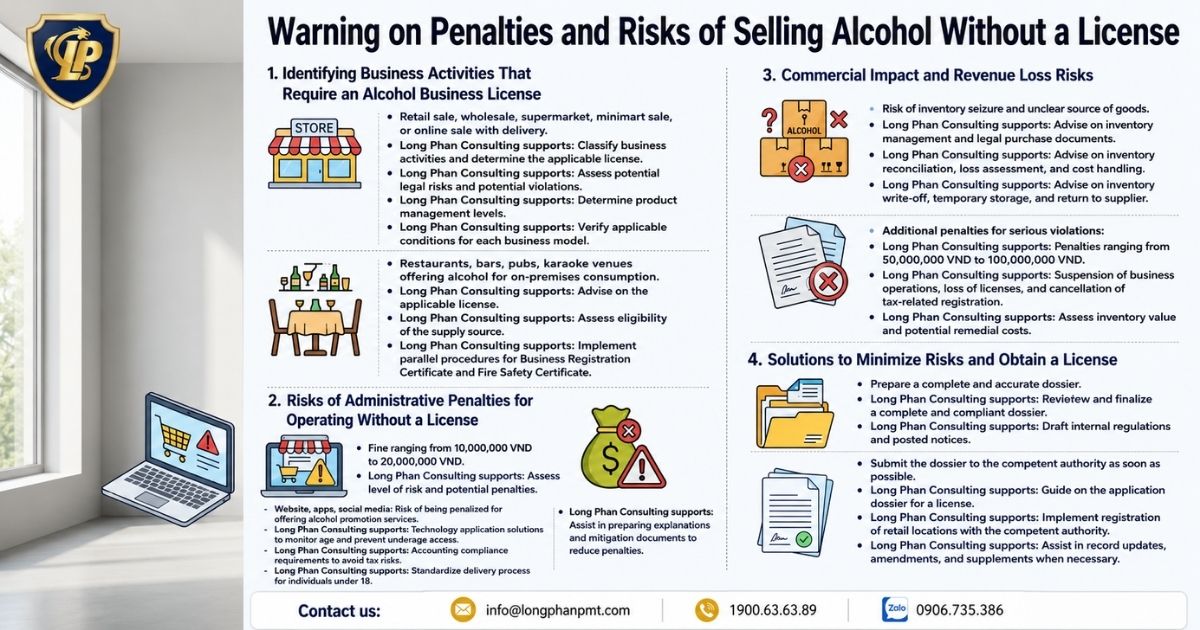
Warning about administrative penalties for selling alcohol without a license
Selling alcohol without a license is not just a procedural error. For F&B businesses, it’s a direct financial risk because the penalties can increase depending on the nature of the violation and the distribution model.
Authorities typically assess licenses, the origin of goods, and the actual scope of sales simultaneously. Therefore, a small shop, restaurant, or distribution unit can all face penalties if it operates outside its designated business type.
The monetary penalty framework applies to individuals and organizations that violate the regulations
Businesses need to anticipate the risk of penalties based on the legal status of the infringing entity. For the same act of selling alcohol without a license, an organization will face a higher penalty than an individual.
The penalty range for individuals from10,000,000 to 15,000,000 VND. This applies to the business of trading restricted goods without a license. This regulation is stipulated in Point a, Clause 3, Article 6 of Decree No. 98/2020/ND-CP.
If the offending party is a company, the penalty is double that of an individual. Therefore, businesses can be fined from 20,000,000 to 30,000,000 VND, according to point b, Clause 4, Article 4 of Decree No. 98/2020/ND-CP.
In addition to fines, establishments may also be required to return profits obtained from illegal business activities. This is a risk that increases compliance costs after inspection, according to Point b, Clause 7, Article 6 of Decree No. 98/2020/ND-CP.
Stricter penalties for wholesale and distribution activities
The risks are higher for businesses that import goods and then resell them to dealers, chain stores, or lower-level sales outlets. This group cannot use a Retail Liquor License to legitimize wholesale or distribution activities.
For violations in the wholesale or distribution of alcoholic beverages, the following monetary penalties apply twice compared to the standard penalty framework. The legal basis is Clause 5, Article 6 of Decree No. 98/2020/ND-CP.
The monetary penalty framework applied to individuals and organizations violating regulations on specialized F&B licenses is based on the current Decree on Administrative Sanctions.
Commercial Risks from Unverified Product Origins
The failure to maintain an alcohol business license often triggers broader scrutiny regarding supply chain documentation. During inspections, enterprises must present not only the required licenses but also invoices, vouchers, product labels, and verifiable proof of origin.
Key risk indicators that must be controlled before introducing alcohol to a retail point include:
Absence of purchase contracts with licensed alcohol producers, distributors, or wholesalers.
Lack of valid invoices and vouchers for each specific batch of alcohol.
Inconsistency between product labels, supplementary labels, or product information and the procurement documentation.
Inability to substantiate the supply route from the vendor to the retail location.
If the documentation chain is fractured, the lack of a license may be escalated to a violation involving goods of unknown origin. This poses a risk of financial damage far exceeding the initial administrative fines.
Confiscation of Evidence and Compulsory Destruction of Goods
For F&B enterprises, the most significant impact is not the administrative fine, but the potential loss of the entire alcohol inventory if inspection authorities determine the goods lack legal documentation.
Conducting business with goods of unknown origin or contraband can result in fines ranging from 50,000,000 VND to 100,000,000 VND, depending on the value of the goods and the severity of the violation.
This penalty scale is determined pursuant to Clause 11 and Clause 12, Article 17 of Decree No. 98/2020/NĐ-CP.
In addition to fines, the evidence of violation may be confiscated if the alcohol fails to meet documentation requirements for legal verification.
This measure is enforced pursuant to Point a, Clause 13, Article 17 of Decree No. 98/2020/NĐ-CP.
If goods are deemed unfit for circulation or pose health risks, authorities may order their destruction.
Enterprises should assess the condition of their inventory before providing explanations to maintain control over their assets.
Furthermore, enterprises may be compelled to disgorge any illegal profits derived from unauthorized business activities, pursuant to Point b, Clause 7, Article 6 of Decree No. 98/2020/NĐ-CP.
Inspection Procedures for Invoices, Vouchers, and Origin Traceability
When Market Surveillance forces conduct inspections, the focus typically extends beyond mere licensing. The establishment must substantiate the legal supply source for every bottle of alcohol currently offered for sale, ensuring full documentation and consistent product labeling.
Enterprises should prepare a defensive dossier comprising the following documentation:
Licenses or registration dossiers appropriate to the specific retail, on-site consumption, wholesale, or distribution model.
Purchase contracts, principle agreements, or introduction letters from authorized suppliers.
Invoices and vouchers for the procurement of goods categorized by batch, product label, and specific business location.
Product labels, supplementary labels, import documentation, or materials verifying the product’s origin.
Internal procedures recording inventory intake, stock outflow, and stock transfers between points of sale.
The absence of any single document link may prevent an enterprise from substantiating the legality of its goods. Consequently, the inspection risk escalates from a licensing infraction to systemic issues involving taxation, labeling, and food safety. Attempting to supplement documentation after an inspection begins often results in ineffective explanations and rapidly increasing remediation costs.
Procedure for authorities to inspect invoices and documents related to the sale of unlicensed alcoholic beverages at establishments.
Inspection Procedures for Invoices, Vouchers, and Origin Traceability
When Market Surveillance forces conduct inspections, the focus typically extends beyond mere licensing. The establishment must substantiate the legal supply source for every bottle of alcohol currently offered for sale, ensuring full documentation and consistent product labeling.
Enterprises should prepare a defensive dossier comprising the following documentation:
Licenses or registration dossiers appropriate to the specific retail, on-site consumption, wholesale, or distribution model.
Purchase contracts, principle agreements, or introduction letters from authorized suppliers.
Invoices and vouchers for the procurement of goods categorized by batch, product label, and specific business location.
Product labels, supplementary labels, import documentation, or materials verifying the product’s origin.
Internal procedures recording inventory intake, stock outflow, and stock transfers between points of sale.
The absence of any single document link may prevent an enterprise from substantiating the legality of its goods. Consequently, the inspection risk escalates from a licensing infraction to systemic issues involving taxation, labeling, and food safety. Attempting to supplement documentation after an inspection begins often results in ineffective explanations and rapidly increasing remediation costs.
Reviewing Site Conditions and Supply Contracts
Business premises must be audited in conjunction with the inventory supply chain. A location that possesses a valid business registration but cannot substantiate the legal right to use the premises may encounter significant obstacles during the licensing process.
Dossiers for an Alcohol Retail License submitted to the Commune-level People’s Committee must include a copy of the business registration certificate, proof of legal rights to use the business location, and an introduction letter or principle agreement from the supplier.
The legal basis for these requirements is provided in Clause 2, Section I, Appendix IV of Decree No. 139/2025/NĐ-CP.
During operations, alcohol traders must maintain compliance with environmental protection, food safety, and fire prevention and fighting requirements.
This obligation to maintain operational conditions is stipulated in Clause 3, Article 4 of Decree No. 105/2017/NĐ-CP, as amended and supplemented by Decree No. 17/2020/NĐ-CP.
For restaurants, pubs, or bars serving alcohol, the Certificate of Food Safety Eligibility must also be reviewed if the business model falls within the scope of mandatory requirements.
Updating Competent Authorities and Licensing Procedures
Enterprises must verify the licensing authority before submitting dossiers. Utilizing outdated forms or submitting documentation to the incorrect agency can significantly extend processing times, particularly during the expansion of multiple sales points.
The authority to receive and grant the Alcohol Retail License currently rests with the Commune-level People’s Committee.
This represents a notable change in management administration for retail chains, mini-marts, and alcohol agencies.
Licenses for alcohol production, distribution, wholesale, and retail granted prior to this regulation remain valid until their expiration date.
Enterprises are not required to re-apply if their current license remains within its valid term.
For requests concerning amendments, supplements, or renewals, the dossier must be submitted to the agency now decentralized to receive such requests: the Commune-level People’s Committee.
The defense dossier and the list of documents proving the legality of product supply aim to optimize the ability to explain the situation when Market Management conducts inspections
Comprehensive Legal Consulting and Representation at Long Phan Consulting
Alcohol business requires the concurrent management of licenses, supply sources, points of sale, and transactional mechanisms. Long Phan Consulting supports F&B enterprises in assessing risks prior to opening, expanding branches, or addressing inspection notices.
Our consulting objectives extend beyond completing licensing dossiers; our core focus is building a robust compliance system to minimize the risks of penalties, inventory seizure, and operational disruption.
Consulting on Alcohol Business Model Legalization:
Determine the correct business model prior to dossier submission to prevent risks from inspection discrepancies.
Classify retail, on-site consumption, wholesale, distribution, and e-commerce activities.
Cross-reference product alcohol concentration, transaction methods, and sales locations to identify applicable procedures.
Draft, standardize, and represent the enterprise in filing for alcohol business licenses tailored to the operational model.
Review the requirement for a Certificate of Food Safety Eligibility for restaurants or on-site dining establishments.
Compliance Audit and F&B Operational Risk Control:
Conduct legal audits of restaurants, bars, pubs, lounges, mini-marts, and alcohol points within F&B chains.
Verify purchase contracts, agency agreements, and introduction letters from licensed suppliers.
Evaluate invoices, vouchers, product labels, supplementary labels, and product origin traceability records.
Develop control mechanisms for online alcohol sales, including age verification, harm warnings, and delivery conditions.
Negotiation and Legal Dispute Resolution:
Represent enterprises in working with Market Surveillance forces and competent inspection authorities.
Advise on appeal strategies for administrative penalty decisions if legal grounds exist to protect legitimate rights.
Support strategies for inventory management to minimize the risk of confiscation or compulsory destruction.
Enterprises may submit documentation for a preliminary evaluation by Long Phan Consulting via Email: info@longphanpmt.com or Zalo/WhatsApp: +84 906 735 386.
Frequently Asked Questions about the Risk and Penalty Warning for Selling Alcohol Without a License
The business of providing alcoholic beverages carries significant legal risks beyond the scope of standard business registration. Understanding compliance limits and penalties for operating an unlicensed alcohol business helps business owners proactively establish a safe risk profile. In-depth explanations tailored to real-world operating situations will support management systems in accurately identifying licensing obligations.
If a restaurant only sells food and serves alcoholic beverages with an alcohol content of 5.5% or higher with the meal, does it need to apply for a Retail Alcohol License?
Businesses selling alcoholic beverages with an alcohol content of 5.5% or higher for on-site consumption are not required to apply for a business license. However, restaurants are still required to register for on-site alcohol sales with the commune-level management agency, as stipulated in Clause 2, Article 4 of Decree No. 105/2017/ND-CP, amended and supplemented by Decree No. 17/2020/ND-CP.
What is the fine for a company that violates the law by selling alcohol at retail without a license?
Businesses will be fined between VND 20,000,000 and VND 30,000,000 for selling alcohol without a valid license. The law stipulates a fine of VND 10,000,000 to VND 15,000,000 for individuals and double the fine for organizations, as per Point a, Clause 3, Article 6 and Clause 4, Article 4 of Decree No. 98/2020/ND-CP. The inspection agency will base its decision on the legal status of the business entity.
What increased administrative penalties will companies engaged in the illegal distribution or wholesale of alcohol face?
Organizations that distribute or wholesale alcoholic beverages illegally will face fines doubled compared to the standard penalty. This increased penalty applies directly to unlicensed violations occurring in the wholesale or distribution of alcohol, as stipulated in Clause 5, Article 6 of Decree No. 98/2020/ND-CP.
Do authorities have the right to confiscate a shipment of imported liquor from a store that lacks proper invoices and documentation?
Market management authorities have full power to confiscate all infringing goods that lack proper documentation. Businesses trading in alcoholic beverages of unknown origin may be fined up to VND 100,000,000 and required to return all illegal profits obtained from their illegal activities, in accordance with Clause 12, Point a Clause 13 of Article 17 and Point b Clause 7 of Article 6 of Decree No. 98/2020/ND-CP.
Which level of authority (commune or district) has the power to receive applications for the latest retail liquor license: the commune-level or district-level People’s Committee?
Currently, the authority to receive and issue licenses for retail sale of alcoholic beverages has been decentralized to the local government. Specifically, the People’s Committee at the commune level has the authority to issue retail alcohol licenses according to Clause 1, Article 7 of Decree No. 139/2025/ND-CP. Businesses and household business owners need to identify the correct management agency in their area to submit their applications, avoiding the risk of delays in their opening plans.
Conclusion
Operating an unlicensed alcohol business generates risks of administrative penalties, inventory seizure, and operational disruption for F&B enterprises that fail to correctly classify their retail, on-site consumption, or e-commerce models. Alcohol retail licenses, on-site consumption registrations, and documentation substantiating product origins must be standardized prior to opening or expanding points of sale. Licensing errors may trigger further risks involving invoices, product labeling, taxation, and food safety. Contact our hotline at 1900636389 for professional appraisal and dossier processing support from Long Phan Consulting.
📚 This article has been professionally reviewed based on the following legal documents:
2019 Law on Prevention and Control of Harmful Effects of Alcoholic Beverages
2012 Law on Handling Administrative Violations, as amended and supplemented in 2020 and 2025
Decree No. 105/2017/ND-CP on alcohol business
Decree No. 17/2020/ND-CP amending and supplementing certain articles of Decrees concerning business investment conditions under the state management of the Ministry of Industry and Trade
Decree No. 24/2020/ND-CP detailing certain articles of the Law on Prevention and Control of Harmful Effects of Alcoholic Beverages
Decree No. 98/2020/ND-CP on administrative penalties in commercial activities, production and trading of counterfeit goods and prohibited goods, and protection of consumer rights
Decree No. 139/2025/ND-CP on the allocation of authority of the two-tier local government system in the field of state management of the Ministry of Industry and Trade
Note: Laws and regulations may change over time. Please contact Long Phan Consulting directly via Hotline 1900.63.63.89 for the latest updates.
Facebook
Linkedin
Twitter
Pinterest
Dương Thị Kim Ngân
Jurist Ngan Duong Thi Kim - Partner of Long Phan, Ms. Ngan possesses profound knowledge in business consulting, labor, and contracts. With dedication and creativity, Ms. Ngân has achieved significant success in advising and supporting businesses in critical areas such as legal matters, finance, management, and contracts. She is committed to providing optimal solutions and helping clients succeed in the business environment.