
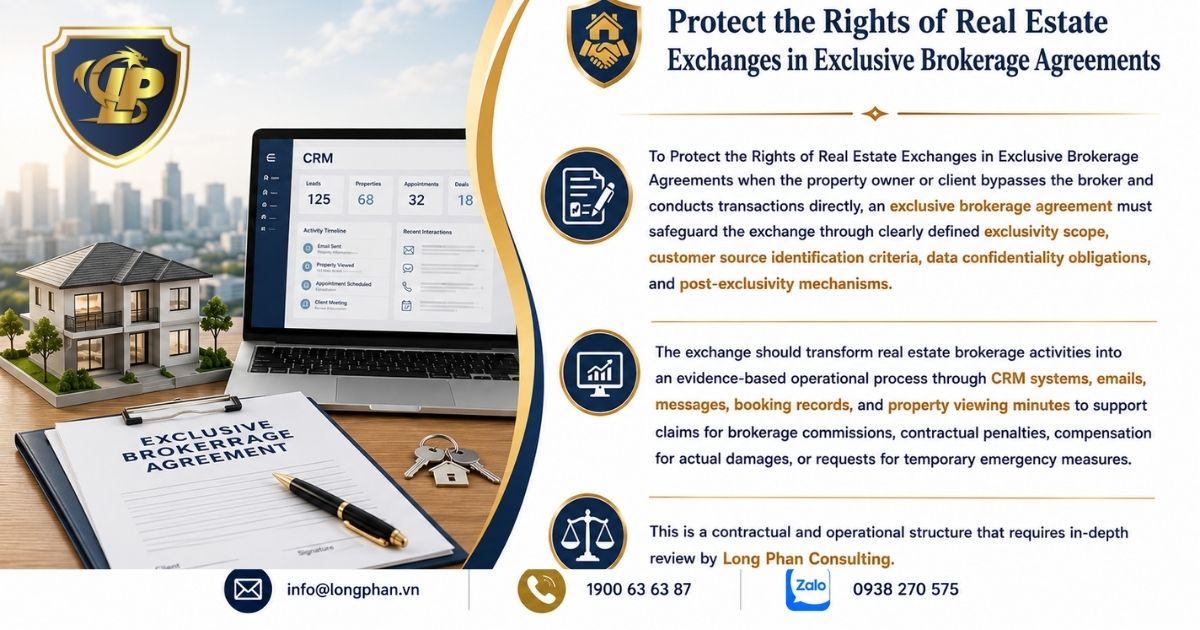
Exclusive Brokerage Agreements must protect real estate exchanges when property owners or clients bypass the broker to transact directly. A robust agreement should define the exclusivity scope, customer-origin criteria, confidentiality duties, and post-exclusivity protections. Real Estate Brokerage operations should also be supported by CRM records, emails, messages, booking logs, and viewing minutes to substantiate commission claims, contractual penalties, damage compensation, or urgent interim measures. Long Phan Consulting Company provides in-depth review of this contractual and operational framework.
Important legal note:
The greatest risk for a real estate brokerage firm is failing to legally bind the relationship between the lead source, the property, and the payment obligation. Without clear evidentiary criteria in an exclusive brokerage agreement, agencies risk losing their real estate brokerage commission despite creating the transaction opportunity.
A common scenario involves property owners and referred clients executing deposit contracts privately after property viewings. This circumvention effectively removes the agency from the transaction, despite their role in connecting, advising, and facilitating negotiations.
Legally, real estate brokerage acts as an intermediary service for parties involved in selling, transferring, leasing, or subleasing properties. This role is formally recognized under Clause 11, Article 3 of the Real Estate Business Law 2023.
Consequently, agencies must transform every client introduction into a verifiable legal record. Relying solely on a broker’s verbal testimony provides weak causal evidence linking the brokerage activity to the final transaction.
Real estate agencies often lose disputes because they cannot prove buyers or investors originated from their internal networks. This operational flaw directly results in the forfeiture of brokerage remuneration rights.
Common data blind spots undermining legal claims include:
When disputes arise, agencies must proactively submit documents and evidence to protect their commercial rights. This legal obligation is mandated under Clause 1, Article 6, and Clause 1, Article 94 of the Civil Procedure Code 2015.
Many exclusive agreements feature basic non-circumvention clauses like “no off-exchange trading” without specifying severe financial consequences. Upon breach, agencies lack negotiation leverage because the penalty rates, damage calculations, and reimbursable costs remain undefined.
Contractual penalties only apply when explicitly agreed upon, with the rate mutually determined by the parties. This mechanism is governed by Clause 1 and Clause 2, Article 418 of the Civil Code 2015.
A more severe risk emerges when contracts omit a post-exclusive mechanism. If clients transact after the contract expires using agency data, the firm loses fee collection rights without a protective tail period clause.
Agencies must distinctly separate the contractual penalty from compensation for actual damages. If the contract solely stipulates a penalty without an explicit damage compensation clause, the agency can only demand the penalty amount. They forfeit the right to claim further damages pursuant to Clause 3, Article 418 of the Civil Code 2015.
The more detailed the contract, the easier it is for the real estate exchange to control the risk of fee revenue loss. The focus should not only be on recording exclusivity, but also on locking down the scope, client sources, data, and financial consequences of any “roundabout” practices.
The exclusivity clause must clearly define which properties the platform is authorized to distribute, in which areas, for what period, and through which sales channels. If the scope is vague, the landlord can argue that the transaction falls outside the exclusivity obligation.
Real estate brokerage service contracts must be in writing and contain core elements such as the subject matter of the service, the content of the service, the results of the service, the term, service fees, remuneration, commission, payment method, and the rights and obligations of the parties. This structure is stipulated in Clause 4, Article 46 of the 2023 Law on Real Estate Business.
To protect the customer base, the contract should clearly define “customers acquired by the platform” according to the following operational criteria:
These criteria help the platform transform sales activities into legal conditions for collecting fees. With out clear criteria regarding the source of customers, disputes often escalate into a comparison of testimonies between the parties.
Customer data is a valuable operational asset with direct commercial value to the real estate exchange. Contracts should prohibit homeowners from using this data to conduct transactions themselves or transferring it to third parties to avoid brokerage fees.
Privacy policy should clearly define the data groups that are protected, including full names, phone numbers, email addresses, purchase/sale inquiries, property viewing history, bookings, and transaction information. This design helps to separate these data customer’s personal data with publicly available information about assets.
The platform also needs to include provisions for consequences when data is misused. These consequences should include penalties for violations, compensation for the costs of generating customer leads, and the right to demand the cessation of any misuse that violates the agreement.
The exchange should not combine penalties for breach of contract and compensation for damages into a single clause. These are two different legal mechanisms, with different application conditions and financial objectives.
A penalty for breach of contract is a sum of money that the breaching party must pay as agreed upon in the contract. The amount of the penalty is mutually agreed upon by the parties and is stipulated in Clauses 1 and 2 of Article 418 of the 2015 Civil Code.
Compensation for actual damages aims to restore the losses incurred by the exchange. The claim may include lost brokerage fees, marketing costs, personnel costs, and benefits that would have been earned under Clause 2, Article 419 of the 2015 Civil Code.
The biggest risk is when the contract only specifies penalties for breach of contract but leaves the compensation section blank. In that case, the exchange can only claim penalties for breach of contract, not compensation, according to Clause 3, Article 418 of the 2015 Civil Code.
Post-exclusive clauses protect the brokerage firm in case the contract has expired but transactions arise from clients previously generated by the firm. This is a necessary mechanism in any exclusive real estate brokerage contract.
This clause should clearly define the “tail” timeframe, the client group to which fees are reserved, the types of transactions incurring fees, and how the client source is verified. If a client has previously received information, viewed the property, or signed a booking through the platform, subsequent transactions may still result in a fee obligation.
For contracts signed before the new law came into effect, the real estate agency needs to take note when amending or renewing them. If the old real estate business contract is amended or supplemented after the new law came into effect, the amendments must comply with the current Real Estate Business Law according to Clause 9, Article 83 of the 2023 Real Estate Business Law.
Therefore, all exclusive extension annexes should be thoroughly reviewed. Simply extending the term without adding post-exclusive mechanisms could create problems toll collection gap for the floor.
Real estate agencies must not treat CRM, emails, Zalo, or booking records merely as sales data. In exclusive real estate brokerage contract disputes, these records serve as critical evidence to prove lead sources and enforce fee collection rights.
Zalo messages, WhatsApp texts, email confirmations for property viewings, and CRM files are not denied legal validity simply for existing in electronic form. Civil transactions conducted via electronic means in the form of electronic data messages hold the same legal validity as written documents, pursuant to Clause 1, Article 119 of the Civil Code 2015.
However, agencies must prove the reliability of this data. The core requirements involve the methods of generating, sending, receiving, storing, maintaining integrity, and identifying the originator of electronic data messages, according to Clause 1 and Clause 2, Article 11 of the Electronic Transactions Law 2023.
Electronic data messages also constitute lawful evidence in civil litigation. This validity is affirmed in Clause 3, Article 95 of the Civil Procedure Code 2015.
For data created before the current Electronic Transactions Law took effect, agencies must review transitional provisions. Incomplete electronic transactions proceed under previous regulations unless parties agree to apply the new law, pursuant to Clause 1, Article 53 of the Electronic Transactions Law 2023.
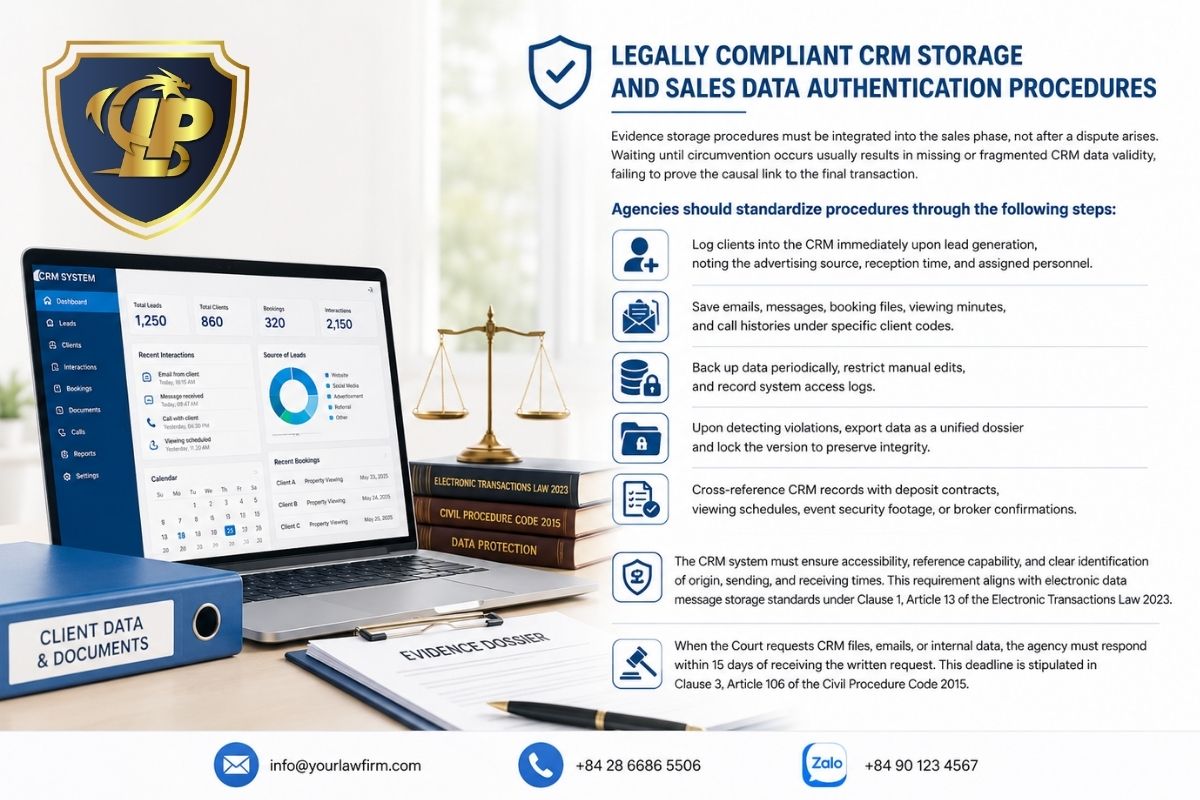
Evidence storage procedures must be integrated into the sales phase, not after a dispute arises. Waiting until circumvention occurs usually results in missing or fragmented CRM data validity, failing to prove the causal link to the final transaction.
Agencies should standardize procedures through the following steps:
The CRM system must ensure accessibility, reference capability, and clear identification of origin, sending, and receiving times. This requirement aligns with electronic data message storage standards under Clause 1, Article 13 of the Electronic Transactions Law 2023.
When the Court requests CRM files, emails, or internal data, the agency must respond within 15 days of receiving the written request. This deadline is stipulated in Clause 3, Article 106 of the Civil Procedure Code 2015.
Once circumvention occurs, the real estate brokerage firm must shift focus from commercial reactions to evidence strategy and financial recovery. The objective is not merely demanding brokerage fees. It involves controlling damages, securing assets, and monitoring the statute of limitations for initiating a lawsuit.
Agencies can demand compensation for actual damages upon proving the breach, the actual losses, and the causal relationship. Compensatory damages include property loss, reasonable costs to prevent further loss, and actual lost or reduced income. This mechanism is established under Clause 2, Article 361 of the Civil Code 2015.
Claimed amounts require precise quantification through evidence, including:
Agencies must distinctly separate fee claims, penalty claims, and compensation claims in the petition dossier. Failing to quantify damages often leads to reduced or rejected compensation requests, even when a breach has undeniably occurred.
Agencies must review the dispute resolution clause before submitting files. The statute of limitations for initiating a lawsuit regarding contract disputes is three years from the date the entitled party knows or should know their rights are infringed. This is governed by Article 429 of the Civil Code 2015.
| Criteria | The competent People’s Court | Commercial Arbitration Center |
| Terms and conditions apply | Applicable when there is no arbitration agreement. | A valid arbitration agreement is required. |
| Competence | Commercial business disputes fall under the jurisdiction of the Court according to Clause 1, Article 30 of the 2015 Civil Procedure Code. | Disputes are resolved if they fall within the jurisdiction of arbitration as stipulated in Clause 1, Article 2 and Clause 1, Article 5 of the 2010 Commercial Arbitration Law. |
| Security | There may be risks of business information leakage. | More suitable for disputes requiring the confidentiality of customer data. |
| Strategy | Suitable when a state-run litigation mechanism is needed. | Suitable for high-value B2B contracts requiring speed and specialization. |
If the contract includes a valid arbitration agreement, the platform should prioritize the Commercial Arbitration Center in disputes requiring the confidentiality of customer data. If such an agreement is absent, legal action in a competent People’s Court should be prepared with a complete set of evidence.
Temporary emergency measures help the exchange limit the risk of homeowners transferring property or disposing of funds before the case is resolved. This is a legitimate pressure tool, but it must be tied to the specific dispute.
The court may apply measures such as freezing bank accounts or prohibiting the transfer of property rights over the disputed property. This mechanism is stipulated in Clauses 7 and 10 of Article 114 of the 2015 Civil Procedure Code.
In arbitration, the arbitration panel also has the authority to apply interim measures when the legally prescribed conditions are met. This authority is stipulated in Clause 1, Article 48 and Clause 1, Article 49 of the 2010 Commercial Arbitration Law.
The exchange should only request this measure when there is evidence of a risk of asset transfer, withdrawal, or completion of transactions to evade obligations. The documentation should include the exclusive contract, evidence of client sources, and documentation of the infringing transaction.
Real estate brokerage firms must treat circumvention risks as an internal corporate governance priority, not merely a post-transaction dispute. Effective protection mechanisms require integrating contracts, CRM data, sales procedures, and evidentiary strategies.
The Board of Directors should implement these priority procedures:
Agencies operating before the current Real Estate Business Law took effect must fulfill missing conditions within 06 months. This transitional obligation is mandated under Clause 1 and Clause 10, Article 83 of the Real Estate Business Law 2023.
Without standardized internal procedures, agencies face severe evidentiary disadvantages before dispute resolution bodies. The ultimate compliance risk remains the inability to legally prove lead sources, actual damages, and the connection to the violating transaction.
Exclusive real estate brokerage contract disputes in Vietnam are highly complex, intertwining local contract laws, strict electronic evidence standards, and data security regulations. Navigating these localized compliance risks requires specialized corporate expertise. Long Phan Consulting Company supports foreign-invested real estate agencies in mitigating operational risks, seamlessly bridging the gap between proactive contract structuring and enforcing commercial rights during dispute resolution.
Our core legal advisory services encompass:
To secure a preliminary legal evaluation, enterprises are invited to send contracts, extracted CRM data, booking records, or dispute dossiers via Email (info@longphanpmt.com) or Zalo/WhatsApp (+84 906 735 386).

Disputes In exclusive brokerage contract. These issues often arise from operational “blind spots”: lack of client source evidence, lack of post-exclusive clauses, and confusion between penalties for breach of contract and compensation for damages. For real estate exchanges, each of the following questions is directly related to the ability to recover fees, protect data, and control litigation risks.
Real estate brokerage firms need to prove their role as intermediaries and the clients they generate before claiming fees, penalties for violations, or compensation. Real estate brokerage is an intermediary activity in the buying, selling, transferring, leasing, subleasing, and lease-purchase of real estate, as defined in Clause 11, Article 3 of the 2023 Law on Real Estate Business. When their rights are violated, the brokerage firm has the right to proactively submit evidence in accordance with Clause 1, Article 6 and Clause 1, Article 94 of the 2015 Civil Procedure Code.
The brokerage firm only has a solid basis to claim commissions after the exclusivity period if the contract includes a post-exclusive clause. The parties are free to agree on the contract terms as long as they do not violate prohibitions and are not contrary to social morality, according to Clause 2, Article 3 of the 2015 Civil Code. Real estate brokerage service contracts must also specify the term, service fees, remuneration, commissions, rights and obligations of the parties, as stipulated in Clause 4, Article 46 of the 2023 Law on Real Estate Business.
The penalty for breach of an exclusive agreement is negotiated between the parties and stipulated in the contract. The legal data provided does not specify a particular ceiling for this case. The penalty for breach is the amount of money the breaching party must pay according to the agreement, and the amount is agreed upon by the parties in the contract, as per Clauses 1 and 2 of Article 418 of the 2015 Civil Code.
The brokerage firm has no basis for claiming damages if the contract only includes a penalty clause for breach of contract without any compensation clause. In the absence of a compensation clause, the brokerage firm can only claim the agreed-upon penalty, according to Clause 3, Article 418 of the 2015 Civil Code. To claim additional actual damages, the contract needs to clearly state the mechanism for compensating lost brokerage fees, marketing costs, personnel costs, and any benefits that would have been received.
Zalo messages, emails, and CRM files can be used as evidence if they meet the requirements of reliability and integrity. Civil transactions conducted electronically have the same value as written documents according to Clause 1, Article 119 of the 2015 Civil Code. Electronic evidence must demonstrate how it was created, sent, received, stored, ensured its integrity, and identify the originator, as stipulated in Clauses 1 and 2, Article 11 of the 2023 Law on Electronic Transactions.
The court must provide internally stored electronic documents and evidence within 15 days of receiving the court’s request. The obligation to provide CRM files, emails, or internal data as requested by the court is defined in Clause 3, Article 106 of the 2015 Civil Procedure Code. The deadline for submitting documents, as set by the judge, must not exceed the time limit for preparing for the first instance trial as stipulated in Clause 4, Article 96 of the 2015 Civil Procedure Code.
The platform should choose commercial arbitration if the contract includes a valid arbitration agreement, especially when customer data confidentiality is required. The arbitration panel has jurisdiction to resolve commercial disputes if there is an arbitration agreement as stipulated in Clause 1, Article 2 and Clause 1, Article 5 of the 2010 Commercial Arbitration Law. If there is no arbitration agreement, the District People’s Court has first-instance jurisdiction as stipulated in Clause 1, Article 30 and Clause 1, Article 35 of the 2015 Civil Procedure Code.
An exclusive real estate brokerage contract, Vietnam only provides effective protection when the agency simultaneously controls three risk layers: contractual clauses, lead source evidence, and circumvention response mechanisms. Without a post-exclusive mechanism, data confidentiality, contractual penalties, and compensation for actual damages, agencies risk losing remuneration rights despite generating the transaction. Foreign Enterprises must immediately audit their exclusive agreements, CRM data validity, and client introduction procedures to mitigate dispute risks. Contact the hotline at 1900636389 for specialized corporate legal support fromLong Phan Consulting Company.
📚 This article is provided with professional consultation based on the following legal framework: