
An On-Premises Alcohol Sales Registration must be identified correctly before a restaurant begins operations because choosing the wrong licensing route may delay opening timelines, increase dossier revision costs, and create inspection risks. For restaurants selling alcoholic beverages for customers to consume at the place of sale, this registration is required, as “on-premises alcohol sales” means selling alcoholic beverages for immediate consumption at the sale location under Clause 5, Article 3 of Decree No. 105/2017/ND-CP.
If the restaurant also sells bottled or canned alcohol for takeaway or operates a packaged liquor retail counter, the business should review Legal Updates and standardize its licensing dossier with Long Phan Consulting.
Important Legal Notes:
Restaurants must definitively categorize their alcohol sales model before designing menus, service counters, or operational dossiers. Misclassifying your model can result in unauthorized business operations, particularly if a restaurant simultaneously serves alcohol at tables and sells bottles for off-site consumption.
The legal boundary is determined by consumption intent: immediate on-site use or off-site usage. Because alcohol business is a conditional investment sector, the operating model must be accurately classified under Clause 2, Article 4 of Decree No. 105/2017/NĐ-CP, as amended by Decree No. 17/2020/NĐ-CP.
| Operational Model | Required Procedure | Competent Authority | Consequences of Non-Compliance |
| Table-side or counter service for immediate consumption | Registration for On-site Alcohol Consumption | Commune-level People’s Committee | Procedure misclassification; delayed opening |
| Selling bottles, gift boxes for off-site use | Liquor Retail License | Commune-level People’s Committee | Operating without a license |
| Business of alcohol < 5.5% ABV | Registration of Activity (No license) | Commune-level People’s Committee | Misclassification as retail if uncontrolled |
For F&B chains, the safest strategy is to strictly segregate the on-site service area from the off-site sales zone. This structural organization enables enterprises to establish accurate dossiers, ensure regulatory compliance, and mitigate risks during interdisciplinary inspections.
Registration for on-site alcohol consumption applies exclusively when a restaurant sells alcohol for immediate consumption at the business premises. This administrative procedure operates under a “compliance commitment” mechanism rather than a retail licensing regime.
Food and beverage establishments only need to complete this registration if their operational scope remains strictly limited to on-site service. This exemption is explicitly provided for under Clause 2, Article 4 of Decree No. 105/2017/NĐ-CP, as amended and supplemented by Decree No. 17/2020/NĐ-CP.
However, risks arise if a restaurant expands to include bottle sales while maintaining only an on-site registration. In such cases, the actual operational model has shifted to retail distribution, necessitating a distinct and more rigorous set of legal dossiers.
A Liquor Retail License is mandatory when a restaurant sells alcohol by the bottle, case, or as part of a gift combo for consumption off the premises. This model is classified as goods distribution rather than standard table-side service.
Enterprises must secure a Liquor Retail License before operating any off-site sales counter. This requirement originates from the conditional classification of alcohol business activities under Clause 2, Article 4 of Decree No. 105/2017/NĐ-CP, as amended and supplemented by Decree No. 17/2020/NĐ-CP.
For internal management, restaurant chains should clearly document the scope of off-site sales within their facility records. Failure to do so may lead to assessments that the business is conducting operations outside of its standardized scope.
Restaurants focusing exclusively on low-alcohol beverages can significantly reduce their administrative burden. The critical regulatory threshold is set at 5.5% ABV, applicable to all low-alcohol drink categories.
Establishments trading only in alcohol below this threshold are exempt from obtaining a formal liquor business license. However, they remain subject to registration procedures to ensure operational visibility. This exemption is grounded in Clause 2, Article 4 of Decree No. 105/2017/NĐ-CP, as amended and supplemented by Decree No. 17/2020/NĐ-CP.
For F&B enterprises, tailoring your menu according to alcohol concentration levels is a proactive compliance strategy. While this approach optimizes your opening timeline, you must continue to maintain robust documentation verifying the legal origin of all products.
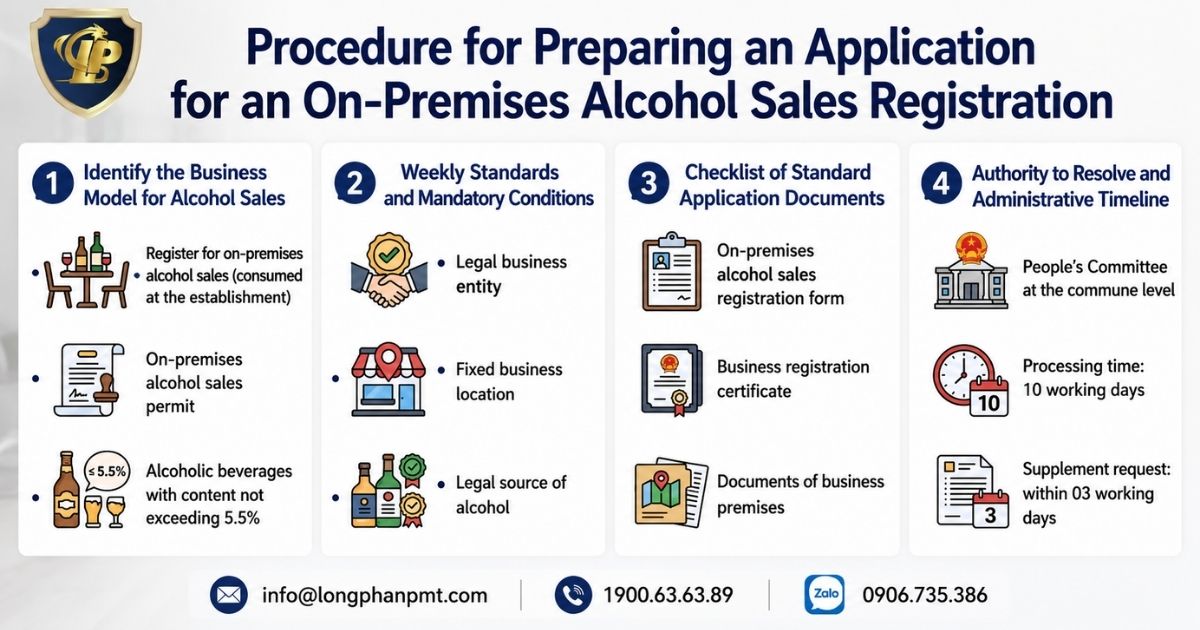
Restaurants intending to sell alcohol must prove three fundamental foundations: a valid business entity, a fixed location, and a legal source of alcohol. These are prerequisite conditions that must be fulfilled before submitting registration dossiers or license applications.
For F&B chains, systemic risk often arises not from a single missing document, but from a failure to synchronize site records, supplier contracts, purchase invoices, and safety certificates.
Enterprises should view these conditions as a matrix for operational control rather than mere procedural documentation. A single point of sale lacking valid origin certificates or safety conditions can jeopardize the reputation and operation of the entire chain.
Food service establishments must have clear legal status before registering to sell alcoholic beverages for on-site consumption. Suitable forms include enterprises, cooperatives, cooperative unions, or household businesses. This condition helps the management agency identify the entity responsible for goods, invoices, and compliance obligations. The requirement regarding the entity is stipulated in Clause 1, Article 14 of Decree No. 105/2017/ND-CP.
The business location must also be fixed and have a clear address. If the leased premises are not stable, a contract lacking the right to operate a liquor business will increase the risk of being required to provide explanations, according to Clause 2, Article 14 of Decree No. 105/2017/ND-CP.
The origin of alcohol is the highest-risk inspection point in restaurant operations. Businesses need to control suppliers from contracts, licenses, invoices to delivery documents for each batch. Alcohol sold in restaurants must be supplied by traders holding a license for production, distribution, wholesale, or retail. This is a mandatory requirement under Clause 3, Article 14 of Decree No. 105/2017/ND-CP.
In cases where homemade liquor is used for blending, the establishment may purchase it directly from households or individuals producing homemade liquor for reprocessing. This exception requires strict control of input documents, as stipulated in Clause 5, Article 16 of Decree No. 105/2017/ND-CP, amended and supplemented by Decree No. 17/2020/ND-CP.
Restaurants not only need to register for the proper procedures to sell alcohol. The establishment must also maintain safe operating conditions throughout the entire process of serving customers at the business location.
Regarding the legal aspects of the alcohol business, the requirements for maintaining fire safety and environmental protection are stipulated in Clause 3, Article 4 of Decree No. 105/2017/ND-CP, as amended and supplemented by Decree No. 17/2020/ND-CP. For the F&B model, food safety documentation also needs to be standardized according to the actual management requirements at the local level.
If any of the satellite requirements are missing, the liquor business record may become insecure during inter-agency inspections. Businesses should keep both soft and hard copies at each location for timely presentation.
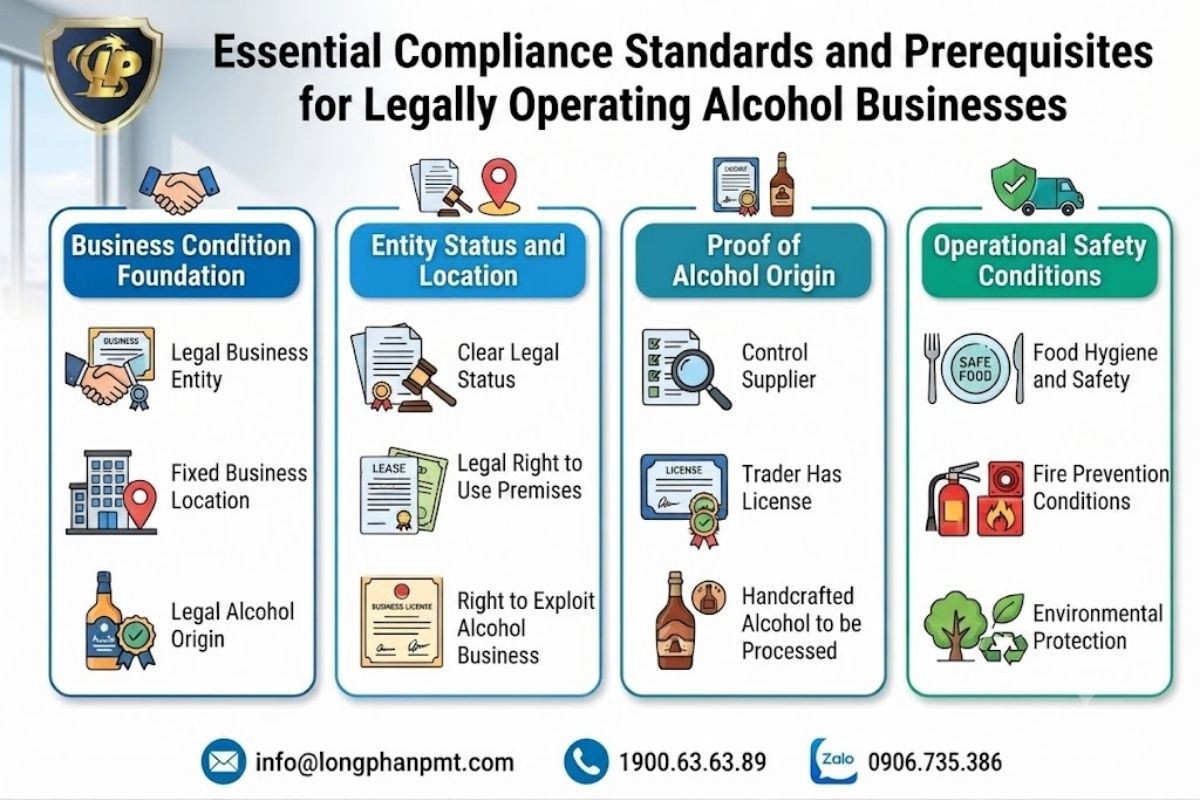
Restaurants need to separate their applications into two streams from the outset: registration for on-site alcohol consumption and application for a retail alcohol license when offering takeout. This separation helps the legal department avoid submitting incorrect forms, applications outside the scope, and applications to the wrong receiving agency.
For on-site alcohol sales, the core documentation consists of registration and liability commitments. Key components include the On-site Alcohol Sales Registration Certificate Form No. 13 and a copy of the business registration certificate, based on Form No. 13 Section II of the Appendix to Decree No. 17/2020/ND-CP.
Documentation should not be prepared solely for submission. For restaurants and F&B chains, the documentation must be sufficient to demonstrate legality during inter-agency inspections at the business location.
This checklist helps businesses not only complete registration procedures. Its greater value lies in creating a defensive profile in case of surprise inspections by market regulators, health authorities, or economic police agencies.
The documentation process needs to be standardized as an internal legal operating procedure (SOP). For restaurant chains, each location should have its own set of records, with consistent storage methods and assigned responsibilities.
This process helps businesses reduce documentation errors and control operational risks after opening. A properly maintained set of documents is generally a more effective safeguard than simply submitting them to complete the initial paperwork.
F&B enterprises must update their dossier submission routing to avoid wasting time on outdated processes. Administrative authority has officially shifted from district-level specialized agencies to the Commune-level People’s Committee where the establishment is located. This transition directly impacts plans for grand openings, branch expansions, and amendments to existing alcohol business records. Enterprises must verify the correct receiving agency during the initial preparation stage, in accordance with Articles 7 and 15, and Clause 3, Article 22 of Decree No. 139/2025/NĐ-CP.
This shift requires businesses to maintain precise communication logs and receipt tracking to ensure compliance during interdisciplinary inspections.
Businesses that were granted licenses or confirmation documents before the transition period do not need to renew them immediately. Documents issued before this date.01/7/2025This provision remains valid until the expiration date stated in the document. This reservation rule helps the restaurant chain avoid operational disruptions due to changes in the administrative structure. The reservation mechanism is stipulated in Clause 4, Article 22 of Decree No. 139/2025/ND-CP and Clause 9, Article 61 of Decree No. 146/2025/ND-CP.
When a license expires, needs renewal, or requires modification, the business must submit the application through the new jurisdiction. A safe approach is to create a license expiration tracking table for each business location.
Files submitted during the transition period should not be withdrawn without a formal request. The agency currently handling the case is responsible for continuing or transferring the processing to the new jurisdiction.
Tasks currently being handled by specialized agencies at the district level will be transferred to People’s Committee at the commune level. This is linked to the enterprise’s geographical location, as stipulated in Clause 3, Article 22 of Decree No. 139/2025/ND-CP. Files received before the transfer date will continue to be processed according to the provisions of Clause 7, Article 61 of Decree No. 146/2025/ND-CP.
For businesses preparing to open, it’s essential to keep records of application receipts, appointment slips, and correspondence with the receiving agency. This serves as proof of legal progress in case of inspections or changes to the opening date.
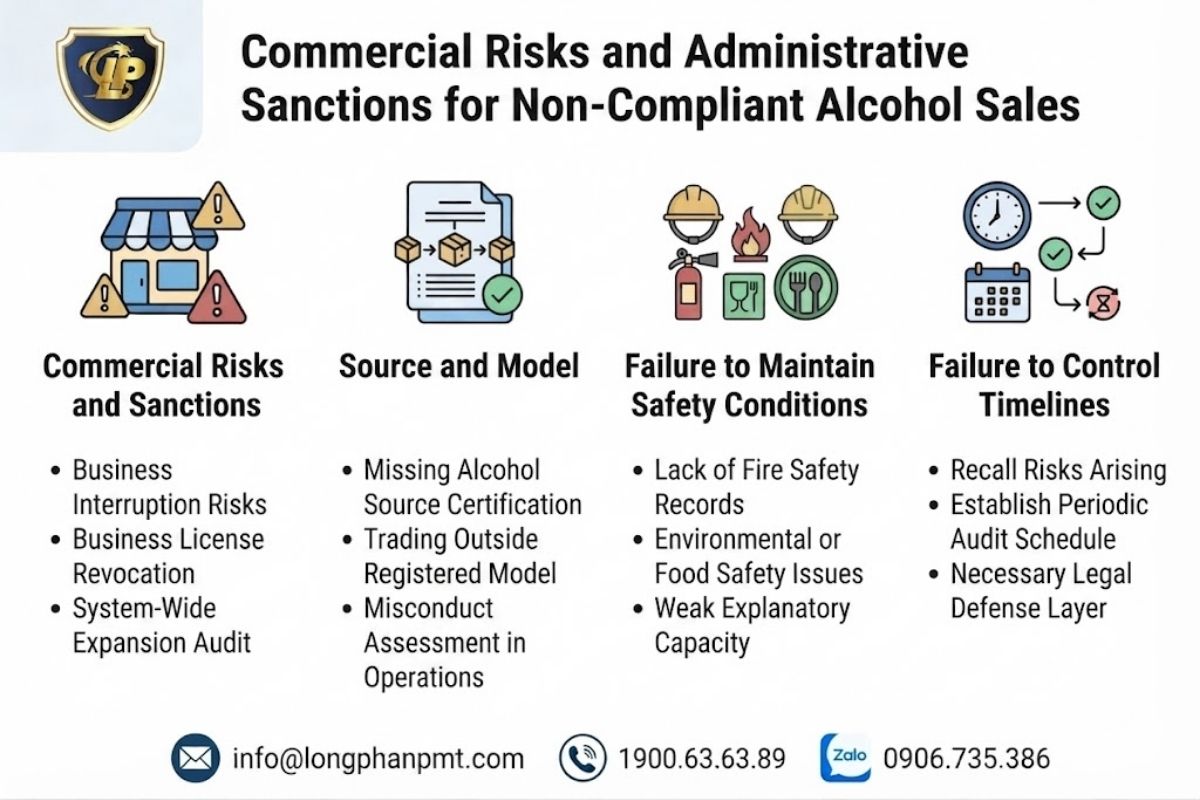
Restaurants failing to maintain source documentation, operating outside their registered scope, or neglecting operational conditions face significant risks of business disruption. For F&B chains, a single point of sale violation may trigger an extensive interdisciplinary audit across the entire system.
The most severe penalty in this sector is the revocation of the business license, which may occur if an establishment falsifies records, fails to maintain required operational conditions, terminates operations, or violates prohibited acts. The following risks must be managed to ensure long-term stability:
Enterprises should establish a periodic review schedule for each location, covering licenses, registrations, supplier contracts, and invoicing records. This acts as a necessary legal defense layer against unannounced interdisciplinary inspections.
Navigating the complexities of alcohol business regulations requires more than just filing forms; it demands a proactive strategy to synchronize your location records, supply chain documentation, and operational safety standards. At Long Phan Consulting, we provide end-to-end legal support, ensuring that your restaurant or F&B chain remains fully compliant from the initial planning stages through to daily operations. We mitigate legal risks by aligning your business model with current statutory requirements, allowing you to focus on your commercial expansion.
Our professional services for F&B enterprises include:
You may send your existing dossiers, facility descriptions, or operational plans via Email: info@longphanpmt.com or Zalo/WhatsApp: +84 906 735 386 for a preliminary evaluation of your compliance risks by our legal experts at Long Phan Consulting.
Properly defining the business model helps businesses avoid legal risks and optimize the time spent on administrative procedures. Understanding the regulations regarding registration, rather than a “retail liquor license,” for on-site operations is key to legally operating a restaurant. Businesses need to stay updated on changes in the authority to receive applications at the commune-level People’s Committee to ensure compliance in the F&B industry.
Restaurants that sell alcoholic beverages for on-site consumption do not need to apply for a license; they only need to register their operations with the state management agency. This regulation applies similarly to businesses selling alcoholic beverages with an alcohol content below 5.5%. These establishments are exempt from the procedure for applying for an alcohol business license as stipulated in Clause 2, Article 4 of Decree No. 105/2017/ND-CP (amended and supplemented by Decree No. 17/2020/ND-CP).
Food service businesses must submit their registration applications directly to the People’s Committee of the commune where the restaurant is located. According to the latest regulations on administrative jurisdiction, this agency is the sole point of contact for receiving and processing all applications related to alcohol business activities in the area, as stipulated in Article 7 and Clause 3 of Article 22 of Decree No. 139/2025/ND-CP.
The business establishment must have legal personality or be a legally registered household business and own a fixed business location with a clear address. All alcoholic beverages served to customers on-site must be legally sourced from traders with licenses for production, distribution, wholesale, or retail. Furthermore, the restaurant must commit to fully complying with fire safety and environmental protection standards as stipulated in Clauses 1, 2, and 3 of Article 14 of Decree No. 105/2017/ND-CP.
Restaurants will have their licenses revoked if they falsify documents, fail to maintain sufficient business conditions, or cease operations. Additionally, a period of 12 months without continuous business activity is also grounds for license revocation. Significant violations related to prohibitions on alcohol sales will also lead to this penalty, as stipulated in Point d, Clause 1, Article 33 of Decree No. 105/2017/ND-CP.
Securing a valid liquor retail license and maintaining strict adherence to Decree No. 139/2025/NĐ-CP is a non-negotiable operational prerequisite for foreign investors operating in Vietnam’s competitive F&B market. Beyond securing administrative permits, success requires a robust, systemic approach to managing alcohol origin, site safety, and regulatory documentation to mitigate risks of sudden business suspension during interdisciplinary inspections. As enforcement by the Commune-level People’s Committee intensifies, proactive legal alignment is your most effective safeguard for long-term commercial sustainability. Ensure your organization’s compliance profile is audit-ready by consulting the legal experts at Long Phan Consulting. For immediate professional guidance, contact our team via the legal hotline at 1900636389 to protect your operational assets and investment integrity.
📚 This article has been professionally reviewed based on the following legal documents: