
A Security and Order Permit is required before enterprises may operate in regulated sectors such as accommodation, private security, karaoke, pawnbroking, printing, massage, and other activities presenting public security risks. Officially issued as the Certificate of Eligibility for Security and Order, it must be processed within four working days after a complete dossier is received under Point a, Clause 3, Article 23 of Decree No. 96/2016/ND-CP.
Under the Law on Enterprises and Businesses, Long Phan Consulting helps align registered business lines, responsible personnel, fire safety records, and corporate documents to reduce rejection, revocation, and operational disruption risks.

Key legal notes:
A security and order permit is mandatory when a business establishment belongs to a group of industries or professions subject to conditional investment and business regulations regarding security and order. The official legal term is: Certificate of eligibility regarding security and order, granted to business models with complex elements that are easily exploited to generate violations.
Businesses should not rely solely on the industry name stated on their Business Registration Certificate. The evaluation must be based on practical activities. This includes business location, scale of operation, and accompanying specialized licenses. Clause 2, Article 4 of Decree No. 96/2016/ND-CP identifies this as a group of industries and professions with complex elements related to security and order, easily exploited for criminal activities or other violations of the law.
The following occupational groups are typically required to review their eligibility for certification:
The list of industries and professions subject to management is defined in Article 3 of Decree No. 96/2016/ND-CP. For investors, the risk lies not in the seemingly insensitive name, but in how the establishment is actually generating revenue. Before signing a lease agreement or opening a business, your company should conduct a three-layer legal verification process.
Misaligning industry codes leads to erroneous assessments of security certification obligations. Risks typically arise when registration documents record general business lines, while actual operations fall under conditional security sectors.
Authorities may evaluate activities based on their operational nature rather than trade names. Warning signs to review before launching include:
Pursuant to Article 3 of Decree No. 96/2016/NĐ-CP, as amended by Decree No. 58/2026/NĐ-CP, this is the definitive basis for identifying conditional security sectors. The most critical step for investors is reconciling industry codes, actual operations, and business locations before filing for certification.
Enterprises should only submit a dossier upon completing three fundamental compliance layers: legal entity qualification, Fire Prevention and Fighting (FPF) safety, and designated responsible personnel. Failure to fulfill any of these layers will likely trigger requests for additional documentation or outright rejection during the initial screening phase.
Establishments must be registered, licensed, or established legally within Vietnam. This serves as a mandatory entry condition before the police authority reviews the certificate application, as stipulated in Clause 1, Article 7 of Decree No. 96/2016/NĐ-CP.
| Compliance Category | Applied Requirement | Corporate Compliance Implication |
| Legal Status | Legally registered or established entity. | Must harmonize business registration, location, and actual operations; managers must not fall under disqualification criteria. |
| FPF Safety | Must satisfy fire prevention and fighting safety conditions. | FPF documentation must be prepared prior to the security certification submission. |
| Electronic Data Exception | Automatic waiver of FPF document submission if data is already digitally connected/shared. | Verify your establishment’s capability to extract FPF data via the environmental/digital management system. |
The requirement for FPF safety is established under Clause 3, Article 7 of Decree No. 96/2016/NĐ-CP. The specific waiver regarding the submission of FPF proof is detailed in Point e, Clause 3, Article 19, as amended by Decree No. 58/2026/NĐ-CP.
The person responsible for security and order is the most critical audit point. Enterprises must proactively review personnel declarations, Criminal Record Certificates, and conviction information to prevent dossier rejection.
The designated individual must not have a criminal record for infringing upon national security or intentional criminal offenses resulting in a prison sentence of more than 03 years that has not yet been expunged. This personal requirement is stipulated in Point a, Clause 2, Article 7 of Decree No. 96/2016/NĐ-CP, as amended by Decree No. 58/2026/NĐ-CP.
Operational risks often arise when enterprises verify only the legal job title without auditing personal history. For models such as pawnbroking, hospitality, security services, or karaoke, personnel failures frequently delay opening dates and inflate fixed overhead costs.
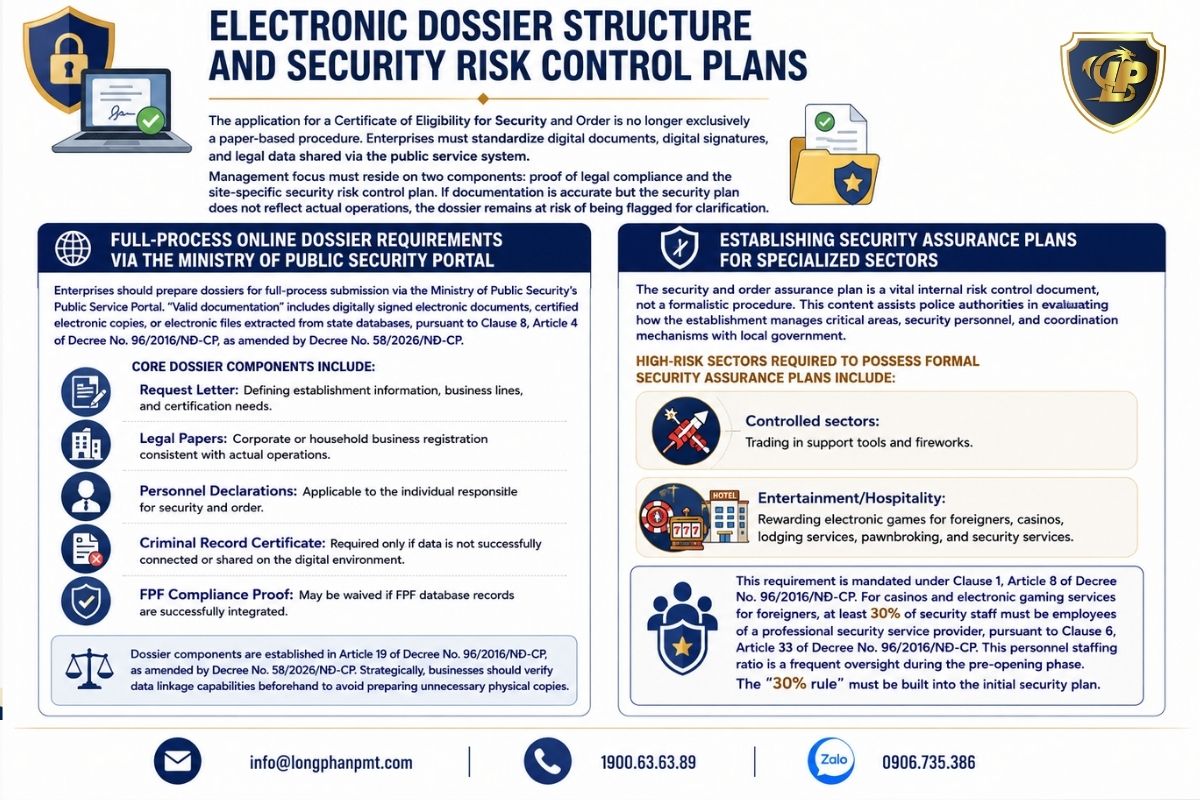
The application for a Certificate of Eligibility for Security and Order is no longer exclusively a paper-based procedure. Enterprises must standardize digital documents, digital signatures, and legal data shared via the public service system. Management focus must reside on two components: proof of legal compliance and the site-specific security risk control plan. If documentation is accurate but the security plan does not reflect actual operations, the dossier remains at risk of being flagged for clarification.
Enterprises should prepare dossiers for full-process submission via the Ministry of Public Security’s Public Service Portal. “Valid documentation” includes digitally signed electronic documents, certified electronic copies, or electronic files extracted from state databases, pursuant to Clause 8, Article 4 of Decree No. 96/2016/NĐ-CP, as amended by Decree No. 58/2026/NĐ-CP.
Core dossier components include:
Dossier components are established in Article 19 of Decree No. 96/2016/NĐ-CP, as amended by Decree No. 58/2026/NĐ-CP. Strategically, businesses should verify data linkage capabilities beforehand to avoid preparing unnecessary physical copies.
The security and order assurance plan is a vital internal risk control document, not a formalistic procedure. This content assists police authorities in evaluating how the establishment manages critical areas, security personnel, and coordination mechanisms with local government.
High-risk sectors required to possess formal security assurance plans include:
This requirement is mandated under Clause 1, Article 8 of Decree No. 96/2016/NĐ-CP. For casinos and electronic gaming services for foreigners, at least 30% of security staff must be employees of a professional security service provider, pursuant to Clause 6, Article 33 of Decree No. 96/2016/NĐ-CP. This personnel staffing ratio is a frequent oversight during the pre-opening phase.
Determining the appropriate authority for issuing a Certificate of Eligibility for Security and Order should not be based on outdated filing habits. Enterprises must cross-reference their business sector, scale, and legal entity type before selecting the receiving agency. Filing with the incorrect authority delays opening schedules, inflates rental costs, and disrupts recruitment planning. The current priority is identifying the exact processing level, especially for small establishments now under the jurisdiction of commune-level police.
Commune-level police now possess the authority to issue certificates for lodging service establishments with fewer than 10 rooms and household-based gas businesses. This shift is established under Clause 4, Article 24 of Decree No. 96/2016/NĐ-CP, as amended by Clause 7, Article 1 of Decree No. 56/2023/NĐ-CP.
| Competent Authority | Target Licensing Scope | Corporate Implication |
| Police Department of Administrative Management (MPS) | Industrial explosives, blasting services, military firearms, casinos, 5-star+ lodging, foreign-invested security services. | Suitable for large-scale projects, specialized factors, or foreign capital. |
| Provincial Police Department (PAPP) | Entities registered at the provincial or central level: lodging, karaoke, nightclubs, printing services. | Verify the agency issuing the business registration and actual operations. |
| Commune-Level Police | Lodging with < 10 rooms and household-based gas businesses. | Avoid traditional filing habits; ensure correct jurisdiction. |
Enterprises may submit applications in person, via postal services, the National Public Service Portal, or the VNeID national identification application. This channel is authorized under Clause 2, Article 23 of Decree No. 96/2016/NĐ-CP, as amended by Decree No. 58/2026/NĐ-CP.
The processing sequence should be controlled as follows:
The processing time for new or amended applications is no more than 04 working days from the date a valid dossier is received, pursuant to Point a, Clause 3, Article 23 of Decree No. 96/2016/NĐ-CP, as amended by Point c, Clause 12, Article 1 of Decree No. 58/2026/NĐ-CP. If refused, the police authority must respond within 08 working hours for portal/VNeID submissions, or 02 working days for in-person/postal filings, pursuant to Clause 4, Article 23 of Decree No. 96/2016/NĐ-CP, as amended by Clause 13, Article 1 of Decree No. 58/2026/NĐ-CP.
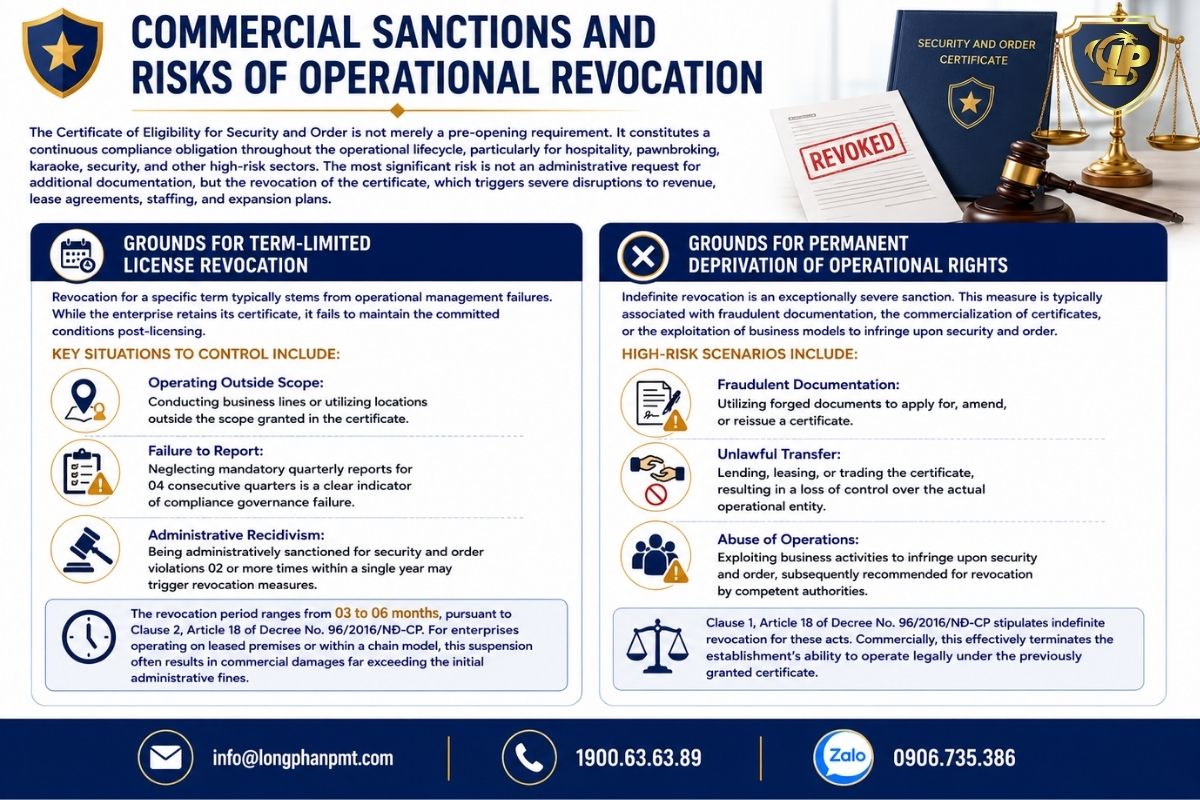
The Certificate of Eligibility for Security and Order is not merely a pre-opening requirement. It constitutes a continuous compliance obligation throughout the operational lifecycle, particularly for hospitality, pawnbroking, karaoke, security, and other high-risk sectors. The most significant risk is not an administrative request for additional documentation, but the revocation of the certificate, which triggers severe disruptions to revenue, lease agreements, staffing, and expansion plans.
Revocation for a specific term typically stems from operational management failures. While the enterprise retains its certificate, it fails to maintain the committed conditions post-licensing.
Key situations to control include:
The revocation period ranges from 03 to 06 months, pursuant to Clause 2, Article 18 of Decree No. 96/2016/NĐ-CP. For enterprises operating on leased premises or within a chain model, this suspension often results in commercial damages far exceeding the initial administrative fines.
Indefinite revocation is an exceptionally severe sanction. This measure is typically associated with fraudulent documentation, the commercialization of certificates, or the exploitation of business models to infringe upon security and order.
High-risk scenarios include:
Clause 1, Article 18 of Decree No. 96/2016/NĐ-CP stipulates indefinite revocation for these acts. Commercially, this effectively terminates the establishment’s ability to operate legally under the previously granted certificate.
Security and order conditions involve more than just initial licensing. Enterprises must simultaneously control industry codes, locations, personnel, FPF filings, electronic dossiers, and post-licensing maintenance obligations. Long Phan Consulting Company supports enterprises with a risk-management approach, moving beyond mere administrative drafting to ensure long-term operational sustainability.
Prior to submission, enterprises must precisely define their industry scope and applicable conditions. Errors at this stage inflate costs for site leasing, staffing, and waiting times.
Long Phan Consulting Company executes core tasks including:
Digital dossiers require precise formatting, authorized signatories, and system-wide data consistency. Without standardization, enterprises often receive multiple requests for amendments.
Long Phan Consulting Company provides procedural representation:
After securing the certificate, enterprises must maintain strict adherence to security conditions. Violations regarding industry scope, location, periodic reporting, or personnel records risk certificate revocation.
Long Phan Consulting Company maintains compliance through:
Enterprises are invited to submit legal files, location information, and business models via Email at info@longphanpmt.com or Zalo at +84 906 735 386 for a preliminary assessment by Long Phan Consulting Company.
Proactively managing legal risks arising during operations is crucial to the safety of investors’ capital. To help businesses optimize their implementation process, the following in-depth explanations will clarify the practical aspects of preparing a “Security and Order Permit” under the latest legal framework.
Businesses or household businesses operating accommodation establishments with fewer than 10 rooms must submit their applications to the commune-level police. The commune-level police agency has the authority to directly issue licenses and manage accommodation businesses with fewer than 10 rooms as stipulated in Clause 4, Article 24 of Decree No. 96/2016/ND-CP, amended and supplemented by Clause 7, Article 1 of Decree No. 56/2023/ND-CP.
Individuals with prior convictions for intentional offenses resulting in sentences of more than 3 years imprisonment that have not been expunged are absolutely prohibited from registering under their names. The background check requirement for individuals responsible for security and order stipulates that they must not have prior convictions for offenses against national security or other intentional crimes resulting in sentences of more than 3 years imprisonment that have not been expunged, as stipulated in Point a, Clause 2, Article 7 of Decree No. 96/2016/ND-CP, amended by Clause 5, Article 1 of Decree 58/2026/ND-CP.
Businesses operating casinos are required to maintain at least 30% of their total security personnel as employees of professional security service providers. The security personnel quota for establishments operating electronic gaming with prizes for foreigners and casinos must meet this minimum ratio as stipulated in Clause 6, Article 33 of Decree No. 96/2016/ND-CP.
Businesses will be subject to license revocation for a period of 3 to 6 months if they operate in an incorrect location or fail to submit periodic reports. The revocation of the business license for a period of 3 to 6 months is applied when a business operates outside its registered business scope or location, or fails to submit quarterly reports for four consecutive quarters, as stipulated in Clause 2, Article 18 of Decree No. 96/2016/ND-CP.
The competent police agency must process the licensing within 4 working days from the date of receiving a complete application. The time limit for processing a new Certificate of Eligibility regarding security and order is no more than 4 working days from the date of receiving a complete and valid application, as stipulated in Point a, Clause 3, Article 23 of Decree No. 96/2016/ND-CP, amended by Point c, Clause 12, Article 1 of Decree 58/2026/ND-CP.
The Security and Order Certificate serves as a mandatory operational safeguard for enterprises operating within high-risk conditional business sectors. Achieving full compliance requires rigorous standardization across industry classification, site-specific security plans, fire safety standards, and digitized personnel records. Failure to align your actual business activities with these regulatory requirements frequently results in application rejections, delayed market entry, or the total revocation of your right to operate. Protect your capital and ensure long-term operational stability by auditing your compliance status with the experts at Long Phan Consulting Company. Contact our professional advisory team via our dedicated hotline at 1900636389 to secure your facility and navigate the complexities of Vietnam’s security licensing framework with absolute authority.
📚 This article is provided with professional consultation based on the following legal framework: