
Long Phan Consulting has received many inquiries from shop owners, KOLs/KOCs, and affiliate marketers regarding VNeID authentication for E-commerce livestream sellers following the official effectiveness of the 2025 Law on E-Commerce. This is a mandatory obligation directly linked to the right to open an online store and conduct livestream sales on platforms such as Shopee, TikTok Shop, or social networks with ordering functions. For legal matters related to online business activities, clients may also refer to regularly updated Law on Enterprises and Businesses content prepared by Long Phan Consulting.

Important Notes:
Sellers on intermediary platforms or social networks operating e-commerce must provide information to the platform operator for identity authentication purposes, under Point a, Clause 1, Article 21 of the 2025 Law on E-Commerce. The platform must complete electronic identity authentication of the seller before permitting sales, under Point c, Clause 1, Article 17 of this Law.
Livestream sellers are responsible for providing information to the platform operator for identity authentication, under Clause 1, Article 24 of the 2025 Law on E-Commerce. The platform must complete electronic identity authentication of the livestream seller before permitting the livestream, under Clause 4, Article 22 of this Law.
Before setting up a referral link or referral code, an affiliate marketer must provide authentication and identification information to the organization or individual providing the affiliate marketing service, under Point a, Clause 1, Article 26 of the 2025 Law on E-Commerce. The affiliate marketing service provider is responsible for completing this authentication before permitting the activity, under Point a, Clause 1, Article 25 of this Law.
A foreign livestream seller is authenticated through valid legal documents instead of VNeID, under Clause 4, Article 22 of the 2025 Law on E-Commerce. The same rule applies to foreign affiliate marketers, under Point a, Clause 1, Article 25 of this Law.
Authentication is not self-performed by the seller or the livestream seller; it is carried out by the e-commerce platform operator, based on the national identification and electronic authentication system.
The operator of an intermediary platform with an online ordering function must perform electronic identity authentication in accordance with the 2025 Law on E-Commerce and the laws on identification and electronic authentication, before permitting sales, under Point c, Clause 1, Article 17 of this Law. A social network operating app e-commerce with livestream and online ordering functions carries an equivalent responsibility under Clause 3, Article 18 of this Law, which refers back to Clause 2, Article 17.
Decree 248/2026/ND-CP details this obligation at Articles 17 and 18, requiring platforms to authenticate sellers and vet product information before display.
VNeID, managed and operated by the Ministry of Public Security, is the platform linked to national population data that allows e-commerce platforms to cross-check and authenticate the identity of domestic sellers and livestream sellers. Linking an e-commerce transaction account to VNeID is one of 11 mandatory account groups under Clause 9, Article 40 of Decree 69/2024/ND-CP, as supplemented by Article 19 of Decree 320/2026/ND-CP.
>>>See more: Mandatory Documentation for Livestream Sales Starting July 2026
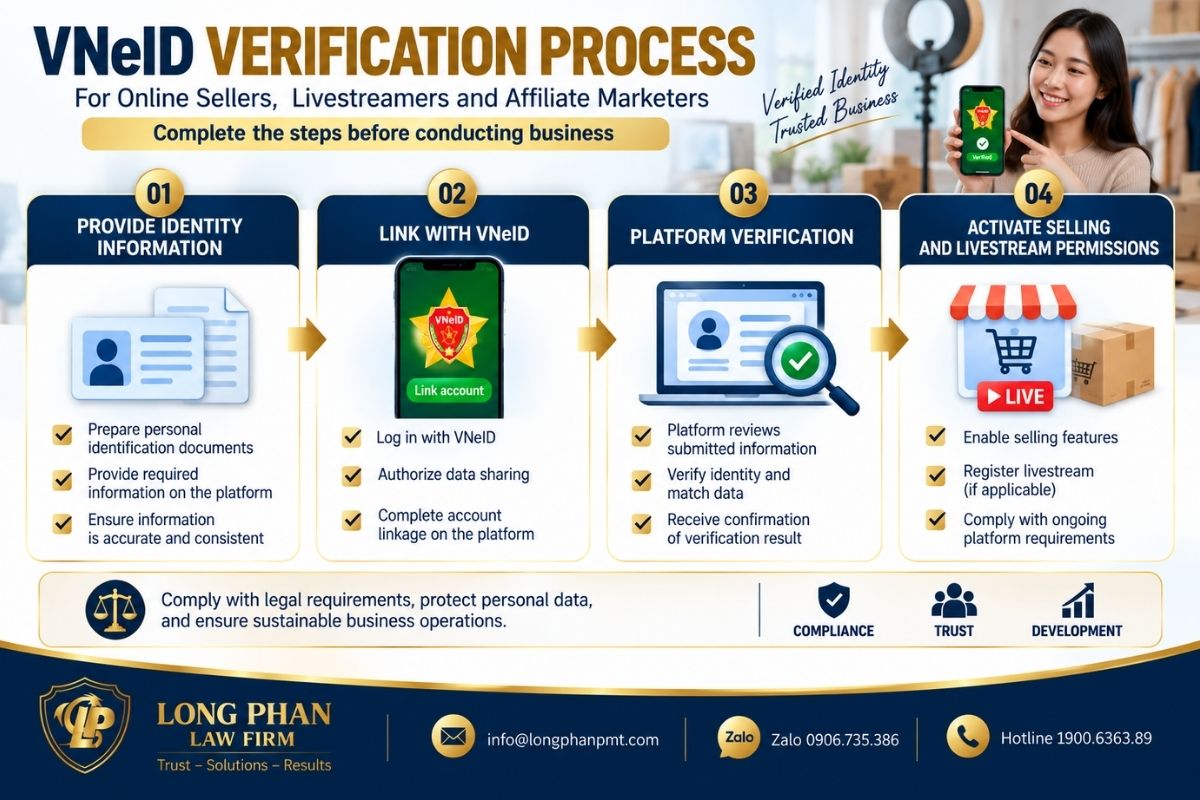
The authentication process consists of three main steps, which platforms must publish in their livestream operating rules and seller account opening rules under Article 12 of Decree 248/2026/ND-CP.
Sellers and livestream sellers register and declare personal identification information, or business/household business information, as required by the platform, under Point a, Clause 1, Article 21 and Clause 1, Article 24 of the 2025 Law on E-Commerce.
The selling or livestream account on the platform is linked to a level-2 electronic identification account on VNeID, under the linkage mechanism set out in the amended Clause 9, Article 40 of Decree 69/2024/ND-CP.
The platform compares the information provided against national electronic identification data; if it matches, the account is granted the right to sell or livestream, under Point c, Clause 1, Article 17 and Clause 4, Article 22 of the 2025 Law on E-Commerce.
Sellers and livestream sellers must distinguish between two parallel legal timelines, as each carries a separate deadline and scope of application that can easily be confused if not properly separated.
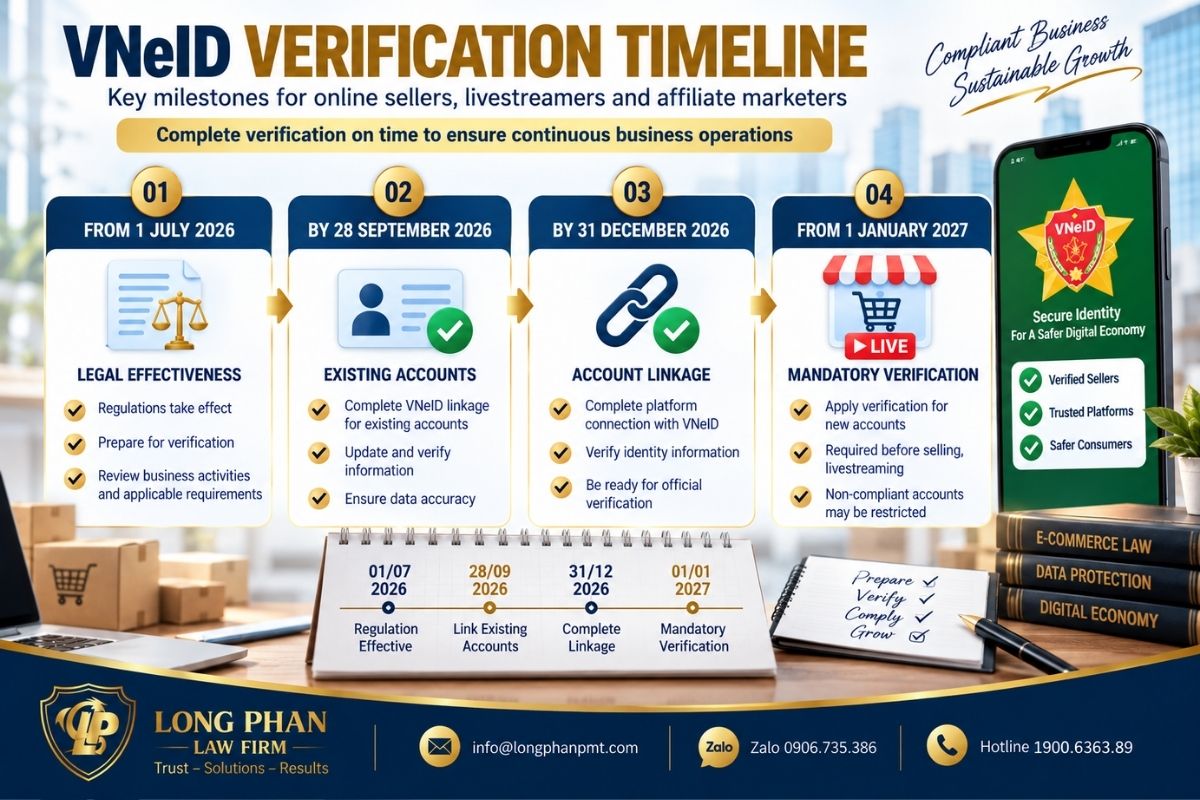
The Law on E-Commerce No. 122/2025/QH15 takes effect from July 1, 2026, under Article 40 of this Law. Decree 248/2026/ND-CP, detailing certain provisions of the Law, also takes effect on the same date.
Although Decree 248/2026/ND-CP takes effect on July 1, 2026, the specific requirement for electronic identity authentication of sellers and livestream sellers is only officially implemented from January 1, 2027. This is the milestone from which platforms must formally refuse selling or livestream rights to accounts that have not completed authentication.
Under Clause 3, Article 20 of Decree 320/2026/ND-CP, an e-commerce transaction account created before September 28, 2026 must complete VNeID linkage and authentication no later than December 31, 2026. This deadline applies independently of the January 1, 2027 milestone under Decree 248/2026/ND-CP, so sellers and livestream sellers should complete linkage early to avoid facing both obligations at once.
The 2025 Law on E-Commerce allocates obligations among sellers, livestream sellers, affiliate marketers, and platform or service operators. It is therefore necessary to identify who must provide information and who is responsible for performing electronic identity authentication before applying the rules to each activity.
| Subject Group | Specific Obligation | Legal Basis | Applicable Deadline |
| Sellers on intermediary platforms, e-commerce social networks (domestic) | Provide identifying information to the platform for authentication before selling | Point c, Clause 1, Article 17; Point a, Clause 1, Article 21 of the 2025 Law on E-Commerce | Authentication applies from January 1, 2027 (Decree 248/2026/ND-CP); VNeID linkage must be completed before December 31, 2026 if the account was created before September 28, 2026 |
| Livestream sellers (domestic) | Provide information to the platform for authentication before being permitted to livestream | Clause 4, Article 22; Clause 1, Article 24 of the 2025 Law on E-Commerce | Same as the seller group |
| Affiliate marketers (domestic) | Provide authentication information to the affiliate marketing service provider before commencing activity | Point a, Clause 1, Article 25; Point a, Clause 1, Article 26 of the 2025 Law on E-Commerce | Same as the seller group |
| Foreign livestream sellers and affiliate marketers | Authenticated using valid legal documents instead of VNeID | Clause 4, Article 22; Point a, Clause 1, Article 25 of the 2025 Law on E-Commerce | From July 1, 2026 (Law effective date) |
Failure to complete authentication directly affects a seller’s or livestream seller’s right to operate on the platform, rather than being a purely administrative formality.
The platform has both the right and the responsibility not to grant selling or livestream rights to an account that has not completed electronic identity authentication, under Point c, Clause 1, Article 17 and Clause 4, Article 22 of the 2025 Law on E-Commerce.
Where a violation is found relating to content or a subject that has not been validly authenticated, the platform must suspend the livestream and remove the displayed information as soon as it is detected, or upon request of the competent state authority, under Clause 6, Article 22 of the 2025 Law on E-Commerce.
An account that has not linked to VNeID by the deadline under Decree 320/2026/ND-CP risks having its transaction functions restricted on the platform, due to failure to meet the mandatory authentication condition attached to the transaction account.
Understanding common errors in advance helps sellers and livestream sellers prepare an accurate dossier from the outset, avoiding repeated resubmissions.
A mismatch between the information declared on the platform and the citizen identification or national population data is a common cause of automatic dossier rejection.
Under Decree 320/2026/ND-CP amending Decree 69/2024/ND-CP, from September 28, 2026, the VNeID system automatically locks an electronic identification account if the registered phone number no longer belongs to the account holder, which disrupts the linkage with the selling or livestream account.
Many accounts were created before the linkage requirement took effect, but the account holder has not proactively updated the linkage, creating a risk of missing the December 31, 2026 deadline under Clause 3, Article 20 of Decree 320/2026/ND-CP.
Long Phan Consulting supports individuals, household businesses, enterprises, sellers, and other entities operating on e-commerce platforms in reviewing legal conditions, carrying out procedures, and organizing business activities in compliance with applicable regulations. For sales, livestreaming, and affiliate marketing activities on digital platforms, the scope of support includes:
Clients may send their case documents via email at info@longphanpmt.com or via Zalo at 0906.735.386 for a preliminary assessment.
Below are practical issues that sellers and livestreamers commonly encounter when implementing VNeID authentication for E-commerce livestream platforms.
Yes. The 2025 Law on E-Commerce does not distinguish based on business scale. All individuals selling goods on intermediary platforms or social networks conducting e-commerce activities must provide information for identity verification under Point a, Clause 1, Article 21 of the Law.
The platform is responsible for electronically verifying identity before allowing sales activities under Point c, Clause 1, Article 17 of the 2025 Law on E-Commerce. The verification obligation under Decree No. 248/2026/ND-CP officially applies from January 1, 2027, while the VNeID account-linking obligation under Decree No. 320/2026/ND-CP has a separate and earlier deadline.
No. Verification is linked to the livestreamer’s identity on each e-commerce platform rather than to each seller with whom the livestreamer cooperates, pursuant to Clause 1, Article 24 and Clause 4, Article 22 of the 2025 Law on E-Commerce.
A foreign livestream seller may verify their identity using valid legal documents instead of a VNeID account, pursuant to Clause 4, Article 22 of the 2025 Law on E-Commerce.
Yes, if the social network provides online ordering functions or sales livestreaming features that facilitate contract formation, pursuant to the definition in Clause 5, Article 3 and the responsibilities prescribed in Clause 3, Article 18 of the 2025 Law on E-Commerce.
The 2025 Law on E-Commerce and current implementing regulations do not prescribe a separate fee for electronic identity verification on e-commerce platforms. Any costs incurred, if applicable, depend on the operating policies of each platform.
Linking an electronic transaction account with VNeID under Clause 9, Article 40 of the amended Decree No. 69/2024/ND-CP is a condition for completing verification. Livestreamers should upgrade their electronic identification accounts to level 2 to ensure that the verification process and livestream authorization are not interrupted.
VNeID verification is a mandatory condition for sellers, livestreamers, and affiliate marketers to be authorized to operate legally on e-commerce platforms from the applicable effective dates stated above. Business operators should proactively link their electronic transaction accounts with VNeID before December 31, 2026 and prepare complete identity information to avoid operational disruption when the verification requirements under Decree No. 248/2026/ND-CP officially apply from January 1, 2027. If you need assistance reviewing documents or handling specific issues, please contact Long Phan Consulting via Hotline 1900636389 for timely support.
📚 This article has been professionally reviewed based on the following legal documents: