Important Notes:
- There is currently no 6-month maximum period for liquidating contracts and settling debts under the 2020 Law on Enterprises. This limit existed only under the 2014 Law on Enterprises, which is no longer effective. Enterprises may now determine the relevant period themselves and specify it in the dissolution resolution.
- Enterprise dissolution registration fees are fully exempt under Article 5 of Circular No. 47/2019/TT-BTC. In practice, the main costs generally arise from outstanding tax obligations and accounting service fees rather than State registration fees.
- The 5-working-day deadline for submitting the dissolution dossier to the Business Registration Authority only begins after the enterprise has fully settled its debts, not from the date the dissolution resolution is issued. This is a point that enterprises frequently misunderstand.
- From the date a dissolution decision is issued, the enterprise is prohibited from entering into new contracts, except those necessary for the dissolution process; pledging, mortgaging, or donating assets; dispersing assets; or converting unsecured debts into secured debts, pursuant to Article 211 of the 2020 Law on Enterprises.
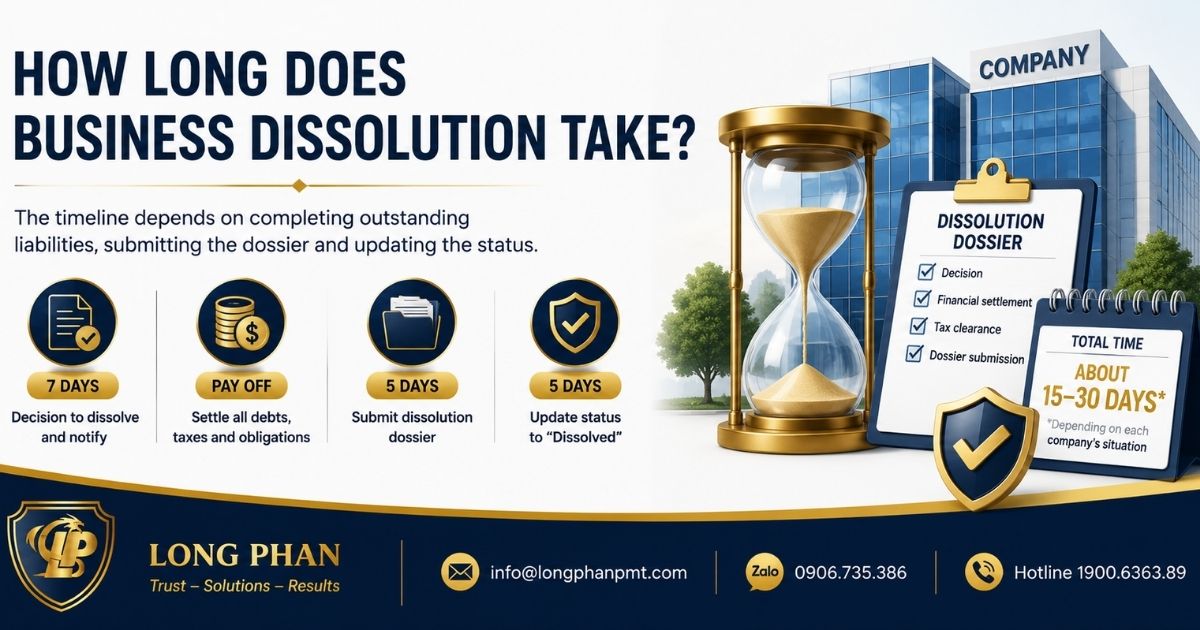
Business Dissolution Timeline: Breaking Down Each Milestone
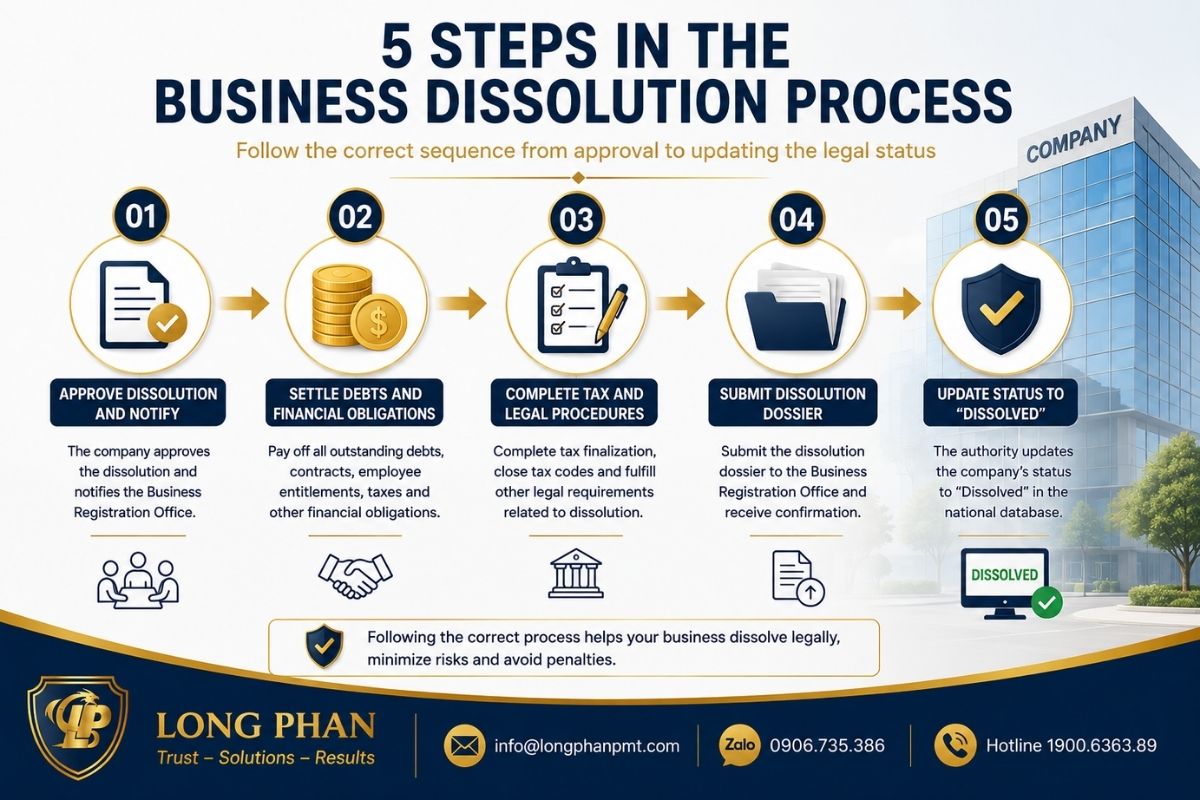
Understanding how long enterprise dissolution takes starts with separating two distinct components. The first is a set of fixed statutory milestones, usually measured in days. The second is the period a business spends resolving debt, tax, and labor matters, which has no fixed cap. The section below sets out the five steps in the order established under Article 208 of the Law on Enterprises 2020 and Article 64 of Decree No. 168/2025/ND-CP.
Step 1 – Adopt and Send Notice of the Dissolution Resolution or Decision
The Members’ Council, General Meeting of Shareholders, company owner, or private enterprise owner adopts the dissolution resolution or decision. The mandatory content includes the business name and address, the reason for dissolution, and the timeline and procedure for contract liquidation and debt payment. It must also include the plan for handling labor contract obligations, under Clause 1, Article 208 of the Law on Enterprises 2020.
Within 7 working days of adoption, the business must send the resolution, decision, and meeting minutes to the business registration authority, the tax authority, and employees. It must also publish the resolution on the National Business Registration Portal and post it at the head office and branches, under Clause 3, Article 208 of the Law on Enterprises 2020. Immediately upon receiving this dossier, the business registration authority must update the business’s status to “undergoing dissolution procedures” on the National Portal, under Clause 4, Article 208 of the Law on Enterprises 2020.
Step 2 – Pay Debts and Finalize Corporate Income Tax
The business must pay debts in the priority order set out in Clause 5, Article 208 of the Law on Enterprises 2020. The order is: (1) unpaid wages, severance pay, social insurance, health insurance, unemployment insurance, and other employee entitlements; (2) tax debts; and (3) other debts.
In parallel, the business must file its corporate income tax finalization dossier no later than 45 days from the date the operation-cessation event arises. This deadline is set under Clause 4, Article 44 of the Law on Tax Administration 2019.
This is the most commonly misunderstood milestone. The 45-day period is only the deadline to file the finalization dossier, not the deadline for the tax authority to complete its review. In practice, if the dossier contains invoice discrepancies, invalid expenses, or data mismatches, the tax authority’s review and request for explanation can extend the process by several additional months. This observation reflects actual case-handling practice, not a statutory deadline.
Step 3 – Confirm Completion of Tax Obligations and Deactivate the Tax Code
After completing the financial obligations set out in Article 15 of Circular No. 105/2020/TT-BTC, including filing invoice usage reports and completing tax, fee, and charge obligations, the business files the tax code deactivation dossier. This dossier uses Form No. 24/DK-TCT under Article 14 of Circular No. 105/2020/TT-BTC, based on Articles 38 and 39 of the Law on Tax Administration 2019. The tax authority processes the dossier and issues a tax code deactivation notice under the procedure in Article 16 of Circular No. 105/2020/TT-BTC. Only after this notice is issued can the business file the dissolution dossier with the business registration authority.
Step 4 – File the Dissolution Registration Dossier with the Business Registration Authority
Within 5 working days of the date all of the business’s debts are paid, the legal representative sends the dissolution dossier to the business registration authority. This deadline is set under Clause 7, Article 208 of the Law on Enterprises 2020.
The dossier components follow Article 210 of the Law on Enterprises 2020 and Article 64, Chapter VI of Decree No. 168/2025/ND-CP. These include the dissolution notice, the asset liquidation report, and the list of creditors and debts paid, if any.
Step 5 – The Business Registration Authority Updates the Legal Status to “Dissolved”
The business registration authority updates the legal status to “dissolved” in the National Database within 5 working days of receiving a valid dossier. Where a business fails to file the dissolution dossier on time, the business registration authority may still automatically change the status to “dissolved.” This occurs if no written objection is received from a related party within 180 days of receipt of the dissolution resolution or decision under Clause 3, Article 208. The legal basis for this automatic change is Clause 8, Article 208 of the Law on Enterprises 2020.
>>>See more: New Policy Context and the Pressure of Converting a Household Business to an Enterprise
Business Dissolution Costs: Breaking Down Each Item
The cost of business dissolution does not lie in the state fee, which is nearly zero. It lies in outstanding tax obligations and professional service fees needed to close the books correctly. The section below lists each cost group in the order it typically arises.
Mandatory State Fees
Under Article 5 of Circular No. 47/2019/TT-BTC, the dissolution registration dossier is exempt from the business registration fee. This differs from the procedure for establishing or changing business registration. The business pays no fee specifically for the dissolution procedure at the business registration authority.
Outstanding Tax Obligations to Settle Before Dissolution
This is usually the largest cost item. The business must fully settle corporate income tax, value-added tax, and withheld but unpaid personal income tax, along with late-payment interest and administrative tax penalties, if any. Under Clause 1, Article 67 of the Law on Tax Administration 2019, completing tax obligations upon dissolution follows the law on enterprises and other related regulations. This is a prerequisite for the tax authority to confirm tax code deactivation. The specific amount depends entirely on each business’s bookkeeping status, with no general rate.
Costs That Arise in Practice
This group includes tax and accounting services to review and close the books before finalization, cancellation of unused e-invoices, and labor contract liquidation and severance pay, if any. It also includes recovery of the company seal or handling of the digital signature. The fee for each item depends on the actual scale of the dossier and the service provider. Clients should request a specific quote after providing their dossier status.
Cost Comparison by Business Scale
| Criteria | Business with No Revenue | Business with Revenue and Employees |
| Dissolution registration fee | Exempt (VND 0) | Exempt (VND 0) |
| Outstanding tax obligations | Usually none if fully declared | May include corporate income tax, VAT, and late-payment interest |
| Accounting review and book-closing services | Minimal | Higher due to a larger volume of documents and invoices |
| Labor-related costs | None | Includes severance pay and social insurance closure |
The specific fee for each item depends on the actual dossier, and there is no fixed fee schedule that applies uniformly to all businesses.
Why Actual Dissolution Time Often Exceeds the Statutory Timeline
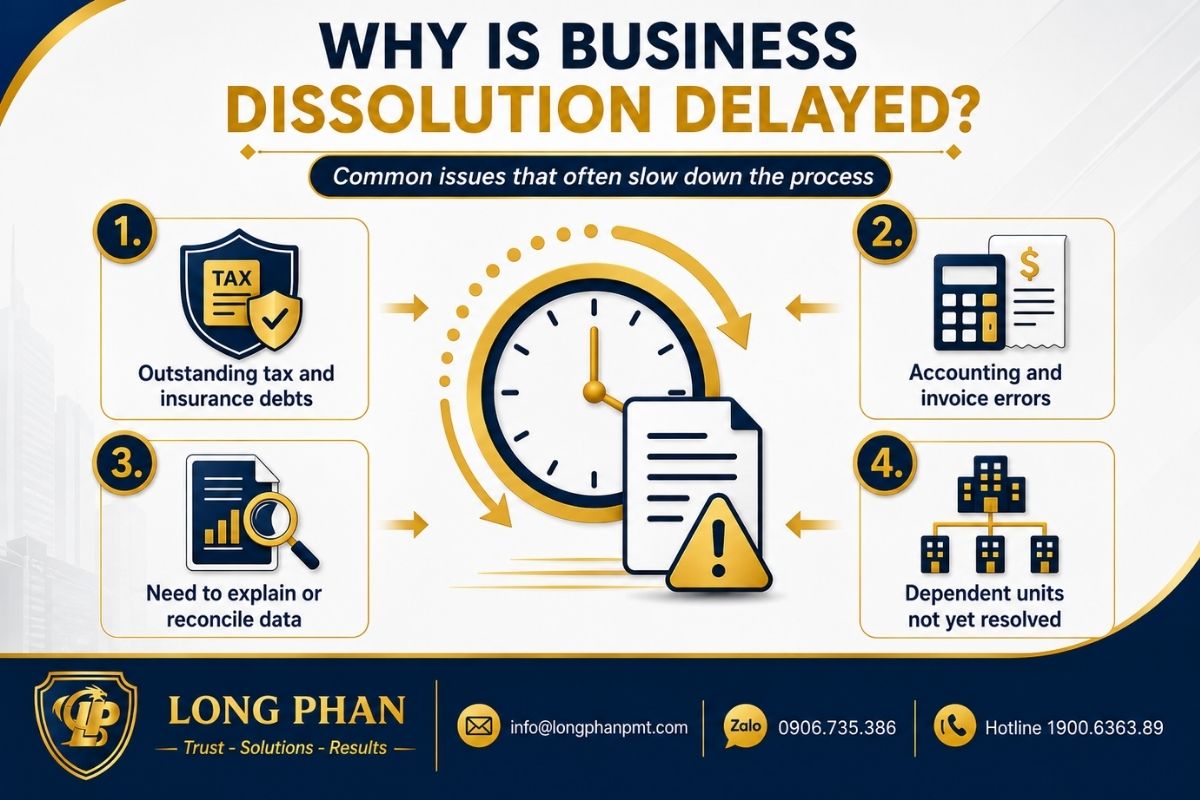
The three causes below are the most common reasons why actual figures for how long enterprise dissolution takes exceed the statutory milestones described above.
Outstanding Tax or Social Insurance Debts Not Yet Resolved
The business registration authority only accepts the dissolution dossier after the business has paid all debts, under Clause 7, Article 208 of the Law on Enterprises 2020. If tax or social insurance debts remain, the business must complete these obligations first, which extends the entire timeline according to the processing time of the tax and social insurance authorities.
Accounting or Invoice Errors That Trigger a Tax Authority Explanation Request
Discrepancies between declared figures and actual invoice usage, expenses lacking valid documentation, or mismatches between declaration periods are common causes that lead the tax authority to request additional explanations. This extends the time needed to confirm completed tax obligations before the tax code can be deactivated.
Branches, Representative Offices, or Dependent Business Locations Not Yet Terminated
A business with branches, representative offices, or dependent business locations must complete the termination procedure for these units under Article 213 of the Law on Enterprises 2020. This must occur before the parent company’s dissolution dossier can be approved, adding an extra layer of parallel procedure.
What Options Does a Business Have for Handling Dissolution?
A business may handle the dissolution procedure itself or authorize an individual or organization providing business registration services to do so. The appropriate choice should depend on the status of tax obligations, debts, employees, dependent units, and the complexity of the dossier. Under Article 12 of Decree No. 168/2025/ND-CP, the person authorized to sign the business registration application may delegate an individual or another organization to carry out the business registration procedure.
| Criteria | Self-Filing | Authorizing a Consulting Firm |
| Processing time | Usually longer due to limited experience working with the tax authority | Shortened through proactive review and direct engagement with the tax authority |
| Risk of dossier errors | Higher, with a greater chance of rejection due to missing documents or incorrect forms | Lower, through control under a standard process |
| Cost | No service fee, but consumes internal staff time | A service fee applies, but it saves time and reduces the risk of penalties |
| Best suited for | Small businesses with a simple dossier and no outstanding debt | Businesses with tax debts, complex invoicing, or employees to be handled |
Common Errors That Delay or Cause Rejection of Dissolution Dossiers
The dissolution procedure involves more than filing a dossier with the business registration authority. It also involves settling debts, completing tax obligations, handling employee entitlements, and terminating dependent units. Businesses should therefore review all obligations comprehensively before and during dissolution to avoid dossier amendments or a prolonged process.
- Filing the dissolution dossier before completing tax obligations or before receiving the tax code deactivation notice from the tax authority.
- Overlooking termination of a branch, representative office, or dependent business location before filing the parent company’s dissolution dossier.
- Failing to publish the dissolution resolution within the 7-working-day deadline under Clause 3, Article 208 of the Law on Enterprises 2020, resulting in a request for supplementation.
- Signing new contracts or carrying out activities prohibited under Article 211 of the Law on Enterprises 2020 after the dissolution decision has been issued.
- Failing to retain complete book-closing records, leading the tax authority to request explanations repeatedly and delaying confirmation of completed tax obligations.
- Failing to notify and fully settle employee entitlements before terminating labor contracts.
Comprehensive Consulting and Representation Services for Enterprise Dissolution Procedures
This service includes legal consulting and authorized representation to directly review tax obligations, prepare dissolution dossiers, and work with competent authorities on the client’s behalf throughout the dissolution process, rather than merely providing procedural guidance. When authorizing Long Phan Consulting to handle an enterprise dissolution dossier, clients receive support with the following matters:
- Conducting a comprehensive review of tax obligations, invoices, and social insurance status before commencing the dissolution procedure.
- Preparing the dissolution resolution, dissolution decision, and documents required for public disclosure in accordance with the mandatory contents prescribed in Article 208 of the 2020 Law on Enterprises.
- Working directly with the tax authority to explain accounting figures, handle outstanding invoices, and obtain confirmation that tax obligations have been fulfilled.
- Preparing and submitting the dossier for termination of tax identification number validity under Circular No. 105/2020/TT-BTC.
- Preparing and submitting the enterprise dissolution registration dossier to the Business Registration Authority under Decree No. 168/2025/ND-CP.
- Monitoring the processing status and updating the enterprise’s legal status until it is officially recorded as “dissolved.”
- Advising on the termination of branches, representative offices, affiliated business locations, and matters concerning employees’ rights and interests.
Clients may send their case documents via email at info@longphanpmt.com or via Zalo at 0906.735.386 to receive a specific service fee quotation.
Frequently Asked Questions About How Long Enterprise Dissolution Takes
Below are common practical questions about how long enterprise dissolution takes, what it costs, and the conditions that apply, together with the relevant legal basis.
1. How long does enterprise dissolution take in the fastest scenario?
For an enterprise that has generated no revenue, has no outstanding debts, and has no employees, the dissolution process may be shortened to approximately 1–2 months. This period mainly consists of administrative processing time at the tax authority and the Business Registration Authority in accordance with statutory timelines.
2. Can an enterprise be penalized for failing to submit the dissolution dossier within 5 days after fully paying its debts?
The 2020 Law on Enterprises does not prescribe a separate penalty for late submission of the dissolution dossier under Clause 7, Article 208. However, enterprises should submit the dossier within the prescribed period to avoid additional reporting obligations or prolonged legal status as an enterprise “undergoing dissolution procedures.”
3. Can a company be dissolved if it still has outstanding tax liabilities?
No. Under Article 207 of the 2020 Law on Enterprises, an enterprise may only be dissolved after all debts and other property obligations, including tax liabilities, have been fully settled. Under Clause 1, Article 67 of the 2019 Law on Tax Administration, the tax authority must confirm completion of tax obligations before the tax identification number can be terminated.
4. Is an enterprise registration fee payable for dissolution?
No. Under Article 5 of Circular No. 47/2019/TT-BTC, enterprise dissolution registration dossiers are exempt from enterprise registration fees.
5. Can the parent company complete dissolution if one of its branches has not yet terminated operations?
No. The enterprise must first terminate the operations of its limited liability company branch, representative office, and affiliated business locations under Article 213 of the 2020 Law on Enterprises before the parent company’s dissolution dossier can be approved.
6. What is the difference between enterprise dissolution and bankruptcy?
Dissolution applies when an enterprise remains capable of fully paying its debts and is carried out either voluntarily or as required by law under Article 208 of the 2020 Law on Enterprises. Bankruptcy applies when an enterprise becomes insolvent and must undergo court proceedings under the 2025 Law on Recovery and Bankruptcy (No. 142/2025/QH15), effective from March 1, 2026 and replacing the 2014 Law on Bankruptcy. Bankruptcy does not fall within the scope of the Law on Enterprises.
7. How long does it take to receive the result after submitting the dissolution dossier?
The Business Registration Authority updates the enterprise’s legal status to “dissolved” within 05 working days from the date it receives a valid dossier, pursuant to Clause 8, Article 208 of the 2020 Law on Enterprises.
Conclusion
How long does enterprise dissolution take, and how much does it cost? Both depend primarily on the status of tax obligations, invoices, and employment matters when the procedure begins, rather than on State registration fees. Enterprises should review their accounting records as early as possible to avoid prolonged explanations and reconciliation with the tax authority. Long Phan Consulting assists with dossier review, document preparation, and direct representation before competent authorities throughout the dissolution process. Clients may contact Hotline 1900636389 for advice tailored to their specific circumstances.
📚 This article has been professionally reviewed based on the following legal documents:
- 2020 Law on Enterprises.
- 2019 Law on Tax Administration.
- Decree No. 168/2025/ND-CP regulating enterprise registration.
- Circular No. 105/2020/TT-BTC providing guidance on tax registration.
- Note: Laws and regulations may change over time. Please contact Long Phan Consulting directly via Hotline 1900.63.63.89 for the latest advisory updates.