


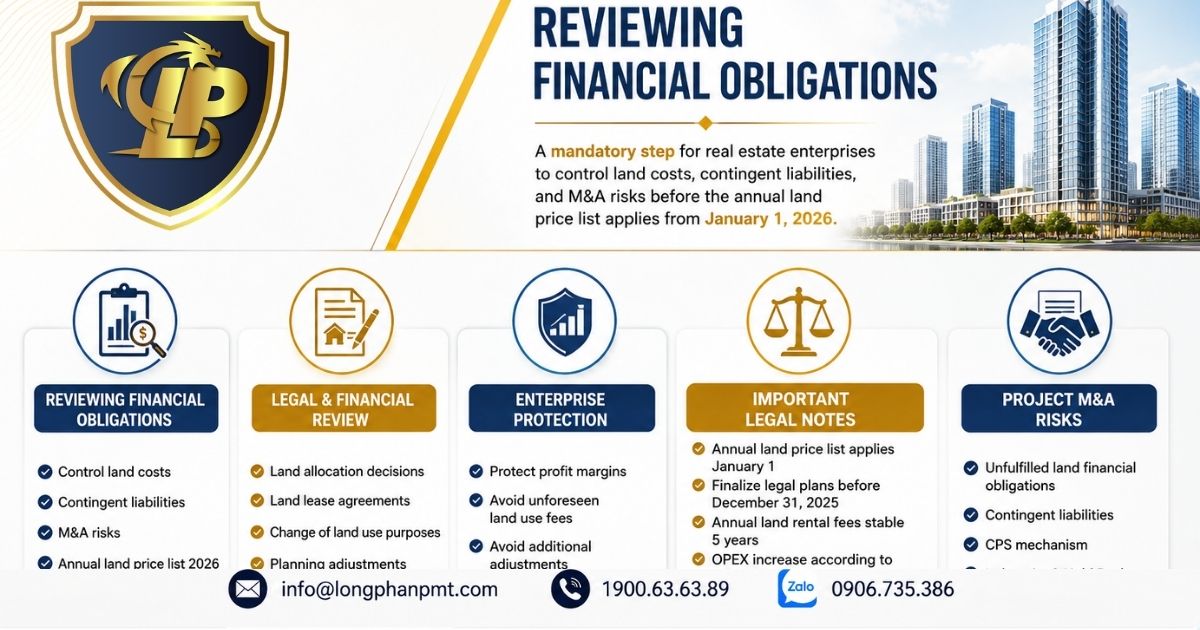
Reviewing financial obligations enables real estate enterprises to manage land costs, contingent liabilities, and M&A risks before the annual land price list takes effect on January 1, 2026. Developers, CFOs, and legal teams should compare land allocation decisions, land lease agreements, land use conversion approvals, planning adjustments, and project transfer dossiers with the Law on Enterprises and Businesses to safeguard profit margins and prevent unexpected land use fees, rental charges, or additional financial adjustments. Long Phan Consulting provides this in-depth analysis for reference.
Important legal note:
The annual construction land price list fundamentally changes how real estate enterprises formulate project budgets. Land costs are no longer variables that can be fixed long-term, particularly for projects currently awaiting land allocation, land lease, change of land use purpose, or planning adjustments.
Critical risk lies in the legal timing. The land price list is adjusted, amended, and supplemented annually for announcement and application from January 1 of the following year, as decided by the Provincial People’s Council upon submission by the Provincial People’s Committee, pursuant to Clause 1, Article 16 of Decree 71/2024/ND-CP.
| Review Content | Before Jan 1, 2026 | From Jan 1, 2026 | Governance Impact |
| Land budget foundation | Enterprises can still rely on the currently applicable price list during the transition phase. | Land price list updated via annual mechanism. | Requires updating project financial models. |
| Land allocation/lease dossiers | Prioritize finalizing procedures before local authorities apply the new price list. | Costs may fluctuate according to the new land price list. | Increased CAPEX overrun risk. |
| Annual land lease projects | Operating cash flow may remain stable during the existing cycle. | New cycle impacted by updated land price list. | Increased long-term OPEX pressure. |
| M&A project transactions | Buyers need to verify determined financial obligations. | Risk of post-closing obligations is significantly higher. | Requires Holdback and Indemnity mechanisms. |
For developers, the December 31, 2025, milestone must be viewed as a strategic audit point. Enterprises should immediately review legal land dossiers, land use fee notifications, rental obligations, and planning adjustment statuses to avoid being caught off-guard when the new price list alters cash flow.
For CFOs and M&A investors, the land price list is not merely administrative data. It is a variable directly affecting profit margins, collateral asset values, disbursement conditions, and price adjustment mechanisms within project transfer contracts.
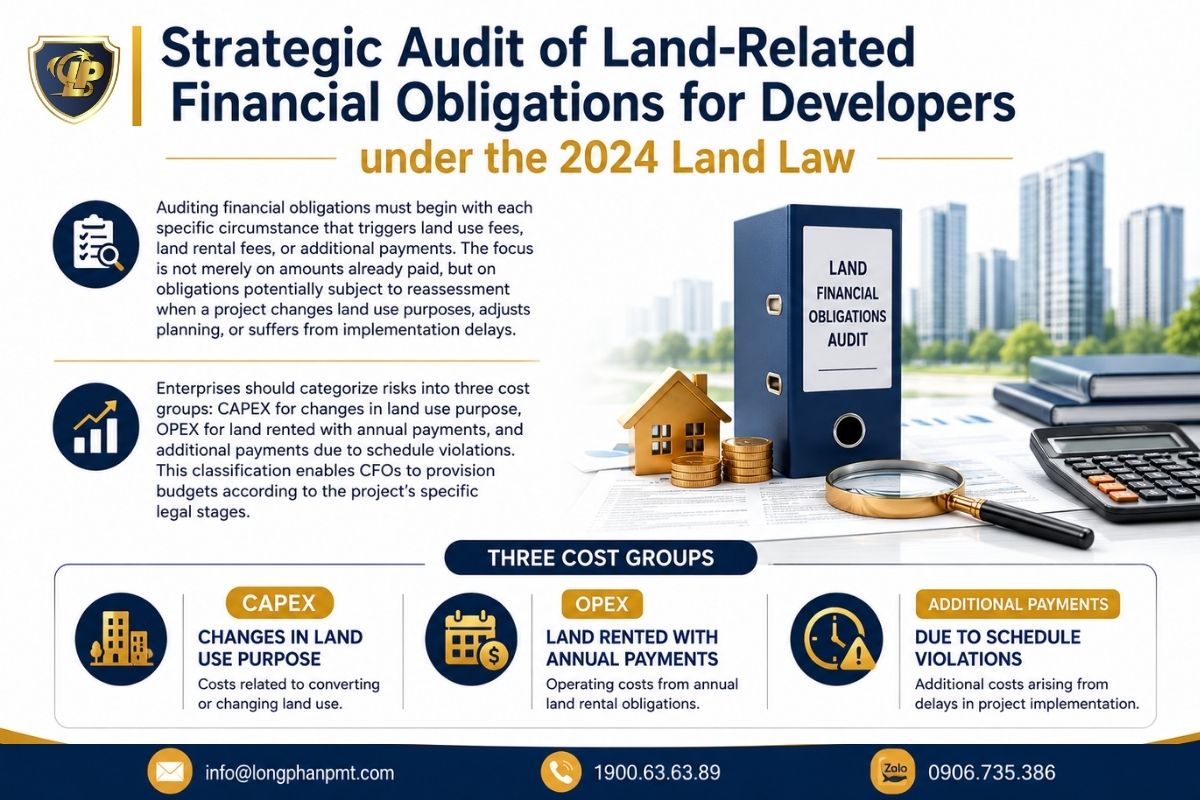
Auditing financial obligations must begin with each specific circumstance that triggers land use fees, land rental fees, or additional payments. The focus is not merely on amounts already paid, but on obligations potentially subject to reassessment when a project changes land use purposes, adjusts planning, or suffers from implementation delays.
Enterprises should categorize risks into three cost groups: CAPEX for changes in land use purpose, OPEX for land rented with annual payments, and additional payments due to schedule violations. This classification enables CFOs to provision budgets according to the project’s specific legal stages.
For commercial housing projects with mixed-use land, the cost of changing land use purposes can fundamentally alter total investment efficiency. Enterprises must calculate the differential between the land use fee after conversion and the land value prior to conversion.
Pursuant to Clause 1, Article 7 of Decree 103/2024/ND-CP, as amended and supplemented by Clause 3, Article 13 of Decree 50/2026/ND-CP, the payable amount is determined by the land use fee of the post-conversion land type minus the land use fee or land rental fee of the pre-conversion land type, with the pre-conversion land value allocated proportionately to the remaining land use term.
Land fund groups that must be independently audited before financial modeling include:
Failure to quantify this differential can lead to CAPEX overruns after capital mobilization contracts, bank loans, or M&A prices have been finalized. This is a risk that must be quantified prior to investment plan approval.
For commercial centers, services, warehouses, logistics, and industrial zones, annual land rental fees represent long-term operating costs. When land prices change annually, enterprises must re-forecast profit margins for each lease cycle.
Pursuant to Clause 2, Article 153 of the 2024 Land Law, annual land rental fees are applied stably for a 05-year cycle from the time the State decides to lease the land or permits land use purpose changes associated with annual land rental.
Financial constraints that must be reflected in sub-lease contracts include:
For revenue-generating asset groups, the risk lies not in a single payment, but in escalating OPEX across cycles while sub-lease contracts lack corresponding adjustment mechanisms.
Projects that are slow to put land into use may incur additional payments beyond the original budget. This cost is easily overlooked when developers only audit original land use or rental fees.
Pursuant to Clause 8, Article 81 of the 2024 Land Law, the law permits land use extensions of up to 24 months when the investor is behind schedule. Upon extension, the enterprise must pay an additional amount corresponding to the extension period, pursuant to Clause 1, Article 15 and Clause 1, Article 31 of Decree 103/2024/ND-CP.
The process for quantifying these additional payments should be deployed as follows:
These additional payments are non-deductible from compensation, support, or resettlement costs and are ineligible for exemption or reduction policies, pursuant to Clause 2, Article 15 and Point b, Clause 4, Article 30 of Decree 103/2024/ND-CP. If the project remains unused after the extension expires, the State may recover the land without compensation, pursuant to Clause 8, Article 81 of the 2024 Land Law.
In real estate M&A transactions, unfulfilled land financing obligations should be considered contingent liabilities. This risk can alter the purchase price, disbursement terms, transfer schedule, and post-closing liability.
Buyers need to examine the entire land record chain, not just the certificate or investment approval decision. Key documents include land allocation decisions, land lease decisions, land use fee notices, payment receipts, tax confirmations, and planning adjustment history.
In real estate M&A transactions, unfulfilled land-related financial obligations must be treated as contingent liabilities. These risks can necessitate modifications to purchase prices, disbursement conditions, transfer timelines, and post-closing indemnity responsibilities.
Buyers must audit the entire land dossier chain, not merely rely on Certificates of Land Use Rights or Investment Policy Approval decisions. Critical documents include land allocation and lease decisions, land use fee notifications, payment vouchers, tax confirmations, and the history of planning adjustments.
Land-related financial obligations serve as a rigid legal prerequisite for project transfer transactions. If the transferor has not fulfilled these obligations, the buyer risks facing transaction rejection or inheriting land debts post-transfer.
Pursuant to Clause 3, Article 40 of the 2023 Law on Real Estate Business, the investor transferring all or part of a project must fulfill land-related financial obligations to the State, including land use fees, land rental fees, taxes, charges, and fees related to the transferred land area.
Transfer dossiers must include clear financial evidence to mitigate audit risks. A written confirmation from the tax authority regarding the completion of land-related financial obligations and receipts for relevant fees and charges are mandatory dossier components, pursuant to Point h, Clause 3, Article 10 of Decree 96/2024/ND-CP.
From an investment perspective, buyers must synchronize requirements under land law, real estate business law, and investment law. Project transfer transactions must satisfy conditions stipulated by laws on land, housing, real estate business, and related regulations, pursuant to Point c, Clause 1, Article 34 of the 2025 Investment Law.
When land-related financial obligations cannot be definitively determined prior to signing, M&A contracts must translate these risks into specific commercial mechanisms. The appropriate approach involves quantifying risks, linking them to conditions precedent, and adjusting payment cash flows.
Buyers should demand the following clause groups in Share Purchase Agreements (SPA) or Asset Purchase Agreements (APA):
These clauses do not replace mandatory legal obligations. Their value lies in the financial risk allocation, protecting the buyer against land-related obligations arising after the project’s control has been transferred.
Transitional provisions are cost management tools, not merely mechanisms for processing backlog dossiers. Enterprises with projects awaiting land allocation, land use purpose changes, land valuation, or project transfers must immediately review these to select financial scenarios with lower risk profiles.
Transitional scenarios can create budgetary advantages that require proactive assessment:
The commercial value of transitional provisions lies in the right to select the timing and mechanism of application. If analysis is delayed, enterprises may miss opportunities to lock in costs, prolong late payment obligations, or decrease M&A transaction values.
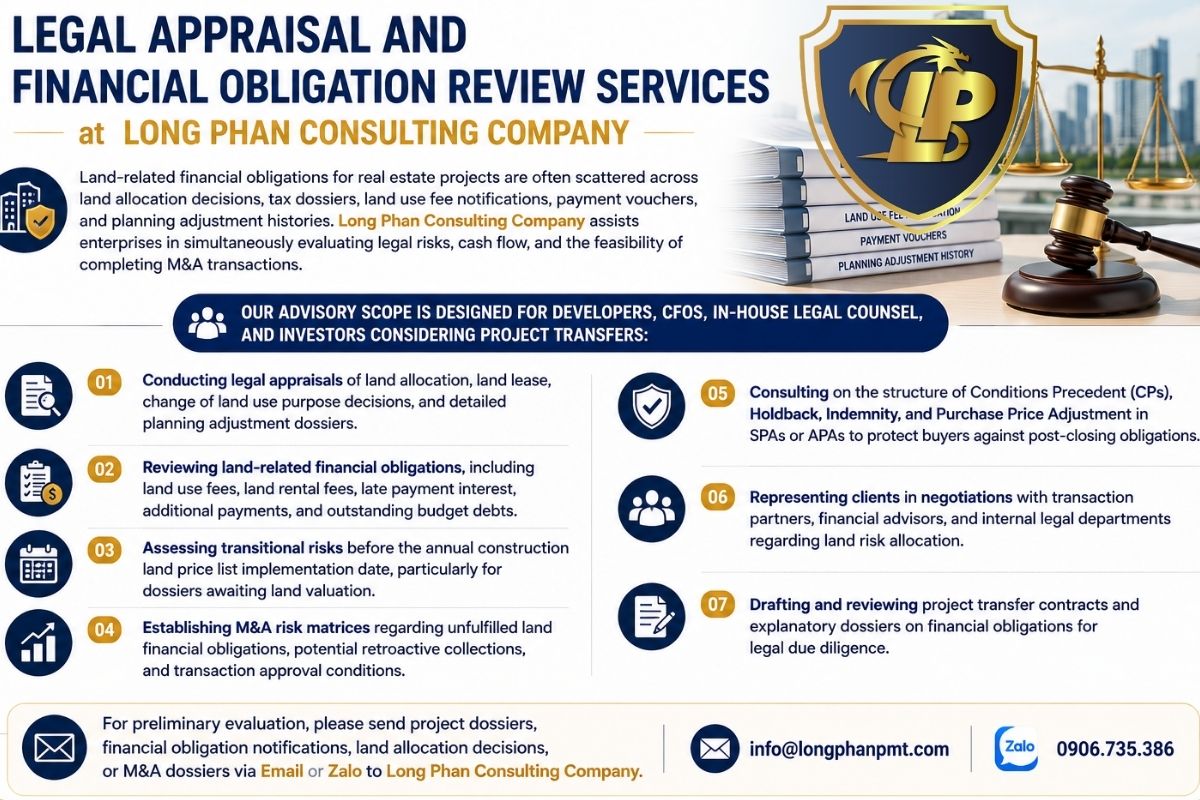
Land-related financial obligations for real estate projects are often scattered across land allocation decisions, tax dossiers, land use fee notifications, payment vouchers, and planning adjustment histories. Long Phan Consulting Company assists enterprises in simultaneously evaluating legal risks, cash flow, and the feasibility of completing M&A transactions.
Our advisory scope is designed for developers, CFOs, in-house legal counsel, and investors considering project transfers:
For preliminary evaluation, please send project dossiers, financial obligation notifications, land allocation decisions, or M&A dossiers via Email: info@longphanpmt.com or Zalo: 0906.735.386 to Long Phan Consulting Company.
The “financial obligations review” process goes beyond simply calculating basic cash flows; it also requires businesses to thoroughly address legal risks arising from transitional clauses. Changes in pricing mechanisms or potential schedule breaches can disrupt the entire acquisition structure. Investors and investment funds need to understand the guidelines for handling specific situations to maximize commercial protection.
Businesses are absolutely not allowed to deduct land compensation costs from the additional payment. For delayed projects that are granted extensions, the investor is required to pay an amount equivalent to the land use fee for the extended period. Businesses are not allowed to deduct resettlement support costs and are not entitled to any exemptions or reductions as stipulated in Clause 2, Article 15 of Decree No. 103/2024/ND-CP.
The investor is not required to have a land use right certificate for the transferred area. The core condition is that the transferor must have fulfilled all financial obligations regarding land to the State as stipulated in Clause 3, Article 40 of the 2023 Law on Real Estate Business. To prove eligibility, the transfer dossier must include a confirmation document from the tax authority stating that financial obligations have been fulfilled as stipulated in Point h, Clause 3, Article 10 of Decree No. 96/2024/NĐ-CP.
Economic organizations are not required to switch to land lease and are not required to pay additional land rent for the remaining term. If the enterprise has fulfilled its financial obligations before the new law takes effect, it may continue to use the land according to Clause 2, Article 255 of the 2024 Land Law. If the enterprise voluntarily wishes to switch to land lease, it is not required to pay land rent for the remaining land use term as guided in Clause 6, Article 51 of Decree No. 103/2024/ND-CP.
Businesses have the right to continue applying the old regulations or request implementation under the new regulations. Investors need to proactively assess the budget to choose the most advantageous pricing mechanism. The law allows for flexible processing of applications for land allocation or land use conversion that were submitted validly before the new law came into effect but have not yet received a decision, as stipulated in Clause 7, Article 255 of the 2024 Land Law.
Annual land rent does not increase continuously each year but is applied stably for a 5-year cycle. This rent is calculated from the time the State decides to lease the land according to Clause 2, Article 153 of the Land Law No. 31/2024/QH15. Specifically, the rate of adjustment of land rent for the next cycle is limited to a ceiling not exceeding the total annual consumer price index of the country for the previous 5-year period, as stipulated in Clause 2, Article 153 of the Land Law No. 31/2024/QH15.
Auditing land financial obligations for Vietnam real estate projects is a vital strategic measure to control land costs, cash flow, project transfer conditions, and contingent liabilities ahead of the new annual land pricing mechanism. To avoid significant capital overruns, retroactive tax arrears, or fractured M&A deals, developers and investors must simultaneously synchronize their audits of land use fees, rental obligations, conversion costs, and transitional regulatory dossiers. Bypassing this foundational financial and legal appraisal directly triggers disastrous profit margin erosion and operational paralysis. Secure your investment by partnering with elite legal experts at Long Phan Consulting Company. Contact our senior partners immediately via Hotline 1900636389 to engineer a resilient financial and legal strategy tailored to your specific project objectives.
📚 This article is provided with professional consultation based on the following legal framework:


