
A strategic approach to Converting a Household Business to an Enterprise should treat the process as a legal risk management decision, not merely a business expansion step. After the flat-rate tax regime is removed, high-revenue household businesses will encounter corporate-level compliance demands in Business Registration, tax reporting, e-invoices, and transparent financial data. Long Phan Consulting provides practical guidance for this transition.
Important legal note:
Household business owners need to view the transition as a risk management decision, not just a step towards expansion. When the lump-sum tax system is abolished, household businesses with high revenue will face similar pressure regarding declarations, invoices, and financial data as larger enterprises.
Maintaining a household business model while experiencing rapid growth in revenue, labor, and transactions creates severe risks of tax arrears, data discrepancies, and fractured B2B relationships. Owners must review actual revenue prior to the 2026 deadline. The flat-rate tax system for household businesses will be completely abolished, pursuant to Section III, Part 7 of Resolution 68-NQ/TW.
Early warning signals of legal risk that require immediate evaluation include:
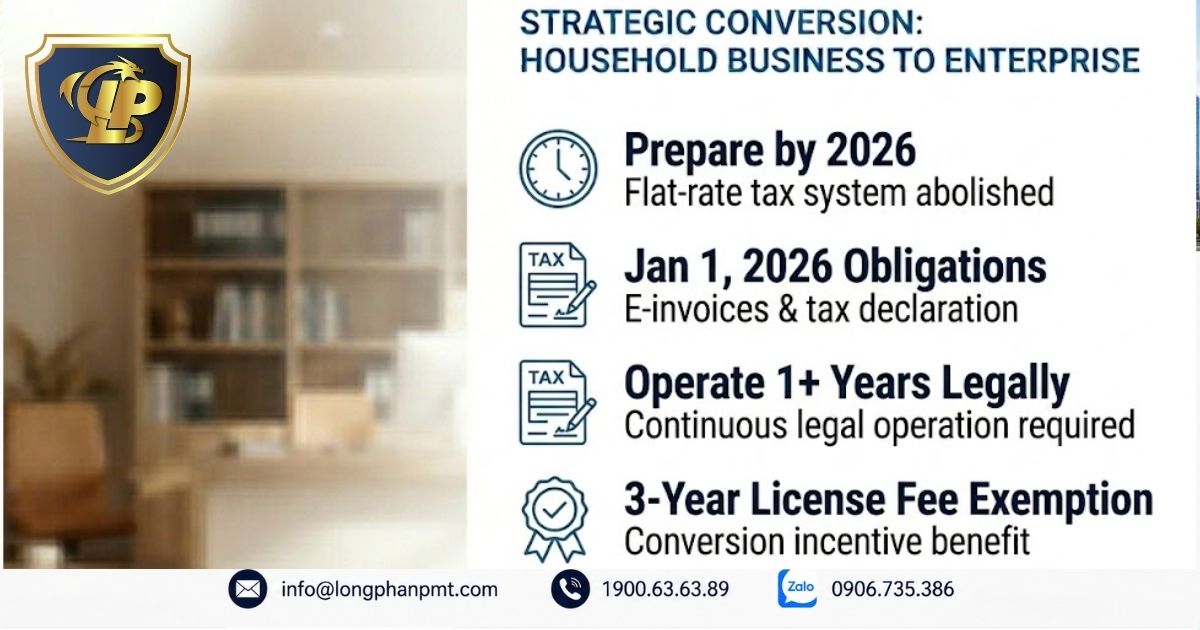
Starting January 1, 2026, regulations on tax declaration, calculation, and mandatory e-invoice usage for household businesses will take early effect, pursuant to Clause 2, Article 52 of the 2025 Tax Administration Law. Consequently, executing this transition before the deadline allows business facilities to proactively control post-conversion compliance costs.
Upon transitioning, the new enterprise must operate under a strict mechanism of tax declarations, valid vouchers, and deductible expenses. This is a significant shift from the flat-rate tax system. However, it unlocks the ability to officially record expenses, secure bank loans, sign major corporate contracts, and elevate legal credibility.
| Criteria | Pre-Conversion Household Business | Post-Conversion Enterprise |
| Accounting Regime | Typically relies on the flat-rate tax system with highly simplified bookkeeping. | Must organize a transparent accounting, voucher, and financial data system. |
| Invoices | May fail to fully meet the e-invoice demands of corporate B2B clients. | Must issue standard electronic invoices (e-invoices) when selling goods or services. |
| Tax Mechanism | Primarily tied to the flat-rate tax or simplified tax declarations. | Operates under Corporate Income Tax (CIT), VAT, and stricter declaration mechanisms. |
Enterprises are obligated to self-calculate payable taxes and declare tax dossier contents accurately and honestly, pursuant to Clause 1, Article 12 of the 2025 Tax Administration Law. When selling goods or providing services, the enterprise must issue electronic invoices matching the tax authority’s standard data format, pursuant to Point a, Clause 5, Article 26 of the 2025 Tax Administration Law.
This operational divergence increases initial compliance costs but drastically reduces legal risks as the business scales. For facilities serving corporate clients, an early conversion secures the capability to issue valid invoices, expand commercial contracts, and standardize cash flow.
Conversion is not merely “renaming” a household business into a company. Fundamentally, this is the registration of a new enterprise that inherits the operations, assets, contracts, and obligations arising from the old model.
Household owners must proactively resolve outstanding debts, contracts, and tax obligations prior to enterprise registration. The new enterprise inherits the lawful rights, obligations, and interests of the household business, but this structural inheritance does not automatically erase past liabilities.
The critical risk lies in unpaid asset obligations. When converting to a Limited Liability Company (LLC) or Joint Stock Company (JSC), the household business owner must still bear unlimited personal liability for debts incurred prior to the conversion, unless otherwise agreed with creditors, pursuant to Clause 3, Article 16 of the 2017 SME Support Law.
Therefore, before submitting the conversion dossier, the facility owner should finalize debt balances, reconcile commercial contracts, and draft obligation confirmation minutes with partners. This directly mitigates disputes regarding the liable paying entity after the new enterprise receives its Enterprise Registration Certificate (ERC).
Selecting the correct enterprise type directly dictates the level of personal asset protection. For business facilities with high revenue, numerous contracts, or fundraising demands, choosing a limited liability model is structurally safer than a private enterprise.
The fundamental differences that must be evaluated prior to conversion include:
From a post-conversion risk management perspective, a private enterprise is rarely the optimal choice if the primary objective is to separate assets and control legal liability. Owners must prioritize corporate structures aligning with their capital scale, owner headcount, specific industry, and long-term scaling plans.
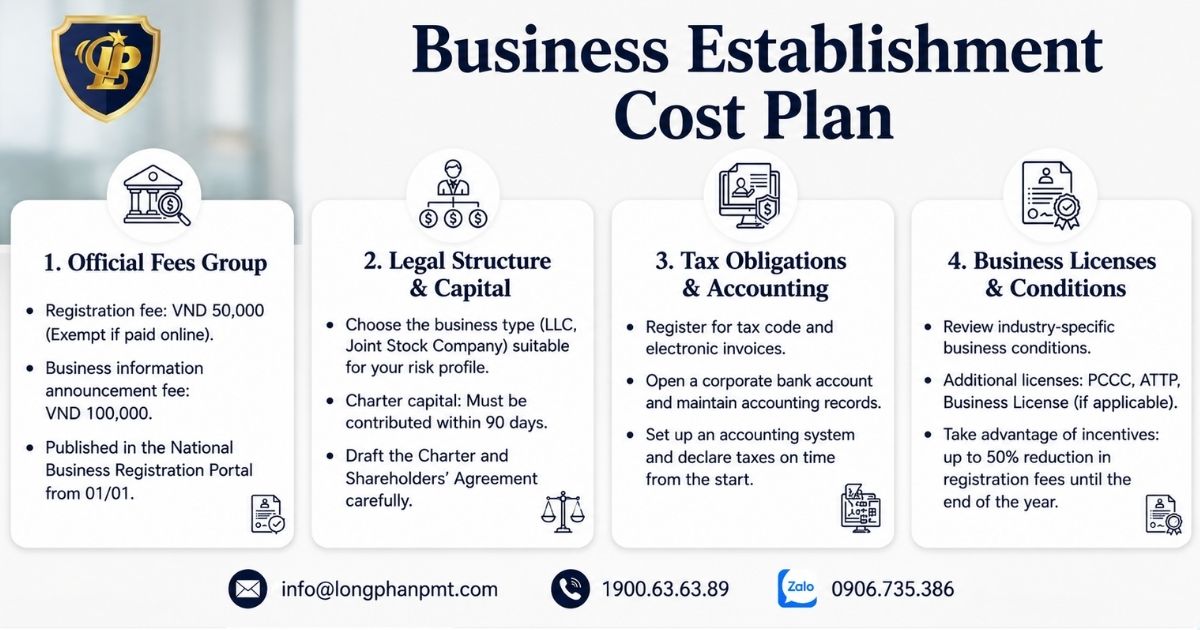
Incentives triggered when converting a household business to an enterprise act as a vital tool to reduce initial compliance costs. However, these are not automatic benefits. The enterprise must explicitly prove it satisfies the exact conversion conditions and is executing a first-time business registration.

Owners must verify conditions prior to dossier submission, rather than hastily dissolving the household business to establish a new company. If the submitted dossier fails to accurately reflect the conversion process, the enterprise risks losing its incentives and facing retroactive tax arrears.
Upon satisfying these conditions, the converted enterprise is 100% exempt from the first-time enterprise registration fee and the first-time information publication fee, pursuant to Article 16 of Decree 80/2021/ND-CP. Standardizing your original dossiers is therefore the ultimate step to protecting your entitlement to these financial incentives.
Financial incentives help new enterprises severely alleviate cash flow pressure during their initial scaling phase. However, facility owners must clearly distinguish between fee exemptions, tax exemptions, and preferential tax rates to prevent disastrous false declarations.
The primary incentive group that must be planned for from the issuance date of the Enterprise Registration Certificate includes:
If an enterprise applies incentives under incorrect conditions, heavy tax arrears and penalty obligations will immediately arise. Therefore, the conversion dossier must be comprehensively synchronized with the enterprise’s tax, accounting, and cash flow strategy right from the preparation phase.
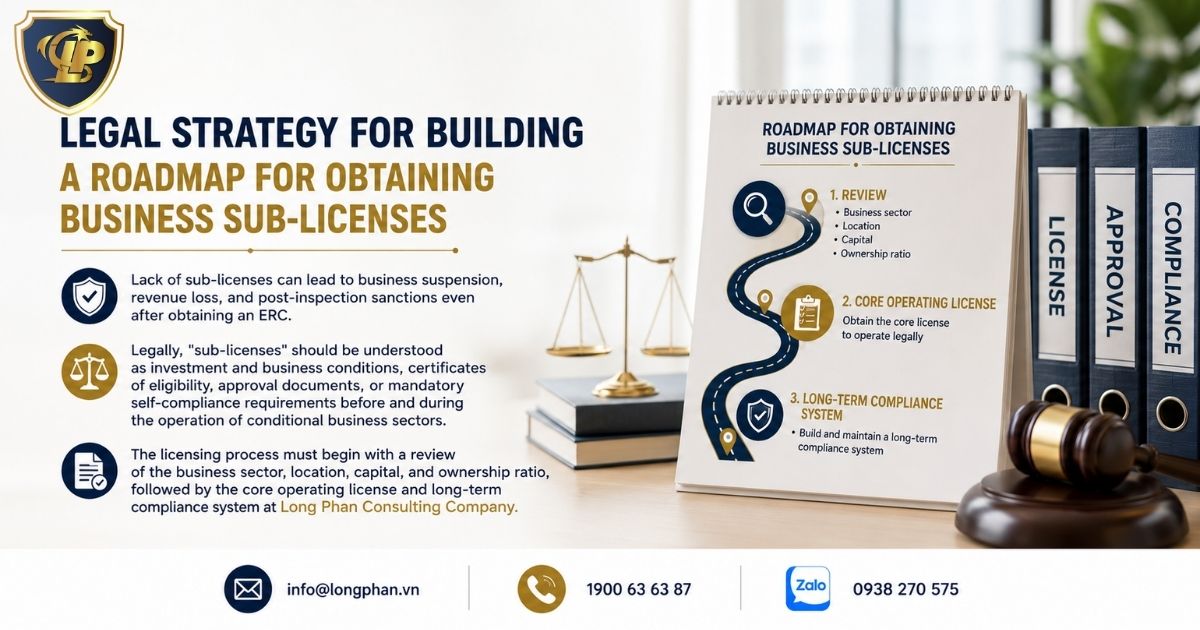
The conversion roadmap must be meticulously designed as a comprehensive legal, tax, and operational project. If a facility merely submits an enterprise registration dossier while neglecting contracts, debts, labor, and licenses, operations may face immediate disruption upon acquiring the new legal entity.
Owners must deploy procedures sequentially for risk control rather than processing dossiers in isolation. The authority to receive enterprise registration dossiers based on a conversion belongs to the Provincial Business Registration Office where the enterprise intends to locate its headquarters, pursuant to Clause 1, Article 27 of Decree 168/2025/ND-CP.
An inter-agency mechanism mitigates the risk of omitting household business termination procedures. Within 02 working days from the ERC issuance date, the Provincial Business Registration Office sends information to the commune-level business registration agency, pursuant to Point a, Clause 3, Article 27 of Decree 168/2025/ND-CP. Upon receiving confirmation of fulfilled tax obligations, the commune-level agency updates the legal status of the household business to “terminated” within 03 working days, pursuant to Point b, Clause 3, Article 27 of Decree 168/2025/ND-CP.
Post-establishment, the greatest risk stems not from the new certificate, but from the fundamental change in the business entity itself. Enterprises must review every operational asset to avoid disputes, loss of business conditions, or delivery disruptions.
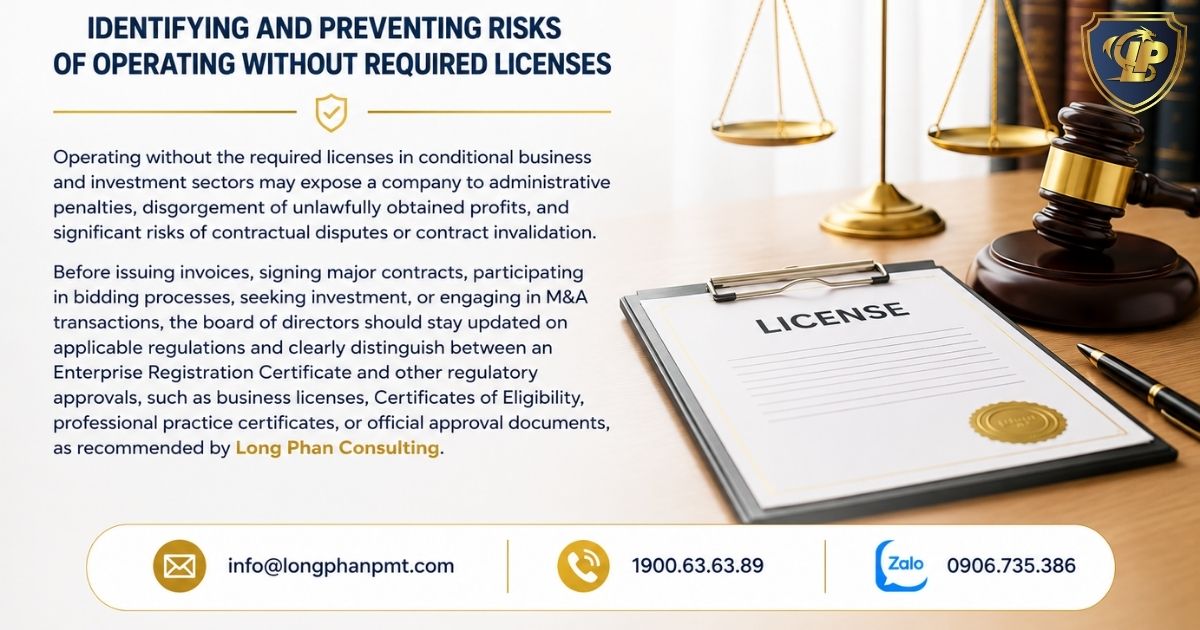
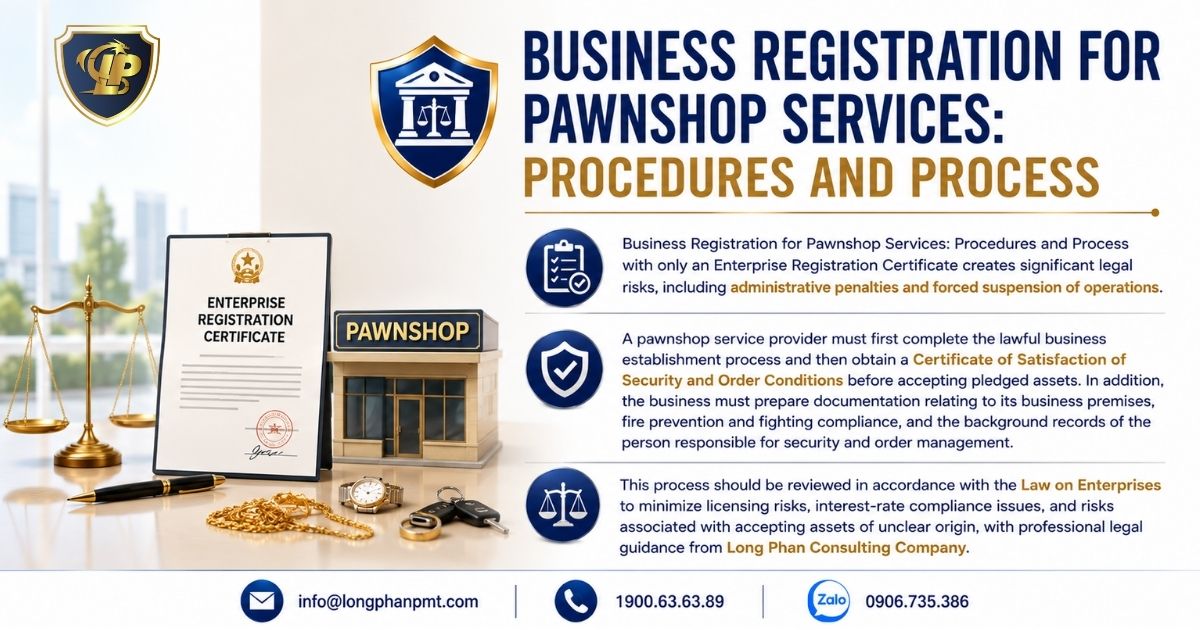
For conditional business sectors, enterprises must not automatically utilize licenses previously issued to the household business. Continuing operations when the licensed entity is no longer legally aligned triggers severe risks of administrative penalties, operational suspension, or commercial disputes with partners.
Converting a household business to an enterprise demands the simultaneous resolution of legal, tax, contract, asset, and licensing complexities. Long Phan Consulting Company assists enterprises in designing a highly secure conversion roadmap. We minimize personal asset liability risks and strictly prevent operational disruptions immediately after the new legal entity is registered.
Long Phan Consulting Company executes the following core corporate legal tasks:
To ensure a safe conversion where legal dossiers, cash flow, and tax obligations are fully standardized before operations commence, clients may send documents via Email to info@longphanpmt.com or via Zalo/WhatsApp at +84 906 735 386 for Long Phan Consulting Company to conduct a preliminary risk evaluation.

Proactively converting household businesses into enterprises helps businesses control asset boundaries and maximize financial privileges. The roadmap to eliminate the “lump-sum tax method” requires management to establish a transparent governance model right from the transition phase. The legal explanations below remove barriers regarding eligibility for tax incentives and the process of integrating new tax identification numbers.
Household businesses are not required to convert unless they wish to maintain operations after the lump-sum tax system is abolished. The roadmap for completely abolishing the lump-sum tax method for household businesses will be implemented no later than 2026. The legal basis is established in Section III, Part 7 of Resolution No. 68-NQ/TW.
Businesses must be established from household businesses that have been continuously operating for at least one year. The tax exemption is granted for two consecutive years from the date of taxable income. This support is stipulated in Clause 1, Article 16 of the Law on Support for Small and Medium-Sized Enterprises 2017. Specific details of the incentives are in Clause 4, Article 15 of the Corporate Income Tax Law 2025.
Yes, the business owner remains liable with all personal assets for outstanding debts. Unlimited liability applies to unpaid debts incurred before the conversion. Unless otherwise agreed with the creditor, this obligation complies with Clause 3, Article 16 of the Law on Support for Small and Medium-Sized Enterprises 2017.
A preferential corporate income tax rate of 15% applies to enterprises with total annual revenue not exceeding 3 billion VND. Businesses with annual revenue exceeding 3 billion VND up to 50 billion VND are subject to a 17% tax rate pursuant to Clauses 2 and 3, Article 10 of the Corporate Income Tax Law 2025.
The Economic Department of the commune-level business registration agency shall terminate the business operations of the household business within 3 working days. The processing time is calculated from the date of receiving information on the completion of tax obligations from the Tax Authority. The procedure shall be carried out in accordance with Clause 2, Article 20 and Point b, Clause 3, Article 27 of Decree No. 168/2025/ND-CP.
Businesses are exempt from business license fees for a period of 3 consecutive years from the date of initial issuance of the Business Registration Certificate. This incentive is specifically for small and medium-sized enterprises converting from household businesses. This is based on Article 18 of Decree No. 80/2021/ND-CP.
Yes, household businesses are required to apply for electronic invoices starting from January 1, 2026. The obligation to declare taxes and use electronic invoices for household businesses will be implemented early. This is stipulated in Clause 2, Article 52 of the 2025 Tax Administration Law.
Converting a household business to an enterprise is a sophisticated structural repositioning, not a mere administrative name change. It is the mandatory bridge for high-revenue facilities to circumvent the total 2026 abolition of the flat-rate tax system, professionalize e-invoice compliance, and decisively isolate personal assets from unlimited business liability. To avoid the disastrous risks of tax arrears, disqualified incentives, or fractured commercial contracts, owners must meticulously standardize their legacy obligations before the new legal entity is activated. Secure your operational continuity and optimize your long-term tax position by engineering a resilient transition. Contact Long Phan Consulting Company immediately via Hotline 1900636389 to execute your comprehensive legal conversion strategy today.
📚 This article is provided with professional consultation based on the following legal framework: