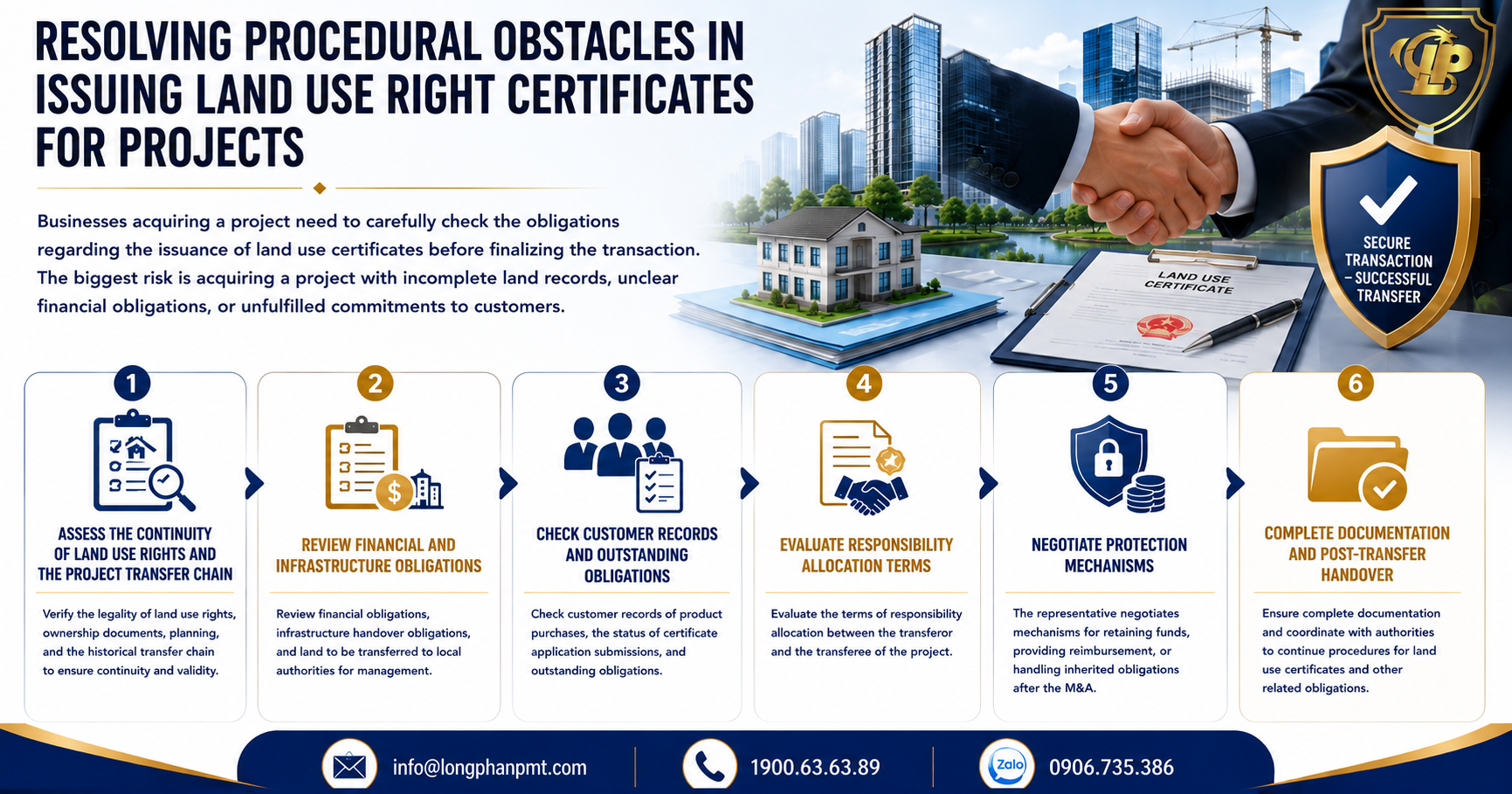
The real estate project conditions are specified in the Law on Real Estate Business 2023 and the Law on Investment 2020. Adhering to these conditions ensures a project’s legality and serves as a foundation for a company’s sustainable growth. These legal regulations establish a clear framework, requiring businesses to demonstrate financial capacity, experience, and project alignment with master plans. This analysis from Long Phan Consulting Company details these provisions.
Conditions for enterprises to implement real estate projects, including real estate project conditions.
Eligible Real Estate for Business
Current law defines the types of real estate and projects permitted for business activities. This classification helps determine a company’s scope of operations and the corresponding legal conditions. When undertaking a real estate business project, a company must accurately identify the asset type to comply with regulations on information disclosure, sales, and transfers.
Based on Article 5 of the Law on Real Estate Business 2023, the types of real estate and projects eligible for business include:
Existing houses and off-plan houses.
Existing construction works and off-plan construction works, including those for education, healthcare, sports, culture, offices, commerce, services, tourism, accommodation, industry, and mixed-use purposes.
The floor area within a construction work as defined in Clause 2 of this Article.
Land use rights with existing technical infrastructure in a real estate project.
Real estate projects.
Each type has specific requirements regarding legal dossiers and the timing of transactions. For example, a key prerequisite for off-plan housing is the completion of the foundation and a written confirmation from the provincial state management agency. This clarity allows businesses to plan their strategies and resources effectively.
Meeting Real Estate Project Conditions
For a business to execute a real estate project, the law requires it to meet conditions ranging from the legal status of the entity to the technical and legal standards of the project itself. These regulations ensure that only entities with sufficient financial capacity, experience, and legal compliance can participate in the market.
Conditions for Real Estate Businesses
According to Article 9 of the Law on Real Estate Business 2023, a real estate business entity must be established as a company or cooperative. This entity must meet the following conditions:
Must be established in accordance with the law on enterprises and have registered for the real estate business sector.
Must not be under a ban, temporary suspension, or of real estate business activities by a competent state authority.
Must have an owner’s equity of no less than 20% of the total investment capital for projects with a land use scale of under 20 hectares.
Must have an owner’s equity of no less than 15% of the total investment capital for projects with a land use scale of 20 hectares or more.
Must ensure the ability to mobilize capital to implement the project according to schedule.
Must maintain a safe ratio of credit debt and corporate bond debt to owner’s equity as prescribed by the Government.
Requirement for Investment Policy Approval
Most real estate business projects must undergo the investment policy approval procedure. This is the first legal step for a competent state agency to review the project’s suitability with planning and socioeconomic development goals. The authority for this approval is clearly delineated in the Law on Investment 2020:
National Assembly Approval Authority: Per Article 30 of the Law on Investment 2020, the National Assembly approves projects with significant environmental impacts or large-scale land use conversion requirements (e.g., nuclear power plants, projects using over 50 hectares of special-use forest land, or over 500 hectares of dual-crop rice land).
Prime Minister Approval Authority: Per Article 31 of the Law on Investment 2020, the Prime Minister approves projects such as housing and urban area construction with a land use scale of 300 hectares or more, or a population of 50,000 people or more, and projects involving casinos.
Provincial People’s Committee Approval Authority: Per Article 32 of the Law on Investment 2020, the provincial People’s Committee approves projects requesting land allocation or lease from the state without auction, and housing or urban area projects with a land use scale under 300 hectares and a population under 50,000 people.
Regulations on the authority to approve real estate business projects.
Conditions for Bringing a Real Estate Project to Market
After receiving investment policy approval, a project must still satisfy specific legal and infrastructure conditions before its products can be officially transacted.
For Existing Houses and Construction Works
According to Article 14 of the Law on Real Estate Business 2023, conditions for selling existing houses and construction works include:
Having a Certificate of Land Use Rights, Ownership of Houses, and Other Assets Attached to Land.
No disputes over land use rights or ownership.
Not being subject to distraint for judgment enforcement.
Completion of financial obligations related to land.
Public disclosure of information about the real estate as per Article 6 of the Law on Real Estate Business 2023.
For Off-Plan Houses and Construction Works
Based on Article 24 of the Law on Real Estate Business 2023, for an off-plan construction work to be put into business, it must meet these conditions:
Construction of the house or work has commenced.
Possession of one of the following land use right documents: a decision on land allocation, a decision on land lease and a corresponding lease contract, a decision permitting the change of land use purpose, or a land use right certificate.
A construction permit and its application dossier (for cases requiring a permit).
A construction commencement notice and design dossier (for cases not requiring a permit).
Documents on the acceptance of completed technical infrastructure corresponding to the project’s progress. For apartment buildings, a document certifying the completion of the foundation is required.
A written confirmation from the provincial state agency that the housing is eligible for sale or lease-purchase.
A guarantee from a commercial bank for the developer’s financial obligations.
For Land Use Rights with Existing Technical Infrastructure
According to Article 29 of the Law on Real Estate Business 2023, a project with land use rights and completed infrastructure must meet the following requirements to be put into business:
The project meets the requirements of Article 11 of the Law on Real Estate Business 2023.
The investment in and construction of technical infrastructure have been completed according to the approved detailed plan and project schedule.
The project aligns with the approved 1/500 detailed plan.
Ensured provision of electricity, water, drainage, and waste collection services, and connection to the regional public infrastructure system before transfer.
Completion of financial obligations related to land.
A written confirmation from a competent state agency confirming eligibility for transfer.
The Investment Policy Approval Procedure
This is a complex legal process requiring a complete dossier and interaction with multiple state agencies. The procedure, detailed in the Law on Investment 2020 and Decree 31/2021/NĐ-CP, typically includes these steps:
Prepare the Dossier: The investor prepares a dossier according to Article 33 of the Law on Investment 2020, including a project proposal, documents on the investor’s legal status and financial capacity, and land use proposals.
Submit the Dossier: The dossier is submitted to the competent authority (Provincial Department of Finance, Management Boards of Industrial Parks, or the Ministry of Finance, depending on the project’s scale).
Appraise the Dossier: The receiving agency gathers appraisal opinions from relevant state bodies (e.g., Department of Construction, Department of Environment). The appraisal focuses on the project’s suitability with planning, investor capacity, and socioeconomic impact.
Decide on Investment Policy Approval: Based on the appraisal report, the competent authority issues a decision. This approval is the legal basis for the investor to proceed with subsequent steps like detailed planning, site clearance, and construction permits.
To ensure safety and efficiency, businesses must manage legal risks throughout the project lifecycle. Key legal points to note include:
Information Disclosure (Article 6): Businesses must fully and truthfully disclose project information on state and company websites. Failure to do so can lead to severe penalties.
Compliance with Planning and Schedule (Article 11): The project must align with the approved detailed plan and schedule. Any deviation requires approval from competent authorities.
Financial Obligations: All financial duties related to land and taxes must be fulfilled before selling or transferring property.
Standard Contracts: Sales and lease-purchase contracts must comply with legally mandated content. Unlawful clauses can be declared void.
Bank Guarantee (Article 24): For off-plan housing sales, the developer must have a bank guarantee to protect buyers. If the developer fails to deliver on time, the bank is responsible for refunding the buyer.
Project Transfer (Article 40): Transferring a project requires strict conditions for both the transferor and the transferee, including proven financial capacity and a commitment to continue the project as approved. This transfer must be approved in writing by a competent state agency.
The issues that investors need to pay attention to when implementing a real estate business project.
Consulting Services from Long Phan Consulting Company
Executing a real estate business project demands deep legal understanding. To navigate these challenges, Long Phan Consulting Company offers comprehensive and specialized consulting services.
Our services include:
Initial Legal Consultation: Assessing project feasibility and advising on capital structure.
Investment Policy Approval Procedures: Preparing dossiers and representing clients before state agencies.
Legal Support During Project Implementation: Assisting with land allocation, lease procedures, and construction permit applications.
Consulting on Market-Entry Conditions: Ensuring the project meets all conditions for selling off-plan or existing properties.
Contract Drafting and Review: Developing compliant contract templates and negotiating with partners.
Risk Management and Dispute Resolution: Advising on information disclosure, warranty obligations, and resolving disputes.
Long Phan Consulting Company is committed to partnering with businesses throughout the project lifecycle, providing practical legal solutions to optimize processes and mitigate risks effectively.
Frequently Asked Questions
Do foreign-invested enterprises have additional conditions?
Yes. In addition to general conditions, they must comply with investment procedures for foreign investors and may face limitations on their scope of operations, such as not being allowed to acquire agricultural land for projects.
What are the developer’s housing warranty obligations?
The developer must provide a warranty. According to the Law on Housing 2023, the minimum warranty period is 60 months for apartment buildings and 24 months for individual houses, starting from the completion of construction and acceptance for use.
Can a developer mobilize capital from customers before being eligible to sell off-plan housing?
No. The developer cannot collect payments exceeding a specified percentage of the contract value according to construction progress. The first payment cannot exceed 30% of the contract value and can only be collected after the foundation is complete and confirmed by the Department of Construction.
What are the penalties for violating real estate business conditions?
Violations can result in administrative fines of hundreds of millions or even billions of VND, suspension of business activities, and mandatory remediation (e.g., refunding customers).
How does a real estate project transfer proceed?
The developer must ensure the project has an investment policy approval, a 1/500 plan, and has completed site clearance. The transferee must be a real estate business with sufficient financial capacity. The transfer requires written approval from a competent state agency.
What is the role of land use right auctions in selecting investors?
Auctioning land use rights is a transparent method for the state to allocate land. It selects the investor with the best financial capacity, ensures revenue for the state budget, and minimizes a “ask-give” mechanism.
What are the main tax obligations for a real estate business?
Key tax obligations include land use fees/rent paid to the state, Value Added Tax (VAT) on property sales or leases, and Corporate Income Tax (CIT) on profits.
How does a bank guarantee for off-plan housing work?
If a developer fails to hand over the house on schedule, the guaranteeing bank is responsible for refunding the amount the customer has paid and other amounts as per the contract.
Conclusion
The real estate project conditions constitute a multi-sector legal framework requiring strict compliance from preparation to completion. Mastering the regulations on developer capacity, investment approval procedures, and property conditions is essential. To ensure full compliance and optimize the legal process, please contact Long Phan Consulting Company for professional and effective support via hotline 1900.63.63.89.
Facebook
Linkedin
Twitter
Pinterest
Luật sư Nguyễn Thu Hương
Lawyer Nguyen Thu Huong is a leading expert in the field of investment and licensing for foreigners. With extensive knowledge of investment laws and the complex regulations related to licensing procedures, she has successfully assisted numerous businesses and foreign investors in establishing their operations in Vietnam.