
Real Estate Brokerage Process for Foreign Clients is crucial content that helps foreign buyers or investors access the Vietnamese real estate market safely and legally. In the following article, Long Phan Consulting Company analyzes the fundamental steps in the real estate brokerage process for foreign clients according to current legal regulations.

The real estate brokerage process for foreign clients begins with receiving the request and collecting the client’s basic information to determine their purpose for buying, investing, or using real estate in Vietnam.
Simultaneously, the client’s legal documents are inspected to determine whether they fall under the category permitted to own housing under current law. Early verification mitigates legal risks related to the subject’s transaction status.
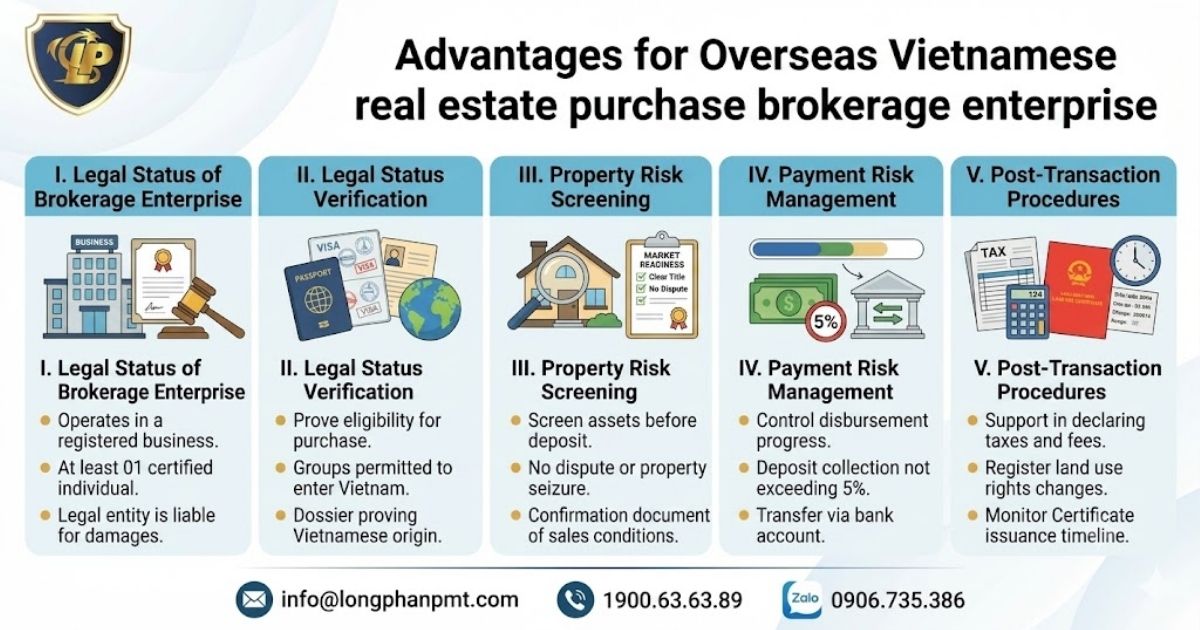
In this step, documents such as a valid passport, entry visa, or documents proving Vietnamese origin (for Overseas Vietnamese) are collected and cross-referenced to accurately determine the client’s legal status.
Based on the verified information, the client’s investment needs and financial capacity are analyzed to guide the selection of suitable real estate types, such as apartments, housing in commercial projects, or other real estate products prescribed by law. Furthermore, the client’s profile is established as either a foreign individual or a foreign organization to correctly apply the conditions, ratio limits, and ownership scope under Vietnamese law.
When participating in the Vietnamese real estate market, foreign clients must clearly understand the scope of their ownership rights over housing types and land-attached assets according to the law. Accurately identifying legal conditions ensures lawful transactions and limits risks related to ownership duration or restricted national defense/security areas.
According to Clause 2, Article 20 of the 2023 Housing Law, foreign individuals may own housing as agreed upon in transactions of purchase, lease-purchase, gift receipt, or inheritance for a maximum of 50 years from the date the Certificate is issued. This can be extended once for a period not exceeding 50 years if desired; the housing ownership duration must be clearly stated on the Certificate. Furthermore, housing purchases may only be made within commercial housing projects located outside national defense/security areas or other restricted zones stipulated by the State.
Additionally, buyers must note financial obligations arising during the transaction and ownership establishment process, including taxes, fees, and related costs under civil transaction and housing laws.
After clearly identifying the client’s needs and legal conditions, the next step of real estate brokerage process for foreign clients is to conduct a market review to select properties that suit the investment or usage objectives. The selection typically prioritizes properties with clear legal status, transparent planning information, and favorable market transaction potential.
During this real estate brokerage process for foreign clients, the property’s status is verified through relevant legal documents such as land use right certificates, completion certificates, and documents proving ownership by the developer or owner. Simultaneously, factors such as planning regulations, mortgage status, or transaction restrictions are also considered to ensure the property is eligible for transfer according to regulations.
In addition, the potential of a property is assessed through factors such as location, infrastructure, construction quality, and future usability. Criteria such as transportation systems, local amenities, building structure, and rental or appreciation potential are also analyzed to select an option that suits the customer’s needs.
Once suitable real estate is selected, the parties negotiate crucial transaction elements to agree on purchase conditions. The negotiation typically focuses on issues such as the transfer price, payment method and schedule, asset handover deadline, and the parties’ responsibilities in case of contract breach.
Agreed-upon terms may be recorded in a document such as a Memorandum of Understanding (MOU) or a deposit agreement, clearly defining payment milestones, contract execution conditions, and related obligations before the official contract is signed. Documenting this creates a clear legal basis for the subsequent transaction process.
Additionally, costs related to owning and using the real estate are considered during negotiations, including operational management fees, maintenance funds for apartments, or other arising costs as prescribed. The parties must also control the role of participating intermediaries to ensure transparency in cash flow and the legal responsibilities of each subject.

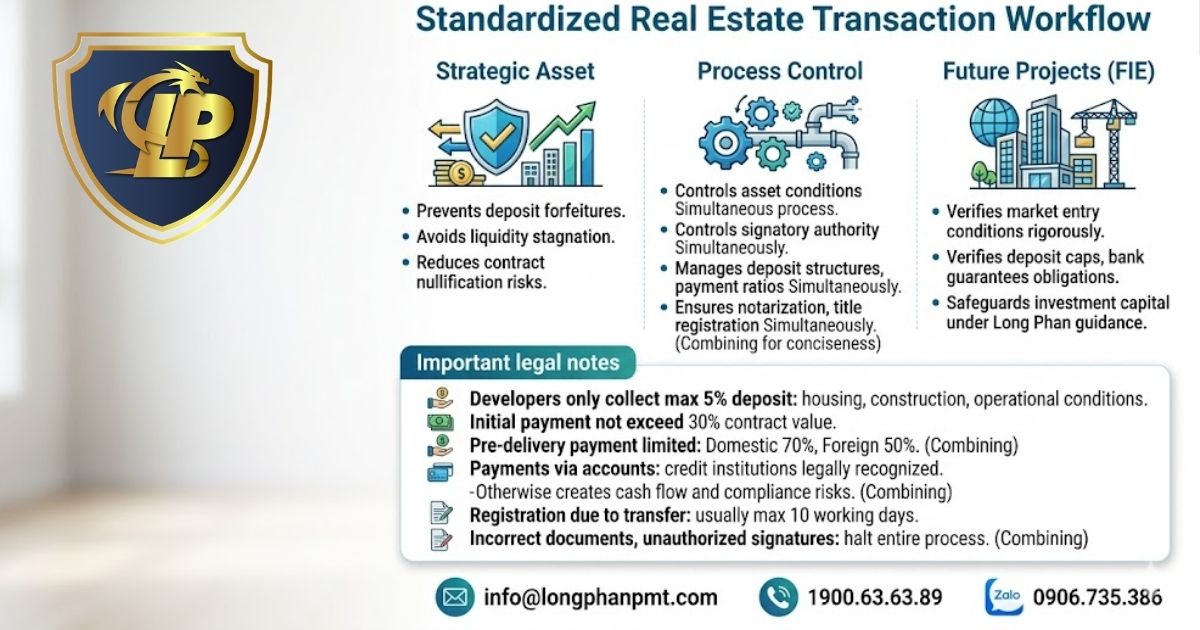
The deposit is a vital step in the real estate brokerage process for foreign clients to secure the signing and execution of the sale and purchase contract between the parties. The deposit agreement is usually established in writing to clearly define the buyer’s and seller’s commitment to proceed with the transaction within the agreed timeframe.
The deposit document typically stipulates basic contents: Transacted asset information, transfer price, deposit amount, official contract signing deadline, and breach responsibilities. These clauses create a clear legal basis to protect the rights and interests of the participating parties.
Deposit payments should be made via bank transfer or other lawful payment methods to ensure verification receipts from credit institutions. If situations such as a change of intent or force majeure events arise, the handling of the deposit and the parties’ responsibilities will be applied according to the deposit agreement and civil law.
For clients living abroad, preparing dossiers to execute real estate transactions in Vietnam must comply with regulations on consular legalization and authorization procedures. Documents drafted abroad must be certified or legalized as prescribed before use in the notarization process in Vietnam.
Pursuant to Article 13 of Decree 111/2011/ND-CP, amended by Clause 13, Article 1 of Decree 196/2025/ND-CP, executing consular certification procedures at Diplomatic Missions requires preparing the following documents:
If the client cannot be physically present in Vietnam, drafting a Power of Attorney (POA) for a representative to execute transaction-related procedures is necessary. The POA must clearly state the representative’s scope of authority, including signing contracts, submitting dossiers, and executing related legal procedures at the notary office and competent state agencies.
The real estate sale and purchase or transfer contract must be notarized at a notary practicing organization pursuant to Clause 5, Article 44 of the 2023 Law on Real Estate Business to ensure the transaction’s legal validity. Notarization confirms the contract’s legality and records the voluntary agreement of the participating parties.
Before signing, related documents such as the parties’ personal IDs, the certificate of land use rights, and other legal documents will have their originals inspected for cross-referencing. The Notary Public reviews the dossier, explains the contract’s content, and confirms that the parties understand their rights and obligations before proceeding with the signing.
After the parties sign the contract, the document is certified, stamped, and assigned a notary number by the Notary Public. The notarized dossier is archived at the notary organization and serves as the basis for executing subsequent procedures related to registering changes in land use rights and land-attached asset ownership.
>>> See more: Overseas Vietnamese Real Estate Contract Guide
Payments in real estate brokerage process for foreign clients must comply with Vietnamese law on foreign exchange management and international payments. Payments are typically made through the banking system to ensure transparency and control over the flow of funds in the transaction.
During the money transfer process in the real estate brokerage process for foreign clients, the transfer details must clearly state the purpose of the payment related to the real estate purchase or transfer contract. Conducting transactions through international payment systems helps ensure that the money transfer is carried out securely and is documented by the bank.
After the funds are transferred to the account at a domestic bank, the credit institution will confirm the transaction and carry out the payment steps as agreed upon by the parties. At the same time, factors such as foreign exchange rates, conversion fees, and international money transfer costs also need to be considered to ensure the payment process runs smoothly and in accordance with regulations.
After completing the notarization of the contract and making the agreed payment, the next step of real estate brokerage process for foreign clients is to register the change of ownership at the land registration agency to update the new owner’s information. This is an important procedure to officially record the buyer’s land use rights and ownership of assets attached to the land in accordance with the law.
The application for land registration change is submitted to the Land Registration Office or the competent authority as prescribed, along with documents such as the notarized transfer contract, land use right certificate, and other relevant documents as prescribed in Article 133 of the 2024 Land Law. After receiving the application, the competent authority will issue an appointment slip for receiving the results according to the administrative procedure.
During the document verification process, the tax authorities and the environmental and natural resources agency may check the financial obligations related to the transaction and the validity of the transferee. Once the documents are valid and the financial obligations have been fulfilled, the transferee’s information will be updated in the Land Use Right Certificate as prescribed.
During the transfer of land use rights and housing ownership, parties must fully fulfill financial obligations prescribed by law before completing the title transfer procedure. Declaring and paying taxes is a necessary condition for state agencies to execute change registrations and update the new owner’s information on the Certificate.
Pursuant to Article 24 of the 2025 Personal Income Tax Law (effective July 1, 2026), income from real estate transfers is subject to Personal Income Tax (PIT) at a rate of 2% of the transfer price recorded in the contract. Furthermore, the transferee must pay a registration fee when registering ownership, collected at 0.5% of the asset’s value under Clause 1, Article 8 of Decree 10/2022/ND-CP.
The base value for calculating taxes and registration fees is determined based on the contract transfer price or the land price table issued by state agencies, depending on the specific case under Clause 1, Article 7 of Decree 10/2022/ND-CP (amended and supplemented by Decree 175/2025/ND-CP). After declaring and paying taxes/fees at the tax agency, the taxpayer receives a state budget payment receipt to serve as the basis for continuing the title transfer registration procedure.
>>> See more: Real estate deposit procedure for overseas Vietnamese
After completing all legal procedures and financial obligations, the parties proceed with the physical handover of the real estate as agreed in the contract. This is the final step in the real estate brokerage process for foreign clients, serving to confirm the transfer of the asset’s management and usage rights from the seller to the buyer.
During the handover, the asset’s current state is inspected to ensure it matches the agreed content, covering items such as electrical and water systems, technical equipment, auxiliary works, and the property’s finishing level. Simultaneously, land-attached assets like furniture, equipment, or related warranty documents are inventoried and handed over.
The handover is usually recorded in a minute to document the asset’s condition at the time of transfer, alongside items like keys, access codes, or related usage rights. Upon completing this step, the buyer officially receives and manages the asset according to their established ownership rights.

Long Phan Consulting Company provides in-depth advisory services to assist foreign clients in executing real estate transactions in Vietnam safely and in accordance with legal regulations. With a team of experts experienced in land, housing, and civil transactions, we help clients control legal risks throughout the entire process from property searching and contract signing to finalizing title transfers. We structure our professional support into the following key area:
Below are some frequently asked questions about the real estate brokerage process for foreign clients; please refer to them:
No. Foreigners are only allowed to buy houses in commercial housing projects that are permitted to be sold to foreign organizations and individuals, and are not located in areas designated for national defense or security, or other restricted areas as stipulated by competent state authorities.
(Legal basis: Point b, Clause 2, Article 17 of the Housing Law 2023)
Foreign organizations and individuals as stipulated in points b and c of Clause 1, Article 17 of the 2023 Housing Law are only allowed to buy, lease-purchase, receive as gifts, inherit, and own no more than 30% of the number of apartments in a condominium building. If it is a detached house, including villas and townhouses, then in an area with a population size equivalent to a ward, they are only allowed to buy, lease-purchase, receive as gifts, inherit, and own no more than 250 houses.
In cases where an area has a population equivalent to a ward and there are many apartment buildings, or for individual houses on a street, foreign organizations and individuals may purchase, lease-purchase, receive as gifts, inherit, and own no more than the number of apartments or individual houses stipulated in Clause 1, Article 17 of the 2023 Housing Law.
(Legal basis: Article 19 of the Housing Law 2023)
No, foreign individuals are only allowed to buy or lease-purchase housing from developers of housing construction projects or to buy housing from foreign individuals who already own housing in Vietnam. You are not allowed to directly purchase townhouses owned by Vietnamese individuals outside of permitted commercial housing projects.
(Legal basis: Point b, Clause 2, Article 17 of the Housing Law 2023)
Payment in real estate transactions and projects is determined by agreement between the parties in the contract and complies with legal regulations. Project developers, real estate businesses, and real estate service businesses receive payments from customers according to real estate business contracts and real estate service contracts through accounts opened at domestic credit institutions or branches of foreign banks legally operating in Vietnam.
(Legal basis: Article 48 of the 2023 Law on Real Estate Business)
In the case of a foreign individual marrying a Vietnamese citizen residing in Vietnam, they are entitled to own housing and have the same rights as a homeowner as Vietnamese citizens.
In the case of a foreign individual marrying a Vietnamese citizen residing abroad who is permitted to enter Vietnam, they are entitled to own housing and have the same rights as a homeowner as Vietnamese citizens residing abroad.
(Legal basis: Point c, Clause 2, Article 20 of the Housing Law 2023)
For foreign individual owners, they are allowed to rent out their houses for purposes not prohibited by law, but before renting out the house, the owner must notify the housing management agency of the district, town, or city under the provincial or centrally-governed city (hereinafter referred to as the district level) where the house is located in writing, as stipulated by the People’s Committee of the commune level, and must pay taxes on the rental income.
(Legal basis: Clause 2, Article 21 of the Housing Law 2023, Clause 3, Article 9 of Decree 140/2025/ND-CP)
Foreign individuals are only permitted to receive housing as gifts within commercial housing development projects that are legally permitted to be owned. If gifted property outside of these areas, you will only be entitled to the value of the property through sale or authorized sale.
(Legal basis: Clause 2, Article 17 of the Housing Law 2023)
Applying a professional real estate brokerage process for foreign clients helps buyers access project information and execute transactions remotely and safely. The brokerage process executed by Long Phan Consulting Company guarantees optimal protection of your legal rights. For detailed advice on real estate investment in Vietnam, please contact Hotline 1900636389 for direct support.
>>> See more: Conditions for overseas Vietnamese to buy property in Vietnam