
The Product Regulation Conformity Certification procedure is a mandatory legal process for many types of products before they are allowed to circulate on the market. It serves as the basis for assessing a product’s compliance with national technical regulations, ensuring safety for consumers and the environment. This article provides an overview of the process and legal requirements related to this procedure.

According to Decree 74/2018/NĐ-CP, products classified as Group 2—those posing a risk to human health and the environment—are subject to mandatory regulation conformity certification. The specific lists are managed by various government ministries:
To determine if a product belongs to Group 2, businesses must consult the list of Group 2 products and goods specified in the circulars issued by the relevant ministry. Each ministry publishes a list of products under its jurisdiction, including HS codes, product names, risk levels, and corresponding management forms.
For Group 2 products, undergoing the Product Regulation Conformity Certification and declaration process is not only a mandatory legal requirement but also a foundation for ensuring consumer and environmental safety and enhancing transparency in market circulation.
Regulation conformity certification bodies apply 8 assessment methods according to Article 5 of Circular 18/2012/TT-BKHCN. The chosen method must be appropriate for the product’s nature and is specified on the certificate of conformity. The application procedure must adhere to the designated assessment method.
The 08 certification methods include:
Selecting the appropriate conformity certification method is a key part of the product conformity assessment process. The certification body and the enterprise must coordinate to determine the correct method, ensuring the product is assessed objectively, in compliance with regulations, and legally certified.

Organizations and individuals needing Product Regulation Conformity Certification must complete two mandatory procedures: registration for conformity certification and declaration of certification results.
The dossier for conformity certification registration depends on whether the product is domestically produced or imported.
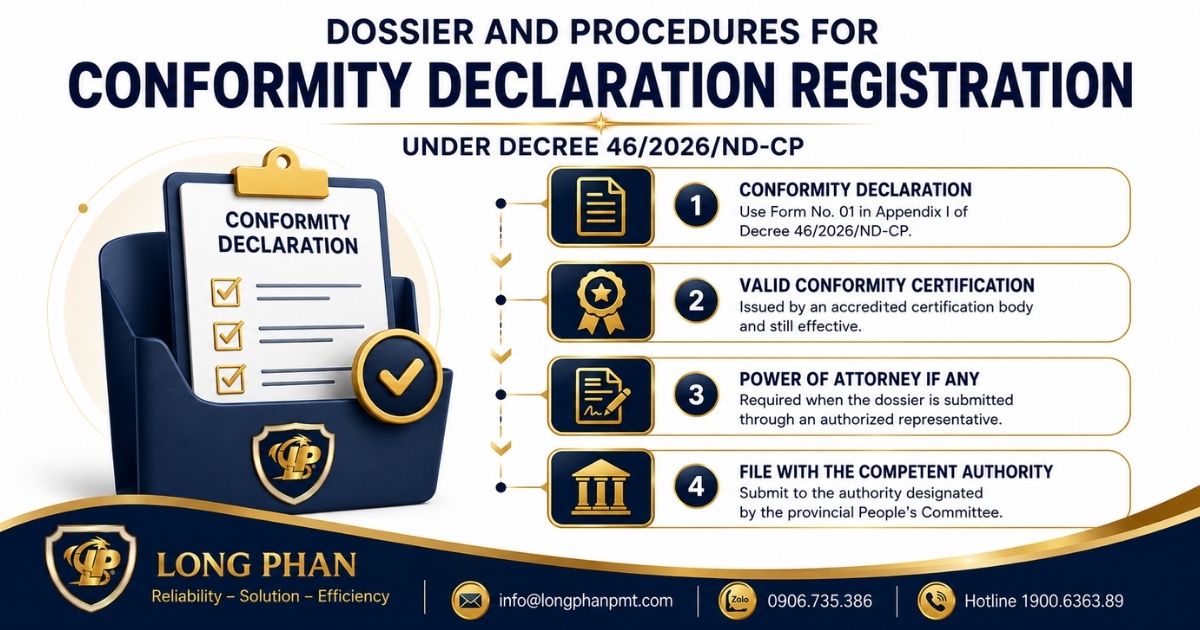
After completing the registration and receiving the assessment results, the facility prepares a dossier for declaration of conformity, which includes:
Enterprises with Group 2 products must follow the certification and declaration procedure. The specific steps are:
Step 1: Select a Suitable Regulation Conformity Certification Body Businesses must choose a certification body appropriate for their product sector. This can be a designated body appointed by the government or an accredited body recognized by reputable organizations for broader certification capabilities.
Step 2: Submit the Certification Dossier The business submits the dossier to the designated certification body or competent authority. The dossier review period is 03 working days. If incomplete, the receiving body will request supplementation.
Step 3: Product Assessment and Testing The certification body reviews the dossier and plans the inspection and testing. Samples are taken according to regulations and sent to an accredited laboratory for technical testing. Test results are the primary basis for issuing the Certificate of Conformity. On-site assessment at the production facility may be required.
Step 4: Issuance of the Certificate of Conformity Upon successful test results and meeting all conditions, the certification body issues the Certificate of Conformity for the product.
Step 5: Submit the Declaration of Conformity Dossier The business submits the declaration of conformity dossier to the competent authority (Sub-department of Standards, Metrology, and Quality). The processing time is 05 working days from receipt of a complete and valid dossier. If the dossier is invalid, the authority will notify the business to supplement it within 03 working days. If not supplemented within 15 working days, the application may be canceled.
Step 6: Affix the Conformity Mark and Launch the Product After receiving the Notice of Receipt, the business is permitted to affix the conformity mark (CR mark) to the product and circulate it on the market. The certificate’s validity is specified on the document itself.
This systematic Product Regulation Conformity Certification procedure ensures products meet all technical requirements before market entry, enhancing business reputation and ensuring legal compliance.
>>> See more procedures for some detailed products:

The Product Regulation Conformity Certification procedure is a critical legal process. To ensure compliance, businesses must prepare a complete dossier, select the appropriate certification method, and coordinate with a designated certification body.
Long Phan Consulting Company offers a professional, all-inclusive service to help businesses navigate this process efficiently. Our service includes:
With solid experience and expertise, Long Phan Consulting Company partners with businesses throughout the certification process, saving time and costs and ensuring products reach the market legally and safely.
Determining if a Product Requires Mandatory Certification: The most accurate method is to cross-reference the product’s name and HS code with the Group 2 goods list issued in the circulars of the relevant managing ministry. A match confirms that certification is mandatory.
Cost and Timeframe for Regulation Conformity Certification: Cost and time depend on product complexity, the applicable technical regulation, the number of tests required, the chosen certification method, and the certification body’s fees. The process typically takes 2-4 weeks or longer, excluding time for corrective actions if needed.
Difference Between Regulation Conformity and Standard Conformity: Regulation conformity certification is mandatory, confirming a product meets a national technical regulation (QCVN) related to safety, health, and the environment. In contrast, standard conformity certification is voluntary, confirming a product meets a standard (TCVN, ISO, etc.) to affirm quality and enhance reputation.
Selecting the Appropriate Certification Method: The choice depends on the product and business model. For instance, Method 7 (Testing and assessment of a product shipment) is common for imported goods in lots. Method 5 (Typical sample testing and assessment of the production process) suits stable, mass-production facilities. The certification body will advise on the optimal method.
Handling Non-Conforming Test Results: If test results fail, the certification body will issue a notice of non-conformity. The business must take corrective actions, improve the product or process, and then re-apply for testing.
Validity and Renewal of the Certificate of Conformity: The validity period is typically 1 to 3 years and is stated on the certificate. Before expiration, the business must apply for a re-assessment. The renewal process is similar to the initial certification but may be streamlined if there are no significant changes to the product or production process.
The Conformity Mark (CR Mark) and Its Usage: The Conformity of Regulations (CR) mark is a symbol indicating the product has completed the certification and declaration of conformity procedure. The CR mark must be displayed clearly and recognizably on the product, its packaging, or accompanying documents.
The Product Regulation Conformity Certification procedure requires a deep understanding of legal regulations and practical experience. Long Phan Consulting Company is committed to helping businesses complete this licensing procedure quickly and effectively. For detailed advice on product lists, dossiers, and the certification process, contact our hotline at 1900 636389 for dedicated support.