
Procedures for Overseas Vietnamese authorizing real estate transactions in Vietnam are executed based on the regulatory system of the 2024 Land Law and the 2024 Notary Law. This process requires meticulous preparation of legal dossiers and authentication at competent agencies. In the following article, Long Phan Consulting Company provides detailed guidance to help you successfully execute the procedures for overseas Vietnamese authorizing real estate transactions in Vietnam.

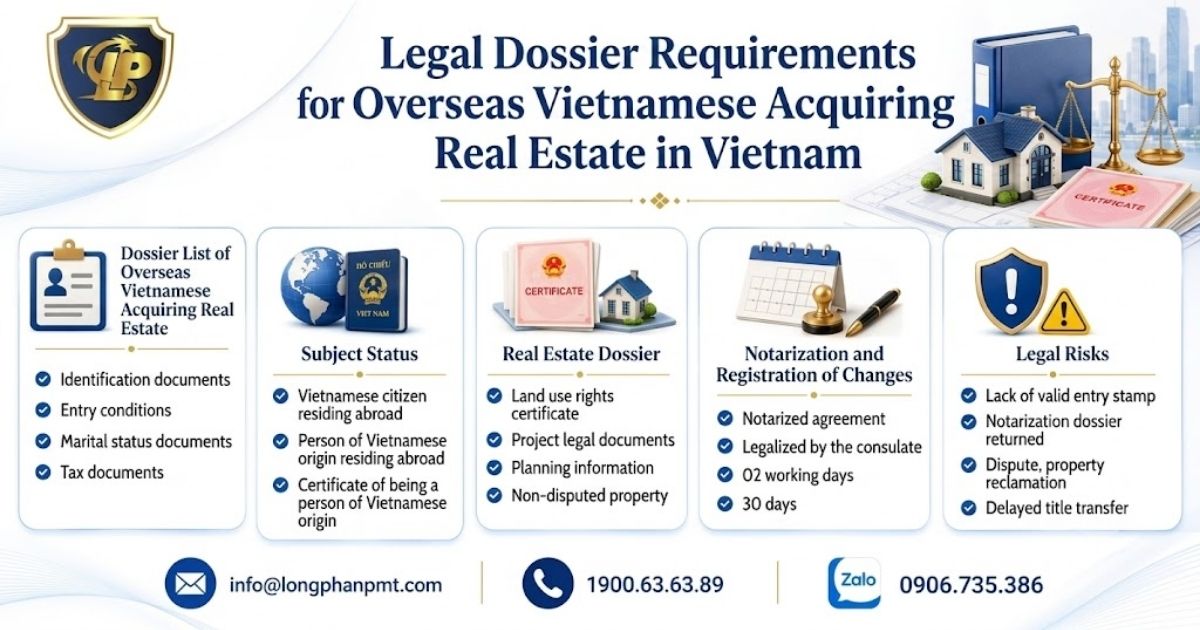
The dossier components decisively determine the legality of the entire real estate transaction process conducted through a representative. You must clearly distinguish between documents proving subject capacity and documents directly related to the authorization content. The omission of any document in the prescribed list can lead to the functional agency rejecting the dossier or requesting supplements, causing execution delays.
To execute the authorization procedure, proving the right to own real estate in Vietnam is a prerequisite. Current legal regulations clearly distinguish the required documents based on the authorizing person’s nationality status. This ensures that only legally permitted subjects can participate in real estate transactions, protecting the lawful rights of related parties.
>>> See more: Real Estate Power of Attorney in Vietnam Guide
To execute the authorization, real estate-related documents are indispensable. Comprehensive and accurate preparation of these documents provides the authorized person with the basis to execute related procedures. This acts as evidence of the asset’s information and status, ensuring the authorizing person’s rights during the transaction.
The process of executing an authorization to buy real estate must comply with current laws, specifically the 2015 Civil Code and the 2024 Notary Law. For Overseas Vietnamese, this is usually done through an authorized person in Vietnam.
Currently, Article 138 of the 2015 Civil Code explicitly states: “Individuals and legal entities may authorize other individuals and legal entities to establish and perform civil transactions.” This regulation allows individuals to authorize others to execute civil transactions, including buying/selling real estate and processing the Red Book. To authorize a purchase and have the Red Book issued in your name, the procedures for overseas Vietnamese authorizing real estate transactions in Vietnam follows these specific steps:
Step 1: Prepare Necessary Dossiers
Collect all documents prescribed by law:
Step 2: Draft the Authorization Document
The authorization document is the core of this transaction. Ensure the content is:
Step 3: Notarize the Authorization Document
If you are present in Vietnam, the document is notarized at a competent Notary Office or Notary Public Office. The Notary Public will check the parties’ IDs and the document’s content before notarizing, confirming the signatures and lawful content.
Step 4: Execute Transactions and Procedures in Vietnam
The authorized person will use the notarized document to represent you in executing the purchase and related procedures, including:

For Overseas Vietnamese who wish to execute an authorization but cannot return to Vietnam, performing the procedure at a Vietnamese Diplomatic Mission or Consulate abroad is the solution. This ensures the document’s legality and facilitates domestic transactions for expatriates.
Step 1: Draft the Authorization Document
Draft a document clearly stating the authorized contents (signing contracts, submitting Certificate dossiers, related procedures). Utilizing professional drafting services ensures validity under the 2015 Civil Code.
Step 2: Submit Dossiers and Authenticate at the Mission/Consulate
Bring the dossier to the Vietnamese Embassy or Consulate where you reside. A consular or diplomatic officer will authenticate the document.
Note: Under Article 73 of the 2024 Notary Law, these agencies may only authenticate authorization documents; they cannot directly notarize real estate transfer contracts in Vietnam.
Step 3: Mail the Authorization Document to Vietnam
Safely and timely mail the authenticated document to your authorized representative in Vietnam.
Step 4: The Authorized Person Executes Procedures in Vietnam
Upon receipt, the representative will act on your behalf to:
>>> See more: Authorizing real estate sales for Overseas Vietnamese
Establishing authorization content requires detail and foresight regarding practical situations arising in real estate transactions. You must clearly define the authority granted to prevent abuse of power or actions contrary to your will. Elements such as operational costs, validity periods, and document formats must be clearly agreed upon and recorded in writing to maximize economic protection and prevent future legal claims.
The scope of authorization is the core content. You must clearly and specifically define the rights granted to ensure the representative does not exceed their authority. The scope may include:
Under the 2015 Civil Code, the form can be a Power of Attorney (POA) (unilateral) or an Authorization Contract (bilateral). The choice affects the parties’ rights and obligations.
Agreeing on remuneration is a key element that must be clearly stipulated in the authorization document or contract to ensure the representative’s lawful rights and maintain a clear relationship. Remuneration can take various forms:
The duration is a mandatory clause that must be specifically determined to avoid disputes over when obligations end. The duration can be defined as:
If not specifically stipulated, the authorization remains valid until terminated as prescribed by law (e.g., unilateral termination under the 2015 Civil Code).
>>>See more: Do the authorization contracts need to be notarized or authenticated?
Despite meticulous preparation, disputes may arise. Clearly stipulating a dispute resolution mechanism is an effective risk-prevention measure. Common forms include:
At Long Phan Consulting Company, we provide an in-depth system of solutions to help you execute real estate transactions in Vietnam as safely and efficiently as possible. Our expert team will handle complex administrative barriers on your behalf. We structure our professional support into the following key area:

Below are frequently asked questions regarding the procedures for overseas Vietnamese authorizing real estate transactions in Vietnam. We invite interested customers to refer to this information.
Yes, however, the scope of authority of a foreign authorized representative will be limited by their legal capacity and the conditions of their real estate ownership in Vietnam.
Based on Article 138 of the 2015 Civil Code, you have the right to choose an individual as your representative. However, to ensure enforceability when signing at the Land Registration Office, the authorized person should be a Vietnamese citizen with full legal capacity to avoid complex explanations regarding the ownership conditions of foreigners as stipulated in Article 4 of the 2024 Land Law.
While not mandatory, it is extremely necessary to protect your financial interests. According to Article 562 of the 2015 Civil Code, the content of the authorization is agreed upon by the parties; clearly stating the minimum selling price or the maximum buying price helps prevent the representative from arbitrarily deciding on the price, which could cause financial losses.
The law does not specify a maximum time limit but prioritizes the agreement of the parties. According to Article 563 of the 2015 Civil Code, unless otherwise agreed and the law provides otherwise, the power of attorney contract is valid for one year from the date of establishment of the authorization.
Yes, but only in two specific cases stipulated in Article 564 of the 2015 Civil Code: with your consent or due to force majeure events where the purpose of the transaction cannot be achieved without re-authorization. The re-authorization must be in writing and must not exceed the scope of the original authorization.
You have the right to unilaterally terminate the power of attorney contract at any time, but you must notify the authorized party and any third parties (if any) in writing. According to Article 569 of the 2015 Civil Code, if the power of attorney is for a fee, you must pay the fee corresponding to the work performed and compensate for damages; if there is no fee, you must still give the authorized party reasonable notice.
There are differences in the required documents proving eligibility. You need to provide a Certificate of Vietnamese Origin as stipulated in Article 4 of the 2008 Vietnamese Nationality Law and Article 3 of Decree 95/2024/ND-CP. This document serves as the basis for the notary public to determine that you are eligible to own housing and land use rights in Vietnam as a citizen, in accordance with the new spirit of the 2024 Land Law.
No, the authorized representative only acts on your behalf to carry out the procedures; the person named on the Certificate must be you. According to Clause 1, Article 139 of the 2015 Civil Code, the representative establishes and executes civil transactions for the benefit of the represented party. Therefore, all rights regarding land use and house ownership must be recorded for you – the actual owner of the property.
Procedures for overseas Vietnamese authorizing real estate transactions in Vietnam require absolute precision regarding dossiers and execution sequences. Long Phan Consulting Company is committed to accompanying you in protecting your assets and enforcing your legal rights in your homeland.
For swift and in-depth consulting support on procedures for overseas Vietnamese authorizing real estate transactions in Vietnam, please contact us directly via Hotline 1900636389 for timely answers.