


Obtaining a permit for office buildings may disrupt project schedules and projected cash flow when investment approvals, land documents, planning records, and technical designs are not coordinated at the preparation stage. Accelerating the licensing process requires a complete and consistent dossier for Grade I construction projects, parallel implementation of fire safety and environmental procedures, and regular review of Legal Updates concerning the proposed 10-working-day processing mechanism for valid applications.
Since the permit generally requires construction to commence within 12 months, Long Phan Consulting supports enterprises in developing a structured licensing roadmap, controlling procedural risks, and aligning approval timelines with project execution plans.
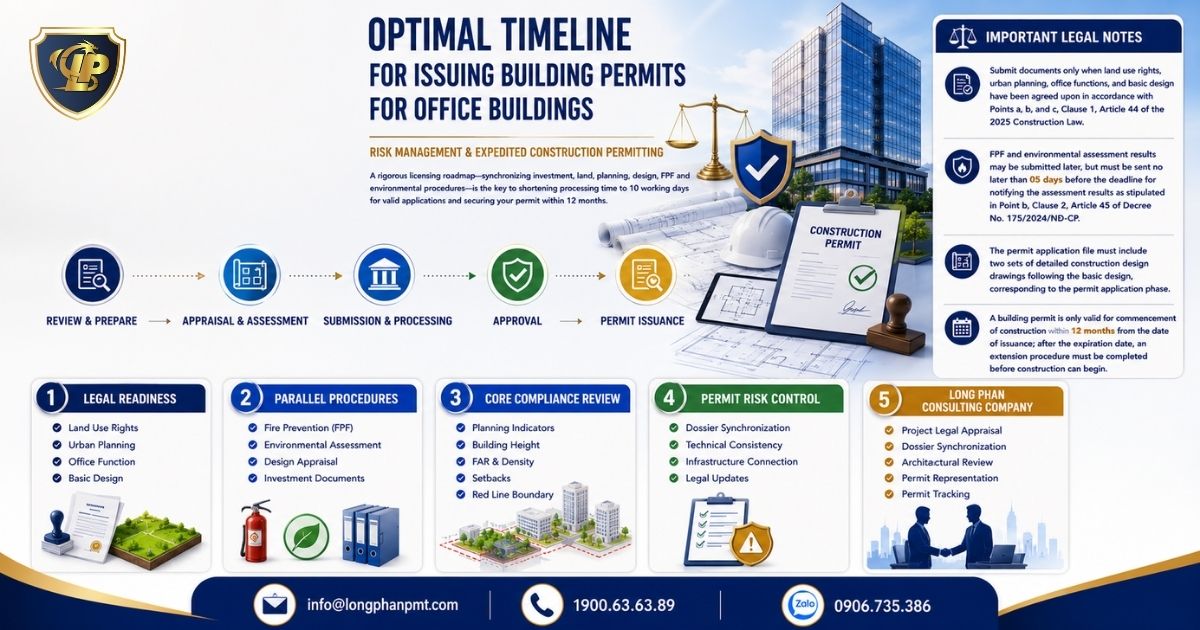
Key legal notes:
Enterprises should refrain from submitting permit applications before verifying the legal status of the land, urban planning, and building functionality. For large-scale office projects, discrepancies arising during the preliminary check phase can render a technically complete design dossier ineligible for submission.
Pursuant to Points a, b, and c, Clause 1, Article 44 of the 2025 Law on Construction, for Grade I construction projects, the permitting authority simultaneously assesses land use rights, urban planning, structural safety, environmental compliance, and fire prevention and fighting (FPF) standards.
Key prerequisites requiring review before dossier preparation include:
If these three groups of conditions are not cross-checked, early dossier submission will not expedite the process. Conversely, the enterprise may incur additional time costs for design revisions, planning explanations, or re-processing the investment dossier.
The primary inspection point is the consistency between land use rights, land use purposes, and the intended office functionality. Enterprises must reconcile land documentation with the zoning plans, detailed plans, and architectural indicators applicable to the project site.
Regarding land, the investor must ensure legal land use rights and usage in accordance with the approved purpose. Encroachment or evasion of financial obligations serves as a direct barrier to permit issuance, pursuant to Article 5, Clause 1, and Clause 9, Article 11 of the 2024 Land Law.
Regarding planning, enterprises must clarify urban planning indicators before finalizing the design. Essential indicators to verify include building density, floor area ratio, structure height, setbacks, and building lines.
The greatest risk is not the absence of a single document. The tangible risk is that the land dossier, planning records, and design drawings do not reflect the same functionality, scale, and construction indicators.
For Foreign Direct Investment (FDI) investors, construction permitting conditions are inseparable from investment conditions. The project objectives, scope of activities, and intended construction functionality must be consistent across the entire legal dossier.
Foreign investors are entitled to market access conditions equivalent to domestic investors, except in cases included in the restricted list. Enterprises must still review capital ownership ratios, investment forms, and scopes of activity pursuant to Clause 1 and Clause 3, Article 8 of the 2025 Law on Investment.
If the project is implemented through an economic organization in Vietnam, the conditions for establishment and project implementation must be verified from the outset pursuant to Clause 2, Article 19 of the 2025 Law on Investment.
Regarding transitional provisions, investors granted an Investment Registration Certificate or approval of investment policy prior to March 1, 2026, may continue to implement projects in accordance with previously issued documents. This mechanism is recognized under Clause 1, Clause 11, and Clause 14, Article 52 of the 2025 Law on Investment. FDI enterprises must take special care to avoid scenarios where the project objective is recorded as “commercial services” while drawings reflect incompatible functionality. Such discrepancies may compel the investor to adjust the investment dossier before applying for a construction permit.
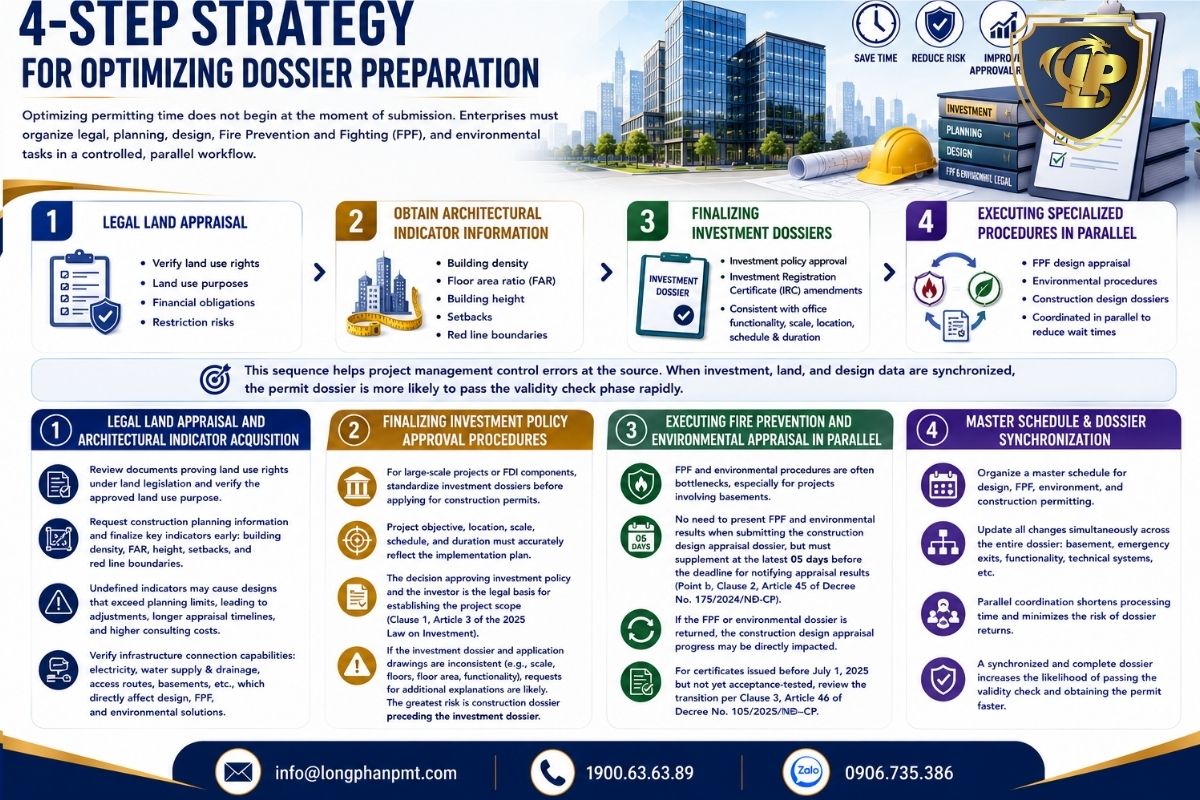
Optimizing permitting time does not begin at the moment of submission. Enterprises must organize legal, planning, design, Fire Prevention and Fighting (FPF), and environmental tasks in a controlled, parallel workflow.
For office building projects, the preparation sequence should follow these four steps:
This sequence helps project management control errors at the source. When investment, land, and design data are synchronized, the permit dossier is more likely to pass the validity check phase rapidly.
The initial step is determining whether the project possesses a sufficient legal foundation to develop an office facility. Enterprises must review documentation proving land use rights under land legislation and verify the approved land use purpose.
Concurrently, the investor should request information regarding construction planning. The group of indicators that must be finalized early includes building density, floor area ratio, structure height, setbacks, and red line boundaries.
If these indicators remain undefined, the design unit may propose plans exceeding planning limits. The consequence is that the enterprise must adjust the basic design, extending the appraisal timeline and increasing consulting costs.
This is also the time to verify infrastructure connection capabilities. Electricity, water supply and drainage, access routes, and basements can directly influence design solutions, fire prevention (FPF), and environmental requirements.
For large-scale office projects or those with FDI components, investment dossiers must be standardized prior to applying for construction permits. The project objective, location, scale, schedule, and duration must accurately reflect the implementation plan.
The decision approving the investment policy and the investor serves as a crucial basis for establishing the project scope, pursuant to Clause 1, Article 3 of the 2025 Law on Investment.
If an FDI investor changes the scale, number of floors, floor area, or operational functionality, discrepancies between the investment dossier and the application drawings frequently trigger requests for additional explanations.
Evidently, the greatest risk is the construction dossier preceding the investment dossier. When the project objective has not been validly adjusted, the permitting authority may lack the basis to consider the office building’s functionality.
Fire prevention (FPF) and environmental procedures are often bottlenecks for office building projects involving basements. Enterprises should design a parallel processing schedule rather than waiting to complete each procedure linearly.
Legislation allows enterprises to proceed without presenting FPF and environmental results at the time of submitting the construction design appraisal dossier. However, these results must be supplemented at the latest 05 days before the deadline for notifying appraisal results, pursuant to Point b, Clause 2, Article 45 of Decree No. 175/2024/NĐ-CP.
This mechanism provides room to optimize progress, but it does not diminish compliance responsibilities. If the FPF or environmental dossier is returned, the construction design appraisal progress may be directly impacted.
For structures issued an FPF design appraisal certificate prior to July 1, 2025, but not yet acceptance-tested, the transition must be reviewed separately, as regulated in Clause 3, Article 46 of Decree No. 105/2025/NĐ-CP.
The appropriate strategy is to organize a master schedule for design, FPF, environment, and construction permitting. Any changes to the basement, emergency exits, functionality, or technical systems must be simultaneously updated across the entire dossier
The construction permitting mechanism requires that dossiers be consistent across land legality, investment, planning, and technical design. For office buildings, a single conflicting document can result in the entire dossier being subject to requests for clarification or supplementation.
Enterprises should view the permit dossier as a comprehensive set of legal evidence. The permitting authority not only examines the form of the documentation but also evaluates the project’s compliance with planning, safety, environmental, and fire prevention (FPF) standards.
Dossiers for permit applications must be reviewed according to the logic of “one project, one functionality, one set of indicators.” If the investment dossier records one objective while drawings demonstrate different functionality, the risk of being requested to amend is very high.
Core dossier components include:
This checklist assists the legal department in early detection of unsubstantiated errors or data discrepancies. For projects permitted in stages, drawings must correspond exactly to the specific stage being requested.
The sequence for processing dossiers at the Department of Construction or the corresponding competent authority must be managed through specific project milestones. For projects within industrial zones, the Industrial Zone Management Board may participate depending on decentralization and project location.
The processing procedure typically traverses four stages:
Regarding transitionals, construction permit applications submitted before December 30, 2024, that remain unissued continue to be processed under Decree No. 15/2021/NĐ-CP. Applications submitted from that date forward apply Decree No. 175/2024/NĐ-CP, pursuant to Clause 11, Article 122 of Decree No. 175/2024/NĐ-CP.
Enterprises should maintain a separate tracking table for each processing stage. This management method helps control document supplementation timelines, respond to clarification requests, and prevent the loss of legal evidence during the appraisal process.
Delays in construction permitting typically do not stem from a single procedural error but rather from a lack of unified control over legal, planning, design, and specialized documentation from the outset. For office building projects, each month of permit delay directly impacts rental cash flow, capital costs, commitments to contractors, and commercial exploitation plans. Enterprises must identify these risks before the permitting authority issues requests for amendments.
In project management, enterprises should assume that over 80% of delays originate before the dossier is even submitted. This serves as an internal governance indicator to prioritize auditing from the preparation stage rather than waiting for legal deadlines.
Discrepancies often arise between the investment dossier, planning records, basic design, and implementation drawings. A change in the number of floors, floor area, basement configurations, or functionality can compel the investor to re-explain the entire scheme.
The capability of the design consultant is also a critical control point. If their profile fails to meet requirements or if drawings do not adhere to standards, the enterprise risks having to restart the entire appraisal process.
Risk is not limited to processing timelines; dossier inconsistencies can generate additional design costs, supplementary consulting fees, and risks of breaching progress commitments with lessees or financial partners. Enterprises must establish cross-checking mechanisms before submission. Data sets that must be synchronized include investment objectives, office functionality, floor area, planning indicators, FPF, environment, and infrastructure connection schemes.
The greatest risk for investors is commencing construction or modifying works when legal conditions remain incomplete. These actions not only impact progress but can lead to permit revocation or project termination.
| Prohibited Conduct | Legal Consequence | Legal Basis |
| Commencing construction without meeting prerequisite conditions | Strictly prohibited; project at risk of suspension. | Clause 3, Article 15 |
| Unauthorized changes to appraised/approved designs affecting safety, environment, or FPF | Strictly prohibited; dossier may require reprocessing. | Clause 10, Article 15 |
| Forging documents in foreign contractor permit applications | Revocation of construction operating license | Point a, Clause 1, Article 118 |
| Using forged documents or constructing contrary to permit content without compliance | Risk of construction permit revocation | Clauses 1 & 2, Article 64 |
| Failure to perform security deposits or provide guarantees | Potential termination of all or part of project activities | Point e, Clause 2, Article 36 |
This risk matrix illustrates that construction permitting is not an isolated procedure. If investment documentation, contractors, design, and commencement conditions are not managed synchronously, projects may stagnate at both legal and construction stages. For FDI investors and commercial project developers, the safest strategy is to refrain from commencing construction based on permitting expectations. Enterprises should only commence construction when all legal conditions are met and a valid notice of commencement has been issued.
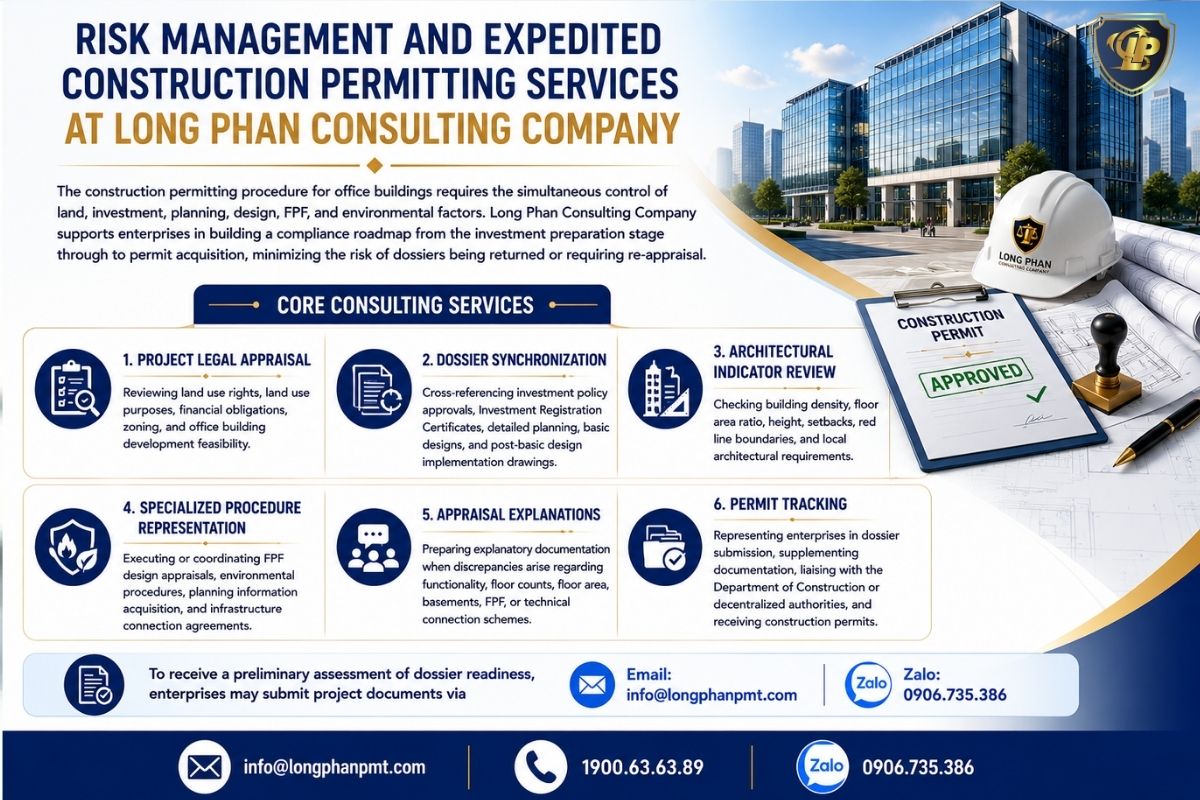
The construction permitting procedure for office buildings requires the simultaneous control of land, investment, planning, design, FPF, and environmental factors. Long Phan Consulting Company supports enterprises in building a compliance roadmap from the investment preparation stage through to permit acquisition, minimizing the risk of dossiers being returned or requiring re-appraisal.
Core Consulting Services
To receive a preliminary assessment of dossier readiness, enterprises may submit project documents via Email: info@longphanpmt.com or Zalo: 0906.735.386.
Discrepancies between investment, planning, fire safety, and environmental documents can delay the issuance of building permits for office buildings, even if businesses have prepared all the necessary formal documents. The questions below focus on situations that can easily lead to increased capital costs, delayed operation, or required document adjustments. Each answer aims to address how to control risks before submitting the permit application.
Businesses can submit construction design appraisal applications even before receiving fire safety and environmental assessment results. However, these results must be submitted to the relevant construction authority no later than the latest deadline.5 days before the deadline for notifying the assessment results, according to Point b, Clause 2, Article 45 of Decree No. 175/2024/ND-CP.
The building permit for the office building is valid for commencement of construction in 12 months from the date of issuance. If the project exceeds this deadline without commencement, the investor must follow the procedure to request an extension of the construction permit, according to Form No. 03, Appendix II of Decree No. 175/2024/ND-CP.
The project requires submission of building permits in stages 2 sets. Construction design drawings developed after the basic design. The drawings must correspond to the approved permit application phase, as stipulated in Point d, Clause 1, Article 56 of Decree No. 175/2024/ND-CP.
Applications may be rejected if the documents are formally complete but inconsistent regarding land use, planning, design, environment, or fire safety. The project must conform to land use purposes, planning, and ensure construction safety, as stipulated in Points a, b, and c, Clause 1, Article 44 of the Law on Construction 2025.
Foreign direct investment (FDI) enterprises must verify market access conditions and the consistency between project objectives and office functions. Foreign investors are subject to the same conditions as domestic investors, except for restrictions on ownership ratios, investment forms, or scope of operations, as stipulated in Clauses 1 and 3 of Article 8 and Clause 2 of Article 19 of the Law on Investment 2025.
Office buildings requiring permits cannot commence construction before a valid building permit is obtained. The investor must also have approved construction design drawings, a contract with the construction contractor, and a valid notice of commencement of construction, in accordance with Clause 2, Article 43, and Points c, d, and e of Clause 1, Article 48 of the Law on Construction 2025.
The licensing authority has the right to request the investor to provide explanations and clarifications for the purpose of granting the license. The competent authority may also suspend construction or revoke the construction permit if violations are detected, according to Points a and d, Clause 1, Article 45 of the Law on Construction 2025.
Securing a Construction permit for office buildings must be managed as a comprehensive risk control process rather than a mere administrative filing. Developers are required to synchronize land legality, urban planning, investment records, technical design, fire prevention, and environmental compliance before seeking official approval for Grade I projects. Failure to execute rigorous cross-checking frequently results in stalled commercial exploitation, unexpected capital expenditure, mandatory re-appraisals, or severe risks of permit revocation.
To optimize your development timeline and manage complex legal hazards effectively, ensure your project remains fully compliant by contacting the advisory team at Long Phan Consulting Company. Secure your investment authority today by reaching out to our experts via our dedicated hotline at 1900636389.
📚 This article is provided with professional consultation based on the following legal framework:


