
Overseas Vietnamese property ownership and long-term residency in Vietnam is a primary concern for overseas Vietnamese planning to resettle in their homeland. Under current Vietnamese law, property rights and residency rights are legally distinct. Owning real estate, evidenced by a “Pink Book,” does not automatically grant the right to long-term residency. However, property ownership provides a significant legal advantage. It serves as the most definitive proof of a “lawful place of residence,” a mandatory condition for all residency applications. This analysis from Long Phan Consulting details the legal framework and pathways for Overseas Vietnamese to secure long-term residency through property ownership in Vietnam.

The relationship between owning property and gaining long-term residency status in Vietnam is often misunderstood. In practice, these are two separate legal areas governed by different systems of law.
Holding a Certificate of Land Use Rights, Ownership of Housing and Other Assets Attached to Land (commonly known as the “Pink Book” or sổ hồng) does not directly confer long-term residency rights on an individual. This certificate is, however, a critical asset. It is the key document that proves the holder meets a necessary condition during the residency registration process. A deeper analysis of property rights versus residency rights and the specific function of the Pink Book is necessary to understand how Overseas Vietnamese property ownership and long-term residency in Vietnam are connected.
Vietnam’s legal framework clearly separates these two rights:
These two rights exist independently. A Overseas Vietnamese can own multiple properties in Vietnam but fail to meet the criteria for long-term residency. Conversely, an individual can qualify for long-term residency without owning any property, provided they meet other legal requirements.
While not a direct qualifier, property ownership offers a superior advantage in the application for long-term residency. A key prerequisite for consideration by state authorities is proof of a “lawful place of residence.”
Under Article 5 of Decree 62/2021/ND-CP, the Certificate of Land Use Rights, Ownership of Housing and Other Assets Attached to Land (the Pink Book) is the highest form of legal documentation to prove this condition.
Therefore, when a Overseas Vietnamese is the registered owner on a Pink Book, the process of demonstrating a stable and lawful residence to the competent state agency becomes simple and convincing. The Pink Book establishes a solid foundation, increases the credibility of the residency application, and helps shorten the time required for processing complex verification procedures.
The path to long-term residency for Overseas Vietnamese who own property in Vietnam depends on selecting the correct legal method. While homeownership is not a direct condition for a residency permit, it is a valuable legal asset that enables two primary methods for registering for long-term stay: using a Visa Exemption Certificate or applying for a Temporary Residence Card (TRC).
A Visa Exemption Certificate allows overseas Vietnamese and their relatives (spouse, children) to enter and reside in Vietnam for a specified period without a visa.
Procedure and Dossier for Visa Exemption Certificate Application (According to Decree 82/2015/ND-CP):
The required application dossier includes:
The dossier can be submitted to a competent Vietnamese representative agency abroad. If the applicant is already residing temporarily in Vietnam, it can be submitted directly to the Immigration Department (Cục Quản lý xuất nhập cảnh). The standard processing time is approximately 5 to 7 working days.
The Role of the Pink Book in Extension of Stay: The critical aspect of this method is the extension process. To stay continuously, the Overseas Vietnamese must apply to extend their temporary stay before the 180-day period expires. This is the point where property ownership becomes a decisive factor. According to Article 10 of Decree 82/2015/ND-CP, the extension application must include documents proving a “legitimate reason” and a “lawful place of residence.”
A Temporary Residence Card (TRC) is a more advanced residency status. It allows the holder to reside continuously in Vietnam for the duration of the card’s validity (from 2 to 10 years) without needing to extend their stay every six months.
However, the law strictly defines the subjects eligible for a TRC. Overseas Vietnamese property ownership is not a qualifying category for a TRC. Instead, the property ownership document is a mandatory part of the application file to certify the declared residential address.
Eligible Categories for a Overseas Vietnamese TRC: Based on Clause 2, Article 36 of the Law on Entry, Exit, Transit, and Residence of Foreigners in Vietnam (amended 2019), a Overseas Vietnamese with a foreign passport must fall into one of the following categories:
The Role of the Pink Book in a TRC Application: When applying for a TRC, the applicant must declare a temporary residential address in Vietnam (on Form NA8) and submit supporting documentation.
TRC Application Dossier (According to Circular 31/2015/TT-BCA):
The dossier is submitted to the Immigration Department or the provincial/municipal Immigration Office where the applicant intends to reside. Processing time is 5 working days from the date of receipt of a complete and valid dossier.
>>> See more at:

The legal procedures for Overseas Vietnamese property ownership and long-term residency in Vietnam are complex. They demand a deep understanding of the Law on Residence, the Law on Entry and Exit, and related guiding documents. An inaccurate or incomplete application can lead to rejection, wasting time and affecting resettlement plans. Engaging a professional consulting firm is the optimal solution.
Long Phan Consulting Company provides a comprehensive service package designed to manage all issues professionally and effectively. Our services include:
The Visa Exemption Certificate allows multiple entries, but each stay is limited to 180 days, requiring an extension for a longer stay. In contrast, the TRC permits continuous residence for its full term (2-10 years) without periodic extensions but is only available to specific subjects like investors, laborers, or dependants.
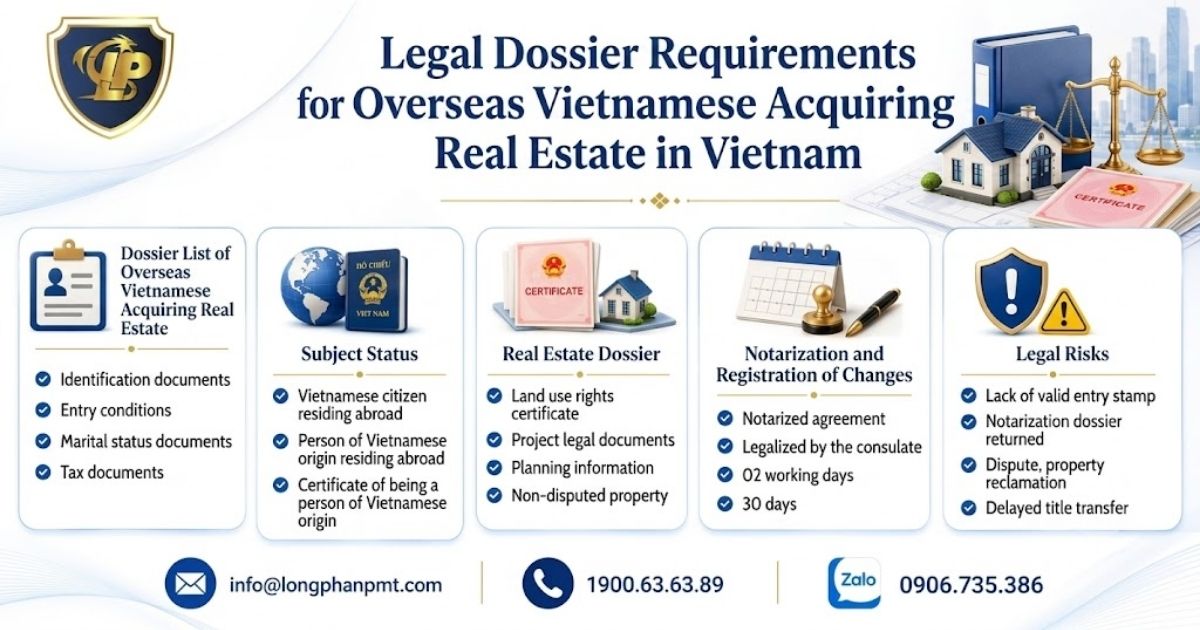
An overseas Vietnamese is a Vietnamese citizen or a person of Vietnamese origin residing long-term abroad. Proof includes a birth certificate, an expired Vietnamese passport, a certificate of renunciation of Vietnamese citizenship, or other documents showing past Vietnamese nationality or origin.
Staying in Vietnam beyond the permitted 180 days without an extension is a violation of immigration law. Depending on the duration of the overstay, penalties include administrative fines. Serious cases can result in forced exit and inclusion on an entry restriction list.
An applicant without property can prove lawful residence with a notarized or certified lease agreement, a house lending contract, or a document certifying permission to stay with family or an individual.
This is entirely possible. The Overseas Vietnamese applicant must submit a copy of the Pink Book registered in their Vietnamese citizen spouse’s name, along with a copy of the marriage certificate. This is a common and highly credible method of proving lawful residence.
This is permissible. The applicant must provide a copy of the Pink Book showing their name as a co-owner. If the applicant’s name is not on the Pink Book but they reside with a co-owner (e.g., parent, sibling), a written consent letter from all other co-owners is required for the application to be valid.
This is not permitted. A dependant TRC is for family reunification and residency purposes only. To work legally, the Overseas Vietnamese must be sponsored by an enterprise, obtain a work permit (or exemption), and convert their TRC to a Laborer (LĐ1, LĐ2) category.

The connection between Overseas Vietnamese property ownership and long-term residency in Vietnam is clear: while ownership is not a direct cause for residency, it is a powerful legal tool. Owning property is the key to proving lawful residence, a mandatory condition for extending a stay under a Visa Exemption Certificate or applying for a Temporary Residence Card. Understanding the Law on Residence and the Law on Entry and Exit to choose the correct pathway and prepare an accurate dossier is critical for success.
To ensure your resettlement plan in Vietnam is executed smoothly and in compliance with all legal requirements, please contact Long Phan Consulting Company via hotline: 1900.63.63.89 for comprehensive and expert assistance.