An Overseas Vietnamese property brokerage transaction must be structured through qualified Real Estate Brokerage providers to avoid deposit forfeiture, nominee ownership risks, and rejected land registration updates. Under the 2023 Law on Real Estate Business, independent freelance brokerage is no longer permitted, and intermediary activities must be conducted by licensed real estate service enterprises with corporate capacity, written service contracts, defined liability for damages, and transparent payment channels. Understanding these statutory safeguards helps investors strengthen legal compliance for Overseas Vietnamese property transactions and reduce cross-border execution risks. By assessing the legal, financial, and operational protections in advance, investors can complete secure property transactions in Vietnam with guidance from Long Phan Consulting.
Important legal note:
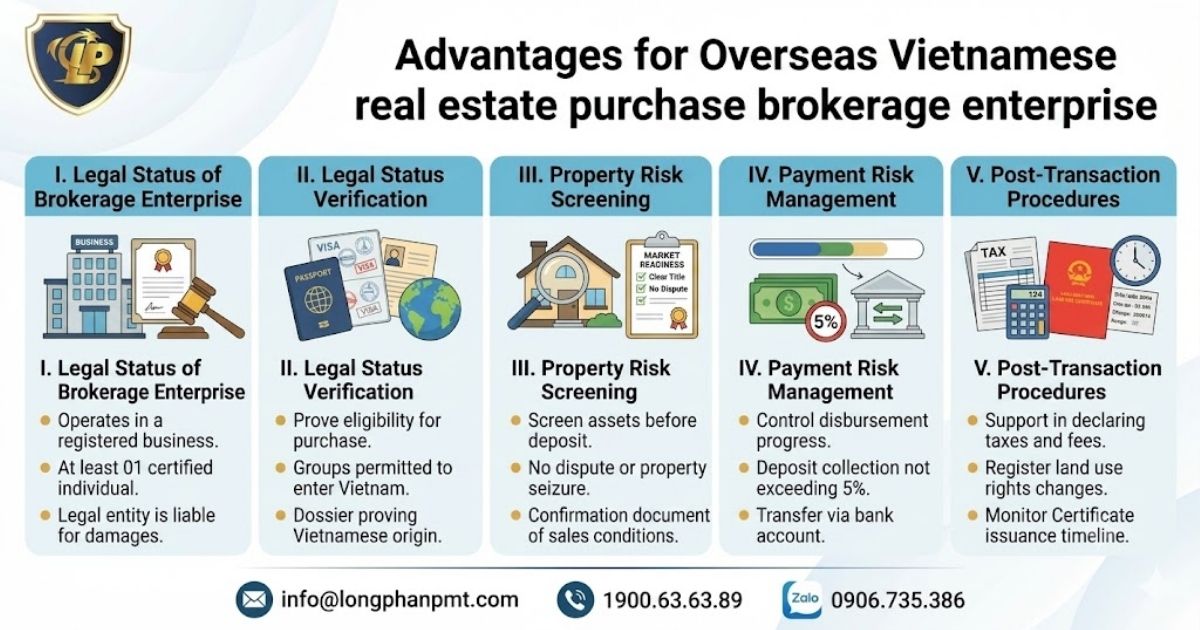
Under the modernized regulatory framework, Overseas Vietnamese investors must no longer treat real estate brokerage as a mere informal personal relationship. Every real estate transaction must operate within a structured corporate framework supported by a binding service agreement and clearly defined corporate liability.
The Law on Real Estate Business 2023 has fundamentally transitioned real estate brokerage into a strictly supervised corporate entity model. Individual brokers can no longer practice independently; they are statutorily required to hold a valid practice certificate and operate within a licensed real estate exchange enterprise or a licensed real estate brokerage firm, pursuant to Points a and b, Clause 2, Article 61 of the Law on Real Estate Business 2023.
For brokerage enterprises established prior to August 1, 2024, the statutory grace period to align with these mandatory operating conditions is 06 months. This transitional mechanism serves as an immediate regulatory filter to purge unaccredited actors from the market, pursuant to Clause 1 and Clause 10, Article 83 of the Law on Real Estate Business 2023.
Prior to executing any transaction, Overseas Vietnamese investors must verify the following statutory conditions:
For offshore investors, selecting a licensed real estate service enterprise provides a crucial first layer of legal risk management before placing earnest money deposits, executing notarized contracts, or filing for land title registration.
Independent freelance brokers no longer represent a legally safe channel for Overseas Vietnamese purchasing real estate in Vietnam. Beyond false project disclosures, transacting through freelance agents leaves investors without recourse to a corporate entity when financial losses occur.
The law explicitly mandates that individual brokers hold practice certificates and operate within licensed real estate service firms, pursuant to Clause 2, Article 61 of the Law on Real Estate Business 2023.
Transacting through unaccredited freelance brokers leaves investors vulnerable to lost earnest money, misstated project approvals, or acquisition of unmarketable real estate with no viable path to recover damages. For Overseas Vietnamese who are not continuously present in Vietnam, this lack of corporate recourse presents a severe legal risk.
The primary legal advantage of engaging a licensed brokerage enterprise is the statutory material liability mechanism. Where incorrect advisory information causes financial loss, the investor possesses direct legal grounds to claim damages from the corporate entity.
Real estate exchanges and licensed brokerage enterprises are statutorily obligated to compensate clients for financial losses resulting from their professional fault, pursuant to Clause 6, Article 58 and Point d, Clause 1, Article 65 of the Law on Real Estate Business 2023.
This corporate liability structure differentiates licensed real estate service firms from personal acquaintances or freelance brokers. When Overseas Vietnamese acquire high-value assets, this legal obligation must be treated as a fundamental commercial condition rather than a mere procedural formality.
Acquiring real estate in Vietnam requires Overseas Vietnamese investors to confirm both asset viability and personal legal capacity. Inconsistencies in identification documents, Vietnamese origin records, or entry visas can stall notarization and land mutation procedures.
Professional real estate service enterprises perform crucial preliminary audits of buyer documentation prior to contract execution. Persons of Vietnamese origin residing abroad are entitled to own residential housing attached to land use rights provided they are permitted to enter Vietnam, pursuant to Clauses 1 and 2, Article 8 of the Housing Law 2023.
Verifying buyer status must occur within the broader civil and land transaction framework, serving as a mandatory input control prior to executing binding purchase contracts, pursuant to Clause 2, Article 161 of the Housing Law 2023.
Licensed brokerage firms review client documentation prior to earnest money payment, reducing the risk of acquiring an eligible asset without the legal capacity to hold title.
Key document groups requiring verification include:
By auditing buyer credentials upfront, brokerage firms coordinate with public notary offices and sellers to standardize filing packages, avoiding the delays common in informal personal transactions.
Utilizing relatives as legal nominees introduces significant asset control risks. Disputes frequently arise if the nominee transfers, mortgages, divorces, dies, or faces inheritance claims involving the property.
A licensed real estate enterprise evaluates whether an Overseas Vietnamese investor qualifies for direct title holding before selecting a transaction structure. Direct title registration on the Land Use Right Certificate remains the safest legal method to protect property rights.
For high-value real estate in Ho Chi Minh City, Hanoi, or Da Nang, legal structure must be treated as a strategic decision. Correcting an improper nominee arrangement after the fact routinely exceeds the cost of preliminary legal due diligence.
Licensed real estate brokerage enterprises create value by systematically screening properties before Overseas Vietnamese investors execute binding earnest money agreements. In commercial housing developments, primary compliance risks stem not from pricing disputes, but from properties brought into commercial operation without satisfying statutory prerequisites. Real estate exchange operators are legally mandated to verify the legal status and operational eligibility of real estate products prior to offering them on the market, pursuant to Clause 1, Article 56 of the Law on Real Estate Business 2023. Properties introduced into transaction workflows must satisfy statutory criteria regarding ownership certificates, absence of legal disputes, freedom from distraint or attachment orders, and clean title status, pursuant to Clause 1, Article 14 of the Law on Real Estate Business 2023.
For off-plan housing (future housing assets), real estate service enterprises execute rigorous due diligence across project documentation. Statutory benchmarks include valid construction permits, formal commencement notices, and official municipal written confirmation authorizing the property for commercial sale, pursuant to Article 24 of the Law on Real Estate Business 2023.
| Low-Risk Compliant Asset Profile | High-Risk Excluded Asset Profile |
| Valid Title / Off-Plan Clearance: Holds a valid Certificate of Land Use Rights or complete statutory project approvals for off-plan sale. | Uncertified / Incomplete Title: Lacks a valid land use certificate or presents incomplete statutory project documentation. |
| Unencumbered Legal Status: Free from active land disputes, asset attachment orders, or statutory transfer restrictions. | Restricted / Encumbered Asset: Subject to active litigation, court attachment, or municipal transfer bans. |
| Transparent Encumbrance Management: Demonstrates transparent mortgage records and clear bank releases if encumbered. | Unreleased Mortgage: Currently mortgaged to a financial institution without formal lender consent or release frameworks. |
| Public Project Disclosures: Full disclosure of municipal planning approvals, project details, and tax obligations by developer. | Opaque Project Status: Lacks transparency regarding municipal planning, construction approvals, or developer tax status. |
This screening framework allows Overseas Vietnamese investors to filter out non-compliant properties prior to incurring earnest money obligations, serving as an indispensable due diligence protocol before making financial commitments.
Acquiring a mortgaged property does not constitute an absolute statutory bar to transacting. Significant operational risks arise, however, when sellers fail to establish transparent mechanisms for mortgage discharge, de-registration of security interests, and timely delivery of original Land Use Right Certificates. Professional real estate brokerage enterprises require sellers to produce original legal files, ownership proof, marital status documentation, existing mortgage records, and bank debt-settlement protocols prior to executing earnest money deposit contracts.
Lacking formal bank discharge notices or written confirmation from security holders, Overseas Vietnamese risk entering transactions that cannot be legally notarized. Direct consequences include tied-up investment capital, costly court litigation, or prolonged negotiations to recover earnest money deposits.
Accessing real estate market databases enables Overseas Vietnamese to overcome information asymmetry risks. Utilizing a licensed real estate service enterprise rather than relying on informal personal referrals ensures objective verification. Brokerage firms cross-reference developer public disclosures against official records housed within the national real estate market information system, validating project status, commercial authorization, and developer compliance.
For transitional projects, developers must disclose project data under updated statutory standards prior to contract execution if the property met legacy legal criteria but remained unexecuted as of August 1, 2024, pursuant to Clause 5, Article 83 of the Law on Real Estate Business 2023. Investors should treat database verification as a non-negotiable prerequisite; if public system records contradict seller marketing materials, earnest money payments must be paused immediately to conduct a comprehensive legal review.

Cross-border fund routing represents the primary financial risk area when Overseas Vietnamese acquire property remotely. A licensed real estate service firm provides structural controls to standardize earnest money agreements, monitor disbursement schedules, and audit banking transaction trails.
For off-plan housing (future housing assets), developers are strictly prohibited from collecting earnest money deposits exceeding 5% of the total selling or lease-purchase price. This statutory threshold applies only after the property satisfies all legal prerequisites for commercial operation, pursuant to Clause 5, Article 23 of the Law on Real Estate Business 2023. This rule functions as a critical statutory barrier against unauthorized capital mobilization schemes.
Payment frameworks must be structured around verifiable legal milestones rather than informal seller requests. Legal counsel assists investors in verifying deposit contracts, receiving bank account details, and refund mechanisms prior to releasing funds.
If a deposit contract demands payments exceeding statutory limits, requires transfers to personal bank accounts, or lacks clear refund clauses, investors must halt the transaction immediately to prevent loss of capital control.
Off-plan residential property investments require strict installment control mechanisms. Overseas Vietnamese should decline seller sales schedules that are not explicitly tied to verifiable construction and legal milestones.
The statutory deposit cap remains 5% of the selling price for fully cleared off-plan assets, pursuant to Clause 5, Article 23 of the Law on Real Estate Business 2023. Total initial disbursement, including deposit funds, is capped at 30%, pursuant to Clauses 1 and 2, Article 25 of the Law on Real Estate Business 2023.
Cumulative payments prior to physical property handover are restricted to a maximum of 70% of total contract value. If the developer is a foreign-invested enterprise (FIE), this pre-handover payment ceiling is lowered to 50%, pursuant to Clause 1, Article 25 of the Law on Real Estate Business 2023.
Until the final Certificate of Land Use Rights and Ownership of Assets Attached to Land is issued, buyer payments must not exceed 95% of total contract value, providing statutory protection for the investor’s remaining funds, pursuant to Clause 3, Article 25 of the Law on Real Estate Business 2023.
All real estate transaction cash flows must be substantiated via official banking records, which is crucial for Overseas Vietnamese remitting investment funds into Vietnam from abroad. Project developers, real estate enterprises, and real estate service firms are statutorily required to receive all client payments through accounts opened at licensed credit institutions operating in Vietnam, pursuant to Clause 2, Article 48 of the Law on Real Estate Business 2023.
This requirement eliminates the risks of cash payments, unverified personal transfers, and unrecorded fund flows. For cross-border transactions, formal bank transaction receipts serve as primary legal evidence during contract enforcement or tax reconciliations.
Following contract execution, legal risk management for Overseas Vietnamese investors extends beyond making final payments. Property value and ownership rights remain fully secure only when tax declarations, asset handover, and land mutation registrations are tracked through to completion.
Licensed real estate service enterprises offer substantial operational value during the post-transaction phase by providing a dedicated local legal contact in Vietnam. This on-the-ground representation is essential for cross-border investors unable to interact directly with developers, public notary offices, or land registration authorities.
Key post-transaction operational workflows requiring continuous oversight include:
Lacking an authorized representative in Vietnam can result in prolonged delays in obtaining official ownership certificates despite full payment, impacting liquidity, rental yields, and future resale strategies.
Filing financial obligations constitutes a vital post-notarization milestone that is easily overlooked. Tax declaration errors can stall land mutation procedures and incur administrative compliance costs. Professional brokerage firms assist investors by organizing legal dossiers, verifying transaction data, and tracking tax payments and registration fees.
When non-commercial or small-scale real estate sales are conducted by individuals or entities, they fall outside the scope of the Law on Real Estate Business 2023 but remain fully subject to statutory tax filing requirements, pursuant to Clause 4, Article 9 of the Law on Real Estate Business 2023.
The issuance of the Certificate of Land Use Rights and Ownership of Assets Attached to Land marks the official conclusion of a real estate transaction. Developer delays in filing title applications can restrict an investor’s ability to transfer, mortgage, or commercially exploit the property.
Project developers are statutorily required to submit title application dossiers to competent land authorities within 50 days from the date of property handover to the buyer or from the time a lease-purchaser completes full payment, pursuant to Clause 3, Article 17 of the Law on Real Estate Business 2023.
A licensed brokerage firm monitors handover milestones, inspects filing packages, and urges developers to meet statutory timelines, providing a vital operational advantage for remote investors.
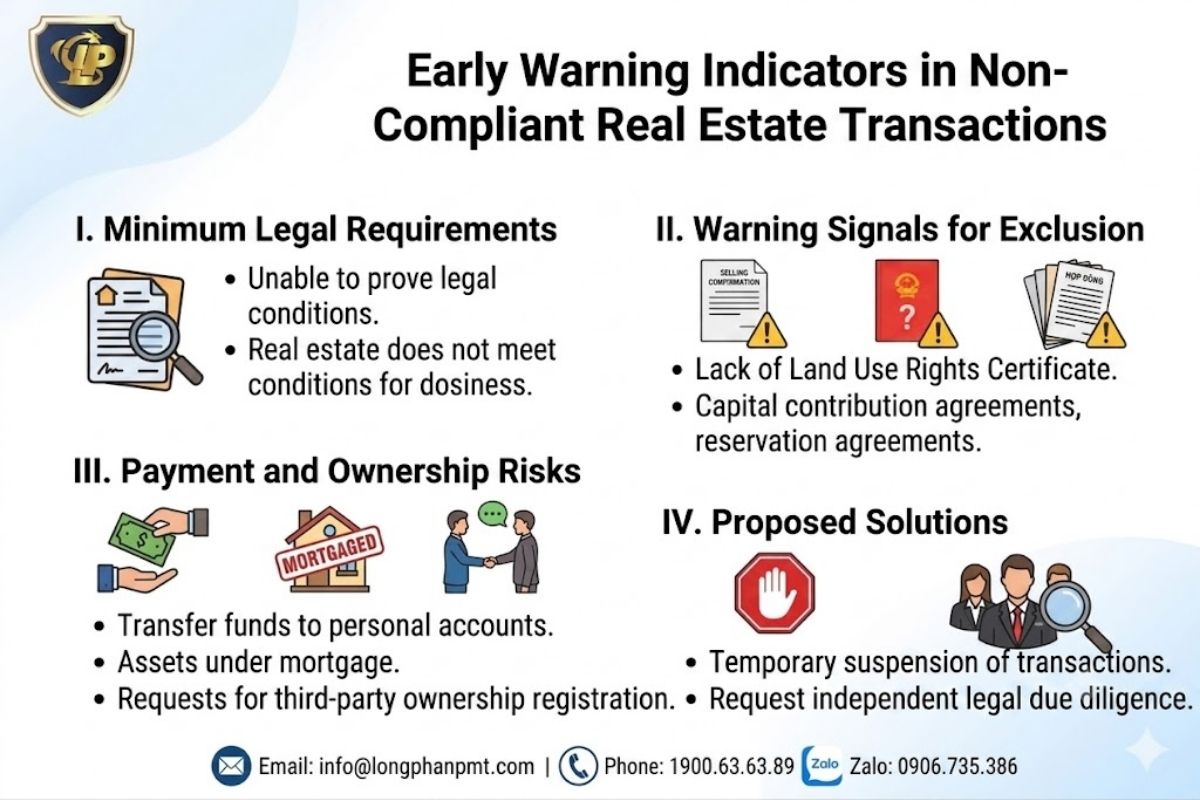
Overseas Vietnamese investors must halt transactions immediately if a property, project developer, or receiving entity fails to substantiate statutory operating conditions. Fraudulent practices, misrepresentations, or bringing non-compliant real estate into commercial operation are prohibited acts under Article 8 of the Law on Real Estate Business 2023.
Investors should screen for and reject the following high-risk indicators prior to executing deposit agreements:
When any of these warning signs emerge, investors should pause payments and commission an independent legal due diligence audit. Preliminary verification expenses are negligible compared to the financial losses associated with forfeited deposits or improper transfers.
>> See more: Can overseas Vietnamese practice real estate brokerage in Vietnam?
Real estate transactions for Overseas Vietnamese involve overlapping compliance layers: legal capacity verification, asset qualification audits, cross-border banking compliance, and land mutation procedures. Senior Legal Counsel at Long Phan Consulting Company approaches transactions through pre-acquisition due diligence, contract risk mitigation, and continuous operational supervision through final title delivery.
Our legal services are tailored for foreign investors requiring a dedicated legal representative in Vietnam to mitigate risks related to lost deposits, unverified bank accounts, or non-compliant assets.
Our legal scope includes:
Overseas investors may transmit property documentation, draft contracts, or transaction details via Email at info@longphanpmt.com or WhatsApp/Zalo at +84 906 735 386 for a preliminary legal risk evaluation.
A thorough understanding of the legal framework regarding home ownership is crucial for Vietnamese people residing abroad to optimize investment opportunities and protect their legal rights in Vietnam. By engaging with professional real estate service businesses, investors are protected against risks related to legal documentation and project progress. Below are key issues that will help businesses and investors gain a strategic perspective in conducting safe real estate transactions.
No, “Vietnamese citizens residing abroad” do not need a professional license when conducting real estate transactions for personal use. A professional license is only required for individuals engaging in “real estate brokerage” activities under the name of a service business. Individuals wishing to perform brokerage services must practice within a real estate exchange service business or a real estate brokerage service business as stipulated in Clause 2, Article 61 of the 2023 Law on Real Estate Business.
Real estate brokerage businesses must directly compensate customers for all material damages if the fault arises from providing false information about the legal status of the property. The law stipulates that real estate exchanges and brokerage businesses have a mandatory obligation to compensate customers for damages caused by their own faults, as per Clause 6, Article 58 and Point d, Clause 1, Article 65 of the 2023 Law on Real Estate Business.
No, cash payments for real estate transactions involving real estate service businesses are invalid. Project developers, real estate businesses, and real estate service businesses are required to receive payments from customers through accounts opened at domestic credit institutions or branches of foreign banks legally operating in Vietnam, as stipulated in Clause 2, Article 48 of the 2023 Law on Real Estate Business.
No. Cash payments for real estate transactions involving real estate service businesses are not compliant. Project developers, real estate businesses, and real estate service businesses must receive customer payments through accounts opened at domestic credit institutions or branches of foreign banks legally operating in Vietnam, as stipulated in Clause 2, Article 48 of the 2023 Law on Real Estate Business.
Vietnamese nationals residing abroad need to prove their eligibility to enter Vietnam in order to own housing attached to land use rights. Businesses need to closely coordinate with customers to review personal records and entry documents, ensuring that the transaction accurately meets the conditions for granting a Certificate of Housing Ownership according to Article 8 of the 2023 Housing Law.
Executing an Overseas Vietnamese real estate purchase brokerage enterprise transaction ensures comprehensive oversight of buyer capacity, asset legal status, payment routing, and land mutation registration. Transacting through accredited corporate entities protects investors from lost deposits, unverified account transfers, non-compliant assets, or hazardous relative nominee arrangements. Conducting legal due diligence prior to executing binding agreements remains essential for cross-border investments. Contact Hotline 1900636389 for professional legal representation from the advisory team at Long Phan Consulting Company.
📚 This article has been professionally reviewed based on the following legal documents: