
Licensing Process for Music Event Permits must be managed according to its proper regulatory classification as prior approval for artistic performance activities, especially ticketed concerts, live music shows, mini concerts, and music festivals. Filing with the wrong authority or omitting key documents such as the performance script, repertoire list, venue records, security plan, or fire safety (PCCC) measures may lead to event suspension, revenue disruption, and administrative sanctions. This guide reviews Legal Updates, clarifies when notification is sufficient and when prior approval is required, standardizes the application workflow, and helps enterprises control operational risks with Long Phan Consulting.
Important legal note:
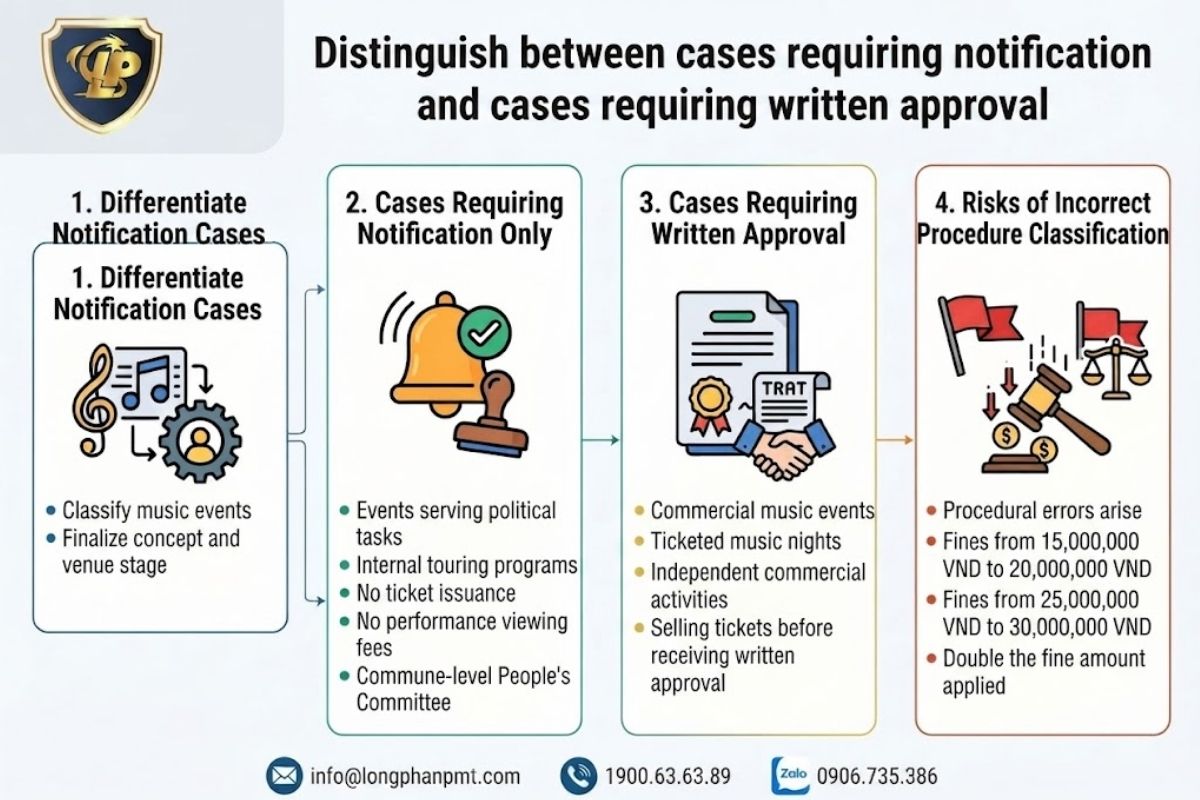
Businesses need to categorize music events right from the concept, venue, and ticket sales planning stages. Incorrect categorization can slow down the media schedule, halt ticket sales, and create the risk of penalties before the event takes place.
Some music events don’t require written approval, but they still have to be held announcement of art performance. This group generally has lower risk because they don’t issue tickets or charge for performances.
Businesses can implement a notification mechanism when events fall into the following categories:
This mechanism is defined in Clauses 1 and 2 of Article 8 of Decree No. 144/2020/ND-CP. The authority to receive notifications currently belongs to People’s Committee at the commune level for the event, as per Clause 1, Article 7 of Decree No. 137/2025/ND-CP.
Commercial music events often cannot simply be announced. Live shows, mini-concerts, music festivals, or ticketed concerts require a formal application process document approving the organization of artistic performances. Businesses must obtain approval when an event falls outside the exempted category. A typical example is a public performance with ticket sales, admission fees, or organized as an independent commercial activity. The legal basis is Clause 3, Article 8 of Decree No. 144/2020/ND-CP.
Selling tickets before official approval creates direct financial risks. If the application is required to be revised or is rejected, the business may have to refund tickets, compensate for sponsorship contracts, and handle crisis communications.
>>> See more: Comprehensive Guide to Obtaining an International Conference Permit
Incorrect classification can lead to procedural errors even when the performance content does not violate any rules. This is a common risk when agencies, brands, or venue managers view “notifications” as a substitute for approval.
Failure to notify the authorities before organizing a performance may result in a fine.15,000,000 to 20,000,000 VND. For individuals, organizing an event that requires permission without written approval may result in a fine.25,000,000 to 30,000,000 VND. For individuals, according to Point a, Clause 3, and Point c, Clause 5, Article 17 of Decree No. 87/2026/ND-CP.
For businesses, the amount of the fine imposed is doubled.2 times compared to individuals for the same violation. This rule significantly increases the cost of wrongful compliance, especially for events with signed contracts with artists, venues, media sponsors, and other sponsors, as stipulated in Clause 2, Article 6 of Decree No. 87/2026/ND-CP.
Enterprises should refrain from preparing an approval dossier without first verifying their organizational capacity and operational conditions at the venue. This pre-approval control layer helps minimize the risk of being requested to submit supplementary documents, facing rejection, or having the event suspended close to the scheduled date.
The entity named in the dossier must possess the appropriate legal capacity for performing arts activities. For agencies, brands, or venue management units, the primary risk often stems from undertaking event organization while lacking the compatible business sectors, functions, or corporate profiles.
The group of eligible subjects that must be screened includes:
These conditions are stipulated in Point a, Clause 1, Article 10 of Decree 144/2020/NĐ-CP. If the named subject is unsuitable, the entire timeline for ticket sales, marketing, and artist contract signing may be delayed.
Music events are not merely cultural procedures; enterprises must demonstrate their ability to control risks at the venue, especially for programs with large crowds, stages, audio-visual systems, and concentrated audience areas.
The groups of conditions that need to be standardized before submission include:
Point b, Clause 1, Article 10 of Decree 144/2020/NĐ-CP requires the organizing entity to meet conditions regarding security, order, social safety, health, environment, and fire safety. Lacking this layer of documentation can result in the event being halted even if the performance script meets the requirements.
The dossier for approval must be standardized to demonstrate three distinct layers of content: the organizing entity, the performance content, and event operational capacity. For ticketed programs, a weak dossier can impede the progress of ticket sales, marketing campaigns, and sponsorship execution.
Enterprises must distinguish between mandatory dossier components and supplementary operational documents. The core legal components must accurately reflect the contents of the program intended for public performance.
The application dossier includes:
These two groups of documents serve as the foundation for competent authorities to evaluate the performance content. If the script does not align with the list of works or the actual lineup of artists, the enterprise may face risks related to organizing content inconsistent with what was approved.
Beyond the required filing documents, enterprises should prepare a supplementary dossier to justify the feasibility of the event. This group of documents helps reduce the risk of requests for clarification for large-scale programs with high attendance or international elements.
The recommended standardized document set includes:
Point a and Point b, Clause 1, Article 10 of Decree 144/2020/NĐ-CP require the organizing entity to hold appropriate status and meet conditions regarding security, order, social safety, health, environment, and fire prevention. Therefore, operational documents should be prepared in advance rather than waiting for requests from state authorities.
The most significant risk for music event dossiers is the lack of consistency between the script, the list of works, the artists, the timing, the location, and the operational plans. For events where tickets have already gone on sale, a single request for revision can disrupt the entire production schedule.
Enterprises should audit their dossier following this sequence:
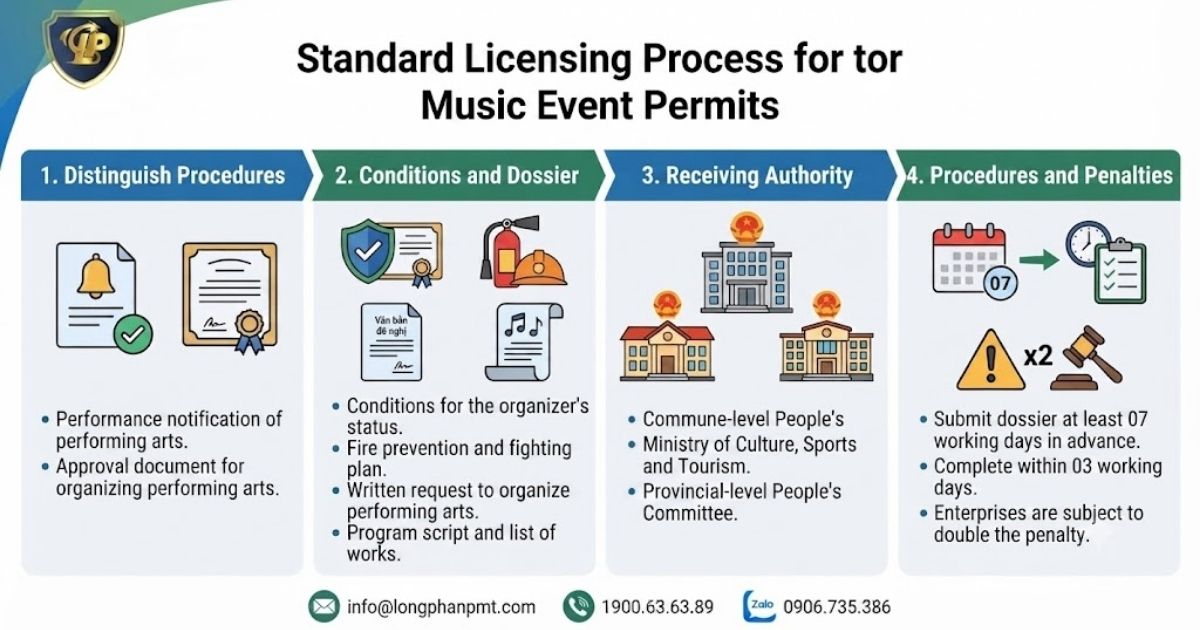
Submitting the dossier at least 07 working days before the intended date is the minimum procedural requirement. If the dossier is invalid, state authorities will notify the organizer of the requirement for completion within 03 working days, in accordance with Point a, Point b, Clause 4, Article 10 of Decree 144/2020/NĐ-CP.
Correctly identifying the receiving authority is the decisive factor in the legal progress of a music event. Submitting to the wrong authority can lead to dossier redirection, delays in script approval, and a direct impact on ticket sale plans.
For events only subject to notification, enterprises no longer submit dossiers through the provincial level as in the past. The authority for direct reception now belongs to the People’s Committee of the commune where the event is held. This mechanism is particularly critical for internal events and programs at accommodation, food and beverage, or entertainment establishments that do not sell tickets. Filing the notification in the correct locality provides enterprises with the basis to prove that they have completed their procedural obligations prior to the event date.
The authority to receive notifications is determined in Clause 1, Article 7 of Decree 137/2025/NĐ-CP. Enterprises should retain the receipt or proof of submission for post-event audits during venue inspections.
The MOCST has the authority to approve events organized within the framework of international cooperation by central agencies. These are typically programs involving diplomatic elements, international artists, or coordination on a central level. Enterprises involved in organizing, sponsoring, or operating events in this group must verify the legal role of the presiding agency. Submitting dossiers to local authorities when the event falls under the MOCST’s jurisdiction can disrupt the approval structure.
This authority is stipulated in Point a, Clause 2, Article 10 of Decree 144/2020/NĐ-CP. For events with international elements, the dossier requires additional control over scripts, lists of foreign works, and their Vietnamese translations.
For the majority of live shows, mini-concerts, music festivals, or commercial music nights held in a locality, the approving authority is the Provincial People’s Committee (for programs not under MOCST’s approval authority). This is the most common practical processing route for event-organizing enterprises. Provincial-level authority is appropriate for standard commercial performance programs that involve ticket sales, charging participation fees, or are organized before the public in the managed locality. The legal basis is Point b, Clause 2, Article 10 of Decree 144/2020/NĐ-CP.
The approval process shouldn’t begin with filling out a form. Businesses need to design the legal, operational, and commercial workflows in advance to avoid the risk of selling tickets before approval.
The pre-approval phase helps businesses determine the correct notification or approval process. This is a necessary step before announcing artists, selling tickets, or signing media agreements with sponsors.
Businesses should implement this in the following order:
If any of the three points above are not met, the business should address them before incurring significant production costs. The cost of adjusting venue, artist, or ticket contracts is often higher than the initial legal review cost.
After pre-approval, the documentation needs to be synchronized between the script, list of works, person responsible for the content, and event schedule. Small discrepancies in the documentation can lead to requests for additional information, directly affecting the performance date.
The application process should be followed as follows:
7 working days is just the minimum procedural deadline. For ticketed events, those featuring international artists, or those using international works, businesses should prepare earlier to handle copyright, venue, and content documentation.
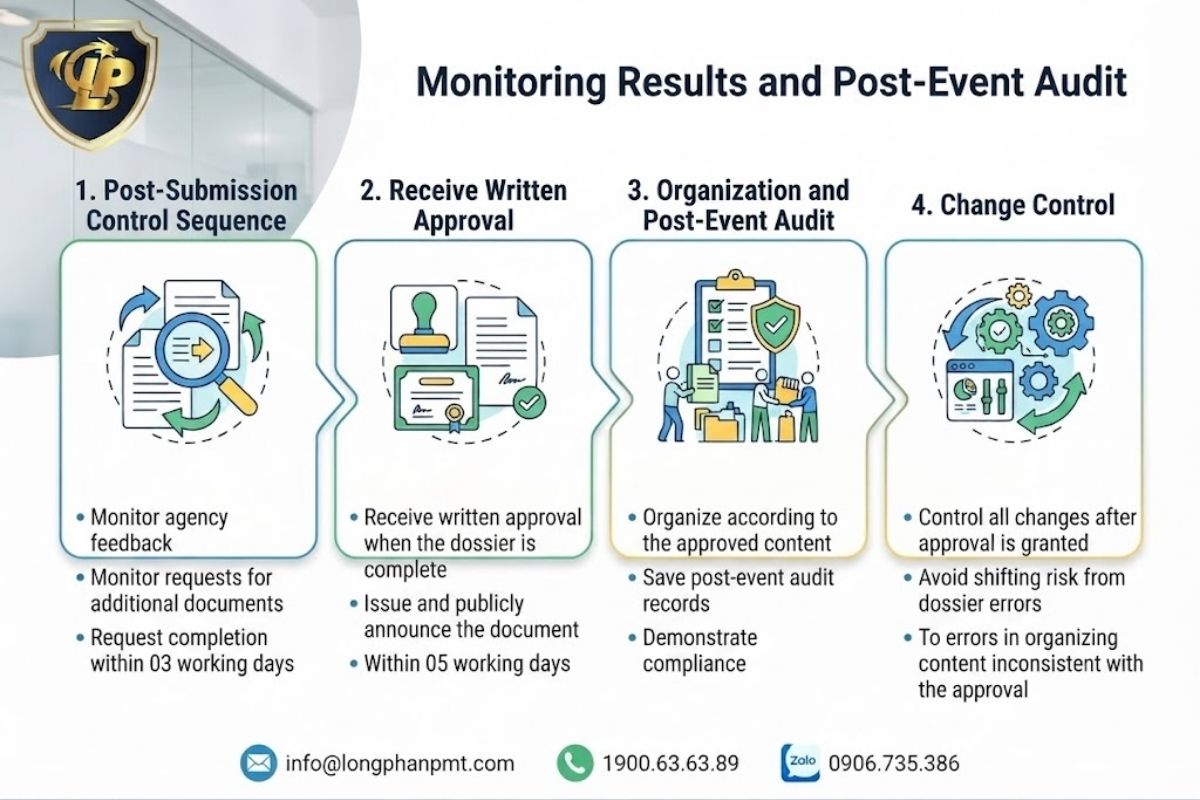
After submitting the application, businesses should monitor the response from the competent authority as a formal operational step. Submitting the application should not be seen as the end of the legal process.
The post-submission control procedure includes:
Businesses need to monitor all changes after approval. Changing artists, works, venues, or dates without proper updating can shift the risk from a record error to an organizational error.
>>> See more: Which events require a permit before being held?
The approval procedure should not begin with filling out forms. Enterprises must first design their legal, operational, and commercial workflows to avoid the risk of selling tickets before the dossier is officially approved.
The pre-approval phase helps enterprises accurately determine whether they only need to notify authorities or must obtain a formal approval document. This step must be completed before announcing artists, opening ticket sales, or signing marketing commitments with sponsors.
Enterprises should proceed in the following order:
If any of the above three points are not met, the enterprise should address them before incurring significant production costs. Costs associated with adjusting venue contracts, artist agreements, or ticket schemes are typically higher than initial legal audit costs.
After the pre-approval phase, the dossier must be synchronized regarding the script, the list of works, the person responsible for content, and the event timing. Small discrepancies in documentation can trigger requests for supplementary materials, directly affecting the event date.
The submission process should be carried out as follows:
The 07-working-day mark is only the minimum procedural deadline; for events involving ticket sales, foreign artists, or international works, enterprises should prepare well in advance to handle copyright, venue, and content documentation.
After submission, enterprises must monitor feedback from competent authorities as a core operational task, rather than viewing submission as the end of the legal process.
The control sequence post-submission includes:
Enterprises must control all changes after receiving approval; changing artists, works, locations, or timing without appropriate updates can shift risks from dossier errors to content violations.
A music event performance permit must be managed as a chain of compliance rather than a mere administrative dossier. Long Phan Consulting assists enterprises in controlling every stage—from event classification and dossier standardization to operational compliance with approval documents and post-event risk management.
Our services are designed for agencies, brands, venue management units, and organizers of live shows or music festivals with high demands regarding schedules, ticket revenue, and compliance responsibilities.
Key Consulting Services:
Effective procedural control from the event design phase helps enterprises minimize risks of suspension, monetary fines, ticket refunds, and contract-based compensation. Enterprises may submit documents via Email info@longphanpmt.com or Zalo/WhatsApp +84 906 735 386 for preliminary evaluation by Long Phan Consulting.
Mastering the legal procedures related to “music event permits” not only helps businesses optimize their operational processes but also prevents the risk of sudden suspension of operations. The questions below focus on common “edge-case” situations in event management, from delegation of authority to the joint liability of the organizing entity. Proactively controlling compliance from the document preparation stage is crucial for protecting cash flow and brand reputation.
Businesses that organize artistic performances without written approval will be subject to administrative penalties ranging from VND 50,000,000 to VND 60,000,000. This penalty is double the amount imposed on individuals, which is VND 25,000,000 to VND 30,000,000 as stipulated in Clause 5, Article 17 of Decree No. 87/2026/ND-CP and Clause 2, Article 6 of Decree No. 87/2026/ND-CP.
Yes, the authority to receive notification procedures for organizing artistic performances has now been directly transferred to the People’s Committee of the commune where the event takes place. Businesses need to proactively review the venue to submit notification documents in the correct manner, ensuring the legality of the performance in accordance with Clause 1, Article 7 of Decree No. 137/2025/ND-CP.
Businesses are required to attach Vietnamese translations of foreign works included in the list of performance scripts when submitting applications. This is a mandatory condition for the management agency to assess the script content, according to Point b, Clause 3, Article 10 of Decree No. 144/2020/ND-CP, amended and supplemented by Decree No. 116/2026/ND-CP. The lack of a Vietnamese translation will result in the application failing the assessment and disrupting the licensing process.
Businesses are entitled to retain the legal validity of their documents during the transfer of jurisdiction. Specifically, documents submitted before July 1, 2025, will be assigned to the People’s Committee at the commune level for further processing. Businesses do not need to withdraw and resubmit their documents, ensuring stability and progress for event production plans in accordance with Clause 1, Article 14 and Clause 1, Article 15 of Decree No. 137/2025/ND-CP.
Businesses that organize performances that violate public morals or incite violence will be fined between VND 60,000,000 and VND 70,000,000. This fine is calculated based on the penalty range for individuals (VND 30,000,000 to VND 35,000,000) as stipulated in Points a and b, Clause 6, Article 17 of Decree No. 87/2026/ND-CP, and the coefficient applied to legal entities as stipulated in Clause 2, Article 6 of Decree No. 87/2026/ND-CP.
A music event performance permit must be controlled by the enterprise from the initial classification phase to the formal application for a cultural event approval document. Errors in jurisdiction, missing content dossiers, unclear venue usage rights, or neglected security and fire safety plans can lead to event delays, monetary fines, program suspension, and commercial compensation obligations. Enterprises should audit their dossiers thoroughly before opening ticket sales or announcing the artist lineup. Contact our hotline at 1900 636 389 for Long Phan Consulting to provide support in evaluating and implementing procedures in accordance with the regulations.
📚 This article has been professionally reviewed based on the following legal documents: