
Incorrectly handling Event Permit Applications may lead to dossier rejection, postponed launch dates, lost sponsorship revenue, or suspension of the planned program. Since no universal event permit applies to every activity, organizers must determine the correct procedure, including artistic performance approval, press conference notification, promotional filing, or registration of prize-based promotions. Under the Law on Enterprises and Businesses and Clause 5, Article 10 of Decree No. 144/2020/ND-CP, artistic performance applications must be filed at least seven working days before the scheduled event.
Long Phan Consulting assists organizers in identifying applicable approvals and preparing compliant submissions from the initial planning stage.
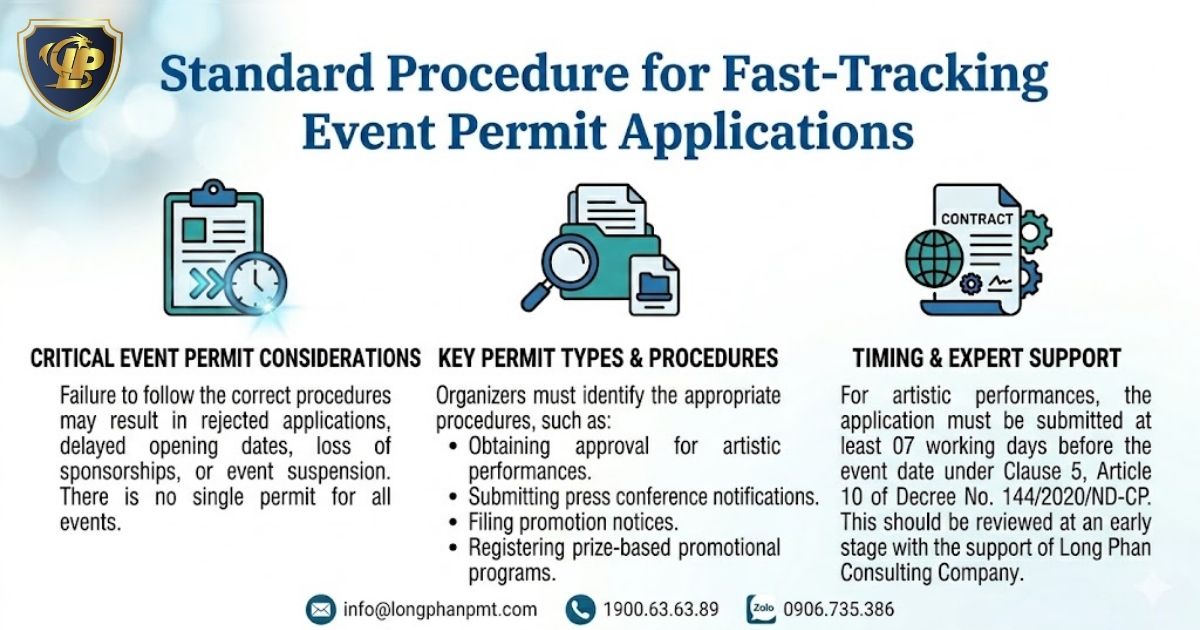
Key legal notes:
Obtaining event permits is not a one-size-fits-all procedure. Businesses need to break down each activity within the program to determine the corresponding documentation, authority, and deadlines.
Combining performances, press conferences, promotions, sports events, or advertisements into a single file can easily lead to submission to the wrong agency. The direct risks include rejection of the application, delays in media coverage, and invalidation of sponsorship contracts.
For public events, businesses need to identify the legal focus before drafting the script. Two categories are often confused: artistic performances and product launch press conferences.
The organizers should view the script as a compliance roadmap, not just an operational document. Each item gives rise to its own legal obligations, with different receiving authorities and handling risks.
Customer appreciation events, grand openings, trade fairs, or product launches often incorporate giveaways. Risks arise when businesses view raffles, lottery draws, or lucky spins as a secondary activity.
Therefore, the marketing department needs to finalize the prize structure, rules, and winner determination process early. Adding an element of chance at the last minute could completely alter the application strategy.
Sporting events and outdoor advertising are often designed as brand communication activities. However, each has its own line of authority and cannot be replaced by a venue rental agreement.
If the event combines sporting events, promotional parades, and stage performances, the business needs to create a separate procedural matrix. Venue documents, fire safety records, or sponsorship agreements do not replace the obligation to notify, register, or obtain specialized approvals.
The event permit application process should be managed like a legal project with a clear deadline. Businesses shouldn’t wait until the media script is finalized before reviewing the procedures, as each content change may generate additional documentation.
The focus of this phase is finalizing the script, determining the correct procedures, standardizing documentation, and monitoring feedback from the receiving agency. This approach helps the organizing committee minimize the risk of having their application rejected close to the event date.
Businesses should implement a streamlined workflow process involving marketing, legal, production, and venue partners. Each step should have a designated person in charge, internal deadlines, and corresponding supporting documentation.
This eight-step process helps businesses simultaneously manage communication progress and legal obligations. For artistic performances and promotional activities, skipping the follow-up step for additional requirements could result in the application not being valid before the event date.
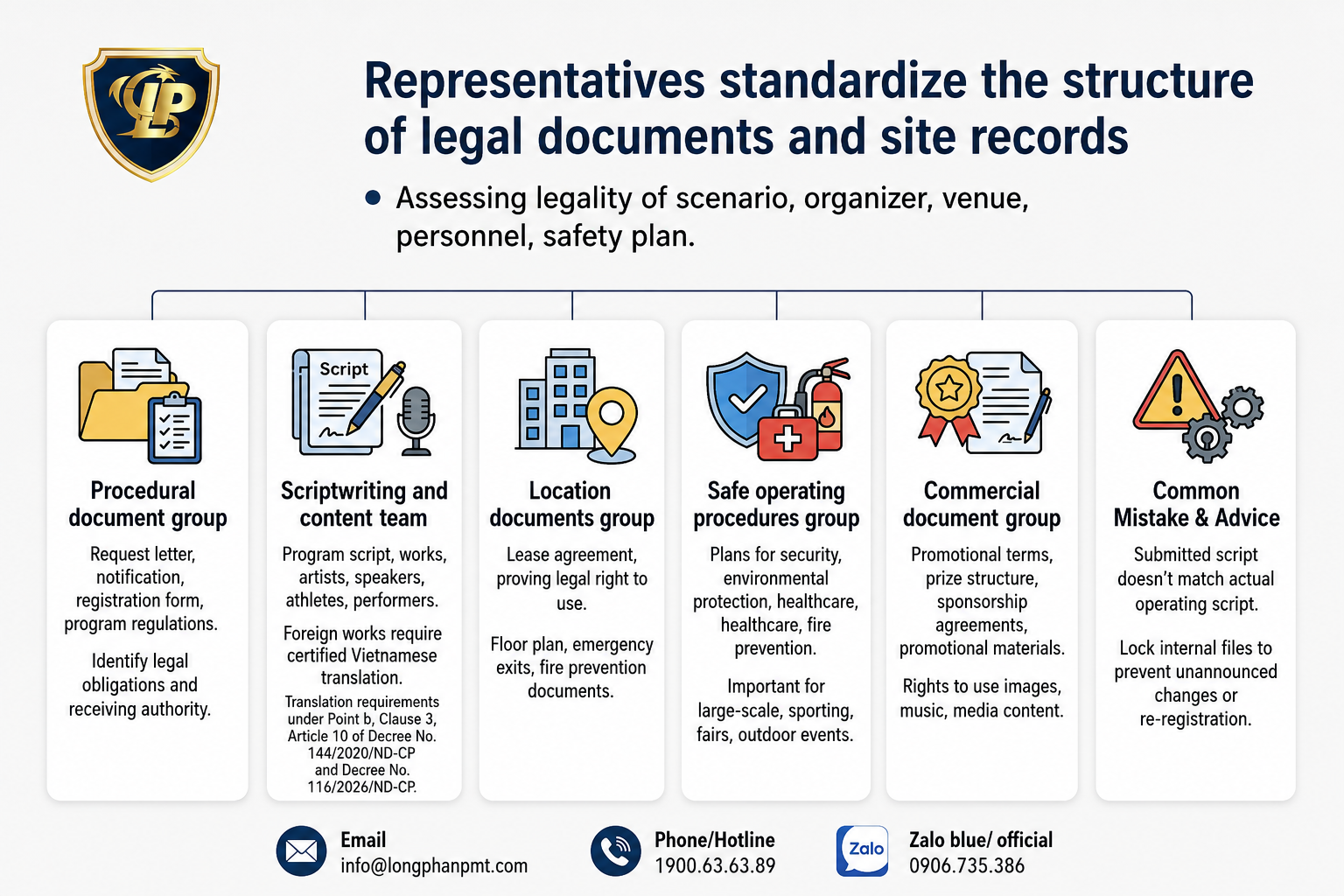
An event permit application includes more than just a request form. The receiving agency typically assesses the legality of the entire scenario, the organizer, the venue, the personnel involved, and the safety plan.
A common mistake is that the script submitted to government agencies doesn’t match the actual operating script. Businesses should lock an internal version of the file to prevent unannounced changes or re-registration.
The deadline for submitting applications is a critical risk control point for event projects. Businesses need to create a backward-looking deadline schedule starting from the event date, instead of relying solely on the production schedule or media schedule.
| Group of events or procedures | Legal deadlines to note | Receiving agency or primary authority | Legal basis |
| Announcement of art performance | At least 05 working days before the scheduled date | Competent authority in the field of culture | Clause 4, Article 9 of Decree No. 144/2020/ND-CP |
| Please approve the organization of the art performance. | At least 7 working days before the scheduled date | Provincial People’s Committee or the Ministry of Culture, Sports and Tourism | Clause 5 of Article 10 and Clause 2 of Article 10 of Decree No. 144/2020/ND-CP |
| Art competitions and festivals | At least 30 working days before the scheduled date | Competent authority within the scope of the organization | Clause 5, Article 14 of Decree No. 144/2020/ND-CP |
| Announcement of promotional activities | Minimum3 working days before proceeding | Department of Industry and Trade where the promotion is organized | Clause 1, Article 17 of Decree No. 81/2018/ND-CP, as amended and supplemented by Decree No. 128/2024/ND-CP |
| Registering for a promotional offer involves an element of chance. | Must be confirmed before proceeding. | The Department of Industry and Trade if within one province, or the Ministry of Industry and Trade if covering two or more provinces. | Clause 3, Article 19 of Decree No. 81/2018/ND-CP, as amended and supplemented by Decree No. 128/2024/ND-CP |
| Register for trade fairs and exhibitions in Vietnam. | Latest30 days before the opening day | The competent authority for industry and trade management. | Point a, Clause 4, Article 29 of Decree No. 81/2018/ND-CP |
| This file is part of the cultural jurisdiction transition period. | Applications received before this date April 8, 2026. The matter will continue to be handled under the previous jurisdiction. | The agency has received the application. | Clause 2, Article 31 of Decree No. 116/2026/ND-CP |
This timeline should be converted into an internal management checklist as soon as the event date is finalized. For events with multiple components, businesses need to submit multiple documents simultaneously to avoid delays in one procedure affecting the entire program.
The greatest risk in organizing an event is not merely incomplete documentation. More serious issues arise when the actual event differs from the approved application, creating grounds for suspension, administrative penalties, or partial termination of the program.
For businesses, commercial consequences often occur before legal sanctions. Last-minute changes may affect sponsorship agreements, media campaigns, artist bookings, and customer commitments.
An approved event script should be treated as a compliance-controlled document. Organizers should not change performers, program content, prize structures, or venues without first assessing whether amendments to the application are required.
Any modification to a registered promotional program must be approved before implementation and must not adversely affect participating customers. Likewise, changes to approved artistic performances may trigger obligations to update the licensing dossier.
Prize draws, lucky wheels, and other chance-based promotions are not legally considered ancillary activities. Businesses must register promotional games of chance and obtain approval before conducting them. If no winner is identified, the organizer may be required to contribute 50% of the announced prize value to the state budget.
A common compliance trap is adding prize-giving activities shortly before the event to increase audience engagement. Without early legal review, such changes may create additional registration, reporting, and financial obligations.
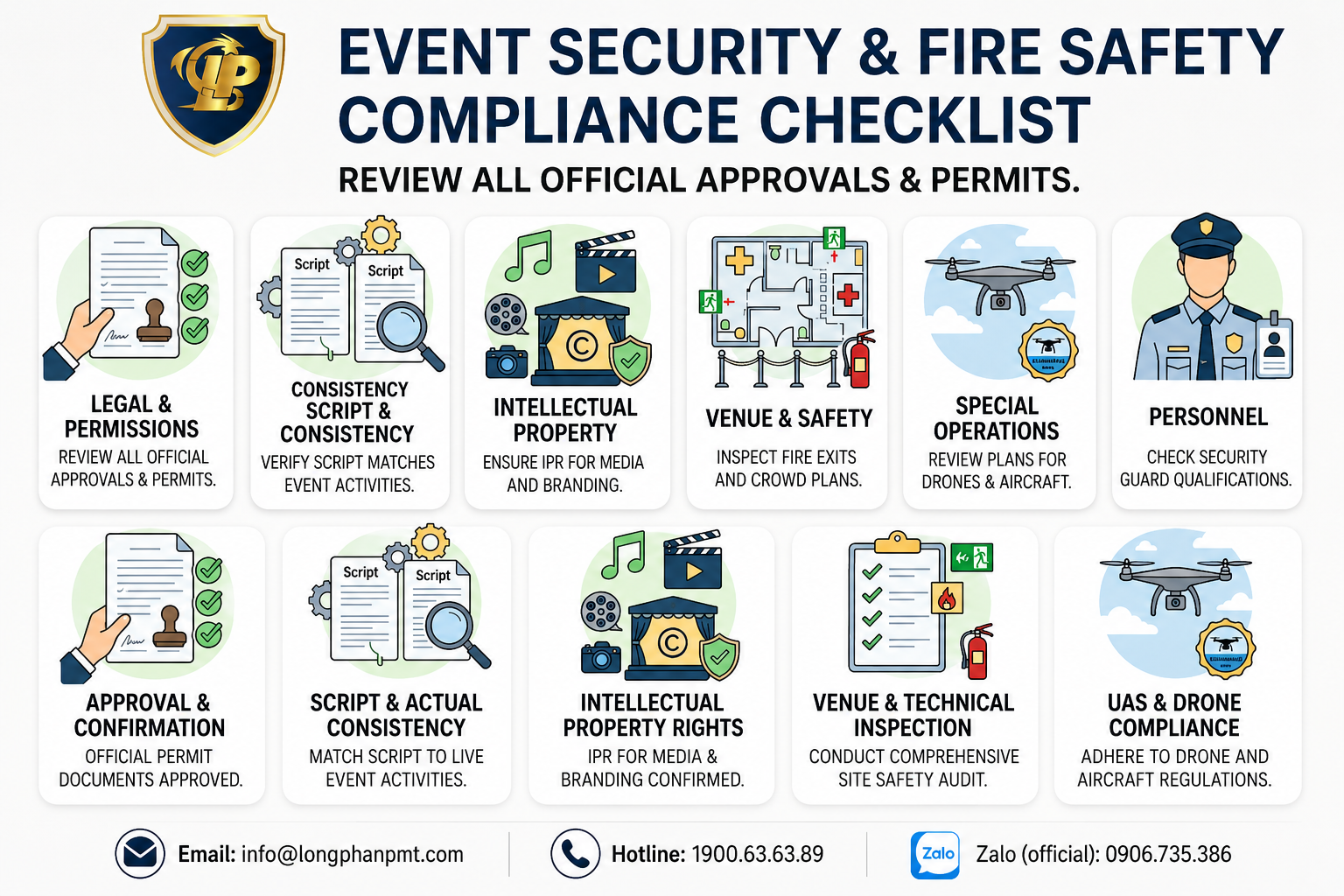
Before the event date, organizers should review both legal documentation and operational conditions, including:
For large-scale, outdoor, or live-broadcast events, businesses should maintain documented inspection records to demonstrate proper oversight of contractors and service providers.
Regulatory violations may result in more than monetary fines. Authorities may order event termination, suspend performance activities, require disgorgement of unlawful gains, or expose businesses to contractual liabilities.
Common violations include:
These penalties demonstrate that delayed or non-compliant licensing procedures can generate losses far exceeding the value of administrative fines. Businesses should manage event scripts, licensing dossiers, and operational partners as part of a unified compliance system.
Event licensing can be complex because a single program may simultaneously involve artistic performances, press conferences, promotional activities, sporting events, and advertising. Long Phan Consulting Company adopts a pre-event risk management approach, helping businesses establish the appropriate legal framework before launching marketing campaigns, booking venues, or signing sponsorship agreements.
Long Phan Consulting assists businesses in analyzing each component of an event to identify the required legal procedures and avoid overlooking compliance obligations.
This approach enables businesses to identify legal risks early and adjust event plans before significant production costs are incurred.
Once the legal structure is determined, Long Phan Consulting supports businesses in preparing and submitting application dossiers to the relevant authorities.
This service is particularly suitable for agencies, shopping malls, marketing departments, and businesses that organize events regularly.
Legal compliance depends not only on approved documents but also on ensuring that actual event operations match the approved plans. Long Phan Consulting assists businesses in establishing a Pre-Event Compliance Checklist to mitigate operational risks.
Businesses may submit event scripts, venue documents, and program materials to info@longphanpmt.com or contact Zalo: 0906.735.386 for a preliminary legal assessment before planning the licensing process.
In large-scale investment transactions, negotiating “business cooperation agreements (BCCs)” always involves complex legal risks related to jurisdiction, confidentiality, and dispute resolution mechanisms. The ability to manage these legal blind spots directly impacts the safety of capital flows and the legitimate rights of investors in the event of conflicts of interest. In-depth analysis of these issues from a corporate risk management perspective will be conducted to establish optimal protection mechanisms.
No, the core nature of this type of contract is business cooperation without establishing an economic entity. However, foreign investors signing contracts with domestic partners are required to apply for an Investment Registration Certificate. This regulation is mandatory to recognize the legal status of foreign capital flows according to Clause 2, Article 22 of the 2025 Investment Law.
Foreign investors have the full right to establish their own operating office in Vietnam to directly manage the project’s cash flow. Instead of relying on a partner’s joint account, this operating office can operate independently with its own seal. The office is permitted to open bank accounts to independently conduct business activities within the scope of the agreement as stipulated in Clauses 1 and 2 of Article 37 of the 2025 Investment Law.
Yes, investors are fully entitled to agree to apply foreign law or international investment practices. The application of foreign law is valid provided that the agreement does not contradict Vietnamese law, as stipulated in Clause 6, Article 4 of the 2025 Investment Law. Furthermore, the language used in commercial arbitration proceedings is entirely at the discretion of the parties, as stipulated in Clause 2, Article 10 of the 2010 Commercial Arbitration Law.
Absolutely not. Real estate project developers are not permitted to authorize partners to sign deposit or housing transfer contracts. Investors should be particularly wary of agreements disguised as partnerships for project distribution. This loophole seriously violates legal regulations. If violated, the parties involved will face legal risks according to Clause 4, Article 17 of the 2023 Law on Real Estate Business.
Any dispute involving at least one foreign investor can be resolved flexibly. The parties have the right to bring the case to Vietnamese courts, Vietnamese arbitration, foreign arbitration, international arbitration, or an arbitration panel established by mutual agreement, as stipulated in Clause 3, Article 13 of the 2025 Investment Law. Furthermore, Vietnamese courts have the authority to recognize and enforce foreign arbitration awards, as stipulated in Clause 5, Article 31 and Clause 1, Article 425 of the 2015 Civil Procedure Code.
Yes, the recipient of confidential information is obligated to fully compensate the other party for any damages if the information is disclosed illegally. Even before the contract is officially signed, the recipient of the information during negotiations must still adhere to the responsibility of absolute confidentiality. Misuse of information causing damage will directly give rise to liability for compensation under Clauses 2 and 3 of Article 387 of the 2015 Civil Code.
Obtaining event permits should be approached as a comprehensive compliance strategy rather than a single administrative procedure. Businesses must correctly identify and comply with the relevant requirements for artistic performance approvals, press conference notifications, promotional activity notifications, chance-based promotion registrations, and applicable sports or advertising procedures. Failure to meet filing deadlines, submit applications to the proper authorities, or manage last-minute program changes may result in event disruptions, administrative penalties, and adverse impacts on sponsorship agreements. To minimize legal risks from the planning stage, businesses are encouraged to contact Long Phan Consulting Company via Hotline 1900636389 for professional support and guidance.
📚 This article is provided with professional consultation based on the following legal framework: