
Land and property legalization is a core risk-management step before transferring, mortgaging, leasing, or contributing capital with assets that remain incomplete or unregistered on the relevant ownership certificate. Under the Law On Land, enterprises must verify the origin and current use of the land, construction status, planning conformity, dispute history, and any unpaid financial obligations before filing. Failure to resolve these issues may result in rejected applications, delayed transactions, or disrupted investment schedules.
Long Phan Consulting assists businesses in assessing legalization feasibility, identifying documentary gaps, and preparing a structured compliance roadmap for complex land and property cases.
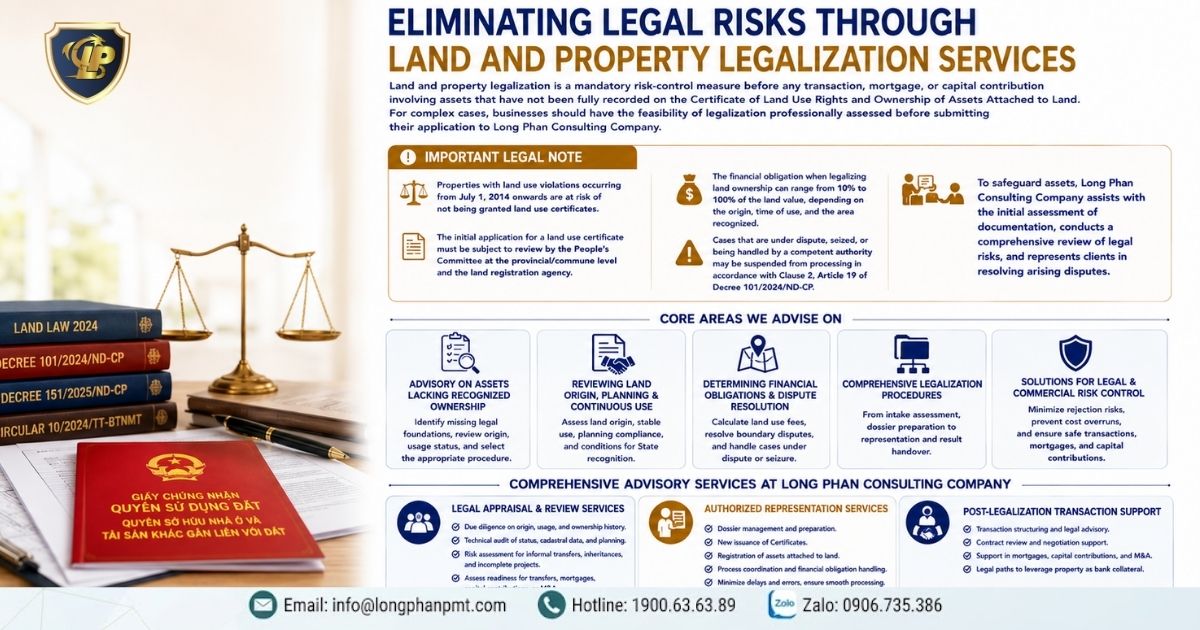
Key legal notes:
Legalizing land and property is not merely a standardized “issuance of a certificate.” It is a rigorous process of auditing origins, actual status, technical dossiers, and registration procedures to ensure assets are legally recognized by the State.
Legally, land registration involves declaring land use rights and ownership of assets attached to land to competent authorities. The Certificate serves as the legal instrument confirming legitimate rights over land and associated assets, pursuant to Clauses 15 and 21, Article 3 of the Land Law 2024.
Common asset groups requiring legalization include:
If not addressed prematurely, these assets face stagnation during transfers, mortgages, or capital contributions. For enterprises, this represents a direct risk to asset liquidity and real estate capitalization strategies.
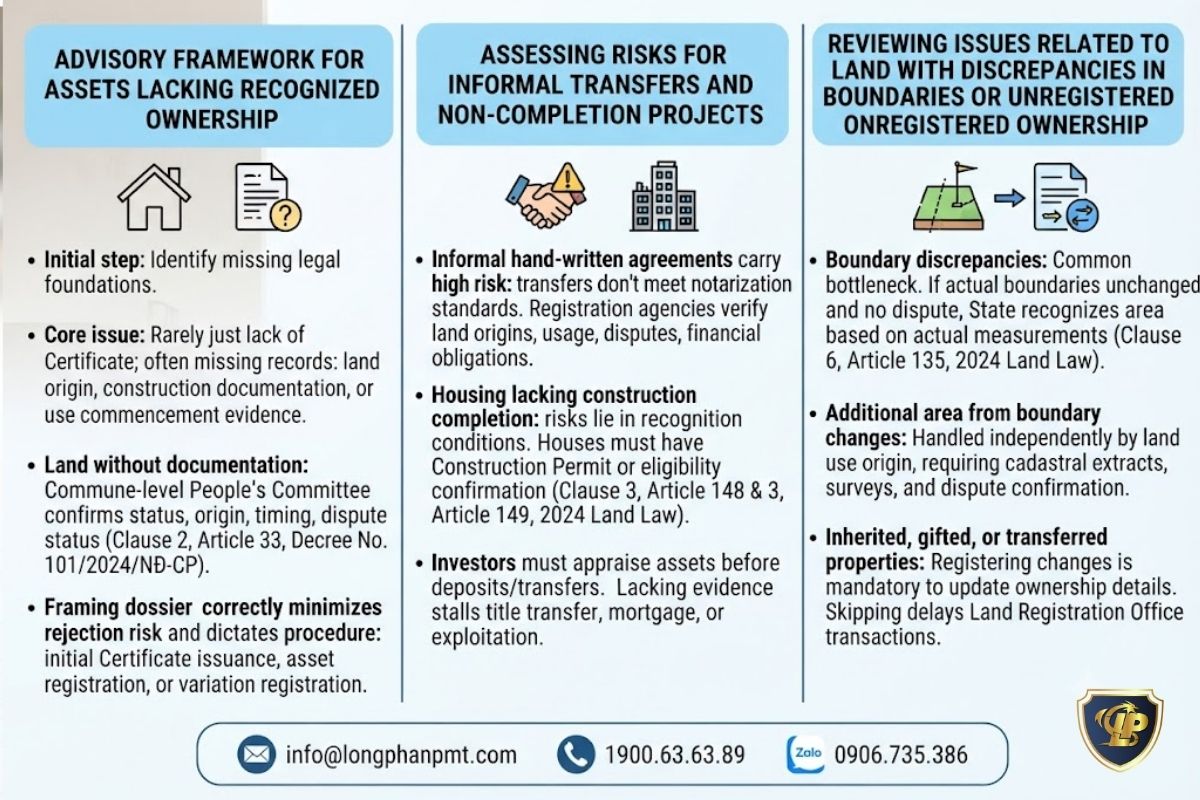
The initial step involves identifying the missing legal foundations for the asset. The core issue is rarely just the absence of a Certificate; it often stems from missing records concerning land origin, construction documentation, or evidence verifying the commencement of use.
For land without formal documentation, the Commune-level People’s Committee is responsible for confirming the current status, origin, timing of use, and dispute status. This mechanism is established under Clause 2, Article 33 of Decree No. 101/2024/NĐ-CP.
Framing the dossier correctly prior to submission minimizes the risk of rejection. This also provides the basis for selecting the appropriate procedure: initial Certificate issuance, registration of assets attached to land, or variation registration.
Real estate assets acquired via informal hand-written agreements carry significant risk, as these transfers do not meet notarization standards. Registration agencies will verify land origins, usage processes, dispute status, and financial obligations before considering recognition.
For housing lacking construction completion, the risk lies in the conditions for asset recognition. Houses or structures must possess a Construction Permit if required or a written confirmation of eligibility for existence, pursuant to Clause 3, Article 148 and Clause 3, Article 149 of the Land Law 2024.
Investors must appraise these asset groups before placing deposits or accepting transfers. Dossiers lacking construction evidence can stall the entire process of title transfer, mortgage, or commercial exploitation.
Discrepancies in area between old land records and the current situation are a common bottleneck. If the actual boundaries remain unchanged and there are no disputes with adjacent landowners, the State recognizes the area based on actual measurements, according to Clause 6, Article 135 of the Land Law 2024.
Conversely, any additional area resulting from boundary changes must be handled independently according to its land use origin. The documentation should then include extracts from cadastral maps, cadastral surveys of the land parcel, and confirmation of any disputes.
For inherited, gifted, or transferred land and properties that have passed through multiple owners, registering land ownership changes is a mandatory step to update the ownership details. Skipping this step can easily lead to delays in subsequent transactions at the Land Registration Office.
Assets can only be legalized after passing the vetting process regarding origin, planning, disputes, and financial obligations. For investors, this is a crucial step in assessing the likelihood of success before submitting the application.
Government agencies not only check existing documents. The records are also compared with actual usage, cadastral maps, planning information, and confirmation from local authorities.
| Inspection criteria | The agency responsible for evaluation | Common risks |
| Origin and time of land use | People’s Committee at the commune level, land registration agency | Stable usage has not been demonstrated. |
| Land use planning and plans | Land management agencies, local specialized agencies | Land subject to land use planning that is not suitable for the purpose for which recognition is requested. |
| Disputes, boundaries, financial obligations | Commune People’s Committee, Land Registration Office, Tax Authority | The application was halted, resulting in higher-than-expected land use fees. |
This checklist helps businesses determine whether a file should be submitted immediately or requires preliminary processing. In cases of disputes, boundary errors, or insufficient grounds for land use, early submission may result in the file being rejected multiple times.
The origin of land use is an input criterion for the entire legalization process. Land with documentation prior to the legally stipulated milestones or that has been used stably may be considered for the issuance of a land use certificate.
For land without proper documentation but not in violation of regulations, the key factors are the period of stable use and its current condition.no dispute as stipulated in Clauses 1, 2, and 3 of Article 138 of the Land Law 2024.
For cases lacking original documents, the People’s Committee at the commune level must verify the current status, origin, time of use, and any disputes. This authority is stipulated in Clause 2, Article 33 of Decree No. 101/2024/ND-CP.
Businesses need to gather evidence of land use before submitting their applications. The less evidence there is, the higher the risk of being asked for additional information or being rejected.
Legalization of land ownership depends not only on the long-term use of the land. The property must also conform to the land use plan and zoning regulations in effect at the time the government agency reviews the application.
In cases where there have been previous violations involving encroachment or misuse of land July 1, 2014. The property will only be considered if it conforms to the planning regulations and does not obstruct the safety corridor of any construction project. This condition is stipulated in Article 139 of the Land Law 2024.
All violations arising from July 1, 2014. These applications risk being rejected for legalization later on. Clause 5 of Article 139 of the Land Law 2024 sets very strict legal boundaries for this group of applications.
Therefore, investors need to check the zoning plan before making a deposit or receiving a transfer of ownership. A property that does not conform to the zoning plan may lose the ability to be transferred, mortgaged, or contributed as capital.
Financial obligations represent the primary cost risk in legalization. Land use fees, registration fees, and supplementary payments can significantly alter investment efficiency.
The process of legalizing real estate assets must be tailored to specific legal objectives. Each dossier varies based on the need for new Certificate issuance, registration of assets attached to land, ownership transfers, or the rectification of cadastral discrepancies.
In practice, files should never be submitted without prior risk assessment regarding potential rejection. Proper preparation of forms, technical documentation, and financial obligation planning significantly reduces processing time at registration offices.
The initial phase identifies the necessary procedure. Misidentifying requirements often leads to redirected dossiers, requests for supplements, or the need to restart the entire process.
Initial review procedures typically include:
Pursuant to Clause 2, Article 14 of Decree No. 49/2026/NĐ-CP, the authority to issue Certificates is decentralized: the Land Registration Office is responsible for initial land use rights Certificates, confirmations of changes, and initial land registration, while other procedures are handled accordingly.
The quality of the dossier determines its validity. Although the goal is legalization, the requirements for initial issuance differ from those for variation registration or updating residential assets on land.
Essential documentation typically includes:
Dossiers must strictly adhere to the Land Law 2024, Decree No. 101/2024/NĐ-CP, Decree No. 151/2025/NĐ-CP, and Circular No. 10/2024/TT-BTNMT. Dossiers missing maps or origin evidence are frequently returned for supplementation.
Following perfection, the ability to represent the client and provide explanations during the process dictates processing speed. This phase requires close monitoring of the Land Registration Office’s feedback.
Key representative tasks include:
Initial Certificate issuance usually takes no more than 3 working days after financial obligations are fulfilled, per Clause 1, Article 22 of Decree No. 101/2024/NĐ-CP. Variation registration or transfers generally require 5 to 15 working days, per Clause 2, Article 22 of Decree No. 101/2024/NĐ-CP.
Attempting to legalize land and property ownership yourself when there are still unresolved issues can increase costs and prolong the transaction time. The biggest risk is not a lack of forms, but rather failing to correctly identify the legal bottlenecks.
Common risks that arise include:
Businesses should carefully review all aspects before making deposits, signing transfer agreements, or applying for loans. Delaying these actions often reduces bargaining power and increases the risk of missing investment opportunities.
Land registration applications are often rejected multiple times due to discrepancies between old documents and the current land use situation. Common issues include inconsistencies in area, boundaries, land type, or constructed property compared to the cadastral records.
If the actual boundaries remain unchanged and there is no dispute with adjacent landowners, the State recognizes the area based on actual measurements. This mechanism is stipulated in Clause 6, Article 135 of the Land Law 2024.
In cases where the area increases due to boundary changes, the documentation must separately record the origin of the additional land. Businesses need to prepare extracts of cadastral maps, cadastral surveys of the land parcel, and documents confirming the status of any disputes.
The explanation to the Land Registration Office should focus on the legal basis for land use. If you only supplement the documents according to the formal requirements, the chances of your application being rejected remain very high.
Construction projects lacking proper documentation pose a direct risk when legalizing land ownership. Investors may acquire the land, but cannot register ownership of the house or building if they lack the necessary construction permits.
Houses and construction works must have a construction permit if they fall under the cases requiring one. If the construction is illegal or without a permit, a document confirming that it meets the conditions for existence as stipulated in Clause 3, Article 148 and Clause 3, Article 149 of the Land Law 2024 is required.
For properties intended for transfer, mortgage, or capital contribution, construction documents must be processed before the transaction can take place. Otherwise, the buyer or bank may request a hold on the funds, reduce the price, or refuse to accept the collateral.
A practical solution is to categorize the parts of the construction that can be recognized and those that need correction. This approach helps limit the risk of the entire process being stalled due to a single construction item failing to meet the requirements.
Disputes are the reason why legalization applications are halted or not accepted. Risks often arise in cases of undivided inherited property, disagreements over co-ownership, or unclear boundary lines.
The land registration agency may refuse and halt the processing of procedures if it receives a document acknowledging a dispute or property seizure. This regulation is stipulated in Points b, c, d, e, and f of Clause 2, Article 19 of Decree No. 101/2024/ND-CP.
Businesses need to resolve disputes in writing before filing. These documents typically include inheritance division agreements, boundary confirmations, mediation records, or co-owner commitments.
Once the dispute is resolved, the legalized documents can be put back into operation. This is a crucial condition for facilitating transactions, mortgages, or asset restructuring within investment plans.
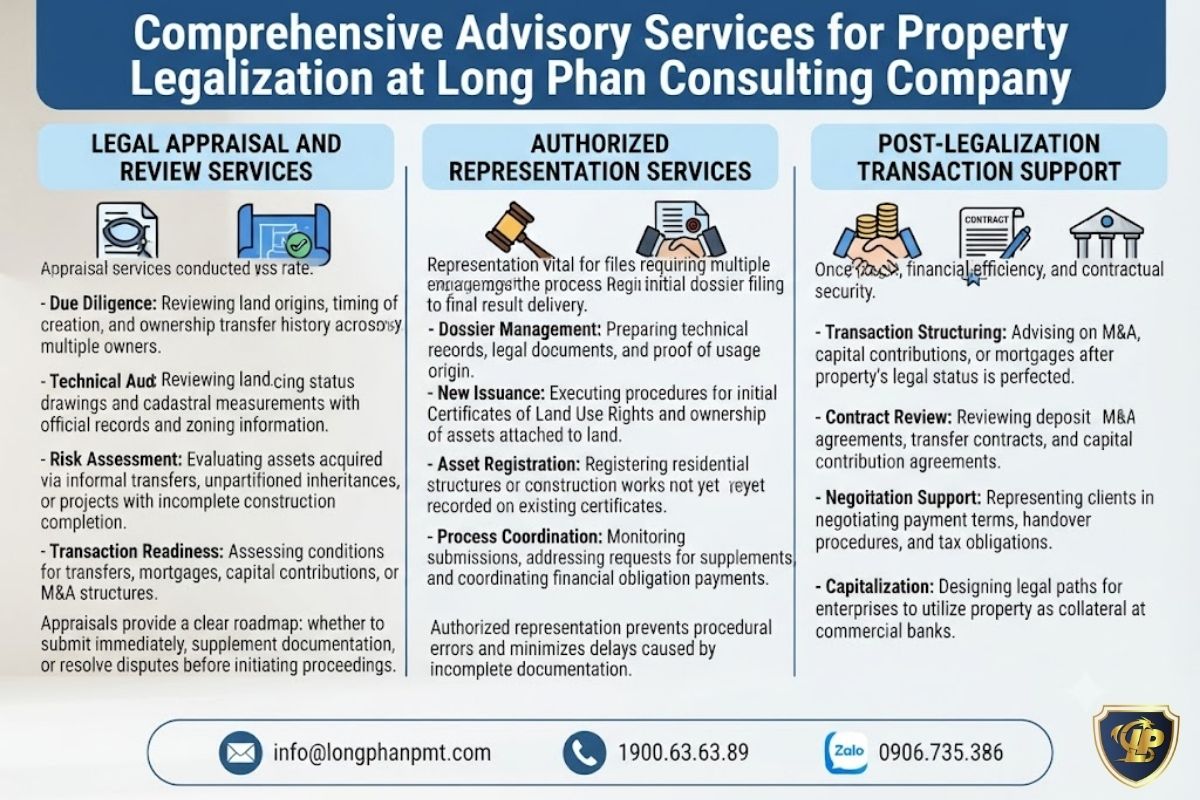
Property legalization rarely involves a single administrative task. Long Phan Consulting Company utilizes a risk-based approach, focusing on evidentiary standards and professional representation before competent authorities. Our objective is to determine if your property qualifies for Certificate issuance, asset registration, or variation registration, thereby minimizing the risks of dossier rejection, transaction delays, or unforeseen financial liabilities.
Appraisal services are conducted prior to submission or transaction signing, focusing on the legitimacy of the asset and the success rate of the legalization strategy.
These appraisals provide a clear roadmap: whether to submit immediately, supplement documentation, or resolve disputes before initiating proceedings.
Representation is vital for files requiring multiple engagements with Land Registration Offices, tax authorities, construction agencies, or local committees. We manage the process from initial dossier filing to final result delivery.
Authorized representation prevents procedural errors and minimizes delays caused by incomplete documentation.
Once your property is legally recognized, the next stage involves exploiting its commercial value safely. We ensure transaction compliance, financial efficiency, and contractual security.
Enterprises may submit documentation via Email: info@longphanpmt.com or Zalo/WhatsApp: +84 906 735 386 for an initial legal status assessment by Long Phan Consulting Company.
Property legalization applications often fail at boundary points: handwritten documents, discrepancies in area measurements, lack of completion certificates, disputes, or financial obligations exceeding expectations. The questions below focus on bottlenecks that can stall transactions, mortgages, and property capitalization plans.
Land acquired through handwritten agreements before 2014 will only be considered if a history of stable and undisputed use can be proven. For land without official documents but not in violation of regulations, the key factor is stable prior use July 1, 2014 and confirmed by the commune-level authorities as being free from disputes, in accordance with Clauses 1, 2, and 3 of Article 138 of the Land Law 2024.
The processing time for registration changes, ownership transfers, or replacements is usually from 5 to 15 business days. Depending on the nature of the application, businesses need to allocate additional time for processing financial obligations, surveying, or providing explanations if there are discrepancies in the application. This administrative timeframe is stipulated in Clause 2, Article 22 of Decree No. 101/2024/ND-CP.
Unfinished houses and land can only be recognized as assets attached to the land if they meet the conditions regarding construction documents or are eligible for existence. Houses and construction works must have a construction permit if they fall under the category requiring one, or a written confirmation from the commune-level construction management agency stating that they meet the conditions for existence, according to Clause 3, Article 148 and Clause 3, Article 149 of the Land Law 2024, as amended and supplemented by Decree 151/2025/NĐ-CP on the delineation of authority.
Applications that have been repeatedly returned need to be reviewed to verify the land’s origin, current status, cadastral survey, and the legal basis for each supplementary request. For land without proper documentation, the People’s Committee at the commune level is responsible for confirming the current status, origin, time of use, and any disputes, in accordance with Clause 2, Article 33 of Decree No. 101/2024/ND-CP.
A larger actual area than stated in the old documents may be recognized if the land plot boundaries remain unchanged and there are no disputes with adjacent landowners. The State recognizes the area based on actual measurements under these conditions, as stipulated in Clause 6, Article 135 of the Land Law 2024. The additional area resulting from boundary changes must be handled separately according to its land use origin..
Property that is under dispute or seizure may have its legalization process halted. The land registration agency will refuse and stop the procedure if it receives a document seizing the property or a document acknowledging a dispute from a competent authority. This regulation is stipulated in Points b, c, d, e, and f of Clause 2, Article 19 of Decree No. 101/2024/ND-CP.
The financial obligations involved in legalizing undocumented land can be significant and must be calculated before the transaction. The tax authorities apply a tax rate based on 10% to 100%. Land prices in the Land Price Table vary depending on the time of use and the area within or exceeding the recognized residential land limit, according to Article 10 of Decree No. 103/2024/ND-CP.
Successful legalization of real estate property in Vietnam is the foundational step for securing assets against disputes and ensuring liquidity for corporate transactions. Entrusting your portfolio to professional oversight allows you to preemptively address complex issues such as informal land transfers, zoning discrepancies, and unrecorded construction structures that otherwise stall M&A or capital contribution efforts. Proactive due diligence and structured dossier management are essential to mitigating the risk of rejection and protecting your investment capital.
To secure your ownership rights and navigate the intricacies of Vietnam’s land regulations with certainty, engage the expert advisory team at Long Phan Consulting Company. Protect your corporate assets today by consulting with our specialists via our hotline at 1900.63.63.89.
📚 This article is provided with professional consultation based on the following legal framework: