
Completion of Corporate Housing may delay property handovers, prevent timely asset registration, and expose enterprises to compensation claims when acceptance records and ownership documentation are not properly coordinated. The procedure generally involves inspecting and accepting completed works for operation, registering construction-related changes, and updating ownership rights over assets attached to land. Project developers must also submit Certificate application dossiers to purchasers within 50 days from the handover date.
Under the Law on Enterprises and Businesses, enterprises should align construction completion records with internal approval, reporting, and asset governance procedures. Long Phan Consulting supports project owners in reviewing dossiers, identifying compliance gaps, and organizing a coordinated completion and registration roadmap.
Key legal notes:
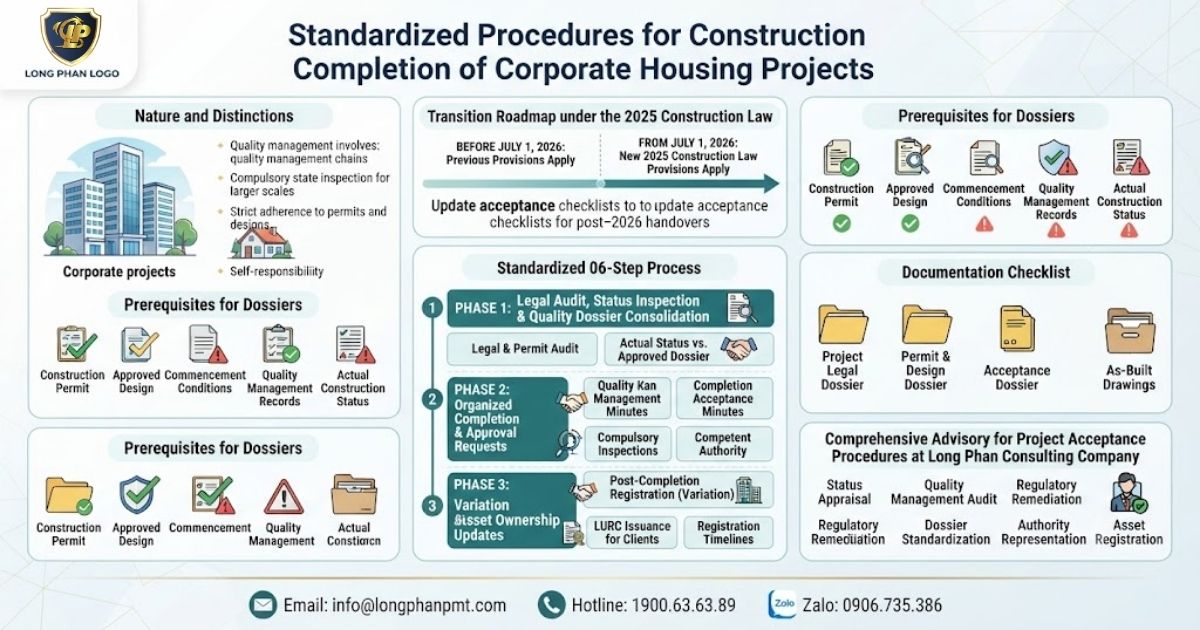
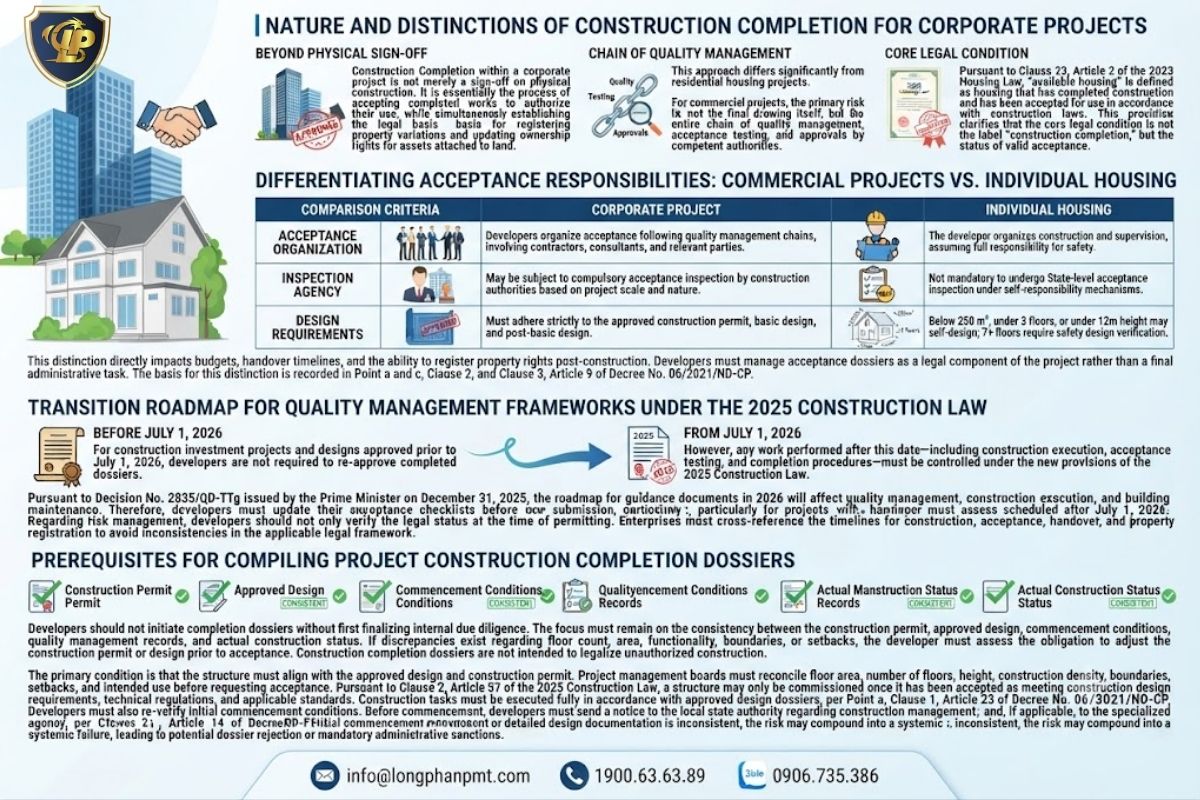
Construction completion within a corporate project is not merely a sign-off on physical construction. It is essentially the process of accepting completed works to authorize their use, while simultaneously establishing the legal basis for registering property variations and updating ownership rights for assets attached to land.
This approach differs significantly from residential housing projects. For commercial projects, the primary risk is not the final drawing itself, but the entire chain of quality management, acceptance testing, and approvals by competent authorities.
Pursuant to Clause 23, Article 2 of the Law on Housing 2023, “available housing” is defined as housing that has completed construction and has been accepted for use in accordance with construction laws. This provision clarifies that the core legal condition is not the label “construction completion,” but the status of valid acceptance.
Project management boards must distinguish between these two mechanisms before compiling their dossiers. Applying the standards for individual housing to a corporate project will likely result in the acceptance dossier being stalled during the compliance validation stage.
| Comparison Criteria | Corporate Project | Individual Housing |
| Acceptance Organization | Developers organize acceptance following quality management chains, involving contractors, consultants, and relevant parties. | The developer organizes construction and supervision, assuming full responsibility for safety. |
| Inspection Agency | May be subject to compulsory acceptance inspection by construction authorities based on project scale and nature. | Not mandatory to undergo State-level acceptance inspection under self-responsibility mechanisms. |
| Design Requirements | Must adhere strictly to the approved construction permit, basic design, and post-basic design. | Below 250 m², under 3 floors, or under 12m height may self-design; 7+ floors require safety design verification. |
This distinction directly impacts budgets, handover timelines, and the ability to register property rights post-construction. Developers must manage acceptance dossiers as a legal component of the project rather than a final administrative task. The basis for this distinction is recorded in Point a and c, Clause 2, and Clause 3, Article 9 of Decree No. 06/2021/NĐ-CP.
Projects extending beyond 2026 require scrutiny under new regulatory milestones. From July 1, 2026, construction activities, acceptance testing, and quality management will be directly impacted by the Construction Law 2025.
For construction investment projects and designs approved prior to July 1, 2026, developers are not required to re-approve completed dossiers. However, any work performed after this date including construction execution, acceptance testing, and completion procedures must be controlled under the new provisions of the Construction Law 2025.
Pursuant to Decision No. 2835/QĐ-TTg issued by the Prime Minister on December 31, 2025, the roadmap for guidance documents in 2026 will affect quality management, construction execution, and building maintenance. Therefore, developers must update their acceptance checklists before submission, particularly for projects with handover phases scheduled after July 1, 2026.
Regarding risk management, developers should not only verify the legal status at the time of permitting. Enterprises must cross-reference the timelines for construction, acceptance, handover, and property registration to avoid inconsistencies in the applicable legal framework.
Developers should not initiate completion dossiers without first finalizing internal due diligence. The focus must remain on the consistency between the construction permit, approved design, commencement conditions, quality management records, and actual construction status.
If discrepancies exist regarding floor count, area, functionality, boundaries, or setbacks, the developer must assess the obligation to adjust the construction permit or design prior to acceptance. Construction completion dossiers are not intended to legalize unauthorized construction.
The primary condition is that the structure must align with the approved design and construction permit. Project management boards must reconcile floor area, number of floors, height, construction density, boundaries, setbacks, and intended use before requesting acceptance.
Pursuant to Clause 2, Article 57 of the Construction Law 2025, a structure may only be commissioned once it has been accepted as meeting construction design requirements, technical regulations, and applicable standards. Construction tasks must be executed fully in accordance with approved design dossiers, per Point a, Clause 1, Article 23 of Decree No. 06/2021/NĐ-CP.
Developers must also re-verify initial commencement conditions. Before commencement, developers must send a notice to the local state authority regarding construction management and, if applicable, to the specialized construction agency, per Clause 3, Article 14 of Decree No. 06/2021/NĐ-CP. If initial commencement or detailed design documentation is inconsistent, the risk may compound into a systemic failure, leading to potential dossier rejection or mandatory administrative sanctions.
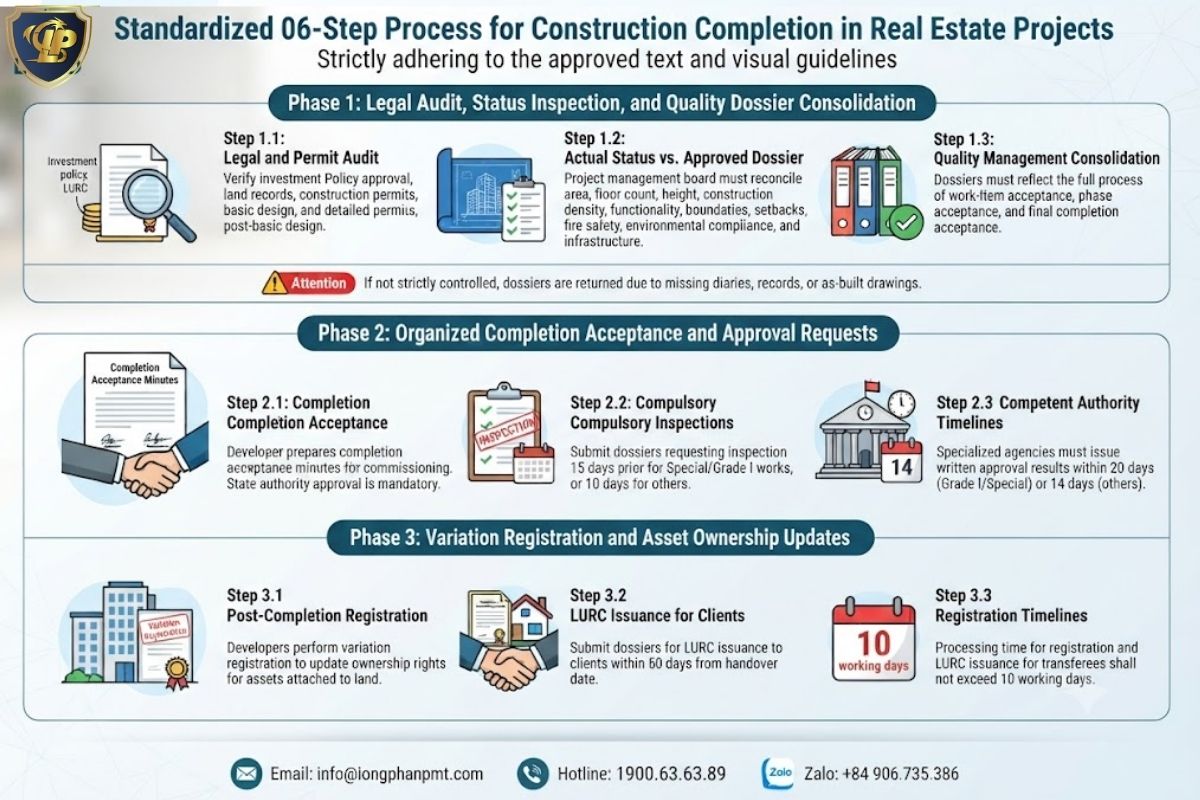
The construction completion process for corporate projects must be organized as a synchronized legal, technical, and asset-management chain. Failure to secure any link can result in delayed acceptance, deferred handovers, and obstacles in updating ownership rights for assets attached to land.
In practice, enterprises should divide this process into three distinct phases. Each phase requires a designated focal point, evidentiary documentation, and internal audit mechanisms prior to submission to competent authorities.
This initial phase determines whether the project possesses a sufficient legal foundation to proceed to acceptance. Developers must simultaneously control land records, construction dossiers, and quality management records.
If this phase is not strictly controlled, completion dossiers are frequently returned due to missing construction diaries, missing material acceptance records, or “as-built” drawings that fail to reflect actual site conditions.
Once quality dossiers are complete, the developer organizes the acceptance of completed works with the contractor, supervision consultant, design consultant, and relevant stakeholders. This transitions the project from construction management to operational commissioning.
Authorities include the specialized construction agency under the Provincial People’s Committee or the relevant Ministry for projects assigned by the Prime Minister. Decentralized authority is defined at Point a, Clause 1, Article 31 of Decree No. 67/2026/NĐ-CP.
With valid acceptance dossiers, the enterprise proceeds to establish the asset on cadastral records. This step directly impacts handover capability, LURC issuance, and the client’s ability to execute secondary transactions.
Construction completion dossiers for corporate projects must be understood as the formal records of completed construction works. This is the collection of documents that must be archived when commissioning the structure, pursuant to Clause 5, Article 2 of Decree No. 06/2021/NĐ-CP.
Developers should inventory dossiers by functional group. This method identifies deficiencies before acceptance, rather than waiting for regulatory authorities to request supplements.
Regarding archiving, construction completion documents must be preserved for at least 10 years for Group A projects, 07 years for Group B, and 05 years for Group C, per Clause 4, Article 26 of Decree No. 06/2021/NĐ-CP. Missing any document category can stall acceptance, asset registration, and commercial handover plans.
Project completion and acceptance procedures require enterprises to simultaneously manage construction dossiers, quality management records, and land registration obligations. Long Phan Consulting Company approaches project documentation by conducting rigorous risk assessments prior to submission, thereby minimizing the need for supplements, explanations, or late-stage remediation.
Our advisory services are deployed to resolve specific project bottlenecks:
For a preliminary evaluation, enterprises may send their construction permits, as-built drawings, acceptance minutes, and project dossiers via Email: info@longphanpmt.com or Zalo/WhatsApp: +84 906 735 386 to Long Phan Consulting Company.
The completion of housing projects within a business often faces obstacles at transitional points: inspection and acceptance, asset updating, and handover responsibilities. These questions focus on situations that could slow cash flow, delay the issuance of certificates, or result in compensation claims. Each answer prioritizes verifiable legal action based on project documentation.
No, the developer is not allowed to hand over housing units until the completion of the acceptance testing of the housing construction and technical infrastructure systems. If handing over unfinished housing, the developer must also complete the entire exterior of the housing. This handover condition aims to avoid the risk of complaints, delays in issuing Certificates of Ownership, and commercial disputes, according to Clause 4, Article 37 of the Housing Law 2023.
The investor must submit the application for inspection and acceptance testing before the expected completion date. The deadline for the specialized construction agency to issue a document is no more than 20 working days for Grade I and special grade projects, and 14 working days for other projects, from the date of receipt of the application for inspection and acceptance testing, according to Article 15 of Decree 14/2026/ND-CP.
The competent authority must issue a document approving the acceptance results within the legally prescribed timeframe upon receiving complete documentation. The maximum timeframe is 30 days for Class I and special-class projects, or 20 days for other projects. Businesses need to factor this milestone into the handover schedule and cash flow, in accordance with Point b, Clause 6, Article 24 of Decree No. 06/2021/ND-CP.
Residential buildings can only be put into operation after acceptance testing has ensured compliance with construction design, technical regulations, and applicable standards. This is a prerequisite for transitioning from construction to operation, handover, or property registration. The lack of valid acceptance testing may render the building’s completion documents legally invalid, according to Clause 2, Article 57 of the Construction Law 2025.
The project developer must submit the application for a Certificate of Ownership to the customer within 50 days from the date of handover of the house. Exceptions only apply when the customer voluntarily undertakes the procedure. This obligation is directly linked to the handover reputation and the risk of post-sale complaints, according to Clause 8, Article 39 of the Law on Housing 2023.
The processing time for registration applications and issuance of certificates to transferees in real estate projects is no more than 10 working days. This timeframe is only relevant when the registration application is complete, including a document confirming that the construction is ready for use. This is stipulated in Clause 6, Article 22 of Decree No. 101/2024/ND-CP.
Yes, the investor and contractor may incur liability for compensation when causing damage or failing to ensure quality construction. The investor of a commercial project must compensate for damages caused to customers or other parties involved in the construction investment, according to Clause 11, Article 39 of the Law on Housing 2023. The construction contractor must compensate for breach of contract or failure to ensure quality construction according to the approved design, according to Point k, Clause 2, Article 61 of the Construction Law 2025.
Executing professional construction completion procedures in Vietnam requires more than drafting as-built drawings; it necessitates a rigorous acceptance chain that satisfies legal commissioning requirements. Developers must synchronize construction permits, design specifications, site status, quality management records, fire safety standards, and technical infrastructure before finalizing handovers. Unresolved discrepancies at this stage inevitably stall Land Use Right Certificate issuance, jeopardize cash flow, and trigger significant indemnity liabilities toward buyers. Proactive internal audits and compliance verification are essential to mitigate these regulatory risks.
To ensure your project documentation is audit-ready and to navigate these critical handover milestones effectively, contact the legal experts at Long Phan Consulting Company today via our hotline at 1900636389.
📚 This article is provided with professional consultation based on the following legal framework: