
Overseas property authorization provides the legal framework for individuals who own property in Vietnam but reside abroad to appoint a representative for real estate transactions. This analysis details the methods and procedures for a property owner living overseas to authorize another person to manage the sale of their property.

A Vietnamese citizen living abroad can grant overseas property authorization to a relative in Vietnam through several methods. The choice depends on practical conditions and the country of residence. Authorization can be processed at a Vietnamese diplomatic mission or a foreign notary public.
Executing an overseas property authorization through a Vietnamese diplomatic mission is the most direct method. According to Clause 2, Article 5 of Decree 111/2011/NĐ-CP, Vietnamese diplomatic missions abroad are authorized to notarize authorization contracts. This method saves time and costs compared to other options.
Document Form: The power of attorney document must be typed and prepared in two bilingual versions: one in Vietnamese and one in the official language of your country of residence. Both versions hold equal legal value. Translation costs vary based on document length and the service provider’s fees.
Document Content: The authorization document must clearly state the following:
Processing an overseas property authorization at a Vietnamese diplomatic mission, available in most major countries, is convenient. The processing time is typically 3-5 business days.
Using a foreign notary public for overseas property authorization is a more complex, multi-step process. The procedure includes notarization at a foreign notary office, authentication by a competent local authority, translation, and consular legalization at a Vietnamese diplomatic mission.
This flexibility allows Vietnamese citizens abroad to select the most suitable method for overseas property authorization based on their access to diplomatic missions and local legal requirements. Regardless of the method, the power of attorney must follow the correct procedures and content requirements to be effective for real estate transactions in Vietnam.
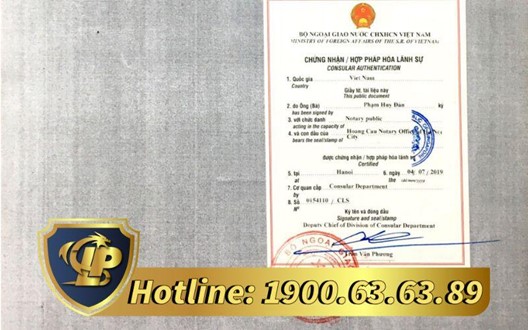
For a power of attorney for a real estate transaction to be legally recognized and used in Vietnam, the consular legalization procedure is mandatory. This can be done at a Vietnamese diplomatic mission or another agency authorized by the Ministry of Foreign Affairs.
The procedure for consular legalization at a Vietnamese diplomatic mission is a critical step for an overseas property authorization document to gain legal force in Vietnam. This process is detailed in Article 15 of Decree 111/2011/NĐ-CP.
Step 1: The applicant can submit the consular legalization request file in person or by post to the diplomatic mission. The file must include:
Step 2: The document undergoes authentication by the host country’s competent authority for consular legalization (e.g., its Ministry of Foreign Affairs).
Step 3: The Vietnamese diplomatic mission performs the final consular legalization by verifying the seal, signature, and title on the document, then issues a Certificate of Consular Legalization. The processing time is typically 5-7 business days.
Completing this procedure is a mandatory condition for the overseas property authorization to be legally valid in Vietnam.
According to Clause 2, Article 5 of Decree 111/2011/NĐ-CP, the Ministry of Foreign Affairs may authorize other agencies to perform specific consular functions. These agencies can certify signatures and seals on documents but not their content or form. This option is available when an official diplomatic mission is not present. The procedure is similar to that at a diplomatic mission.
This alternative provides a legal and flexible solution, ensuring the document is recognized in Vietnam even if the process takes longer due to verification.
>>> See more at: Procedure for selling real estate for Overseas Vietnamese
Long Phan Consulting Company provides professional consulting services for the overseas property authorization process for Vietnamese citizens abroad. We assist clients in completing all authorization procedures in compliance with Vietnamese law. Our services include:
Long Phan Consulting Company is committed to delivering high-quality legal consulting services at a reasonable cost. With our experienced team, your overseas property authorization will be handled efficiently and effectively.

>>> See more at: Consulting services for real estate for overseas Vietnamese
Costs vary significantly by country and jurisdiction, determined by the specific notary’s fee schedule. Contact a notary office in your country of residence for an accurate estimate.
Consular legalization fees are set by the Vietnamese government. Refer to the official website of the Vietnamese diplomatic mission in your country of residence or contact them directly for the latest fee schedule.
This method is more time-consuming. The process can take from several weeks to a few months, factoring in foreign notarization, local authentication, translation, and consular legalization by the Vietnamese mission.
Yes, it can be revoked or amended. The procedure involves drafting a new document that explicitly states the revocation or amendment. This new document must undergo the same notarization and consular legalization process as the original.
A “Power of Attorney” (Giấy ủy quyền) is a unilateral declaration of authorization. An “Authorization Contract” (Hợp đồng ủy quyền) is a bilateral agreement between the principal and the agent. For real estate transactions, an “Authorization Contract” is often preferred as it clearly outlines the rights and obligations of both parties, providing a stronger legal basis.
Common errors include incomplete information, an unclear scope of authorized tasks, inaccurate property details, or failure to properly complete the translation and consular legalization steps. It is critical to be precise with all information and follow all procedural steps.
There are two primary methods for overseas property authorization. Property owners must select the appropriate method and follow the correct procedures to ensure legal validity. For detailed advice and support with the overseas property authorization process, please contact Long Phan Consulting Company at hotline 1900636389 for a consultation and detailed quote from our expert team.