


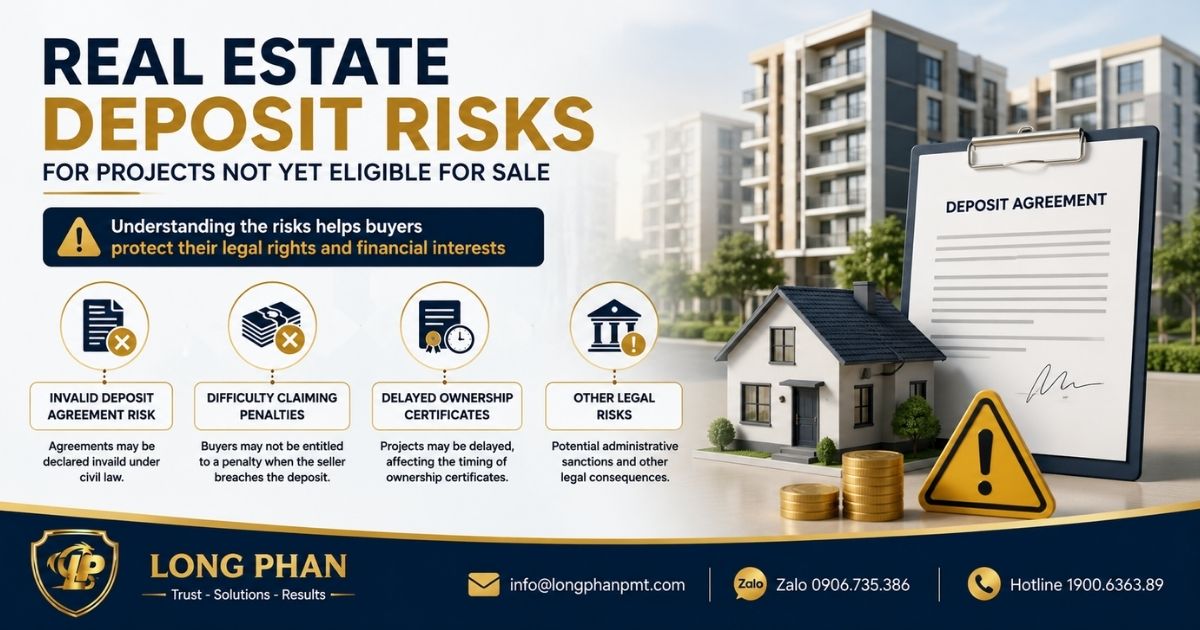


Legal Notes:
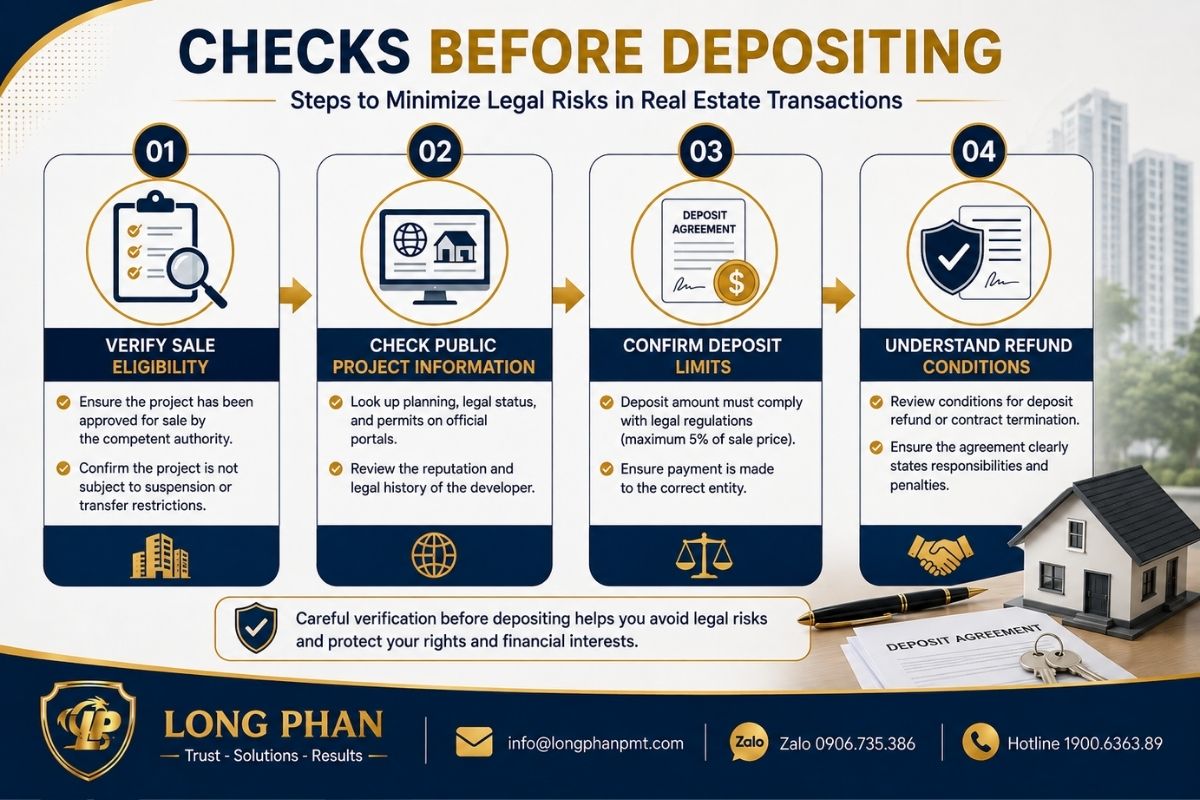
A project developer may only collect a deposit of no more than 5% of the sale or lease-purchase price for off-plan housing, construction works, or floor areas within a construction work, and only once the housing or construction work has satisfied all conditions to be put into business under the 2023 Law on Real Estate Business (Clause 5, Article 23, effective from January 1, 2025). The deposit agreement must clearly state the sale or lease-purchase price of the housing, construction work, or floor area concerned.
This marks a fundamental change from the 2014 Law on Real Estate Business, which set no cap on the deposit ratio, allowing many developers to collect large reservation deposits before construction even began. From January 1, 2025, two conditions must be met at the same time: the deposit ratio must not exceed 5% of the sale price, and the property must already be eligible for business under Article 24 of the 2023 Law on Real Estate Business. If either condition is missing, the deposit transaction already carries legal risk for both parties, with buyers typically bearing the direct loss.
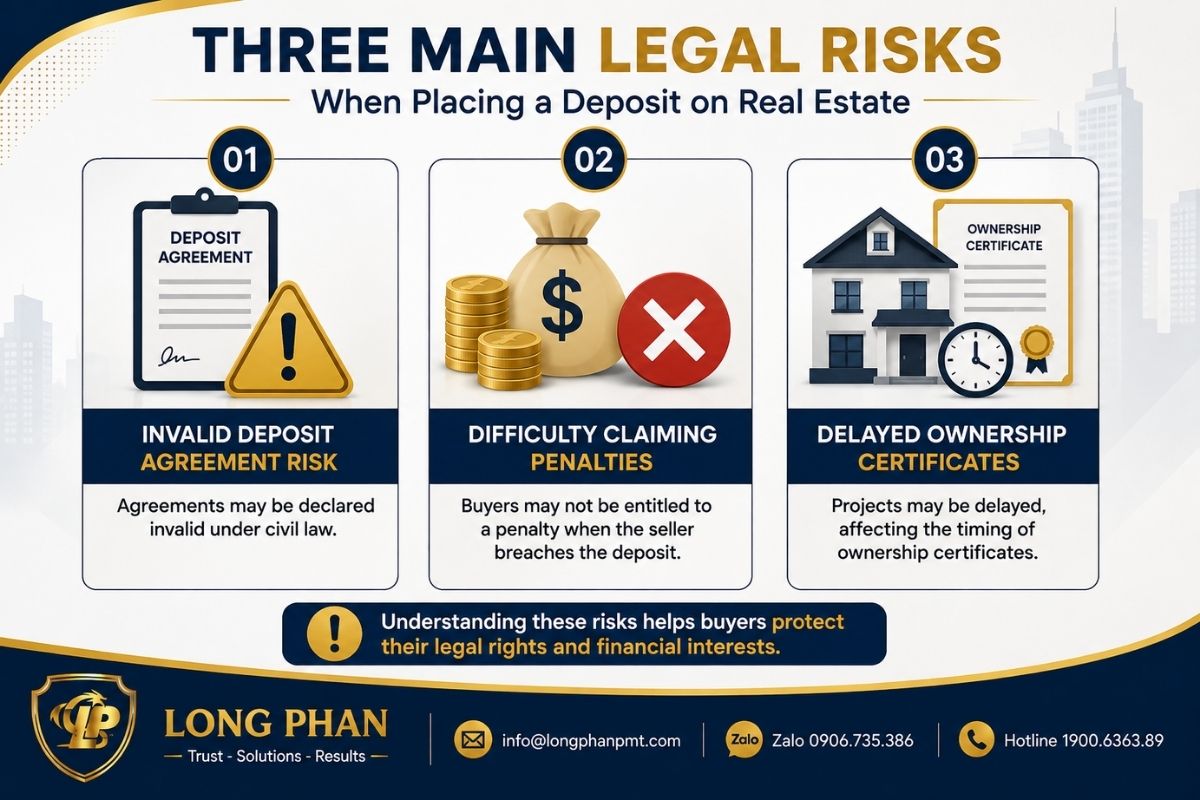
When a developer accepts a deposit while a project is not yet eligible for business, buyers face three specific categories of legal risk: possible invalidity of the deposit agreement, difficulty enforcing a deposit penalty, and delays affecting the land use right certificate. Each risk below is tied to a specific legal basis for buyers to check before signing.
Conducting real estate business without meeting the conditions set out in the 2023 Law on Real Estate Business is a prohibited act under Clause 1, Article 8. When a developer accepts a deposit for real estate that is not yet eligible for business, the deposit transaction is linked to this prohibited act and risks being declared invalid by a court for violating a prohibition of the law and social ethics under Article 123 of the 2015 Civil Code, and for failing to meet the conditions for the validity of a civil transaction under Article 122 of the 2015 Civil Code.
Where the subject matter of the deposit is the right to purchase a house or floor area that does not yet legally exist, for example a project lacking land use right documents or technical infrastructure acceptance, the agreement may also be considered invalid due to an impossible subject matter from the time of formation under Clause 1, Article 408 of the 2015 Civil Code. Once a deposit agreement is invalid, the parties must restore the original state and return what each has received. The deposit penalty clause, which is normally the buyer’s main protection, no longer has a legal basis for application.
When the main contract cannot be concluded because the party receiving the deposit does not meet legal conditions, Clause 2, Article 328 of the 2015 Civil Code sets out the general principle: the party at fault for the failure to conclude or perform the contract must bear the deposit penalty. Specifically, if the receiving party refuses to conclude or perform the contract, it must return the deposited property together with an amount equal to the value of that property to the depositing party.
In practice, determining fault is not straightforward. Precedent No. 25/2018/AL of the Supreme People’s Court establishes that if the receiving party cannot perform its commitment for an objective reason beyond its control, it does not bear the deposit penalty and only has to return the deposit received. In real disputes, developers of projects that are not yet eligible for business often cite objective causes, such as prolonged legal procedures or delayed approvals from state authorities, to avoid penalty liability. Buyers can then only recover the exact amount deposited, without additional compensation, while dispute resolution often takes years if the project stalls or the developer becomes insolvent.
Conditions for off-plan housing and construction works to be put into business under Article 24 of the 2023 Law on Real Estate Business include holding one of the required land use right documents (Clause 2) and meeting the conditions set out in Points b, c, d, dd of Clause 1, and Points a and c of Clause 2, Article 14 of the same Law (Clause 6), covering the lawful status of the real estate offered for transaction. These conditions form the legal basis for the developer to later complete the procedure for issuance of the land use right and property ownership certificate to the buyer.
When a developer accepts a deposit before meeting these conditions, the project typically lacks one or more legal bases needed to complete the land dossier, which delays or interrupts the certificate application process after handover. Buyers may end up having paid most of the contract value without establishing lawful ownership of the property, directly affecting their ability to transfer, mortgage, or otherwise use the asset later.
>>>See more: Guide to Real Estate Project Conditions
Conducting real estate business where the property does not fully meet the required conditions, or is not permitted to be put into business, is subject to a fine of VND 400,000,000 to VND 600,000,000 under Article 58 of Decree 16/2022/ND-CP. Additional penalties include suspension of real estate business activity for three to six months, and remedial measures requiring the developer to return all funds improperly mobilized and to cease the violation.
This provides an important basis for buyers dealing with the provincial state authority for real estate business (the Department of Construction) if they discover a developer accepting deposits in violation of regulations, allowing them to request an inspection of the project’s legal status and enforcement action. An administrative penalty does not automatically render the deposit agreement invalid, but it serves as important evidence that the receiving party is at fault when resolving a civil dispute.
Before depositing or signing any agreement, buyers should check the legal status of the real estate and the project to determine whether it is eligible for business. The warning signs below can help buyers identify risk early and avoid transacting with projects that do not yet meet the conditions under the 2023 Law on Real Estate Business.
| Warning Sign | Legal Basis | Risk Level |
| No written notice from the developer to the provincial state authority confirming the property is eligible for sale or lease-purchase | Clause 4, Article 24, 2023 Law on Real Estate Business | High — a direct sign the project is not yet eligible |
| No land use right documents (land allocation decision, land use right certificate, etc.) | Clause 2, Article 24, 2023 Law on Real Estate Business | High — directly affects the ability to obtain a certificate later |
| Property and project information not yet publicly disclosed on the required system | Article 6 and Clause 7, Article 24, 2023 Law on Real Estate Business | Medium — indicates a lack of legal transparency |
| No written confirmation that project land plots are eligible for transfer to individuals for self-construction | Clause 7, Article 31, 2023 Law on Real Estate Business | High — applies specifically to land-plot transactions |
| Deposit agreement exceeds 5% of the sale price or fails to state the sale price | Clause 5, Article 23, 2023 Law on Real Estate Business | High — direct violation of the deposit ratio and form requirements |
Before signing any deposit document, buyers should follow these steps to confirm the real estate is eligible for business under current regulations:
Long Phan Consulting provides comprehensive support for legal matters related to deposits for real estate purchases, including:
Clients may send their case documents via email at info@longphanpmt.com or via Zalo at 0906.735.386 for a preliminary assessment.
Disputes involving deposits for real estate that has not yet satisfied the conditions for business transactions commonly concern deposit recovery, deposit penalties, limits on amounts developers may receive, and methods for verifying a project’s legal status. The following are several issues buyers should consider before signing an agreement or handling a dispute.
The buyer may request the return of the deposit because a deposit agreement entered into for real estate that has not yet satisfied the conditions for business transactions may be at risk of being declared invalid under Article 123 of the 2015 Civil Code. However, whether the buyer is also entitled to an equivalent deposit penalty depends on which party is found to be at fault under Clause 2, Article 328 of the 2015 Civil Code.
A developer that receives a deposit exceeding 5% of the sale price directly violates Clause 5, Article 23 of the 2023 Law on Real Estate Business and may be subject to administrative penalties under Article 58 of Decree No. 16/2022/ND-CP. The buyer may request a refund of the amount exceeding the 5% limit and may also request that the relevant part of the deposit agreement be declared invalid.
Some developers describe advance payments as a “reservation deposit” or “goodwill fee” in an attempt to avoid the 5% limit under Clause 5, Article 23 of the 2023 Law on Real Estate Business. In substance, if the payment is intended to secure the conclusion or performance of a sale and purchase agreement, it remains subject to the deposit provisions under Article 328 of the 2015 Civil Code and Article 23 of the 2023 Law on Real Estate Business, regardless of the name used in the document.
The buyer may request that the developer provide the written response issued by the provincial-level state authority responsible for real estate business confirming that the property satisfies the conditions for sale or lease-purchase under Clause 4, Article 24 of the 2023 Law on Real Estate Business. The buyer should also review the project information publicly disclosed under Article 6 of this Law.
When a deposit agreement is declared invalid, the parties must restore the original situation and return to each other what they have received. The deposit penalty clause in the invalid agreement is no longer enforceable. In this case, the buyer may generally recover the amount of the deposit paid, unless other losses can be proven in accordance with civil law.
A project land plot may only be transferred to an individual for self-construction of a house after the developer has submitted a notice confirming eligibility for transfer to the provincial-level state authority responsible for real estate business under Clause 7, Article 31 of the 2023 Law on Real Estate Business. Paying a deposit before this point exposes the buyer to risks similar to those associated with depositing for off-plan housing that has not yet met the required conditions.
Reviewing project legal documents, verifying eligibility for real estate business transactions, and examining deposit provisions requires consideration of several specialized laws at the same time, including the 2023 Law on Real Estate Business, the Law on Land, the 2023 Law on Housing, and the 2015 Civil Code. For high-value transactions, having a lawyer conduct a review before signing can help identify risks early and provide a basis for renegotiating deposit terms.
Risks of Real Estate Deposits that has not yet met the conditions for business transactions arise when the developer receives a deposit before satisfying the requirements under Article 24 of the 2023 Law on Real Estate Business. This may result in the deposit agreement being declared invalid, difficulty claiming a deposit penalty, and delays in obtaining the Certificate of Land Use Rights later. Buyers should proactively verify the project’s legal status and review the amount and form of the deposit against Clause 5, Article 23 of the 2023 Law on Real Estate Business before signing any document. Long Phan Consulting is available to assist clients in reviewing project legality and handling deposit disputes via Hotline 1900636389.
📚 This article has been professionally reviewed based on the following legal documents:


