
The fees and levies that overseas Vietnamese must pay when purchasing real estate in Vietnam are specified in laws on tax, land, and housing. Understanding these financial obligations, including registration fees, notary fees, and certificate issuance costs, is an integral part of the transaction process. This analysis by Long Phan Consulting Company details each fee and levy according to current law. Understanding the property fees for overseas Vietnamese is a critical first step.

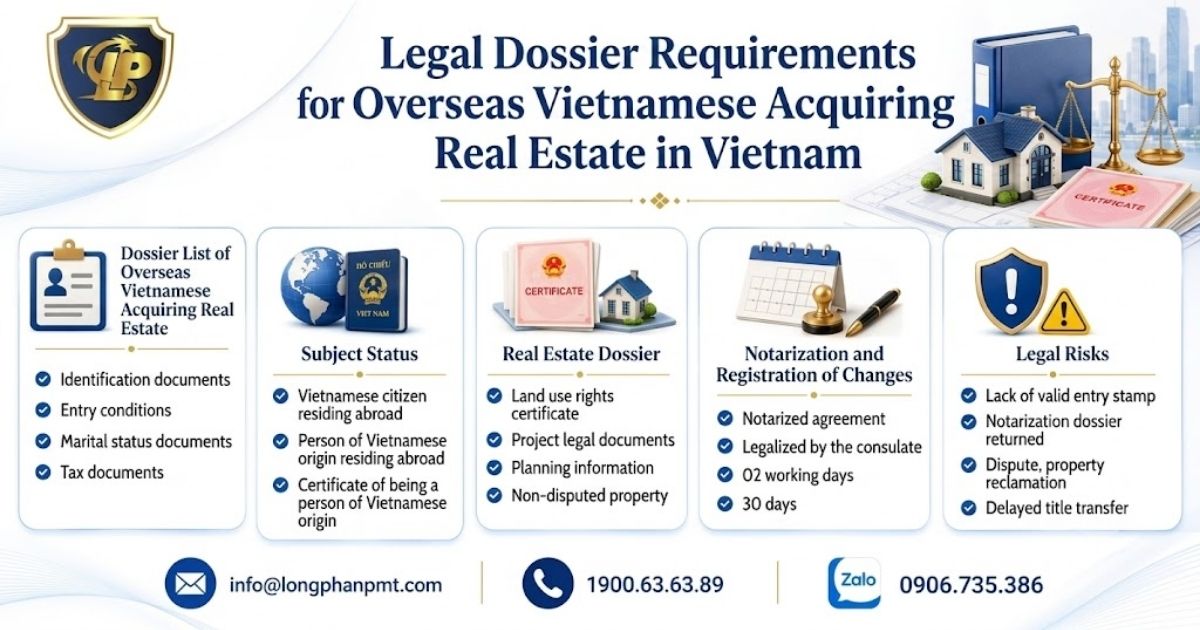
The Housing Law 2023 and Land Law 2024 provide more open conditions, expanding real estate ownership rights for Vietnamese residing abroad. The fundamental condition is that the individual must be permitted to enter Vietnam. Current law distinguishes between two groups with different ownership scopes, a factor clients must accurately identify.
This distinction is the legal basis for determining the right to purchase, receive transfers, and be named on the Certificate of Land Use Rights, Ownership of Housing, and Other Land-Attached Assets. According to Article 8 of the Housing Law 2023 and Articles 4, 28, and 44 of the Land Law 2024, these two groups are:
Vietnamese Citizens Residing Abroad:
People of Vietnamese Origin Residing Abroad:
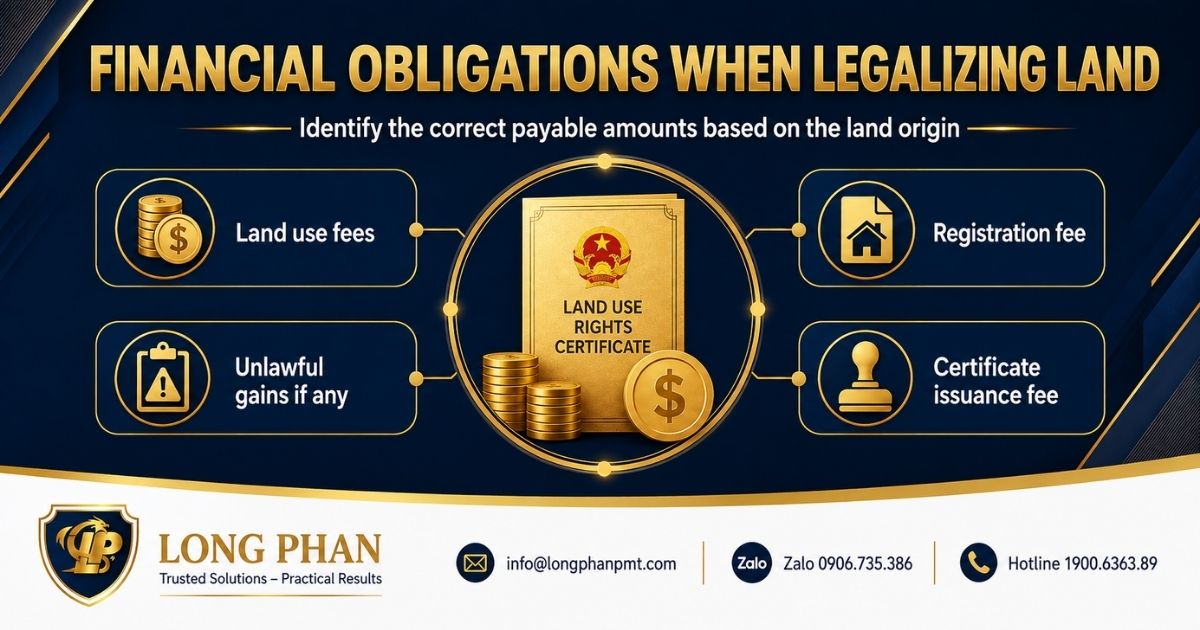
After meeting the eligibility requirements and signing a transfer contract, the buyer must fulfill financial obligations to the state to complete the ownership registration process. These fees and levies are regulated by various specialized laws. The total cost depends on the transaction value of the real estate and specific local regulations. This guide details the property fees for overseas Vietnamese to ensure a smooth transaction.
Declaring and paying these fees and levies fully and on time is mandatory for the dossier to be processed and the Certificate to be issued. Clients must prepare financially for these items, including the registration fee, notary fee, Certificate issuance levy, and dossier appraisal fee.
The registration fee is a mandatory payment to the state budget when an individual or organization registers ownership or usage rights for their assets with a competent state agency. The basis for calculating the registration fee for houses and land is detailed in Article 7 of Decree 10/2022/NĐ-CP, guided by Clause 1, Article 3 of Circular 13/2022/TT-BTC.
The calculation is based on two factors: (1) the price for calculating the registration fee and (2) the registration fee rate.
Registration Fee Rate: The rate for houses and land is fixed at 0.5%.
Price for Registration Fee Calculation This is a more complex factor, determined by a core principle: The price for calculating the registration fee is the higher value between the price on the transfer contract and the price set by the provincial-level People’s Committee (PC). The price for calculation will be the value recorded on the land use right transfer contract or house purchase contract.
The method to determine the value of a house and land according to the provincial PC’s regulations is as follows:
For Land:
For Houses:
Note for Apartments: The price for calculating the registration fee does not include the common area maintenance fund (2% of the apartment’s value). If the contract does not separate this amount, the fee will be calculated on the total contract value.
Comprehensive Calculation Formula

A contract for the transfer of land use rights and housing ownership is a transaction that must be notarized at a notary practice organization (State Notary Office or private Notary Office) to ensure legal validity. When performing this procedure, clients must pay a notary fee as regulated.
According to Article 4 of Circular 257/2016/TT-BTC, the notary fee for a transfer contract is determined as follows:
Basis for Calculating Notary Fee: The value for calculating the notary fee is the total value of the land use rights and the assets attached to the land (housing). This value is determined by the following principle:
Notary Fee Schedule for Real Estate Contracts: The fee is calculated on a progressive scale based on the asset’s value or the contract’s transaction value.
This is a levy paid to the state agency for the procedure of issuing a new Certificate or registering a change to transfer the name on the Certificate (Pink/Red Book). It is an administrative levy paid for the ownership registration procedure. This levy should be distinguished from the registration fee, as it is not calculated as a percentage of the property’s value.
Based on Article 4 of Circular 85/2019/TT-BTC from the Ministry of Finance, this levy is not a percentage. The specific collection level is decided by the provincial-level People’s Council, based on the local socio-economic conditions. Typically, the fee for individuals and households is relatively low, ranging from tens of thousands to a few hundred thousand VND, depending on the area (urban, suburban).
During the registration process to transfer the name on the Certificate, besides the levies paid to the state budget, clients often need to pay for public administrative services. The most common are the dossier appraisal fee and, in certain cases, the cost of cadastral surveying or mapping. Correctly paying these property fees for overseas Vietnamese is essential.
Dossier Appraisal Fee for Certificate Issuance This is a fee collected by the land registration agency to cover the costs of checking and appraising the completeness and legality of the dossier, ensuring all conditions are met before submitting for Certificate issuance to the buyer. This fee is not fixed nationwide but is regulated separately by the People’s Council of each province or city, based on local socio-economic conditions. The specific fee depends on factors such as:
Fee for Cadastral Surveying or Mapping This fee only arises in specific cases where the registration dossier requires a new cadastral extract or land parcel diagram.Applicable Cases:

The process of purchasing and registering real estate in Vietnam for overseas Vietnamese involves many complex legal regulations. To ensure your investment process is safe, transparent, and efficient, Long Phan Consulting Company offers a specialized legal consulting package. Understanding the property fees for overseas Vietnamese is part of this comprehensive service.
Our team of experts will assist you throughout the entire process. The services from Long Phan Consulting Company include:
This section answers common questions regarding the process and costs when overseas Vietnamese buy property.
Yes. Another significant financial obligation is the Personal Income Tax (PIT) from the real estate transfer. The seller is obligated to pay this tax at a rate of 2% of the transfer price. In practice, parties often agree that the buyer will declare and pay this tax on the seller’s behalf before completing the name transfer procedure.
The financial obligations are typically fulfilled in these steps:
Yes. The law provides exemptions for the Registration Fee and PIT for property transfers between individuals with marital, blood, or nurturing relationships: spouses; biological parents and children; adoptive parents and children; parents-in-law and children-in-law; grandparents and grandchildren; and biological siblings.
After owning the property, you must pay an annual Non-Agricultural Land Use Tax. This is a recurring tax with a relatively low rate, calculated based on the land area and the price per square meter of land from the provincial PC’s Land Price List.
There is a significant difference. A person receiving property through inheritance or as a gift will not pay the Registration Fee and PIT (at 10%) if the relationship between the giver and receiver falls under the exemption cases mentioned in question 3. If not, the recipient must pay the Registration Fee (0.5%) and PIT (10% on the property value exceeding 10 million VND).
Yes, overseas Vietnamese can borrow from Vietnamese banks, but the conditions and procedures are more complex than for domestic residents. The bank will require proof of stable, legal income, and the mortgaged asset must have complete legal documents.
Certainly. The buyer can create a Power of Attorney for a relative or trusted person in Vietnam to handle the procedures. This Power of Attorney must be notarized in Vietnam. If created abroad, the document must be consular legalized at a Vietnamese diplomatic mission in the host country before it can be used in Vietnam.
The actual time depends on the locality and the dossier’s complexity. Typically, after the contract is notarized and a complete, valid dossier with all tax/fee payments is submitted, the processing and issuance time for a new Certificate is no more than 15 working days by law. The entire process, from start to receiving the Certificate, can take 1 to 2 months.
Identifying and correctly fulfilling financial obligations is the final and decisive step in the property purchase process for overseas Vietnamese in Vietnam. A clear understanding of the various property fees for overseas Vietnamese not only helps you prepare financially but also ensures the transaction proceeds smoothly and lawfully. For detailed consultation and professional support, please contact Long Phan Consulting Company via our hotline at 1900 6363 89.